
From Count to Context: What Vehicle Detection Actually Needs to Deliver Across Gates, Roads, and Parking
- July 14, 2026
- Posted by:
- Category: News
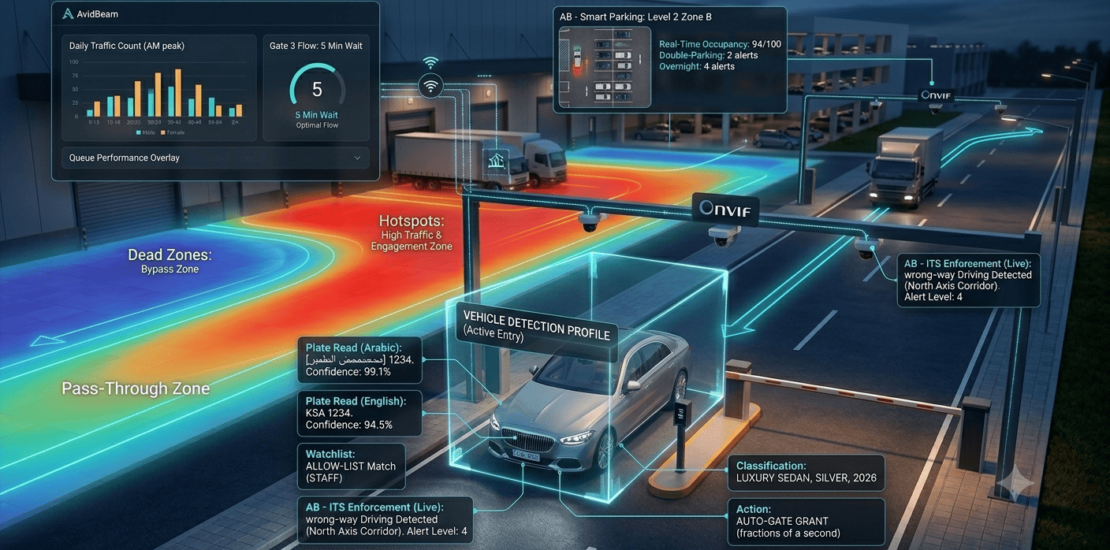
Every camera pointed at a road or gate detects vehicles. The vehicle enters the frame, the system registers its presence, and a count increments. That is not operational intelligence. It is basic motion counting with a vehicle filter applied.
Useful vehicle detection produces more than a count. It identifies the vehicle specifically: plate number, plate type, vehicle make, model, and color. Furthermore, it cross-references that identity against watchlists in real time, feeds gate access decisions automatically, and continues tracking the vehicle across roads and parking areas after the initial detection event.
AvidBeam’s AvidAuto platform delivers this across three integrated modules: AB – Vehicle Analytics for detection and classification, AB – ITS (Intelligent Traffic Systems) for road enforcement, and AB – Smart Parking for parking intelligence. All three run on Artificial Intelligence (AI) powered server-based processing on the cameras already installed.
What Vehicle Detection Needs to Produce
The operational value of vehicle detection is determined by what each detection event produces. A count is the minimum. A full vehicle profile with real-time watchlist matching is what security and operations teams actually need. Two factors determine whether a vehicle detection platform reaches that standard.
Accuracy Under Real Conditions
Vehicle detection accuracy figures from controlled test environments rarely match field performance. The conditions that matter for real deployments include nighttime and low-light operation, rain and fog, high vehicle speeds across multi-lane approaches, and partially obscured plates.
AvidAuto uses server-based processing to address this directly. As covered in AvidBeam’s guide to what separates vehicle detection systems operationally, the architecture choice determines the accuracy ceiling. Server-based models run on centralized infrastructure rather than individual camera hardware. Consequently, accuracy does not degrade under adverse conditions because it is not limited by what each camera can compute locally.
AvidAuto delivers 98%+ accuracy for Arabic License Plate Recognition (LPR) and 92%+ for English, sustained across all the conditions listed above.
Classification Beyond the Count
Plate recognition is one output of vehicle detection. Classification is another, and it carries equal operational weight. When a vehicle enters a monitored frame, AvidAuto identifies its type, make, model, and color alongside the plate read. It also identifies the plate type: private, commercial, or tourist.
Furthermore, the system saves a vehicle image per detection event. Therefore, every detection record includes visual confirmation alongside the structured data. Consequently, enforcement coordinators and security teams receive everything they need to act without additional manual steps.
To find out how AvidAuto’s vehicle detection applies to your existing camera infrastructure, send an email to [email protected] and the technical team will follow up. |
How AvidAuto’s Vehicle Detection Works
AvidAuto’s vehicle detection runs on a server-based architecture that separates it structurally from edge-based alternatives. Understanding how that architecture shapes the detection process explains why the accuracy and classification outputs hold up across real deployment conditions.
Server-Based Processing
Edge-based vehicle detection processes video locally at each camera. That limits model complexity and constrains accuracy under low light and high speed. Server-based detection runs all analysis on centralized infrastructure. As a result, the same detection models process every connected camera feed simultaneously, regardless of individual camera hardware capacity.
Additionally, capability updates deploy through software across the full network at once. Therefore, new vehicle detection capabilities reach all cameras without per-device hardware intervention. Any Open Network Video Interface Forum (ONVIF) compliant camera already covering a gate or road segment connects to the platform without replacement.
The Detection Event
When a vehicle enters a monitored camera frame, AvidAuto runs the full detection pipeline in fractions of a second. First, it identifies the vehicle as an object in the frame. Second, it reads the plate. Third, it classifies the vehicle by type, make, model, and color. Fourth, it cross-references the plate against the active watchlist. Fifth, it logs the complete detection record with a timestamp, camera source, and saved image.
All five steps complete before the vehicle clears the camera frame. Consequently, the watchlist alert, if triggered, fires before the vehicle reaches the gate, not after it has already entered the facility.
What Vehicle Detection Enables
Detection is the foundation. What detection enables is where the operational value compounds. AvidAuto’s vehicle detection layer connects directly to three downstream functions: access control automation, traffic violation enforcement, and parking intelligence. Each one depends on accurate, structured detection data to operate effectively.
Access Control Automation
Accurate vehicle detection enables gate automation without manual credential checks. Allow-listed vehicles clear automatically. Deny-listed vehicles trigger a security alert before the gate opens. Very Important Person (VIP) vehicles receive priority routing based on operator configuration.
For a detailed look at how vehicle detection connects to full gate intelligence, see AvidBeam’s guide to what a car detection system actually needs to deliver. The principle applies equally here: detection accuracy at the gate determines the reliability of every access decision that follows.
Traffic Violation Enforcement
AB – ITS extends vehicle detection to road-level enforcement. It applies deep learning models to every connected camera feed continuously. Violation types covered across every monitored road segment include red-light running, wrong-way driving, sudden lane switching, illegal parking, speeding, mobile phone use while driving, and seatbelt non-compliance.
Each flagged violation includes the plate read, vehicle classification, camera source, timestamp, and event clip. Consequently, enforcement documentation is complete at the moment of detection, without additional manual steps.
Parking Intelligence
AB – Smart Parking extends vehicle detection into parking structures after gate clearance. Real-time occupancy detection distinguishes occupied from empty spaces across all monitored levels. Double-parking detection alerts when a vehicle parks across a marked space boundary. Entrance and exit blocking detection fires when vehicles obstruct emergency access or loading approaches. Furthermore, overnight monitoring flags vehicles remaining beyond authorized timeframes.
Full Vehicle Detection Capability Breakdown
The table below maps every vehicle detection capability AvidAuto delivers across its three integrated modules, along with the operational output each one produces.
| Detection Capability | AvidAuto Module | What It Produces |
|---|---|---|
| License Plate Recognition (LPR) | AB – Vehicle Analytics | 98%+ (Arabic) / 92%+ (English); sustained across night, rain, and high speed |
| Vehicle classification | AB – Vehicle Analytics | Type, make, model, and color identified per detection event alongside every plate read |
| Plate type identification | AB – Vehicle Analytics | Private, commercial, and tourist plates distinguished automatically per detection |
| Watchlist cross-referencing | AB – Vehicle Analytics | Deny, allow, and VIP lists matched in real time at every camera point |
| Vehicle count analytics | AB – Vehicle Analytics | Daily, weekly, and monthly volume data per location for planning and reporting |
| Traffic violation detection | AB – ITS | Red-light, wrong-way, lane switching, parking, speeding, phone, seatbelt |
| Traffic density analytics | AB – ITS | Volume and distribution per road segment; congestion forecasting by hour and location |
| Parking occupancy | AB – Smart Parking | Real-time occupied vs. empty per space; double-parking and entrance blocking alerts |
| Forensic vehicle search | AB – Vehicle Analytics | Search by plate, make, model, color, date, time, location; results in minutes |
Basic vs. AvidAuto – Comparison
The table below sets out where AvidAuto’s vehicle detection platform diverges from basic detection setups at the output quality, accuracy, and operational capability level.
| Capability | Basic Vehicle Detection | AvidBeam AvidAuto Platform |
|---|---|---|
| Detection output | Count only; no vehicle identity or profile | Full profile per event: plate, type, make, model, color, and plate type |
| Accuracy | Degrades at night, rain, and high speed | 98%+ (Arabic) / 92%+ (English); consistent via server-based processing |
| Watchlist matching | Not available in real time | Deny, allow, and VIP lists matched at every camera point simultaneously |
| Traffic enforcement | Officer-dependent; intermittent | Continuous detection across all violation types on all monitored segments |
| Parking coverage | No detection after gate clearance | Real-time occupancy, double-parking, and blocking alerts across all levels |
| Post-incident investigation | Manual footage scrub; hours per case | Forensic query by vehicle attribute; results in minutes |
| Hardware requirement | Dedicated detection units per zone | Layers onto existing Open Network Video Interface Forum (ONVIF) compliant cameras |
In short, basic vehicle detection counts. AvidAuto detects, classifies, authorizes, enforces, manages, and investigates, across the cameras already installed.
Infrastructure and Deployment
AvidAuto connects to any ONVIF compliant camera via standard network protocols. All detection processing runs centrally, not at the camera. Therefore, no dedicated detection hardware is required at individual gate or road points.
The infrastructure baseline per camera processed:
- 2GB RAM minimum; one virtual core at 2.4 GHz minimum
- Multiple Graphics Processing Unit (GPU) configurations supported for high-density deployments
- Camera resolution: 2MP up to 4K; lens focal length 3mm to 25mm
Video Management System (VMS) integration covers Milestone, NetworkOptix, and Genetec platforms. Deployment options include on-premise, private cloud, public cloud, and hybrid. Notably, watchlist updates propagate instantly to every connected camera point across all locations simultaneously.