
Detection Is the Starting Point. What Happens Next Is What Separates Vehicle Detection Systems.
- June 22, 2026
- Posted by:
- Category: Articles
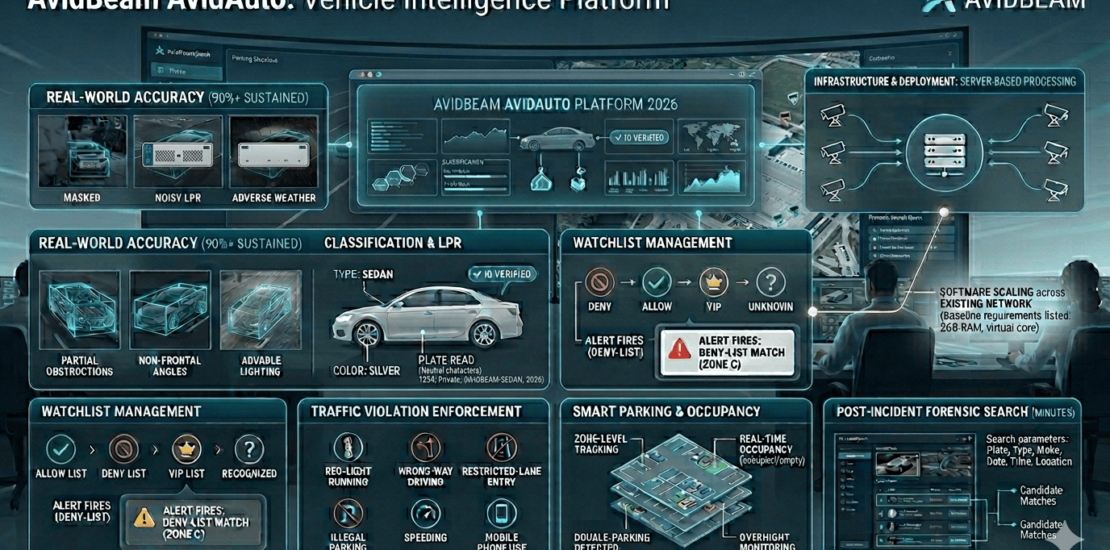
Basic vehicle detection systems count vehicles. Some read plates. Most stop there. However, the operational problems that facility managers, traffic coordinators, and security teams actually face start after the detection event, not before it.
A vehicle appeared at the gate. Was it authorized? Is it on a watchlist? What type is it? Where did it go afterward? These questions require an intelligence layer. Consequently, detection alone is not enough.
AvidBeam’s AvidAuto platform delivers vehicle detection as the foundation of a full intelligence stack. Built on Artificial Intelligence (AI) video analytics, it covers detection, classification, access control, traffic violation enforcement, parking management, and forensic investigation. Furthermore, it runs on the cameras already installed, no new hardware per coverage point.
What Vehicle Detection Systems Actually Need to Deliver
The gap between a vehicle detection system that counts traffic and one that supports operations is wider than most procurement conversations acknowledge. Consider the problems that a count-only system leaves unresolved:
- A deny-listed vehicle enters the facility because the detection layer has no live watchlist connection
- A contractor parks in an emergency lane for 40 minutes; no detection layer covers that zone continuously
- Post-incident investigation requires manually scrubbing footage across dozens of cameras for a specific vehicle
- Traffic violations on internal roads go unenforced because the vehicle detection system has no enforcement module
- Parking occupancy is unknown without a manual count; peak periods cause congestion with no early warning
These are not edge cases. They are the standard operational gaps that facilities discover after deploying basic vehicle detection systems. Additionally, they compound over time. As a result, most organizations eventually replace basic systems with platforms that close all five gaps simultaneously.
| To find out how AvidAuto’s vehicle detection system applies to your facility’s camera infrastructure, send an email to [email protected], and the technical team will follow up. |
How AvidAuto’s Vehicle Detection Works
AvidAuto is structured around three integrated modules. AB – Vehicle Analytics handles detection, classification, and License Plate Recognition (LPR). AB – ITS (Intelligent Traffic Systems) covers road-level violation enforcement. AB – Smart Parking manages occupancy and zone compliance. Together, they turn a detection event into a complete intelligence record. Each module operates independently or in combination through one centralized management interface.
Server-Based Architecture
AvidAuto processes all vehicle detection centrally on dedicated server infrastructure. This is the key architectural decision. Unlike edge-based systems – which process locally at each camera – server-based detection is not constrained by individual camera hardware capacity.
As a result, detection accuracy holds consistently across low light, adverse weather, high vehicle speeds, and partial obstructions. Furthermore, new detection capabilities are deployed through software across all connected cameras simultaneously. No per-camera firmware update required. Additionally, any Open Network Video Interface Forum (ONVIF) – compliant camera already on the network feeds into the platform without hardware replacement.
Detection, Classification, and Recognition in One Event
Every vehicle that enters a monitored frame generates a structured detection event. It includes the vehicle type, make, model, and color. It also includes the plate number, plate type – private, commercial, or tourist – and a saved vehicle image. Consequently, operators receive a complete vehicle profile per event, not just a log entry with a timestamp.
LPR accuracy reaches 98%+ for Arabic plates and 92%+ for English. Notably, both character sets run within the same deployment. No separate hardware or configuration is needed per language.
Access Control – Automated Vehicle Authorization
Vehicle detection without access control is surveillance. Vehicle detection with access control is security. AvidAuto connects its detection layer directly to gate authorization – removing manual checks for authorized vehicles and ensuring flagged ones never clear the gate undetected.
Watchlist Categories
Three watchlist categories run in parallel at every monitored entry point simultaneously. Each produces a different automated response the moment a matching vehicle is detected:
- Allow lists: authorized vehicles clear automatically. No guard verification required. The detection fires, the authorization is confirmed, and entry is granted in fractions of a second.
- Deny lists: flagged vehicles trigger a security alert before clearing the gate. The alert includes the plate read, vehicle profile, camera source, and timestamp in real time.
- VIP lists: designated vehicles receive priority routing or access permissions. The alert fires at approach, not at the gate, giving operations teams time to prepare.
Unknown Vehicles and Audit Trails
Vehicles not on any list generate an alert for manual review. Therefore, the gap between known and unknown traffic is actively managed rather than silently ignored. Furthermore, every detection event is logged with a timestamped audit trail. This supports compliance reporting and post-incident documentation without additional manual steps.
Traffic Violation Detection
AvidAuto’s AB – ITS module extends vehicle detection to road-level enforcement. It applies deep learning models to every connected camera feed continuously. As a result, violations are flagged the moment they occur, not during a retrospective review. Each flagged event includes the plate read, vehicle profile, camera source, timestamp, and event clip.
Violation types covered across every monitored road segment:
- Red-light running: fires the instant a vehicle crosses against a red signal
- Wrong-way driving: alerts operators immediately when direction rules are violated
- Sudden lane switching and restricted-lane entry: identified per segment with configured boundaries
- Illegal parking: alert fires the moment a vehicle stops in a prohibited zone
- Speeding: detected against configured thresholds per road segment
- Mobile phone use while driving: identified at camera-covered intersections
- Seatbelt non-compliance: logged per event with full vehicle profile
Additionally, AB – ITS generates traffic density analytics. Volume and distribution data per road segment feed directly into congestion forecasting and infrastructure planning. Consequently, operations teams can respond proactively, before bottlenecks form, not after.
Parking and Zone Intelligence
Vehicle detection systems that cover gates and roads but not parking areas leave a significant operational gap. Unauthorized parking in emergency lanes, blocked entrances, and unknown occupancy across multi-level structures are all problems that begin after the vehicle clears the gate.
AB – Smart Parking closes this gap. It covers all monitored parking areas through the same camera network:
- Real-time occupancy: occupied versus empty per space, updated continuously
- Double-parking detection: alerts when a vehicle parks across marked space boundaries
- Entrance and exit blocking: flags vehicles obstructing emergency access or loading bay approaches
- Overnight monitoring: alerts for vehicles remaining beyond authorized timeframes
Moreover, vehicle movement tracking extends across parking zones. A specific vehicle can be tracked from gate entry through the parking structure and back to exit, producing a complete movement record for investigation or audit purposes.
Full Vehicle Detection Capability Breakdown
The table below maps every capability AvidAuto delivers across its three integrated modules, along with the operational output each one produces.
| Capability | What It Does | Operational Output |
|---|---|---|
| Vehicle detection | Identifies vehicles in frame across all traffic conditions | Continuous detection across all connected cameras, no manual triggers |
| Vehicle classification | Type, make, model, and color identified per detection | Full vehicle profile per event, not just a count or plate number |
| License Plate Recognition (LPR) | Arabic and English plates read simultaneously at 98%+ / 92%+ | Plate type identified: private, commercial, tourist |
| Watchlist cross-referencing | Deny, allow, and VIP lists checked in real time | Alert fires before the vehicle clears the gate |
| Vehicle count analytics | Daily, weekly, and monthly volume data per location | Peak period identification for staffing and planning |
| Traffic violation detection | Red-light, wrong-way, lane, parking, speeding, phone, seatbelt | Continuous enforcement, no officer stationed required |
| Vehicle density analysis | Volume and distribution per road segment and parking zone | Congestion identified before it develops into a bottleneck |
| Parking occupancy | Occupied vs. empty per space in real time | Double-parking and entrance blocking alerts included |
| Vehicle movement tracking | Specific vehicle tracked across time and location | Movement pattern reconstructed for post-incident investigation |
| Forensic vehicle search | Search by plate, type, color, make, date, time, location | Targeted results returned without manual footage scrubbing |
Basic System vs. AvidAuto – Comparison
The table below sets out where AvidAuto diverges from basic vehicle detection systems at the detection depth, access control, enforcement, and investigation levels.
| Capability | Basic Vehicle Detection System | AvidBeam AvidAuto Platform |
|---|---|---|
| Vehicle detection scope | Motion-triggered; counts only | Detection with classification, type, make, model, color, and plate |
| Watchlist alerting | No live cross-referencing | Real-time alert at the gate before the vehicle enters |
| Access automation | Manual gate checks required | Allow, deny, and VIP lists processed automatically per vehicle |
| Traffic enforcement | Officer-dependent; inconsistent coverage | Continuous enforcement across all violation types on all monitored segments |
| Parking intelligence | Manual occupancy checks | Real-time occupancy, double-parking, and blocking alerts |
| Post-incident search | Manual footage review; hours per case | Multi-attribute forensic query returning results in minutes |
| Hardware requirement | Dedicated sensors or cameras per zone | Layers onto existing Open Network Video Interface Forum (ONVIF)-compliant cameras |
| Scalability | New hardware per additional coverage point | Software extension to cameras already on the network |
In short, basic vehicle detection systems detect. AvidAuto detects, classifies, authorizes, enforces, manages, and investigates — across the cameras already installed, at any scale.
Infrastructure and Deployment
AvidAuto connects to any ONVIF-compliant camera via standard network protocols. All processing runs centrally, not at the camera. Therefore, no dedicated vehicle detection hardware is required at individual coverage points.
The infrastructure baseline per camera processed:
- 2GB RAM minimum; one virtual core at 2.4 GHz minimum
- Multiple Graphics Processing Unit (GPU) configurations supported for high-density deployments
- Camera resolution: 2MP up to 4K; lens focal length 3mm to 25mm
Video Management System (VMS) integration covers Milestone, NetworkOptix, and Genetec platforms. Deployment options include on-premise, private cloud, public cloud, and hybrid. Notably, watchlist updates propagate instantly to every connected gate and camera point across all locations, without per-site reconfiguration.
Verified Deployments
AvidBeam’s vehicle detection deployments across Saudi Arabia span four operational environments. Each applied a different AvidAuto configuration, demonstrating the platform’s range across scale and use case.
- Riyadh Smart Parking: AvidAuto managed vehicle detection across 18,000 cameras from one centralized interface. A hardware-embedded approach would have required 18,000 individual unit configurations.
- Qiddiya: vehicle detection, LPR, and allow/deny list access control across the entertainment destination’s entrances. Multi-zone continuous operation throughout operating hours.
- STC Sawaher Project: vehicle detection, tracking, watchlist management, and traffic flow monitoring combined with AvidFace and AvidGuard in a unified operations view.
- KAPSARC: vehicle detection and traffic monitoring at the King Abdullah Petroleum Studies and Research Center, alongside personnel access management through AvidFace.
| To kick off a technical evaluation of AvidAuto’s vehicle detection system for your facility, reach out to AvidBeam’s team directly via email ([email protected]). The team will follow up with a deployment assessment matched to your current infrastructure. |
Frequently Asked Questions
What is a vehicle detection system?
An AI-powered platform that identifies, classifies, and acts on vehicles in camera feeds, covering access control, traffic enforcement, parking management, and forensic investigation automatically.
Does AvidAuto require new cameras?
No, it layers onto any existing ONVIF-compliant camera; the minimum is 2GB RAM and one virtual core at 2.4 GHz per camera processed.