
From Gate Check to Full Vehicle Intelligence – What a Car Detection System Actually Needs to Deliver
- June 10, 2026
- Posted by:
- Category: Articles
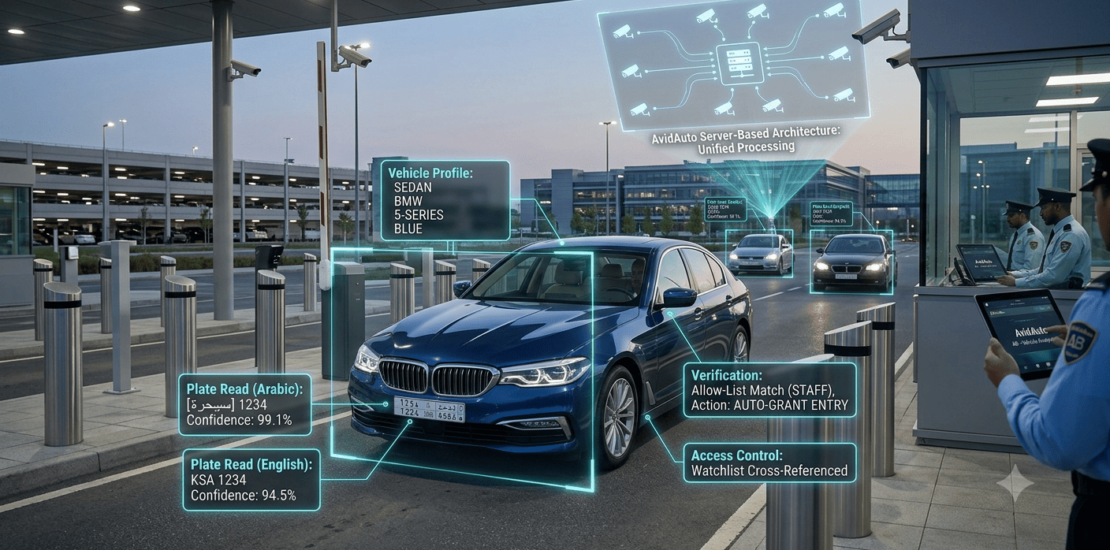
Most facilities that describe themselves as having a car detection system have a license plate reader at the entrance. The plate gets read. The read gets logged. If someone thinks to check the log afterward, the information is there. That is the ceiling of a basic LPR (License Plate Recognition) setup – and it is a much lower ceiling than the term car detection system implies.
A car detection system that delivers genuine operational value goes further on every dimension: it classifies the vehicle by type, make, model, and color alongside the plate read; it cross-references that vehicle against watchlists in real time before it clears the gate; it tracks the vehicle’s movement across the facility over time; it feeds traffic violation enforcement and parking management continuously; and it compresses post-incident investigation from hours of manual footage review to a targeted forensic query.
AvidBeam’s AvidAuto platform covers all of this through three integrated products, AB – Vehicle Analytics, AB – ITS (Intelligent Traffic Systems), and AB – Smart Parking, running on a server-based architecture that layers onto the cameras already installed. The global Automated License Plate Recognition market is projected to reach USD 15.22 billion by 2030, according to The Business Research Company, which reflects how rapidly the operational gap between a plate reader and a full car detection system has become visible to the organizations running them.
Hardware-Embedded vs. Server-Based: The Architecture Decision That Determines Everything
Every car detection system evaluation eventually comes down to architecture, and the architecture choice determines the accuracy ceiling, the scalability path, and the total cost of ownership more than any individual feature on the spec sheet.
Hardware-embedded car detection systems pack the processing unit, optical sensors, and recognition algorithms into each individual camera. Every device runs independently. At a small scale, that works. As deployments grow, it becomes a management problem: each unit requires separate configuration and maintenance, scaling means purchasing and installing additional physical units, capability updates require touching each device individually, and accuracy is permanently bounded by the compute each camera unit can offer locally.
Server-based car detection systems move all intelligence to a dedicated central infrastructure, processing feeds from every connected camera through unified algorithms. The operational difference is direct and measurable:
- All connected cameras are managed through one centralized interface — configuration, updates, and watchlist changes propagate across the full network simultaneously
- Scaling means extending software coverage to cameras already on the network, not purchasing and installing new hardware units per additional coverage point
- Detection model updates are deployed through software without touching any camera hardware
- Accuracy does not vary by camera model or age — the same processing power handles every feed regardless of what hardware is on the other end
AvidBeam’s AvidAuto platform is server-based. The infrastructure baseline is 2GB RAM and one virtual core at 2.4 GHz per camera processed, which means extending the car detection system coverage to cameras already installed across a facility requires no hardware investment beyond the software license.
| To find out how AvidAuto’s car detection system applies to your existing camera infrastructure, send an email to [email protected], and the technical team will follow up with a deployment assessment. |
AvidAuto – AvidBeam’s Car Detection System Platform
AvidAuto is structured around three integrated products, each covering a distinct layer of the car detection system stack. They operate independently or in combination through the same centralized management interface, which means a facility can deploy the access control layer first and extend to traffic violation enforcement and parking management as operational requirements grow — without rebuilding the platform.
AB – Vehicle Analytics — The Intelligence Foundation
AB – Vehicle Analytics is the vehicle intelligence layer that transforms a plate read into a structured detection event. Every detection produces a complete vehicle profile rather than a plate number in isolation: type, make, model, color, plate type (private, commercial, or tourist), timestamp, camera source, and location identifier. The system saves an image of the vehicle for each detection, which means every log entry carries visual confirmation alongside the structured data.
Beyond per-event logging, AB – Vehicle Analytics supports vehicle movement tracking across time and location — following a specific vehicle across multiple camera points throughout the facility to identify movement patterns. This capability applies directly to post-incident investigations where establishing a vehicle’s route through a site is the operative question.
AB – ITS Violation Detection and Traffic Management
AB – ITS (Intelligent Traffic Systems) extends AvidAuto’s car detection system to the road enforcement layer. It applies deep learning models trained on specific violation types to every connected camera feed continuously — flagging violations the moment they occur rather than when someone reviews the footage afterward.
Violation types AB – ITS detects across every monitored road segment simultaneously:
- Red-light running: fires the instant a vehicle crosses an intersection against a red signal, with plate, timestamp, and event clip
- Wrong-way driving: alerts operators immediately when a vehicle moves against the configured permitted direction for a road segment
- Sudden lane switching: identifies improper lane changes and restricted-lane entries with operator-configured boundaries per segment
- Illegal parking: continuous zone-based detection; alert fires the moment a vehicle stops in a fire lane, bus stop, or emergency access point
- Speeding: detects vehicles exceeding configured speed thresholds across monitored road segments
- Mobile phone use while driving: identifies drivers actively using a device at camera-covered intersections and road segments
- Seatbelt non-compliance: flags unbelted drivers across monitored segments with a full vehicle profile attached to each logged event
AB – ITS also generates traffic density analytics — real-time vehicle count and flow data per road segment, peak period analysis, and congestion identification at gate access points. That data feeds directly into staffing and infrastructure planning workflows that operations teams frequently underutilize when their car detection system only covers access control.
AB – Smart Parking | Occupancy and Zone Intelligence
AB – Smart Parking applies AvidAuto’s vehicle detection capabilities to parking structures, visitor areas, and contractor staging zones. It covers the occupancy and compliance layer that access control at the gate does not reach — the vehicle that cleared entry but parked in an unauthorized zone, the double-parked vehicle blocking a driving lane in an underground structure, the overnight vehicle that should have left six hours ago.
- Real-time occupancy detection across every monitored space — occupied vs. empty, updated continuously without manual counts
- Double-parking detection to keep driving lanes clear in operational areas and multi-level structures
- Entrance and exit blocking detection with alerts when vehicles obstruct emergency access points or loading bay approaches
- Overnight monitoring with alerts for vehicles remaining beyond authorized timeframes
Accuracy Under Real Conditions
Accuracy figures quoted in controlled test environments do not predict how a car detection system performs in production, and the gap between lab accuracy and field accuracy is where most hardware-embedded system evaluations disappoint. AvidAuto’s server-based architecture is specifically what allows its accuracy figures to hold across real operating conditions, because detection processing is not constrained by individual camera hardware capacity.
Arabic and English Plate Recognition
AvidAuto delivers 98%+ accuracy for Arabic license plate recognition and 92%+ for English, both running within the same deployment without separate hardware or configuration. Plate type identification runs alongside every read: private, commercial, and tourist plates are distinguished per event, which feeds directly into enforcement and access workflows that apply different rules by vehicle category. The system processes both character sets simultaneously, which matters for facilities in Saudi Arabia and the wider Gulf where mixed-fleet environments are standard.
Challenging Environmental Conditions
The conditions that degrade edge-based car detection systems — nighttime, rain, fog, high vehicle speeds, partially obscured plates, and weathered plate surfaces — are where server-based centralized processing holds its accuracy advantage. AvidAuto’s detection models run on server-grade compute that individual camera hardware cannot match locally, which means the accuracy floor across adverse conditions stays materially higher than what hardware-embedded systems deliver under the same inputs.
Specific conditions AvidAuto’s car detection system handles consistently:
- Low-light and nighttime conditions across all monitored gates and road segments
- Variable weather, including rain and fog, conditions where edge-based accuracy degrades most sharply
- High-speed vehicle movement across multi-lane approaches
- Partial plate obstruction from dirt, damage, or mounting angle
- Mixed traffic environments with motorcycles, heavy vehicles, and standard cars in the same frame
Access Control | From Manual Gate Check to Automated Vehicle Authorization
The access control layer of a car detection system is where the most immediate operational return appears — and where the gap between a plate reader and a full vehicle intelligence platform is most visible to the facility teams running the gate. Manual gate checks are slow, inconsistent, and dependent on the attention of whoever is staffing the checkpoint at a given moment. Automated vehicle authorization removes the dependency on that attention entirely.
Watchlist Categories
AvidAuto’s watchlist management runs three list categories in parallel across every monitored gate simultaneously — each configured to produce a different automated response the moment a listed vehicle is detected:
- Allow lists: authorized vehicles, including residents, staff, and approved contractors, clear automatically without a guard manually verifying credentials; the gate reads the plate, confirms the authorization, and grants entry without queue formation from checkpoint processing
- Deny lists: flagged, reported, or unauthorized vehicles trigger a security alert before the vehicle clears the gate — not after it has entered the facility; the alert delivers plate read, vehicle classification, camera source, timestamp, and location
- VIP lists: designated vehicles receive priority routing, reserved bay allocation, or specific access permissions based on operator configuration; the detection fires at the approach, not at the gate
A fourth category handles unknown vehicles, unregistered plates that do not match any list generate an alert for manual review, which means the gap between known and unknown vehicles is logged and acted on rather than waved through because nobody was watching.
Gate Automation at Scale
The scalability argument for server-based car detection system access control becomes concrete at the kind of scale AvidBeam has already deployed in Saudi Arabia. When Remat, in collaboration with Giza Solutions, deployed AvidBeam’s smart parking solution across a network of 18,000 cameras in Riyadh, a hardware-embedded approach would have required managing 18,000 individual units — each needing separate configuration, maintenance cycles, and watchlist updates. AvidBeam’s server-based platform managed the full network from a centralized interface. That is not a theoretical scalability claim. It is a documented operational reality.
Forensic Vehicle Search and Post – Incident Investigation
Post-incident investigation is the car detection system capability that procurement conversations focused on real-time alerting most consistently undervalue — and the one that security and legal teams reach for most urgently after an incident has occurred. Manual investigation without a forensic search layer means reviewing footage feed by feed, hour by hour, looking for a vehicle that may have passed through dozens of camera points across a multi-hour window.
AvidAuto compresses that process into a structured query. The forensic search capability covers:
- Plate-based search — retrieve all detection events for a specific plate number across the full recorded network, with timestamps and camera sources attached
- Vehicle attribute search — search by make, model, and color across a defined time window — relevant when the plate is unknown but the vehicle description is available from witness accounts or partial footage
- Location and time filtering — restrict search to specific camera points, access zones, or time segments to isolate the relevant footage without reviewing unrelated material
- Movement pattern reconstruction — track a specific vehicle’s route across the facility over a defined period — establishing where it entered, where it went, and when it exited
Each search returns results with saved vehicle images per detection event, which means the investigation output includes visual confirmation alongside the structured log data. That combination is what makes the forensic record usable in security reporting and, where relevant, legal proceedings.
Full Car Detection System Capability Breakdown
The table below maps every capability AvidAuto’s car detection system delivers across its three integrated products, with the operational output each one produces.
| Capability | AvidAuto Product | What It Delivers |
|---|---|---|
| License Plate Recognition | AB – Vehicle Analytics | 98%+ accuracy for Arabic plates; 92%+ for English — across high speed, low light, partial obstruction, and weathered plates |
| Vehicle classification | AB – Vehicle Analytics | Type, make, model, and color identified per detection event alongside every plate read — full vehicle profile per log entry |
| Plate type identification | AB – Vehicle Analytics | Private, commercial, and tourist plates distinguished automatically — feeds enforcement and access workflows that apply different rules per category |
| Allow / Deny / VIP lists | AB – Vehicle Analytics | Three watchlist categories cross-referenced in real time at every monitored gate — alert fires before the vehicle clears entry, not after |
| Vehicle movement tracking | AB – Vehicle Analytics | Specific vehicle tracked across time and location throughout the facility — movement pattern identification for investigations |
| Forensic vehicle search | AB – Vehicle Analytics | Post-incident search by make, model, color, plate, date, time, and location — returns footage without manual scrubbing |
| Traffic violation detection | AB – ITS | Red-light running, wrong-way driving, lane switching, illegal parking, speeding, mobile phone use, and seatbelt non-compliance |
| Traffic density analytics | AB – ITS | Real-time vehicle count and flow data per road segment; peak period analysis for staffing and infrastructure planning |
| Smart parking occupancy | AB – Smart Parking | Real-time occupied vs. empty space detection across all monitored levels; double-parking and entrance blocking alerts |
| Vehicle density analysis | AB – Vehicle Analytics | Volume and distribution across roads and parking areas; congestion identification at gate access points |
Hardware-Embedded vs. AvidAuto – Capability Comparison
The table below sets out where AvidAuto’s server-based car detection system diverges from what hardware-embedded LPR systems and basic plate readers deliver at the operational level — across the dimensions that determine production value rather than demo performance.
| Capability | Hardware-Embedded / Basic LPR | AvidBeam AvidAuto Platform |
|---|---|---|
| Plate reading accuracy | Variable; degrades at night, rain, and high speed | 98%+ (Arabic) / 92%+ (English); consistent via server-based centralized processing |
| Vehicle classification | Plate number only; no type, make, model, or color | Full vehicle profile per event: type, make, model, color, and plate type |
| Watchlist cross-referencing | Batch review; no live matching at the gate | Real-time alert at the moment a listed plate appears at any monitored point |
| Traffic violation detection | Officer-dependent; inconsistent coverage | AB – ITS covers red-light, wrong-way, lane switching, speeding, parking, phone, and seatbelt continuously |
| Vehicle movement tracking | No cross-camera tracking capability | Specific vehicle tracked across time, location, and camera across the full network |
| Parking management | Manual checks; no real-time occupancy data | Real-time occupancy, double-parking detection, and entrance blocking alerts |
| Forensic search | Manual footage scrub by time and camera; hours per case | Search by plate, make, model, color, date, time, and location; minutes per case |
| Scalability | New units required per camera point; separate configuration per device | Software extension to cameras already on network; centralized management regardless of scale |
| Hardware requirement | Often requires dedicated LPR camera units | Layers onto any existing ONVIF-compliant camera; 2GB RAM / 2.4 GHz per camera |
A basic LPR system reads plates. AvidAuto’s car detection system reads plates, classifies vehicles, tracks movement patterns, manages access in real time, enforces traffic violations, manages parking occupancy, and compresses post-incident investigation from hours to minutes — across the cameras already installed, at any scale.
Integration and Deployment
AvidAuto’s car detection system connects to existing camera infrastructure and VMS platforms without requiring a parallel hardware build. The platform maintains compatibility with Milestone, NetworkOptix, and Genetec video management systems, and processes feeds from any ONVIF-compliant camera from 2MP to 4K resolution.
Deployment options cover the full range of data governance requirements:
- On-premise: full local data control; suited for regulated facilities, government environments, and organizations with strict data sovereignty requirements
- Private cloud: scalable across multiple sites without adding on-site server capacity per location
- Public cloud: faster deployment path for organizations without dedicated IT infrastructure
- Hybrid: splits local and cloud-based processing based on data classification requirements across the facility portfolio
The infrastructure baseline per camera processed is 2GB RAM minimum and one virtual core at 2.4 GHz minimum, with multiple GPU configurations supported for higher-density deployments. Watchlist updates, detection rule changes, and capability additions propagate across the full camera network through software, no per-device hardware intervention required.
AvidBeam’s Verified Car Detection Deployments in Saudi Arabia
AvidBeam’s car detection system deployments across Saudi Arabia span four distinct operational environments — each applying a different configuration of AvidAuto’s capabilities, from standalone LPR through to full vehicle intelligence platforms coordinated with AvidFace and AvidGuard. The deployments below represent the evidence that distinguishes a vendor with a product from one with a proven platform.
Riyadh Smart Parking – 18,000 Cameras
Remat, in collaboration with Giza Solutions, deployed AvidBeam’s smart parking solution to manage a network of 18,000 cameras across Riyadh — the largest documented car detection system deployment in AvidBeam’s regional record. The platform handled the full camera network from a centralized interface, covering real-time occupancy management, vehicle detection, and parking analytics across a city-scale infrastructure that a hardware-embedded approach could not have managed without 18,000 individual unit configurations.
STC Sawaher Project
AvidAuto handled license plate recognition, vehicle tracking, watchlist management, and traffic flow monitoring across the STC Sawaher project — a full operational deployment combining AvidAuto’s car detection system layer with AvidFace for personnel tracking and AvidGuard for behavioral anomaly detection in a unified centralized operations view.
Qiddiya
AvidAuto managed vehicle count monitoring, license plate recognition, and allow/deny list access control across the entrances of Qiddiya’s entertainment destination — a multi-zone site requiring continuous vehicle authorization at multiple simultaneous access points throughout operating hours.
KAPSARC
AvidAuto covered traffic monitoring and vehicle tracking at the King Abdullah Petroleum Studies and Research Center — a research facility deployment combining car detection system access control with personnel tracking through AvidFace across a site with multiple access tiers and strict authorization requirements.
The Car Detection System Market
The global Automated License Plate Recognition market is projected to reach USD 15.22 billion by 2030, according to The Business Research Company. That growth trajectory reflects a shift that is already visible in the evaluation conversations AvidBeam’s teams have with facility managers and infrastructure directors across the region: organizations that deployed basic plate readers five years ago are now replacing them with full vehicle intelligence platforms — because the operational gap between what a plate reader delivers and what a car detection system built on AI analytics delivers has become too wide to justify the limitation.
The market context matters for procurement decisions because it signals where the technology is heading: toward server-based, multi-capability platforms that treat vehicle intelligence as one layer of a broader operational picture — connected to identity verification, behavioral detection, and natural-language investigation through the same interface. AvidAuto’s integration with AvidFace, AvidGuard, and AvidGenAI is the current expression of that direction, deployed and verified across Saudi Arabia’s most operationally demanding environments.