
Why Face Detection Cameras Alone Aren’t Enough? The Shift to Server-Based Recognition
- August 5, 2025
- Posted by:
- Category: Articles
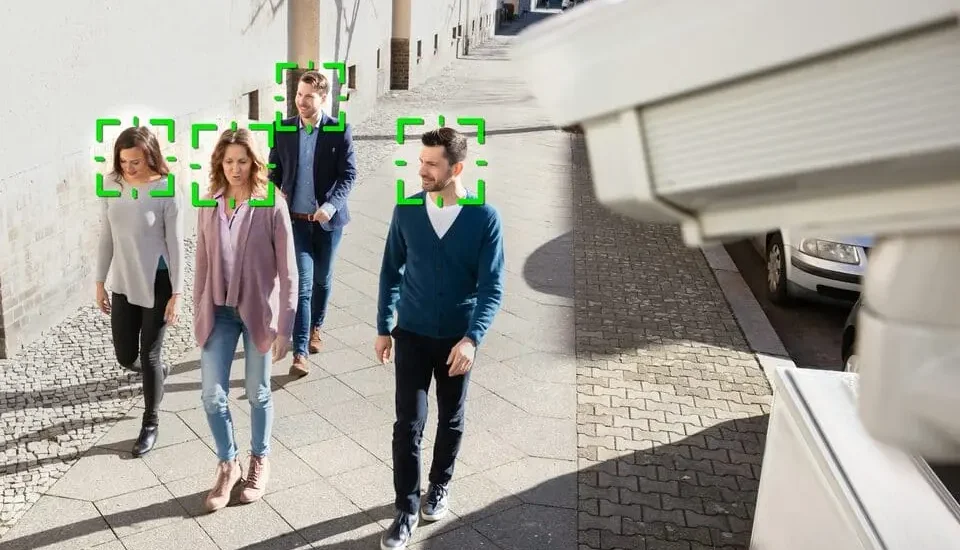
A camera with face detection technology identifies the presence of human faces within video frames, but this capability alone falls short of true security requirements. For identity verification and access management, organizations need complete facial recognition systems that analyze detected faces against authorized databases, a function typically delivered through advanced server-based software solutions.
Understanding Camera with Face Detection: Detection vs. Recognition
Before discussing the difference between detection and recognition, we must underline the facial recognition software market size, which is projected to expand from USD 5.73 billion in 2025 to USD 14.55 billion by 2031 (Statista, 2025).
A camera with face detection operates through sophisticated algorithms that continuously scan video streams to locate human facial structures. The systems identify key facial components, paired eyes, central nose configuration, and mouth positioning, to establish facial boundaries within the frame.
Detection technology excels at answering the question “Is there a face present?” but cannot determine “Whose face is this?” This fundamental limitation makes pure detection insufficient for security applications requiring identity verification. This is where “recognition” technology comes in, which not only detects but also recognizes.
Server-Based Facial Recognition: Beyond Basic Detection
Modern facial recognition systems address detection limitations through server-based architectures that centralize processing power and database management. Rather than relying on individual camera processors, software solutions coordinate multiple detection points and maintain comprehensive identity databases. Server-based facial recognition systems transform detected faces through 5 interconnected stages:
- Scan incoming visual data from multiple cameras, identifying facial structures across various angles and lighting conditions.
- Calculate exact distances between facial landmarks.
- Convert physical measurements into unique numerical codes, creating individual “faceprints”.
- Compare facial signatures against stored profiles in real-time.
- Provide definitive recognition results, confirming authorized individuals or flagging unknown subjects.
Hardware-Embedded vs. Server-Based Approaches
Camera with face recognition technology manifests through two distinct architectural approaches:
- Embedded Processing Systems integrate recognition capabilities directly within individual camera units through built-in processors and local storage. Hardware systems handle single-point verification scenarios where one person authenticates against a limited local database.
- Server-based solutions, like AvidBeam‘s AvidFace, operate as software platforms that connect with existing camera infrastructure. Server-based systems process continuous video streams from multiple detection points, enabling comprehensive recognition across larger installations and maintaining centralized databases.
Camera with Face Detection & Server-Based Solutions: Critical Infrastructure Applications
Facial recognition technology can be utilized across all types of organizations and industries. Here are 3 critical sectors through case studies and success stories:
Railway Station Access Control
Railway infrastructure requires sophisticated access management that distinguishes between multiple user categories: passengers, staff, maintenance crews, and security personnel. India’s ambitious smart station initiative demonstrates this requirement perfectly; 7 major railway stations, including Mumbai’s CSMT and New Delhi Railway Station, are implementing AI-based facial recognition systems (IndiaTV News, August 2025).
Facial Recognition Implementation Strategy:
- Deploy detection cameras at all entry points, platforms, and restricted areas.
- Integrate recognition solutions to process detected faces against comprehensive passenger and staff databases.
- Configure authorization levels: public access areas, staff-only zones, and high-security maintenance areas.
- Establish real-time alert protocols for unauthorized individuals in restricted zones.
- Coordinate ticket verification and boarding processes to reduce passenger queue times.
Facial Recognition Operational Benefits:
- Automated passenger flow monitoring without compromising security.
- Expedited ticket checking and boarding processes through facial verification.
- Instant identification of staff members accessing maintenance areas.
- Proactive threat detection before security incidents escalate.
- Comprehensive audit trails for regulatory compliance and incident investigation.
Port Security and Access Management
Maritime ports present unique security challenges with multiple access points, varied personnel categories, and international regulatory requirements. Rotterdam Port’s modernization initiative exemplifies this complexity. Hutchison Ports ECT Rotterdam has replaced finger scan systems with facial recognition technology, creating faster, more reliable, and entirely contactless verification processes (Trans.Info, 2025).
Facial Recognition Multi-Zone Implementation:
- Perimeter Detection: Cameras with face detection monitor fence lines and unauthorized entry attempts.
- Gate Authentication: Face recognition solution verifies identity against customs databases and employment records, eliminating physical contact requirements.
- Vessel Access Control: Crew verification against international maritime databases.
- Cargo Area Security: Restricted access verification for handling dangerous or valuable cargo.
- Operational Efficiency: Contactless verification reduces processing delays during peak shipping periods.
Oil & Gas Facility Security
Petrochemical facilities demand the highest security standards due to safety hazards, environmental concerns, and critical infrastructure protection. King Abdullah Petroleum Studies and Research Center (KAPSARC) in Saudi Arabia demonstrates these requirements through a facial recognition deployment using AvidBeam solutions to enhance security, safety, and operational efficiency across research and administrative facilities.
Facial Recognition Security Implementation:
- Perimeter Monitoring: Detection cameras identify approaching individuals before they reach facility boundaries.
- Primary Gate Authentication: Server-based recognition verifies employee credentials, safety certifications, and current authorization status against comprehensive databases.
- Zone-Based Access Control: Different recognition requirements for administrative areas, research facilities, production zones, and hazardous material storage.
- Emergency Response Integration: Instant identification of personnel during evacuation procedures or security incidents.
- Safety Protocol Integration: AvidBeam solutions verify Personal Protective Equipment (PPE) compliance through integrated detection algorithms and confirm individual authorization for specific hazardous areas and research zones.
Also you can learn more about: intelligent video analytics solutions
Camera with Face Detection: Investment Strategy and Maximizing Detection Infrastructure
Organizations evaluating camera with face detection systems must consider long-term expansion requirements and database growth. Server-based recognition platforms accommodate organizational growth without requiring hardware replacement. That’s why organizations need to do a cost analysis framework:
- Initial Investment: Camera hardware, software licensing, and installation costs.
- Operational Expenses: Database management, system maintenance, and support services.
- Expansion Costs: Additional camera integration and database scaling.
- Replacement Considerations: Technology refresh cycles and upgrade requirements.
Integration with Existing Infrastructure
Smart deployment strategies maximize existing camera investments through software-based recognition upgrades. Rather than replacing functional detection cameras, server-based platforms enhance current installations with comprehensive identification capabilities.
- Assessment Phase: Evaluate the current camera with face detection capabilities.
- Compatibility Analysis: Determine integration requirements for existing systems.
- Pilot Implementation: Test recognition software with a subset of cameras.
- Gradual Rollout: Expand coverage based on validated performance metrics.
- Full Integration: Complete recognition network with centralized management.
Modern Face Recognition Features Beyond Basic Detection
Server-based recognition systems coordinate multiple detection points at the same time, creating security networks that track individuals across facility zones. Unlike individual cameras with face detection that operate independently, centralized systems maintain continuous identification records as people move between coverage areas.
Dynamic Database Management
Facial recognition platforms support customizable authorization databases with real-time updates. Security administrators configure “authorized personnel” and “restricted individuals” lists with instant alert generation when flagged subjects appear at any detection point.
Behavioral Analytics Integration
Advanced facial recognition systems analyze detected individuals beyond simple identification, monitoring behavioral patterns that indicate potential security threats or operational inefficiencies.
Also you can learn more about: Surveillance Camera with Face Recognition
AvidBeam Software Integration Capabilities
AvidBeam‘s ATUN platform demonstrates hardware-agnostic design principles that maximize existing camera investments while delivering comprehensive recognition capabilities. The system supports various deployment configurations, edge processing, data center operations, or hybrid architectures, depending on organizational security requirements.
Framework Compatibility
AvidFace‘s architecture integrates easily with established video management systems, including Milestone and Genetec platforms. Organizations deploy ATUN as standalone applications or incorporate the software into existing security infrastructure without replacing functional camera networks.
No matter what sector you work in or the organization/company you represent, contact us.
AvidBeam‘s experts will walk you through all the solutions you need, providing in-depth details on how you can maximize your benefits from them.
2 Comments
Comments are closed.
[…] Also you can learn more about: Face Detection Cameras […]
[…] Facial Detection Initiation Advanced sensors continuously monitor surveillance areas, scanning for human facial characteristics. Detection algorithms optimize computational resources by identifying specific areas requiring detailed biometric analysis. […]