
Surveillance Camera with Face Recognition: Software-Based vs. Hardware Solutions in 2026
- July 26, 2025
- Posted by:
- Category: Articles
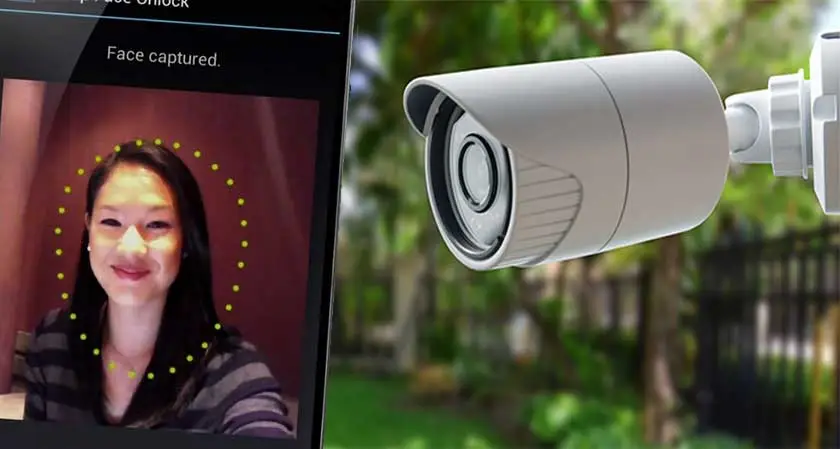
Can a single surveillance camera with face recognition transform the entire security infrastructure? The answer depends on whether you choose hardware devices or software-powered systems that maximize the existing camera investments.
The surveillance camera with face recognition market demonstrates explosive growth, projected to surge from USD 4.5 billion in 2023 to USD 16.5 billion by 2032, representing 15.7% annual expansion from 2024 to 2032 (Allied Market Research, 2024). Meanwhile, facial recognition software is expected to reach USD 5.73 billion in 2025, climbing to USD 14.55 billion by 2031 (Statista, 2025).
Surveillance Camera with Face Recognition: Two Distinct Approaches
A modern surveillance camera with face recognition technology is divided into fundamentally different architectures. Hardware-based solutions embed recognition processing directly within individual camera units, creating standalone systems that handle authentication locally. Hardware-based devices excel at single-point verification scenarios but remain limited to their built-in capabilities.
Software-based recognition systems transform existing surveillance camera infrastructure into intelligent identification networks.
Pro Tip: Rather than replacing cameras, software solutions like AvidBeam‘s AvidFace integrate with current installations, centralizing processing power on backend servers while coordinating multiple camera feeds simultaneously.
Hardware-Based Face Recognition Device vs. Server-based Face Recognition Solution: Core Differences
Processing Capabilities
- Face recognition hardware devices handle single-frame verification (1:1 matching) with a limited scope.
- Face recognition server-based solutions process continuous video streams for identification (1:N matching) across multiple subjects at the same time.
Database and Storage
- Face recognition hardware devices rely on limited local storage capacity.
- Face recognition software platforms utilize scalable cloud databases with unlimited expansion potential.
Infrastructure Requirements
- Face recognition hardware approaches demand dedicated camera units with embedded processing.
- Face recognition software solutions integrate easily with existing surveillance camera infrastructure.
Detection Flexibility
- Face recognition hardware devices require front-facing positioning for accurate verification.
- Face recognition software systems recognize faces from multiple angles under various lighting conditions.
Also you can learn more about: Face recognition device
How Surveillance Camera with Face Recognition Software Delivers Superior Performance
Advanced software solutions process facial recognition through 5 stages that surpass facial recognition hardware-based systems:
Stage 1: Intelligent Detection
Software algorithms continuously scan video streams from multiple surveillance cameras, identifying human faces regardless of angle or environmental conditions. Unlike facial recognition hardware devices that require front-facing positioning, software systems detect faces from various perspectives.
Stage 2: Precision Measurement
Mathematical engines calculate exact distances between facial features—eye separation, nose bridge dimensions, jawline contours, and cheekbone structures—creating detailed biometric maps that exceed hardware device accuracy.
Stage 3: Digital Signature Creation
Processing systems convert physical measurements into unique numerical codes, generating individual “faceprints” that serve as digital identities within extensive databases.
Stage 4: Database Cross-Reference
Matching protocols compare facial signatures against stored records in real-time, searching through millions of profiles immediately, a capability that overwhelms facial recognition hardware-based storage limitations.
Stage 5: Instant Verification
Final determination systems provide immediate identification results, supporting both security authentication and unknown subject discovery across surveillance networks.
Also you can learn more about: License Plate Recognition Camera
Real-World Surveillance Camera with Face Recognition Deployments
Government Security Application
Federal transportation security demonstrates massive software scalability. U.S. Customs and Border Protection operates facial recognition technology across 238 airports, including 14 preclearance stations and 49 international air departure sites (U.S. Customs and Border Protection, 2025). Millions of travelers experience expedited processing monthly, generating overwhelmingly positive feedback for simplified operations.
Private Sector Surveillance Innovation
MDLBeast Soundstorm 2024 showcased a software-based surveillance camera with face recognition capabilities at the Middle East’s largest music festival. AvidBeam Technologies’ AvidFace system secured over 450,000 attendees throughout the three-day Riyadh event, demonstrating the software’s ability to coordinate multiple camera feeds across massive venues.
Also you can learn more about: LPR Camera
Software-Based Surveillance Camera with Face Recognition: Technical Advantages
A modern surveillance camera with face recognition software requires technical foundations to deliver consistent performance across diverse environments. AvidBeam‘s ATUN platform addresses these requirements through a hardware-agnostic architecture.
AvidFace‘s framework-agnostic design ensures compatibility with existing video management systems, including Milestone and Genetec. Organizations deploy ATUN as standalone applications or integrate with their current security infrastructure.
AvidFace Solution Camera Compatibility Requirements
- Resolution support from 2 megapixels to 4K.
- Lens specifications: 3-25mm generally, 2.3-12mm for indoor applications.
- Minimum 2GB memory allocation per camera.
- CPU processing power: 2.4 gigahertz minimum.
- GPU card support for enhanced performance.
- Network bandwidth for real-time processing.
AvidFace Software-Based Solution Features
An advanced software-based surveillance camera with a face recognition system offers capabilities that embedded hardware alone is limited in providing. Take a look at AvidFace features:
- Multi-Face Processing
Real-time detection and tracking of numerous individuals within single scenes, even in crowded public environments. - Reverse Image Search
Archive searching capabilities for finding and tracking specific individuals across historical video footage, supporting investigations and customer tracking. - Dynamic List Management
Customizable “allow” and “deny” lists for high-security areas with instant alert generation. - Advanced Detection Features
Mask detection and demographic profiling generate real-time age and gender analytics for business intelligence, while IoT integration connects with smart doors, lighting, and environmental controls.
Applications for Surveillance Camera with Face Recognition
Smart cities increasingly incorporate surveillance camera with face recognition capabilities into urban management systems. Traffic monitoring, public safety enhancement, and emergency response coordination benefit from real-time identification capabilities that software systems deliver at scale. However, software-based facial recognition systems are increasingly widespread in other sectors, such as:
- Healthcare Facilities
Hands-free entry to sensitive zones, and maintaining hygiene standards. - Educational Institutions
Facility security controls access while tracking attendance, ensuring only authorized individuals enter campuses. - Transportation Networks
Passenger flow optimization through transit systems, with border control automation simplifying immigration processing. - Financial Services
Authentication replacing traditional password-based security systems with biometric verification. - Hospitality Enhancement
Guest experience personalization through recognition-based service customization. - Industrial Safety
Workplace monitoring ensures Personal Protective Equipment (PPE) compliance before accessing hazardous areas.
Investment Considerations: Facial Recognition Software vs. Hardware
Evaluation Factor | Hardware-Based Devices | Software-Based Systems |
Database | Stores facial profiles as per previously given input. | Identifies each facial profile compared to a large database updated in real time. |
Total Cost Analysis | High replacement costs accumulate rapidly for large-scale projects. | Maximizes existing camera investments with better long-term value. |
Scalability Planning | Requires hardware replacement during growth. | Handles organizational expansion without equipment replacement. |
Security Architecture | Basic embedded encryption standards. | Enhanced encryption and access controls with robust cybersecurity. |
Also you can learn more about: Personal Safety Devices
Strategic Decision Framework
Organizations evaluating surveillance camera with face recognition technology should prioritize software solutions when:
- Multiple camera coordination is required.
- Database scalability matters for future growth.
- Integration with existing infrastructure is preferred.
- Advanced analytics and business intelligence are needed.
- Continuous feature updates and improvements are valued.
- Long-term cost effectiveness is prioritized.
Software-based surveillance camera with face recognition deliver superior operational advantages: automated attendance tracking, reduced false alarm rates through enhanced AI accuracy, scalable cloud-managed deployments, and data-driven insights that boost revenue through intelligent marketing and resource allocation.
1 Comment
Comments are closed.
[…] Also you can learn more about: Surveillance Camera with Face Recognition […]