
AvidBeam’s CCTV Heatmap and Server-Based Video Analytics for 2026
- March 26, 2026
- Posted by:
- Categories: Articles, Articles & Blogs
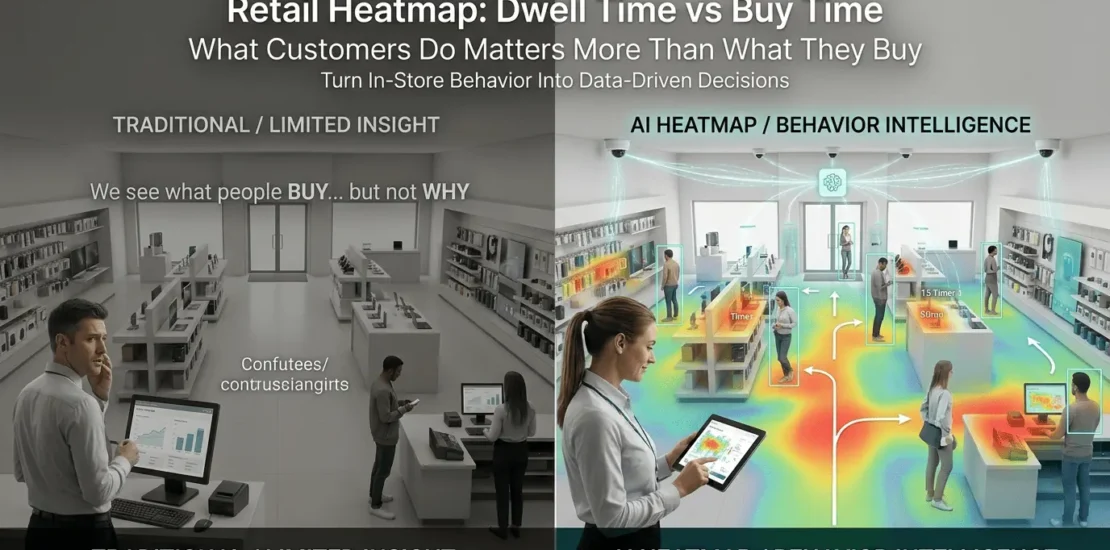
A CCTV heatmap converts thousands of hours of recorded movement into a single, readable layer of spatial intelligence. For operations managers, security directors, and facility executives, evaluating how people actually move through their spaces, that layer or heatmap changes the quality of decisions available to them. AvidBeam‘s server-based video analytics platform delivers this capability without requiring camera replacement or additional hardware investment.
How CCTV Heatmap Analysis Works at the Server Level
The distinction between hardware-based and server-based processing is where most platform evaluations are decided.
- Camera-embedded analytics are constrained by each unit’s local compute capacity.
- Server-based platforms apply consistent, updatable AI models across every connected camera, which produces materially better detection accuracy and far greater analytical depth.
AvidBeam‘s platform processes CCTV feeds through deep learning models running on centralized infrastructure. No camera replacement is required. The analytics layer sits on top of existing hardware, which means organizations extend CCTV heatmap coverage to cameras already on the network rather than committing to a hardware refresh.
The operational advantages of that architecture:
- New detection capabilities and updated AI models are deployed through software across all connected cameras at once
- Multi-site organizations manage all analytics through a single unified platform
- Infrastructure costs scale with software licensing
Learn more about: Heatmap Software for CCTV
| To find out how AvidBeam‘s CCTV heatmap capabilities apply to your facility’s existing camera infrastructure, fill the form from here and the team will follow up with project requirements and deployment assessment. |
What a CCTV Heatmap Produces and Why It Matters Operationally?
The output is a spatial overlay of the monitored floor plan:
- Red and orange zones mark areas where foot traffic concentrates or dwell time runs long.
- Blue and green zones indicate low-activity areas where people move through quickly or avoid altogether.
A CCTV heatmap tells where people went before every decision, and where they did not go at all. AvidBeam‘s AvidSight platform, specifically the AB – Retail module, generates CCTV heatmap outputs connected to parallel behavioral data streams:
- Visitor counting for real-time tracking of entries, exits, and zone-level occupancy across daily, weekly, and monthly windows
- Customer pathway analysis for route mapping from the entrance through the product areas to the checkout
- Dwell time analysis and duration metrics per zone
- Occupancy management and real-time monitoring against preconfigured capacity thresholds
- Traffic forecasting and historical pattern analysis that projects future footfall by hour, day, and season
Learn more about: Heat map Analysis
Where CCTV Heatmap Data Gets Put to Work
The operational questions a CCTV heatmap answers vary by sector. The underlying logic stays consistent: where are people spending time, where are they not, and what does that pattern reveal about layout, staffing, or security exposure?
Retail and Commercial Properties
Retail is where CCTV heatmap analysis delivers some of its most immediate returns. Store managers can assess:
- Which product zones generate sustained dwell time versus which areas customers walk past without stopping
- Where natural customer routes diverge from the intended floor plan logic
- Which promotional display positions receive genuine engagement, versus which ones draw foot traffic without conversion
- How checkout queue formation affects movement in adjacent aisles
- Which sections consistently show low traffic despite proximity to high-activity zones
Banking Environments
AvidBeam‘s AB – Smart Banking module extends the CCTV heatmap framework into financial service operations. Beyond standard movement analysis, the platform covers:
- ATM usage violation detection – alerts when two people use the same ATM
- Limited ATM usage detection – flags when an accessible ATM remains unoccupied for a configurable period
- Employee absence detection – alerts management when staff are missing from designated service positions
- Cash detection – identifies unattended currency in handling zones
- Daily customer service counts – tracks interactions per teller or service point to support performance monitoring
- Vault entrance and exit policy enforcement – the system is configured to allow exactly two authorized persons inside the vault at the same time; if that number falls outside the allowed range, an alert triggers instantly
Security and Facility Operations
A CCTV heatmap feeds directly into security analysis when paired with AvidBeam‘s AvidGuard platform, which supports:
- Loitering detection flags individuals who remain in restricted zones beyond configurable time thresholds
- Crowd detection alerts when group size in a monitored area exceeds specified limits
- Anomaly detection learns the behavioral baseline for each zone and surfaces deviations automatically
- Intrusion detection monitors predefined perimeter zones and generates alerts when unauthorized individuals cross set boundaries
- Tailgating detection identifies individuals entering access points behind authorized personnel without separate verification
AvidBeam in Saudi Arabia and CCTV Heatmap Deployments
As a top video analytics company in KSA, AvidBeam has deployed its server-based analytics platform across Saudi projects where movement intelligence and security monitoring were both operational requirements. Here are some of the deployments:
Soundstorm 2024/2025, Riyadh
AvidBeam deployed AI video analytics crowd management tools, facial recognition, demographics detection, and people counting for an event attended by 700,000+ fans and 150+ artists over three days (for 2 seasons in a row).
BaladBeast, MDLBeast, Jeddah (2025)
AvidBeam deployed facial recognition, demographics detection, crowd management, and people counting across a two-day festival in Jeddah’s historic Al-Balad district featuring 70+ artists across four stages.
Qiddiya, Saudi Arabia (2024)
AvidFace handled blacklist, whitelist, and VIP recognition across the entertainment destination’s facilities. AvidAuto managed vehicle count, license plate recognition, and access control at entrances.
STC Sawaher Project, KSA (2024)
AvidBeam implemented a full combination of solutions to automate operations and improve the quality of experience for end-users and operations teams. AvidFace tracked individuals by location. AvidGuard provided early-warning alerts for anomalies and unusual behavior. AvidAuto handled License Plate Recognition (LPR) and traffic flow monitoring, with CCTV heatmap data feeding into the centralized operations view.
KAPSARC, Saudi Arabia (2024)
AvidFace tracked and recognized individuals within specific facility locations. AvidGuard enabled fast video search and early-warning alerts for anomalies and traffic violations across the research center’s operations.
Learn more about: Heatmap Analytics
AvidBeam’s Technical Infrastructure
AvidBeam‘s platform is built to work with the infrastructure organizations already have in place, such as:
- 2MP to 4K camera resolution; ONVIF-compliant hardware across manufacturers
- 3mm to 25mm lens focal length
- Minimum CPU clock speed of 2.4 GHz; multiple GPU configurations supported
- Pitch -15° to +15°; roll -180° to +180°; yaw -15° to +15°
- Milestone and Genetec platforms
- Deployment options: on-premise, private cloud, public cloud, or hybrid
As a top video analytics company in KSA, AvidBeam‘s server-based architecture supports continuous capability expansion through software updates rather than hardware refresh cycles. Organizations are not locked into fixed technical specifications at the time of installation.
Also you can learn more about: Retail Heatmaps
Frequently Asked Questions
What is the purpose of a heatmap?
A CCTV heatmap provides spatial insights into movement, dwell time, and low-engagement areas to support layout optimization, staffing, security monitoring, and operational planning across industries.
How to analyze the heatmap?
Analyze high and low density zones in a CCTV heatmap, validate expected vs. unusual activity, and use dwell time and time-based patterns to guide staffing, security, and layout decisions.