
Vehicle Detection Platform in 2026: Why AvidBeam’s AvidAuto Goes Beyond the Single Detection Point
- July 20, 2026
- Posted by:
- Category: News
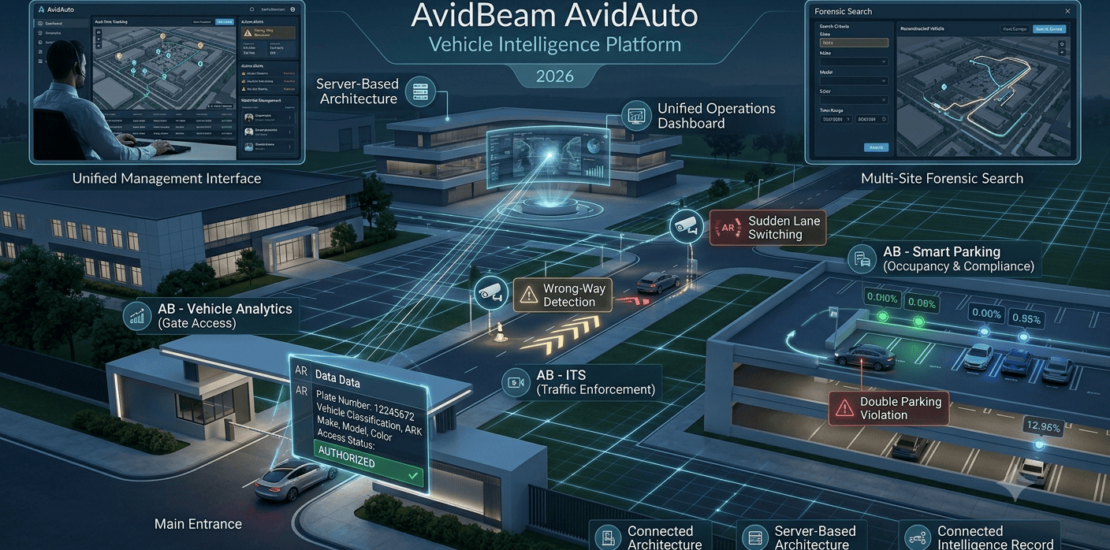
A plate reader at the entrance is a detection point. A vehicle detection platform is something structurally different. It covers every gate, access road, internal route, and parking level through the same management interface, the same watchlist infrastructure, and the same forensic investigation layer. Consequently, every vehicle that enters a monitored network generates a connected intelligence record, not an isolated detection event.
The distinction matters operationally. As covered in AvidBeam’s analysis of what separates vehicle detection systems, the gap between a detection point and a detection platform shows up most clearly in three areas: how watchlists are managed across locations, how investigations work after an incident, and how the system scales when new coverage points are added. AvidBeam’s AvidAuto platform addresses all three through a unified server-based architecture running on existing cameras.
What a Vehicle Detection Platform Requires
The word platform implies more than product depth. It implies that multiple capabilities are unified under shared management, shared data, and shared infrastructure. A collection of detection points, each operating independently with separate configuration and separate logs, is not a platform. It is a set of tools that happen to address the same subject.
Unified Management Across All Detection Points
A vehicle detection platform manages every detection point from one interface. Watchlist updates apply to all gates and cameras simultaneously. Detection rules configured at the platform level propagate across every module without per-device reconfiguration. Furthermore, alerts from every detection point feed into one unified view, so a deny-listed vehicle triggering at Gate 3 and a parking violation on Level 2 appear in the same operations display.
This matters most for multi-site organizations. A watchlist entry added at headquarters should apply at every connected location immediately. In a platform architecture, it does. In a point detection setup, it requires manual propagation to each device.
Scalability Without Hardware
A vehicle detection platform scales through software, not hardware. Adding a new gate to coverage means extending the platform’s software layer to cameras already covering that gate, not purchasing and installing a new detection unit at each new point.
AvidAuto’s server-based architecture enables this directly. All detection processing runs centrally. Therefore, any Open Network Video Interface Forum (ONVIF) compliant camera already on the network becomes part of the vehicle detection platform without hardware investment at the individual camera level. Additionally, capability updates deploy across the full network simultaneously through software.
| To find out how AvidAuto’s vehicle detection platform applies to your existing camera infrastructure, send an email to [email protected] and the technical team will follow up. |
AvidAuto – The Three-Module Vehicle Detection Platform
AvidAuto is structured around three integrated modules, each covering a distinct layer of vehicle intelligence. They operate independently or in combination through the same centralized management interface. Consequently, a facility can deploy the access control layer first and extend to traffic enforcement and parking management as operational requirements grow, without rebuilding the platform foundation.
AB – Vehicle Analytics
AB – Vehicle Analytics is the detection and identity foundation of the platform. Every vehicle that enters a monitored frame generates a structured detection record: plate number, plate type (private, commercial, or tourist), vehicle type, make, model, and color. License Plate Recognition (LPR) accuracy reaches 98%+ for Arabic plates and 92%+ for English.
Furthermore, AB – Vehicle Analytics manages watchlist matching, forensic search, vehicle count reporting, and movement tracking across the platform. Consequently, every detection event is both an immediate operational trigger and a historical record for investigation.
AB – ITS
AB – ITS (Intelligent Traffic Systems) extends the vehicle detection platform to road-level enforcement. It applies Artificial Intelligence (AI) violation detection models to every connected camera feed continuously. Violation types include red-light running, wrong-way driving, sudden lane switching, illegal parking, speeding, mobile phone use while driving, and seatbelt non-compliance.
Additionally, AB – ITS generates traffic density analytics per road segment. Volume and distribution data by hour and location feeds congestion forecasting and infrastructure planning workflows. Therefore, the vehicle detection platform produces both enforcement outputs and planning intelligence from the same detection layer.
AB – Smart Parking
AB – Smart Parking extends the vehicle detection platform into parking structures after gate clearance. Real-time occupancy detection distinguishes occupied from empty spaces across all monitored levels. Double-parking detection alerts when a vehicle parks across a marked boundary. Entrance and exit blocking detection fires when vehicles obstruct emergency access or loading approaches. Furthermore, overnight monitoring flags vehicles remaining beyond authorized timeframes.
The result is a platform that follows each vehicle from approach at the gate, through access roads and internal routes, to the parking bay, without a coverage gap between modules.
Platform-Level Integration
The platform architecture produces capabilities that individual detection points cannot replicate because they depend on shared data across the full network. Two platform-level capabilities illustrate this most directly.
Watchlist Propagation Across Sites
AvidAuto’s watchlist infrastructure manages deny lists, allow lists, and Very Important Person (VIP) lists centrally. Updates to any list apply to every connected gate and camera point across all locations simultaneously. As explored in AvidBeam’s guide to vehicle tracking across gates and roads, a flagged vehicle that approaches a secondary entrance after being detected at the primary gate triggers an alert at both points through the same watchlist, without requiring a manual update between detection events.
For multi-site organizations, this means a single list update at the central management interface applies everywhere. Consequently, there is no lag between a security decision and its enforcement across the full vehicle detection platform.
Forensic Search Across the Full Network
AB – Vehicle Analytics supports forensic vehicle search across the full recorded network. Search parameters include plate number, vehicle make, model, color, date, time, and location. Results return with saved vehicle images per detection event and movement pattern data across every camera the vehicle passed.
This is a platform-level capability because it requires shared detection data across all connected modules. A point detection setup with separate logs per device cannot reconstruct a vehicle’s full journey. The platform can, because all detection records feed into the same shared dataset.
Full Platform Capability Breakdown
The table below maps every capability AvidAuto’s vehicle detection platform delivers across its three modules, along with the operational output each produces.
| Platform Capability | AvidAuto Module | What It Delivers |
|---|---|---|
| License Plate Recognition (LPR) | AB – Vehicle Analytics | 98%+ (Arabic) / 92%+ (English); plate type identification; real-time watchlist matching at every camera point |
| Vehicle classification | AB – Vehicle Analytics | Type, make, model, and color per detection; saved image per event; full profile across the platform |
| Gate access automation | AB – Vehicle Analytics | Allow, deny, and VIP lists managed centrally; propagated to all gates simultaneously |
| Forensic vehicle search | AB – Vehicle Analytics | Multi-attribute query across the full recorded network; movement pattern reconstruction |
| Traffic violation detection | AB – ITS (Intelligent Traffic Systems) | Red-light, wrong-way, lane switching, parking, speeding, phone, seatbelt; continuous across all segments |
| Traffic density analytics | AB – ITS | Volume and distribution per segment; congestion forecasting by hour and location |
| Parking occupancy | AB – Smart Parking | Real-time occupied vs. empty per space; double-parking and blocking alerts |
| Vehicle count reporting | AB – Vehicle Analytics | Daily, weekly, and monthly volume data per location; graphical representation for planning |
| Multi-site management | Platform layer | Unified interface; watchlist updates apply to all connected sites simultaneously |
| Deployment flexibility | Platform layer | On-premise, private cloud, public cloud, or hybrid; data governance requirements accommodated |
Point Detection Setup vs. AvidAuto Platform — Comparison
The table below sets out where AvidAuto’s vehicle detection platform diverges from a collection of point detection setups at the management, scalability, investigation, and coverage level.
| Dimension | Point Detection Setup | AvidBeam Vehicle Detection Platform |
|---|---|---|
| Management interface | Separate configuration per gate or camera | Unified interface across all modules, sites, and detection points |
| Watchlist propagation | Manual update per device or location | Instant propagation to all connected cameras and gates simultaneously |
| Scalability | New hardware per additional coverage point | Software extension to cameras already on the network |
| Detection scope | Gate or intersection only | Gates, access roads, internal routes, and parking structures covered continuously |
| Forensic investigation | Single camera review; no cross-site query | Multi-attribute query across the full recorded network; movement pattern across all sites |
| Traffic enforcement | Not available in basic LPR setups | Continuous enforcement via AB – ITS across every monitored road segment |
| Parking coverage | No coverage after gate clearance | AB – Smart Parking extends the platform into parking structures with real-time intelligence |
| Deployment options | On-premise only in most hardware-embedded systems | On-premise, private cloud, public cloud, and hybrid configurable per deployment |
In short, point detection setups detect vehicles at specific locations. AvidAuto’s vehicle detection platform covers every vehicle across every location, through one interface, with shared intelligence across the full network.
Deployment Options
AvidAuto connects to any ONVIF compliant camera via standard network protocols. All vehicle detection processing runs centrally, not at individual cameras or gate hardware. Video Management System (VMS) integration covers Milestone, NetworkOptix, and Genetec platforms.
Four deployment models are available, configurable based on data governance and operational requirements:
- On-premise: full local data control; recommended for regulated facilities and government environments with data sovereignty requirements
- Private cloud: scalable across multiple sites without adding on-site server capacity per location
- Public cloud: faster deployment path for organizations without dedicated local IT infrastructure
- Hybrid: splits local and cloud-based processing based on data classification requirements across the portfolio
The infrastructure baseline per camera processed is 2GB RAM minimum and one virtual core at 2.4 GHz minimum, with multiple Graphics Processing Unit (GPU) configurations supported for higher-density deployments.
Verified Deployments
AvidBeam’s vehicle detection platform has been deployed across Saudi Arabia at a range of scales and facility types, each demonstrating a different configuration of AvidAuto’s three-module architecture.
- Riyadh Smart Parking: AvidAuto managed vehicle detection across 18,000 cameras from a single centralized interface, covering parking management and vehicle intelligence at city scale.
- Qiddiya, Saudi Arabia (2024): vehicle count monitoring, LPR, and allow/deny list access control across multiple entrance points at the entertainment destination.
- STC Sawaher Project, KSA (2024): LPR, vehicle tracking, watchlist management, and traffic flow monitoring combined with
- KAPSARC, Saudi Arabia (2024): vehicle detection and traffic monitoring across the King Abdullah Petroleum Studies and Research Center alongside personnel access management.
Frequently Asked Questions
What is a vehicle detection platform?
An integrated system that unifies vehicle recognition, access control, traffic enforcement, and parking management under one interface, shared watchlist infrastructure, and shared forensic investigation capability.
How does a vehicle detection platform differ from a point detection setup?
A point detection setup detects vehicles at specific locations with separate management per device; a platform manages all detection points centrally, propagates watchlists instantly, and enables cross-network forensic investigation.