
Perimeter Alarm Systems: 8 Myths Every Security Pro Needs to Know
- March 17, 2026
- Posted by:
- Categories: Articles, Articles & Blogs
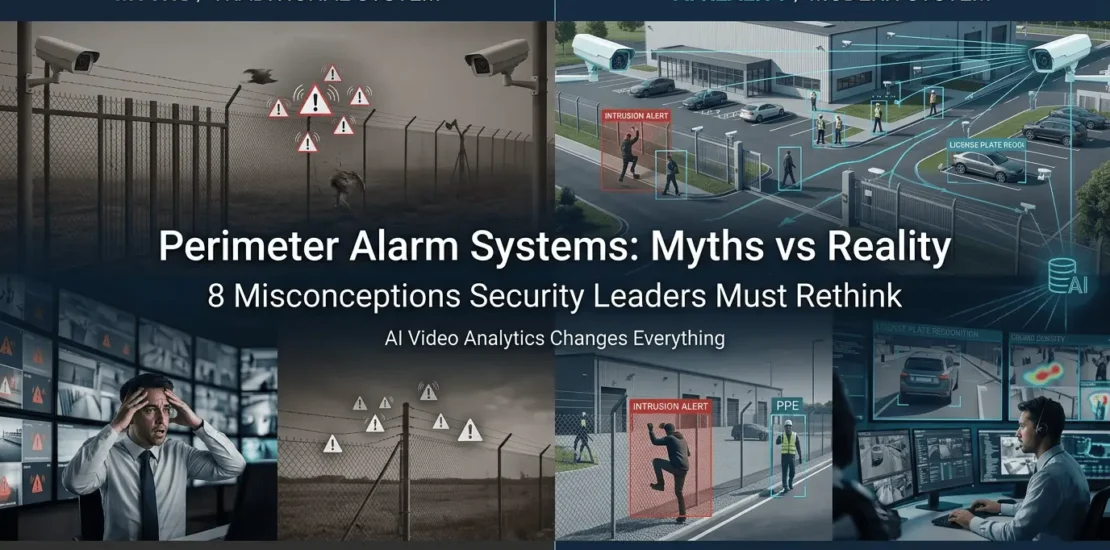
A perimeter alarm system is often the first line of defense enterprises rely on, and, just as often, the first layer that gets misunderstood at the budget table. COOs evaluating security infrastructure and CTOs assessing integration feasibility frequently inherit assumptions about how these systems work, what they cost, and what they actually deliver. Some of those assumptions are outdated. Others were never accurate.
Facts vs. Myths About Perimeter Alarm Systems
AvidBeam‘s video analytics platform, AvidGuard, has been deployed across government facilities, industrial plants, mass-gathering events, and research centers across the Middle East and Africa. The patterns that recur in those deployments reveal where security assumptions tend to break down and where upgrading a perimeter alarm system delivers measurable operational returns.
Here are 8 of the most common myths circulating around perimeter alarm system deployments, paired with what the evidence and current technology actually show:
Myth 1: A Perimeter Alarm System Only Needs to Cover the Outer Fence
Fact: Outer boundary coverage is the starting point, not the full picture, and a perimeter alarm system that monitors only the outer fence leaves significant gaps in facilities with:
- Multiple access points at different security levels
- Internal restricted zones within the broader perimeter
- Loading bays/parking structures and service corridors that sit inside the outer boundary
- Rooftop and elevated access routes that standard fence-line sensors miss
AvidGuard from AvidBeam addresses these gaps by supporting zone-specific detection rules across every monitored area. Each zone carries its own alert thresholds and response protocols.
| To start a technical review of your current perimeter alarm system and find out which AvidGuard capabilities apply to your facility, fill out the form |
Myth 2: More Cameras Mean Better Perimeter Protection
Fact: Camera density matters less than analytical depth. A facility with 200 cameras running basic motion detection will generate more false alerts than a facility with 80 cameras processed through AI-powered video analytics. Therefore, the smart perimeter alarm system’s value comes from what happens to the footage after capture, not from how many lenses are pointed at the boundary.
AvidBeam‘s platform runs on 2GB RAM and one virtual core at 2.4 GHz per camera, which means it scales efficiently without requiring proportional hardware expansion (scalable and budget-friendly), and it’s an analytical layer that determines detection accuracy.
Myth 3: Perimeter Alarm Systems Generate Too Many False Alerts to Be Operationally Useful
Fact: False alarm rates are a function of detection method, not an inherent limitation of perimeter alarm systems. Traditional motion-based systems trigger on pixel changes in a camera’s field of view, and that produces alerts from:
- Animals crossing monitored zones
- Wind-moved vegetation
- Shadows shifting across surfaces
- Rain or fog creates visual disturbances
AI-powered perimeter alarm systems apply object classification/behavioral analysis/zone-specific context to each detection event. AvidGuard distinguishes between a person approaching a fence line and a tree branch moving in the same frame, and the result is a measurable reduction in non-actionable alerts.
Myth 4: Upgrading to A Smart Perimeter System Requires Replacing All Existing Cameras
Fact: Server-based video analytics platforms from AvidBeam work with most existing camera infrastructure. AvidGuard supports cameras from 2MP to 4K resolution and is compatible with ONVIF-standard hardware, which covers the majority of cameras already deployed in enterprise facilities. The upgrade path for a perimeter alarm system typically involves adding the analytics layer to existing hardware, not replacing it. Integration extends to video management systems as well:
- Milestone
- NetworkOptix
- Genetec
That compatibility profile means the server-based perimeter alarm system upgrade does not require a full infrastructure overhaul, and organizations can phase in analytics coverage across camera groups, starting with the highest-priority zones.
Learn more about: Perimeter Security Systems
Myth 5: A Smart Perimeter Detection System Is Just a Security Tool
Fact: The same server-based infrastructure that secures the perimeter generates data that improves facility operations (security and operational uses). AvidGuard‘s detection capabilities extend well beyond intrusion alerts, as the platform monitors:
- Personal Protective Equipment (PPE) compliance in industrial zones (verifying if the workers are wearing helmets, vests, gloves, safety glasses, and footwear properly).
- Crowd density near access points and high-traffic areas.
- Vehicle movement patterns across parking facilities and access roads.
- Fire and smoke conditions in perimeter infrastructure zones.
- Left objects near access points that may represent operational or safety hazards.
For a COO evaluating Return on Investment (ROI), a smart perimeter detection system that also handles safety compliance monitoring and operational risk detection delivers value across multiple budget lines.
Learn more about: Personal Protective Gear Detection
Myth 6: Perimeter Alarm Systems Can’t Handle Complex Environments
Fact: AI-powered perimeter alarm systems are built for exactly such complex environments.
For example, the Soundstorm 2024/2025 festival in Riyadh, KSA, ran AvidGuard across a perimeter security operation covering more than 450,000 attendees over three days (each year). At that scale and in this complex environment, a conventional perimeter alarm system based on motion detection would have produced unmanageable alert volumes. But, AI-powered detection filtered events by object type and zone priority, keeping security teams focused on verified threats.
Also, here are some large-scale deployments of AvidBeam‘s perimeter detection system:
- King Abdullah Petroleum Studies and Research Center (KAPSARC), Saudi Arabia
- Military Stadium, New Capital, Egypt
- New Alamein City Project, Egypt
Each of these environments presented different perimeter challenges, and the same platform from AvidBeam addressed all of them.
Learn more about: Perimeter Security Alarm
Myth 7: Perimeter Alarm Systems Require Constant Manual Monitoring
Fact: Automated detection and response in the smart perimeter alarm system reduces the monitoring burden significantly.
As manual surveillance across large perimeters is not a scalable security model, human attention degrades over long shifts (creating overage gaps), and high alert volumes from conventional systems accelerate fatigue. A well-configured perimeter alarm system is needed to handle the detection layer automatically and surface only verified events that require human judgment.
AvidGuard supports:
- Anomaly detection that learns the behavioral baseline for each monitored zone and flags deviations automatically
- Loitering detection that triggers alerts after configurable time thresholds without operator input
- Scene change detection that alerts when environmental modifications occur in monitored sectors
- Tailgating detection that identifies access control violations at entry points in real time
Therefore, security personnel can focus on response and investigation (not continuous screen monitoring).
Learn more about: Camera for Face Detection
Myth 8: A Smart Perimeter Alarm System Is a One-Time Installation
Fact: Server-based architectures support continuous capability expansion through software updates. Organizations often defer perimeter alarm system upgrades based on the assumption that any installation quickly becomes outdated and requires full replacement to stay current. AvidBeam‘s server-based architecture separates the analytics layer from the camera hardware. Which means new detection capabilities and updated AI models are delivered through software refinements.
AvidBeam’s deployment options support growth at different stages:
- On-premise installations for organizations that retain full data control
- Private cloud hosting for multi-site enterprises scaling across locations
- Public cloud implementations for rapid deployment without on-site server expansion
- Hybrid architectures for facilities with mixed data governance requirements
All in All
Most of the friction around perimeter alarm system investment comes from assumptions that were formed around older, motion-based technology. AI-powered video analytics changes the performance baseline on false alarm rates, integration complexity, scalability, and operational value.
For COOs and CTOs evaluating whether a perimeter alarm system upgrade is justified, the deployments at KAPSARC and Soundstorm in KSA, and at Military Stadium and New Alamein City in Egypt. Offer a concrete reference for AvidBeam solutions.
If your organization is still working through the business case. Reach out via the form to request a detailed breakdown of how AvidBeam solution has performed across facilities similar to yours.
Also you can learn more about: Smart Building Technology
1 Comment
Comments are closed.
[…] Also you can learn more about: Perimeter Alarm Systems […]