
Why Your Perimeter Security Alarm Is Only Half the Solution
- March 12, 2026
- Posted by:
- Categories: Articles, Articles & Blogs
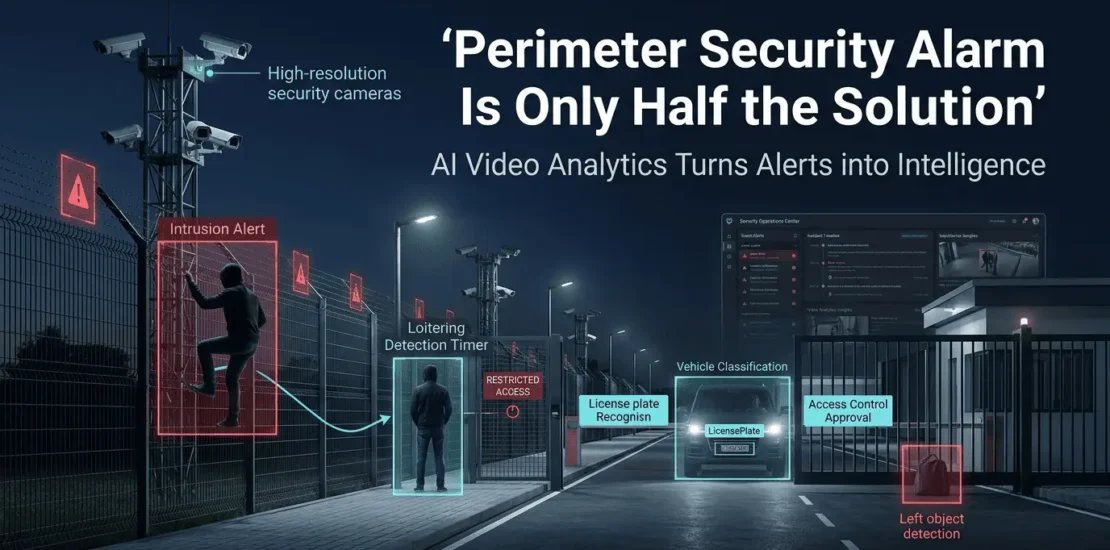
A perimeter security alarm does one thing well: it tells companies that something happened. What most enterprise security teams discover, usually after an incident, is that detection without context leaves responders reacting to alerts they can’t interpret fast enough to act on. That gap between alarm and action is where real losses occur, and COOs know that.
Here’s what’s missing from traditional perimeter security alarm architectures, how AI-powered video analytics fill the gaps, and what COOs and CTOs at large enterprises are deploying to close them.
Limits of Traditional Perimeter Security Alarms
Most legacy perimeter security alarm systems were built around a binary logic: motion detected, then alarm triggered, which made sense when facilities were simpler and threats were more predictable.
But, today’s enterprise campuses, spanning multiple access points and 24/7 operational cycles, generate far more movement than any motion-based system can intelligently parse, and the result is:
- Security operations centers receive dozens of false alerts per shift
- Alert fatigue causes teams to slow their response times across the board
- Actual intrusion attempts get buried in noise
- Incident logs become too cluttered for useful forensic review
Learn more about: Bank Security Cameras
What AI Adds to the Perimeter Security Alarm Equation?
The shift from passive alarm to active intelligence starts at the analytics layer. Instead of triggering on pixel changes in a camera’s field of view, AI-powered systems analyze what’s actually happening, such as object type, movement pattern, behavioral context, and historical baseline for that specific zone.
AvidBeam‘s AvidGuard platform processes video streams through server-based infrastructure, applying deep learning models trained on millions of frames to separate genuine threats from environmental noise. When a perimeter security alarm fires through AvidGuard, it carries:
- Object classification (person, vehicle, animal)
- Movement trajectory and speed
- Zone-specific behavioral context
- Confidence score for the detection event
| Ready to see how AvidGuard performs across your specific perimeter zones? Fill out AvidBeam‘s contact form and our team will walk you through a deployment model matched to your facility’s profile |
Key Capabilities That Change How Perimeter Security Alarms Work
AvidGuard‘s architecture sits at the server level, which means it has access to computational resources that edge devices can’t match, and it supports a range of detection scenarios that individual perimeter security alarm triggers cannot handle on their own. Here are the key capabilities of AvidGurard:
1. Intrusion and Fence Crossing Detection
Monitors designated zones and generates alerts the moment an unauthorized individual crosses predefined boundaries.
2. Loitering Detection
Flags individuals who remain near perimeter boundaries beyond acceptable time thresholds. Many intrusion attempts begin with reconnaissance, and loitering detection surfaces that early.
3. Left Object Detection
Identifies unattended items near access points, a capability that matters as much for safety compliance as it does for security.
4. Tailgating Detection
Catches individuals who follow authorized personnel through access points without separate verification.
5. Anomaly Detection
Learns the behavioral baseline for each monitored zone, then flags deviations. If a delivery truck parks outside its usual window or a person approaches via an unconventional route, the perimeter security alarm escalates automatically.
6. Fire and Smoke Detection
Extends the system’s usefulness beyond intrusion, early warnings protect perimeter infrastructure from environmental threats that motion-based alarms ignore entirely.
Learn more about: AI Smoke Detector
How False Alarm Rates Drop With AI-Powered Detection?
The operational case for upgrading perimeter security alarm infrastructure often starts with false alarm rates. AI-powered perimeter security platforms apply behavioral and contextual filters that passive motion detection skips entirely, and the result is a measurable reduction in non-actionable alerts, which translates directly into:
- Faster average response times on genuine alerts
- Lower operational load on security personnel
- Cleaner incident documentation for post-event review
- Reduced risk of alert fatigue across shifts
Learn more about: Intrusion Detection System
| The global video analytics market size was valued at USD 12.29 billion in 2025 and is projected to grow from USD 14.81 billion in 2026 to USD 65.08 billion by 2034 (Fortune Business Insights, 2025) |
Real Deployments of AvidBeam’s Perimeter Platform
AvidBeam‘s track record across the Middle East and Africa offers a useful reference point for enterprise decision-makers evaluating perimeter security alarm upgrades, and here are some real-life stories:
1. Soundstorm 2024/2025, Riyadh, KSA
AvidGuard managed perimeter security coordination for over 450,000 festival attendees across three days (for 2 seasons in a row). A conventional perimeter security alarm system would have generated unmanageable alert volumes, but AvidBeam’s AI-powered detection filtered events by threat type and location, keeping security teams focused on genuine risks.
2. Military Stadium, New Capital, Egypt
AvidGuard‘s crowd detection and perimeter monitoring capabilities handled large-scale event security at Egypt’s flagship sports venue to maintain perimeter integrity across a high-traffic, high-complexity environment.
3. New Alamein City Project, Egypt
The coastal development deployed an integrated ecosystem combining facial recognition, anomaly detection, video surveillance, and perimeter monitoring across the full development zone.
Learn more about: Perimeter Security Systems
AvidBeam Infrastructure: On-Premise, Cloud, or Hybrid?
One of the practical decisions COOs and CTOs face when upgrading perimeter security alarm infrastructure is deployment architecture. AvidGuard supports three models:
- On-premise installations – full data control, suited for regulated industries
- Private cloud hosting – scalable without on-site server expansion
- Public cloud implementations – fast deployment for multi-site enterprises
Resource requirements are deliberately lean. AvidGuard runs on 2GB RAM per camera and one virtual core at 2.4 GHz, supports cameras from 2MP to 4K resolution, and integrates with Milestone, NetworkOptix, and Genetec VMS platforms through ONVIF-compatible camera standards. That technical profile makes it accessible to facilities that need enterprise-grade perimeter security alarm capability without proportionally large infrastructure budgets.
Learn more about: Perimeter Intrusion Detection System
What AvidBeam GenAI Adds Next?
AvidBeam develops a GenAI integration layer that allows security operators to interact with a perimeter security alarm system through natural language. An operator could query:
“Describe the perimeter alert and explain why it occurred”/”Locate the nearest security checkpoint,” then the system retrieves relevant footage segments. That capability shifts the perimeter security alarm from a reactive notification tool to an investigative platform, one that supports both real-time response and post-incident forensics through the same interface.
If your current perimeter security alarm generates more noise than intelligence, the architecture warrants re-evaluation. AI-powered video analytics gives it the analytical layer it was always missing.
For COOs and CTOs managing multi-site operations, perimeter security alarm performance directly affects insurance liability exposure, operational continuity, and incident response SLAs.
Get in touch with AvidBeam‘s security team via the contact form to kick off a technical review of your current perimeter security alarm setup and identify where AI-powered detection can close the gaps.
Also you can learn more about: Car detection system