
Oil and Gas Surveillance That Pays for Itself: ROI Through Risk Reduction
- December 11, 2025
- Posted by:
- Categories: Articles, Articles & Blogs
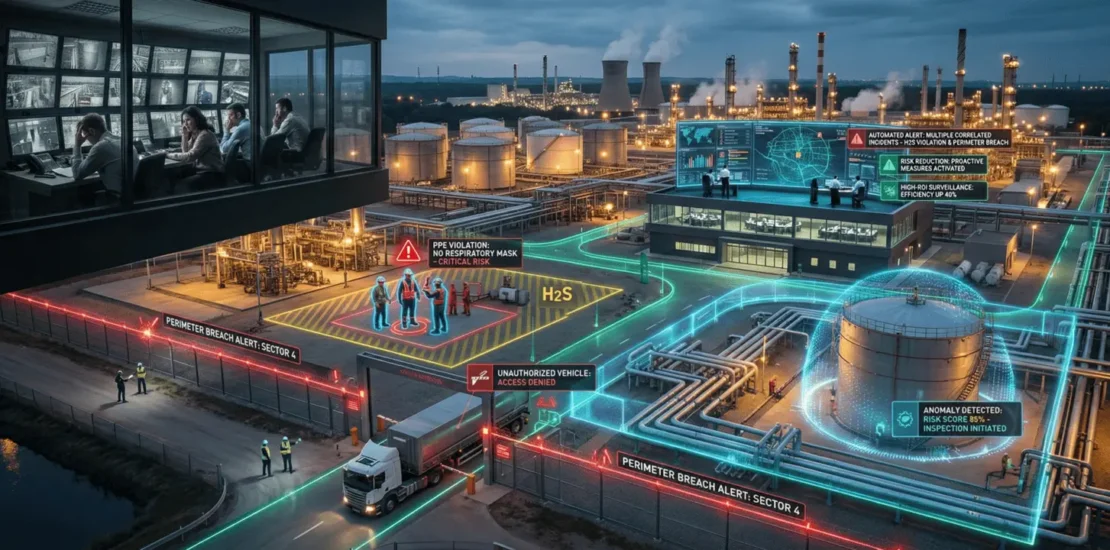
Why does oil and gas surveillance require technology that never blinks or misses a detail? Most facilities operate surveillance systems designed for post-incident investigation rather than prevention. Security personnel monitor banks of screens displaying feeds from dozens or hundreds of cameras, an approach with predictable limitations:
- Human attention degrades after 20 minutes of continuous monitoring.
- Night shifts compound fatigue and reduce detection accuracy.
- Response times depend entirely on whether someone watched the right camera at the critical moment.
- Coverage gaps emerge during breaks, shift changes, or operational incidents.
The consequences of missed detections compound rapidly: perimeter breaches create opportunities for sabotage, for example; workers entering H2S zones (areas within an industrial facility designated by the level of hydrogen sulfide gas risk) without respiratory protection face life-threatening exposure, and unauthorized vehicles introduce ignition sources near flammable materials.
Traditional Surveillance | Intelligent AI-powered Analytics Surveillance |
Post-incident investigation | Real-time threat detection |
Manual compliance monitoring | Automated verification with documentation |
Isolated system alerts | Correlated event intelligence |
Human-dependent response times | Automated alert prioritization |
Reactive security posture | Proactive risk management |
Access Control in Oil and Gas Surveillance
Petrochemical facilities must prevent unauthorized access to tank farms, processing units, control rooms, and critical infrastructure and manage legitimate traffic from employees, contractors, maintenance personnel, and visitors.
Traditional surveillance systems suffer from credential sharing, tailgating, and the inability to verify that authorized individuals actually possess the qualifications required for specific zones. Perimeter intrusions represent a particularly complex threat where facilities spanning hundreds of acres cannot economically fence every boundary with physical barriers and guard posts.
Oil and Gas Surveillance: Multi-Layered Identity Verification
AvidBeam‘s integrated approach combines AvidFace facial recognition with AvidGuard perimeter monitoring to create layered security that verifies both authorization and capability.
Entry Point Verification
AvidFace deployed at facility entry points verifies identity with over 90% accuracy before granting access, creating audit trails that document exactly who entered which zones at specific times. Integration with access control systems enables automated decisions where authorized personnel receive easy entry, and unauthorized individuals trigger security alerts before reaching sensitive areas.
Also, oil and gas facilities need to apply similar principles across multiple security layers:
- Perimeter gates verify vehicle occupants.
- Building entrances confirm authorization for specific structures.
- Control rooms validate credentials for critical infrastructure access.
Perimeter Intrusion Detection
AvidGuard establishes virtual boundaries around critical zones and distinguishes between authorized movement, unauthorized intrusions, and non-threatening activity like wildlife.
Security teams receive alerts with visual verification only when actual threats emerge, eliminating the false alarm fatigue that degrades traditional motion-detection effectiveness.
Strategic Value of Access Control in Oil and Gas Surveillance
Deploying this integrated approach results in response time improvements measured in minutes, the difference between intercepting intruders at perimeter fences versus discovering breaches after individuals reach critical infrastructure.
Operational Intelligence Generated:
- Entry pattern analysis to optimize gate staffing during peak hours.
- Contractor access frequency tracking for permanent authorization decisions.
- Event correlation for incident investigations.
- Zone-specific entry trends for capacity planning.
Vehicle Management in Oil and Gas Surveillance
Oil and gas surveillance extends to vehicle management as facilities handle continuous traffic from tanker trucks collecting product, delivery vehicles supplying materials, contractor fleets servicing equipment, and employee vehicles.
Each vehicle category requires different access permissions, follows distinct routing requirements, and poses unique operational risks. Loading operations represent particularly high-stakes environments where tanker trucks must be verified before accessing loading bays, positioned correctly to prevent spills during product transfer, and monitored for dwell time to maintain throughput targets.
Automated Recognition and Traffic Intelligence
AvidAuto‘s automated license plate recognition (LPR) and traffic flow analysis transforms vehicle management from manual oversight to systematic intelligence.
Gate Access Control
At facility gates, AvidAuto reads approaching vehicle plates and cross-references against authorized databases:
- Tanker trucks scheduled for loading receive automated entry and routing instructions to designated bays.
- Unauthorized vehicles trigger security alerts before entering facilities.
- Audit trails document which vehicles accessed facilities during specific timeframes.
- Integration provides critical data for regulatory compliance and incident investigations.
Parking Optimization
AvidParking for parking area security enables automated vehicle tracking that minimizes unauthorized access. Refineries/oil & gas facilities can apply this functionality across:
| Application Area | Capability | Benefit |
| Employee Parking | Authorized vehicle verification | Security enhancement |
| Contractor Staging | Zone-specific access control | Operational safety |
| Visitor Parking | Segregation from operational areas | Risk reduction |
| Overnight Monitoring | Lingering vehicle detection | Security investigation triggers |
Traffic Flow Analytics
AvidAuto analyzes vehicle movement through loading areas, truck scales, and maintenance zones. Operations managers identify congestion points, then optimize gate operations and adjust loading bay assignments based on actual flow data rather than assumptions.
Vehicle Management Benefits in Oil and Gas Surveillance
- Reduced loading cycle times through delay identification.
- Optimized parking layouts that minimize walking distances.
- Proactive alerts when authorized vehicles fail to arrive during expected timeframes.
- Capacity forecasting through vehicle pattern correlation with production schedules.
Worker Safety & PPE Detection in Oil and Gas Surveillance
Effective Oil and Gas Solutions addresses worker safety as officers face an unforgiving reality where workers entering hazardous zones without required personal protective equipment (PPE) face immediate injury risk and facilities face regulatory citations, operational shutdowns, and potential criminal liability.
Required PPE by Zone Type:
- Hard hats and safety glasses in processing areas.
- High-visibility vests in vehicle traffic zones.
- Respirators in H2S or confined space zones.
- Flame-resistant clothing in high-temperature or fire-risk areas.
Automated PPE Detection and Compliance
AvidGuard‘s automated personal protective equipment (PPE) detection analyzes video streams in real-time to verify that individuals entering designated zones wear required safety equipment, creating systematic enforcement that operates continuously without human intervention.
Real-World Implementation: SABIC deployed AvidGuard across petrochemical facilities in Saudi Arabia to enforce safety regulations through automated PPE detection.
How It Works:
- Detection: Workers entering zones marked for specific equipment requirements trigger automated analysis.
- Identification: System identifies individuals lacking hard hats, safety glasses, high-visibility vests, or respiratory protection.
- Alert: Supervisors receive alerts about non-compliant workers before they enter dangerous areas.
- Enforcement: Integration with access control systems denies zone entry until workers use the required equipment.
Compliance Analytics and Improvement in Oil and Gas Surveillance
Over time, automated verification creates accountability that improves compliance rates as workers recognize that PPE requirements are enforced consistently.
Tracking Metrics by:
- Zone (identifies areas needing additional signage).
- Shift (reveals equipment availability issues).
- Contractor (flags organizations requiring retraining).
- Trend analysis (measures training intervention effectiveness).
| Compliance Aspect | Traditional Monitoring | AvidGuard Solution |
| Coverage | Intermittent, supervisor-dependent | Continuous, automated |
| Consistency | Varies by individual | Uniform enforcement |
| Documentation | Manual logs, gaps common | Timestamped records, complete audit trail |
| Response Time | Minutes to hours | Real-time alerts |
| Audit Readiness | Difficult to verify | Defensible, systematic evidence |
Implementation of Oil and Gas Surveillance Systems
Successful deployment begins with infrastructure assessment, where organizations evaluate existing camera systems for image quality, positioning, and environmental protection adequate for AI analytics. Here is the recommended implementation framework:
1. Infrastructure Assessment
Organizations need to evaluate:
- Existing camera image quality and positioning.
- Network bandwidth capacity for video transport.
- Integration points with current security systems.
2. Hazardous Area Compliance
Oil and gas facilities contain classified hazardous areas where equipment must meet explosion-proof standards:
- Camera selection considers area classification (Zone 1, Division 1 locations).
- Devices carry appropriate certifications for hazardous environments.
- Analytics capability maintained for cameras in hazardous areas.
3. Network Infrastructure
Facilities spanning hundreds or thousands of acres require robust network infrastructure:
- Video stream transport from remote camera locations to processing servers.
- Bandwidth requirements increase with camera resolution and frame rates.
- Network capacity assessments identify upgrade requirements.
- Camera prioritization based on operational criticality.
Strategic Value of Oil and Gas Surveillance
Organizations deploying AvidBeam‘s solutions transform existing camera infrastructure into intelligent detection systems that enhance safety, improve security, and optimize operations.
The strategic question for decision-makers centers on deployment timelines rather than capability justification. Organizations that implement intelligent oil and gas surveillance capture operational, safety, and financial benefits through automated monitoring, compliance verification, and operational intelligence.
Also you can learn more about: Bank Video Surveillance