
How Server-Based PPE Detection Analyzes Workers’ Compliance Across Multiple Locations
- November 23, 2025
- Posted by:
- Categories: Articles, Articles & Blogs
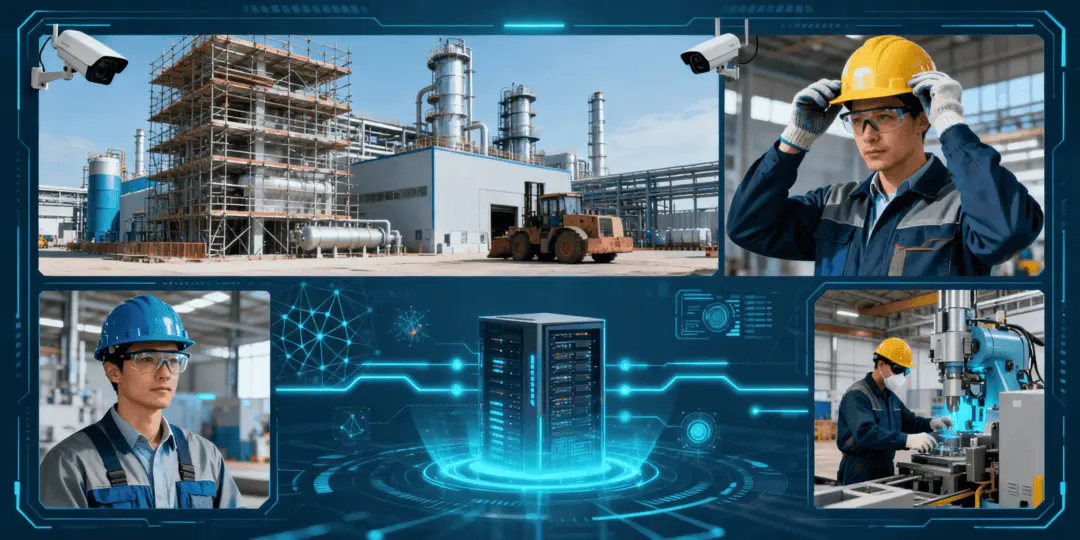
Why do facilities and factories need AI video analytics PPE detection? A single wrench dropped from scaffolding at a petrochemical facility can strike a worker who removed his hard hat during a lunch break 40 feet below. The wrench likely fell because another worker, who may also have been without proper head protection, leaned over a railing to retrieve dropped tools instead of following the retrieval procedures.
Traditional safety supervisors conducting hourly walkthroughs had missed both violations. But, PPE detection through server-based video analytics would have flagged both incidents within seconds, the first worker removing protective equipment in an active zone, the second worker in an industrial zone operating heavy machinery without wearing the required safety goggles and gloves, exposing themselves to potential eye injuries and chemical burns.
These scenarios represent the calculated risks organizations accept when relying on human observation to enforce compliance across facilities where thousands of workers operate simultaneously, in environments where a single violation can cascade into catastrophic outcomes.
Workplace injuries cost companies billions annually, including medical expenses, lost productivity, and administrative overhead. And never forget the tragedies: fathers missing children’s milestones during recovery, mothers unable to work for months following chemical burns that proper equipment could have stopped, families devastated by fatalities occurring because someone thought “just this once” wouldn’t matter.
Server-based PPE detection processes video streams from all cameras through centralized intelligence understanding facility layouts, zone-specific requirements, real-time operational states, and individual worker movements across locations. The system recognizes that the painter’s respirator removal poses no risk in designated break areas but triggers immediate alerts if he/she approaches chemical exposure zones without proper protection.
PPE Detection and Computational Requirements
PPE detection algorithms must differentiate between dozens of equipment types across varying angles, lighting conditions, and partial obstructions. Hard hats appear different from above versus side angles. Safety glasses become nearly invisible in certain lighting. Respirators are partially hidden by raised arms during overhead work. Gloves are obscured while workers manipulate tools. Each equipment category requires distinct recognition models trained on millions of images captured across diverse scenarios.
A petrochemical facility operating three shifts with 500 workers across 12 processing units generates roughly 180,000 worker-camera interactions daily (500 workers × 12 zones × 30 average zone entries per shift × 3 shifts). Each interaction demands real-time analysis across multiple equipment categories.
Server-based PPE detection uses powerful central processing units handling multiple camera feeds through algorithms optimized for GPU acceleration, and when new equipment types require monitoring, centralized processing deploys updated recognition models across all cameras through software updates rather than requiring hardware replacement at each monitoring location.
Also you can learn more about: Safety Equipment and PPE
AvidGuard: Server-Based PPE Detection Platform
AvidGuard from AvidBeam Technologies represents a server-based video analytics platform integrating PPE detection with multi-threat recognition capabilities. Rather than deploying separate systems, multiplying costs and maintenance requirements, AvidGuard delivers unified security and safety intelligence through centralized processing.
AvidGuard operates efficiently on standard hardware configurations requiring just 2GB of memory per camera with 2.4GHz CPU processing power. The platform supports cameras ranging from 2 megapixels to 4K resolution, minimizing infrastructure replacement costs while delivering enterprise-grade performance.
AvidGuard’s server-based architecture accommodates diverse implementation requirements through flexible configuration options:
- On-premise installations for complete data control.
- Private cloud deployments for enhanced scalability.
- Hybrid architectures provide optimal flexibility.
Also, the integration with leading Video Management Systems, including Milestone and Genetec, eliminates costly infrastructure overhauls. ONVIF camera protocol support ensures compatibility with existing surveillance equipment from various manufacturers.
AvidGuard Features
AvidGuard transcends single-purpose PPE detection to deliver comprehensive threat recognition through a unified platform:
Safety Compliance
- PPE detection across multiple equipment categories
- Face mask detection for health protocol adherence
- Social distancing monitoring capabilities
Fire and Environmental Hazards
- Smoke and fire detection through visual pattern analysis
- Combustion signature recognition
- Shape changes and color variations triggering emergency alerts
Security Monitoring
- Intrusion detection for unauthorized area access
- Loitering detection in sensitive zones
- Abandoned object identification
- Crowd monitoring and density analysis
Behavioral Analysis
- Anomaly detection recognizes unusual activities
- Normal operational pattern learning
- Potential safety concern flagging before accidents occur
Access Control Integration
- Unauthorized personnel attempting entry into restricted zones trigger instant notifications
- Only properly equipped workers gain access to dangerous areas
- Credential verification coordinated with equipment compliance
Also you can learn more about: PPE Personal Protective Equipment
AvidBeam’s Server-Based Architecture in the Real World
The capabilities of AvidBeam solutions appear strongly in their real-world applications under actual working conditions and achieve accomplishments and results that make reliance on them sustainable. Among the success stories that must be mentioned:
SABIC in Saudi Arabia, which is considered the fifth-largest petrochemical company in the world, manages thousands of workers across multiple facilities and uses AvidGuard system from AvidBeam Technologies to perform comprehensive video analytics, including PPE detection capabilities.
Likewise, in 2024, EFC by Adnoc launched a project to enhance workplace safety at two factories in Ain Sokhna, Egypt, addressing the need for updated personal protective equipment (PPE) solutions to foster a safer work environment.
AvidBeam Technologies implemented its advanced solution, AvidGuardTM, leveraging video AI to monitor and ensure workers comply with PPE requirements, including safety helmets, glasses, gloves, and high-visibility vests. The approach utilized intelligent video analytics to recognize and safeguard workers against occupational hazards common in industrial sector, significantly improving safety protocols and operational efficiency. This is a simple glimpse of AvidBeam’s server-based solutions applications that are deployed in several countries around the world, including Egypt, Saudi Arabia, and others.
1 Comment
Comments are closed.
[…] Real-World Implementation: SABIC deployed AvidGuard across petrochemical facilities in Saudi Arabia to enforce safety regulations through automated PPE detection. […]