
AI-Powered Video Analytics in 2026: What AvidBeam’s Platform Delivers Across Every Operational Layer
- July 16, 2026
- Posted by:
- Category: Articles
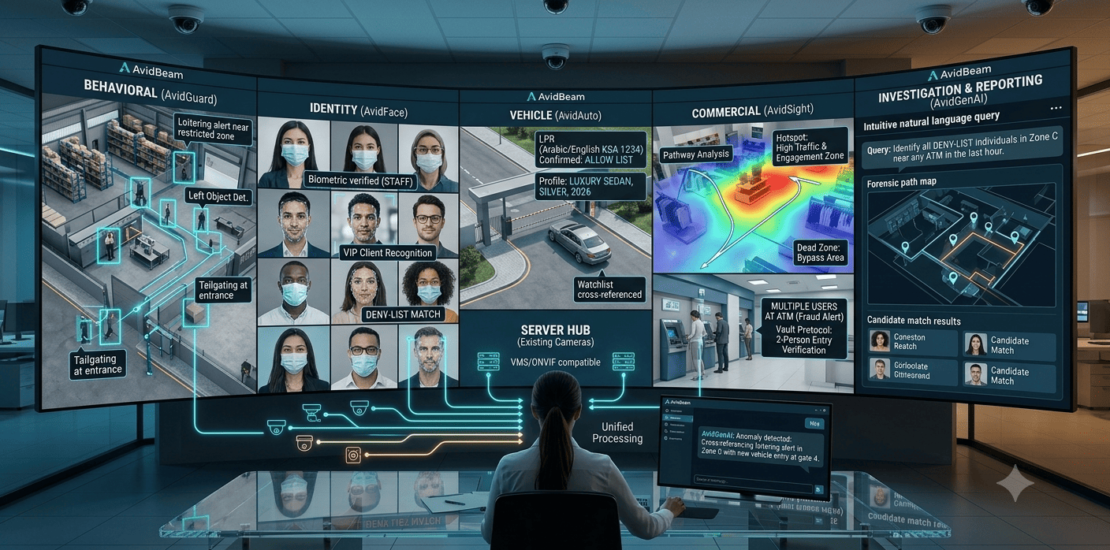
The phrase AI-powered appears on almost every video analytics product page today. However, what it means in practice varies significantly. Some platforms use the label to describe basic motion filtering with a machine learning classifier attached. Others apply it to deep learning models that learn behavioral baselines, recognize individual faces, read license plates at speed, and investigate incidents through natural language queries.
The difference is not cosmetic. It determines whether a platform catches a threat before it escalates or records it for retrospective review. It determines whether post-incident investigation takes minutes or hours. Furthermore, it determines whether the system improves over time or stays fixed at the accuracy level it had on the day it was installed.
AvidBeam’s platform applies Artificial Intelligence (AI) across five integrated suites. Each one uses a different combination of AI technologies to address a distinct operational layer. Together, they convert a camera network into a real-time intelligence system that learns, adapts, and responds without requiring an operator to watch each feed.
What the AI in AI-Powered Video Analytics Actually Means
AI-powered video analytics is not a single technology. It is a stack of AI techniques applied to different detection and intelligence problems. Understanding which technique powers which capability is the foundation for evaluating any platform that carries the label. AvidBeam’s platform draws on five distinct AI technologies across its suites.
Deep Learning and Behavioral Baselines
Deep learning neural networks are what enable behavioral baseline modeling. As covered in AvidBeam’s guide on anomaly detection in video surveillance, a rules-based system can only catch what its operators anticipated. Deep learning changes that. The model learns what normal activity looks like in each monitored zone across different times and operational periods. Consequently, deviations from that baseline generate alerts regardless of whether a specific rule was written to catch that behavior.
Self-learning algorithms extend this further. They adapt continuously as the operational environment changes. Additionally, they handle aging, appearance changes, and seasonal operational shifts without requiring manual reconfiguration. As a result, accuracy improves over time rather than degrading.
Computer Vision and Object Recognition
Computer vision models identify specific objects within video frames and classify them by type, behavior, and relationship to other objects. In AvidBeam’s platform, computer vision powers vehicle classification, crowd density measurement, Personal Protective Equipment (PPE) detection, and left object identification.
These models process every frame continuously across all connected cameras simultaneously. Furthermore, they distinguish object types with enough precision to separate a motorcycle from a car, a safety helmet from a hard hat, and a stationary vehicle from a slowly moving one. Consequently, enforcement and compliance decisions are based on verified classification, not rough approximation.
Vision Language Models
Vision Language Models (VLMs) are the most recent AI layer in AvidBeam’s platform. They convert visual input into linguistic output. AvidGenAI uses this technology to translate video footage into natural language text and to answer operator queries in plain language across the full camera network.
The operational consequence is direct: investigation that previously required manually reviewing footage across dozens of feeds becomes a conversational query. Moreover, structured insight reports generate automatically from video observations without requiring dedicated analytics staff.
To find out how AvidBeam’s AI-powered video analytics applies to your existing camera infrastructure, send an email to [email protected] and the technical team will follow up. |
How AI Powers Each AvidBeam Suite
Each AvidBeam product suite applies AI to a distinct operational domain. The AI technologies involved differ by suite. However, all five share the same server-based processing architecture, which ensures that model complexity and accuracy are not constrained by individual camera hardware capacity.
AvidGuard — AI-Powered Behavioral Detection
AvidGuard applies deep learning behavioral models to perimeter zones, access corridors, and restricted areas. The platform establishes a per-zone baseline and flags deviations from it. Detection events include loitering, intrusion, tailgating, crowd density anomalies, left object detection, fire and smoke, and PPE compliance violations. N+1 redundancy maintains continuous coverage despite hardware failures. Consequently, security teams receive targeted alerts rather than a stream of motion-triggered noise.
AvidFace — AI-Powered Identity Verification
AvidFace applies deep learning facial recognition to every face that enters a monitored frame. The recognition pipeline maps facial geometry into a unique faceprint, matches it against stored databases in fractions of a millisecond, and returns an automated access decision without operator input. Accuracy stays above 90% under masks, glasses, non-frontal angles, and variable lighting. Self-learning algorithms adapt to appearance changes over time without re-enrollment cycles.
AvidAuto — AI-Powered Vehicle Intelligence
AvidAuto applies computer vision and Optical Character Recognition (OCR) models to vehicle detection and License Plate Recognition (LPR). Plate recognition reaches 98%+ accuracy for Arabic plates and 92%+ for English. Alongside every plate read, computer vision identifies vehicle type, make, model, and color. AB – ITS (Intelligent Traffic Systems) applies AI violation detection models to road enforcement. AB – Smart Parking applies occupancy detection models to parking structures.
AvidSight and AvidGenAI — AI-Powered Analytics and Investigation
AvidSight applies AI video analysis to commercial environments. Heatmap generation, pathway analysis, dwell time measurement, demographic distribution, and queue performance monitoring all derive from deep learning models processing existing camera feeds. No specialized sensors required.
AvidGenAI applies Vision Language Model technology to the full platform. It converts detections and video footage into natural language. Operators ask questions and receive contextual answers with timestamps, camera sources, and detection context. Furthermore, automated Key Performance Indicator (KPI) reports generate from video observations across all connected suites without manual data aggregation.
AI Technology Breakdown by Application
The table below maps each AI technology in AvidBeam’s platform to its specific application and operational output. For a framework on evaluating AI-powered video analytics vendors, see AvidBeam’s guide on what to ask AI video analytics companies before signing a contract.
| AI Technology | Where It Applies in AvidBeam | What It Powers Operationally |
|---|---|---|
| Deep learning and neural networks | Behavioral baseline modeling, facial recognition, License Plate Recognition (LPR) | Learns what normal looks like per zone; recognizes faces and plates with high accuracy |
| Computer vision | Object detection, vehicle classification, crowd density measurement | Identifies specific objects, vehicle types, and spatial patterns within video frames |
| Machine learning | Anomaly detection, self-learning adaptation, false positive reduction | Improves accuracy over time; adapts to appearance changes and operational shifts |
| Vision Language Model (VLM) | AvidGenAI natural language queries and video-to-text conversion | Converts surveillance footage into text; enables conversational investigation |
| Optical Character Recognition (OCR) | License plate text extraction across Arabic and English character sets | Reads plate text accurately across mixed-language environments |
Rules-Based vs. AI-Powered Video Analytics — Comparison
The table below sets out where AI-powered video analytics diverges from rules-based platforms at the detection quality, adaptability, and operational capability level.
| Capability | Rules-Based Video Analytics | AI-Powered Video Analytics |
|---|---|---|
| Detection basis | Pre-written rules; fires only on anticipated conditions | Learned baselines; catches unanticipated threats through deviation detection |
| Accuracy over time | Static; degrades without manual reconfiguration | Self-learning; improves with each interaction without re-enrollment |
| Unknown threat types | Not detected; rules cannot catch what was not anticipated | Detected through behavioral deviation from the zone baseline |
| Identity layer | Not available without separate hardware | Facial recognition at 90%+ powered by deep learning neural networks |
| Vehicle intelligence | Count only; no classification or watchlist matching | Full profile with LPR, classification, and real-time watchlist matching |
| Investigation speed | Manual footage review; hours per incident | VLM-powered natural language query; results in minutes |
| Scalability | New hardware or rule sets required per new zone | Software update across all connected cameras simultaneously |
In short, rules-based platforms catch what was anticipated. AI-powered video analytics catches what actually happens, learns from it, and gets better over time without requiring the platform to be manually reconfigured after every new threat type emerges.
Infrastructure and Deployment
AvidBeam’s AI-powered video analytics platform runs all processing on centralized server infrastructure. Therefore, the AI models operate independently of individual camera hardware capacity. Any Open Network Video Interface Forum (ONVIF) compliant camera already on the network connects without hardware replacement.
The infrastructure baseline per camera processed:
- 2GB RAM minimum; one virtual core at 2.4 GHz minimum
- Multiple Graphics Processing Unit (GPU) configurations supported for higher density AI model processing
- Camera resolution: 2MP up to 4K; lens focal length 3mm to 25mm
Video Management System (VMS) integration covers Milestone, NetworkOptix, and Genetec platforms. Deployment options include on-premise, private cloud, public cloud, and hybrid. Notably, on-premise processing keeps all AI analysis and camera data local, the recommended configuration for government and regulated environments.