
15 FAQs on Car Detection Systems for Smarter Infrastructure Decisions
- March 12, 2025
- Posted by:
- Categories: Articles, Articles & Blogs
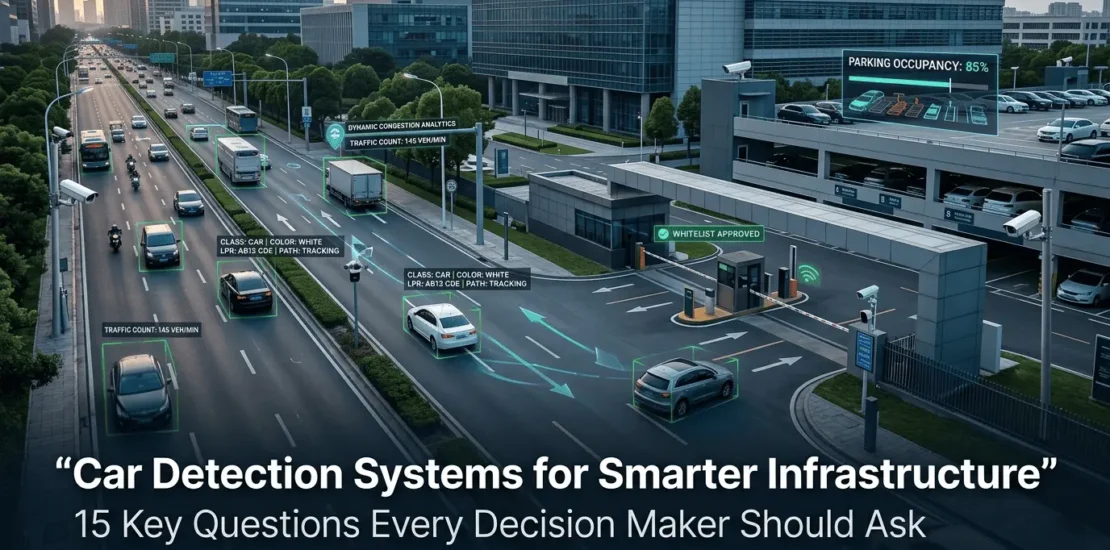
A car detection system is one of those infrastructure investments that looks straightforward on paper and turns complicated the moment procurement, IT, and security operations get in the same room. COOs want to know what the ROI looks like. CTOs want to know what breaks during integration. Security leads want to know whether the accuracy figures vendors quote hold up in production environments.
The FAQs below are drawn from real deployment data and field evidence from AvidBeam‘s Saudi Arabia projects. They are organized to move from foundational concepts through to deployment decisions, so the answers build on each other rather than standing alone.
FAQs About Car Detection Systems
AvidBeam Technologies was founded by former Intel engineers with deep experience in video processing. Its vehicle intelligence platform, AvidAuto, covers license plate recognition, vehicle classification, access control, traffic analysis, and parking management through a server-based architecture that layers onto existing camera hardware. The FAQs below draw on AvidAuto‘s technical profile and AvidBeam‘s regional deployment record.
FAQ 1: What Does a Car Detection System Do?
Beyond reading license plates, a car detection system turns passive surveillance cameras into a live vehicle intelligence layer. The core functions include:
- Vehicle classification by type – cars, trucks, buses, motorcycles
- License plate recognition (LPR) across multiple languages and character sets
- Access control automation for authorized and unauthorized vehicles
- Traffic density analysis and flow monitoring
- Forensic vehicle search by make, model, color, and plate
Organizations apply car detection system data to security investigations, access authorization, safety compliance, and infrastructure planning, often through the same platform from AvidBeam.
FAQ 2: What Is the Difference Between Hardware-Embedded and Server-Based Car Detection Systems?
Hardware-embedded systems pack the processing unit, optical sensors, and recognition algorithms into each individual camera. Every device runs independently, which works at a small scale and becomes a management problem as deployments grow.
Server-based car detection systems move the intelligence to dedicated infrastructure, processing feeds from multiple cameras through unified algorithms. The operational difference shows up across several dimensions:
- Hardware systems require individual configuration and maintenance per unit; server-based platforms manage all connected cameras centrally.
- Scaling hardware means purchasing and installing additional units; scaling server-based means extending software coverage to cameras already on the network.
- Hardware systems lock organizations into fixed technical specifications at the time of manufacture.
- Server-based architectures push capability updates through software without touching the camera hardware.
| To start a technical review of your car detection system requirements, fill out the form, and our team will follow up |
FAQ 3: What Accuracy Levels Should Organizations Expect from a Car Detection System?
The honest answer is that it depends heavily on architecture. Server-based car detection system from AvidBeam delivers 92-98% accuracy across varied conditions. AvidAuto‘s figures specifically are 98% accuracy for Arabic character recognition and 92% for English text, with that performance sustained across:
- Low-light and nighttime conditions
- Partial plate obstruction
- Weathered or damaged plates
- High-speed vehicle movement
FAQ 4: How Large Is the Car Detection System Market?
According to The Business Research Company (2026), the global Automated License Plate Recognition (ALPR) market is projected to reach USD 15.22 billion by 2030.
FAQ 5: How Does a Car Detection System Integrate With Existing Infrastructure?
Integration is where car detection system projects most often stall, usually because the platform being evaluated was not built with open standards in mind. AvidAuto maintains compatibility with:
- Milestone and Genetec video management systems
- ONVIF-compliant cameras from 2MP to 4K resolution
- Access control systems for automated entry and exit authorization
- Centralized command dashboards for unified monitoring across sites
Hardware requirements stay lean: 2GB RAM per camera and 2.4GHz CPU processing capacity, which means extending the car detection system coverage to existing camera networks does not require a parallel infrastructure investment.
Learn more about: Camera with Face Recognition
FAQ 6: How Accurate Can a Car Detection System Handle Arabic and English License Plates?
Server-based platforms add language support through software updates. AvidAuto processes both Arabic and English plates within the same deployment, with 98% accuracy for Arabic characters and 92% for English text running.
FAQ 7: What Access Control Functions Does a Car Detection System Support?
A car detection system with access control capability moves vehicle authorization from a manual checkpoint process to an automated one. AvidAuto manages:
- Whitelist vehicles – residents, staff, and approved contractors clear automatically
- Blacklist vehicles – flagged plates trigger alerts and access refusal
- VIP lists – priority vehicles receive designated routing or reserved lane access
- Unknown vehicles – unregistered plates generate alerts for manual review
Learn more about: Automatic License Plate Scanners
FAQ 8: How Does a Car Detection System Contribute to Traffic Management?
Traffic intelligence is a practical extension of car detection system infrastructure that operations teams frequently underutilize. AvidAuto‘s Intelligent Traffic Systems (ITS) module covers:
- Real-time vehicle counting and flow monitoring across access roads and internal routes
- Traffic violation detection, including illegal parking, wrong-way driving, and lane-switching
- Mobile phone use and seatbelt detection for safety compliance
- Peak period analysis to support staffing and infrastructure planning
At the STC Sawaher Project in Saudi Arabia, AvidAuto was deployed to handle license plate detection, vehicle tracking, watchlist management, and traffic flow monitoring.
FAQ 9: What Does a Car Detection System Deployment Look Like at Scale?
Riyadh’s parking management initiative is a useful reference point. Remat, in collaboration with Giza Solutions, deployed AvidBeam‘s smart parking solution to manage a network of 18,000 cameras across Riyadh, KSA. A hardware-embedded car detection system approach at that scale would have required managing 18,000 individual units, each needing separate configuration, maintenance, and updates.
AvidBeam platform handled the full camera network from a centralized interface. That is the practical scalability argument for server-based car detection system architecture, made concrete.
FAQ 10: How Does a Car Detection System Support Forensic Investigation?
Post-incident investigation is a use case that tends to get overlooked during procurement conversations focused on real-time alerting. AvidAuto supports forensic vehicle search through:
- Make and model detection across historical footage
- Color-based vehicle search within specified time windows
- Movement tracking of specific vehicles across time and location
- Cross-referencing detected plates against watchlists with timestamped logs
When Temple University’s car detection system helped identify a serial burglar by tracking his vehicle across Philadelphia, the forensic search capability was the operationally decisive feature, not real-time alerts. That use case applies directly to corporate campuses, gated communities, and large event venues.
FAQ 11: What Validation Standards Should Organizations Apply When Evaluating Car Detection System Vendors?
As a top video analytics company, AvidBeam publishes detailed technical specifications covering system requirements, camera mounting heights, angle tolerances, and lighting recommendations. When evaluating any car detection system vendor, it is worth requesting:
- Accuracy data across weather conditions, lighting variations, and seasonal changes, not just controlled test results.
- Temporal consistency evidence showing performance across 24/7 operation over extended periods.
- Edge case documentation for obscured plates, non-standard vehicles, and unusual mounting configurations.
- Named production deployments at a comparable scale to your facility.
Learn more about: Video analytics solutions
FAQ 12: What Deployment Architecture Options Are Available from AvidBeam?
Data governance requirements vary significantly across industries and geographies. AvidBeam supports four deployment models for its car detection system platform:
- On-premise – full local data control, suited for regulated or government facilities
- Private cloud – scalable across multiple sites without adding on-site server capacity
- Public cloud – faster deployment for organizations without dedicated IT infrastructure
- Hybrid – splits local and cloud-based processing based on data classification requirements
FAQ 13: How Has AvidBeam’s Car Detection System Performed in Saudi Arabia?
Several of AvidBeam‘s most operationally demanding deployments have run in Saudi Arabia, with AvidAuto serving as the car detection system layer across different facility types and use cases.
- Qiddiya: vehicle count monitoring, license plate recognition (LPR), and whitelist/blacklist access control across the entertainment destination’s entrances
- STC Sawaher Project: license plate recognition (LPR), vehicle tracking, watchlist management, and traffic flow monitoring for full operational visibility
- Riyadh Parking: smart parking management and monitoring across a network of 18,000 cameras through a single platform
- KAPSARC: traffic monitoring and vehicle tracking at Saudi Arabia’s leading petroleum research center
Each project applied a different configuration of AvidAuto‘s capabilities, from standalone license plate recognition (LPR) through to coordinated access control and forensic search.
Learn more about: License plate reader
FAQ 14: How Does a Car Detection System Fit Into a Broader Video Analytics Platform?
A car detection system that operates in isolation captures vehicle data without connecting it to the wider security picture. AvidBeam, as a top video analytics company, integrates AvidAuto with its full product suite so that vehicle intelligence feeds into broader operational awareness:
- AvidFace handles facial recognition and identity verification at the same access points where AvidAuto manages vehicle authorization
- AvidGuard covers perimeter intrusion detection and behavioral analytics across facility zones
- AvidSight handles occupancy and people flow analytics inside the facility
- AvidGenAI lets operators query all systems through natural language rather than separate interfaces
FAQ 15: Where Should Organizations Start When Planning a Car Detection System Deployment?
A phased rollout tends to deliver faster operational returns than a full-facility launch from day one. Starting with the main entrance and exit points, primary parking structures, and key access roads gives teams the chance to validate accuracy, calibrate alert thresholds, and build platform familiarity before extending coverage.
Practical factors to work through before deployment kicks off:
- Current camera hardware compatibility with ONVIF standards and resolution range
- VMS platform in use and the integration pathway with AvidAuto
- Data governance requirements and preferred deployment model
- Existing watchlist data, blacklists, VIP rosters, and approved contractor vehicle databases
- Reporting and forensic search requirements across security and operations teams
As a top video analytics company with a verified track record across the region, AvidBeam‘s team can provide the evidence to support your evaluation needs. Reach out via AvidBeam‘s form.
Also you can learn more about: Video monitoring system