
6 Reasons Your Network Needs AvidBeam’s Intelligent Traffic Violation Detection System
- March 31, 2026
- Posted by:
- Categories: Articles & Blogs, Blogs
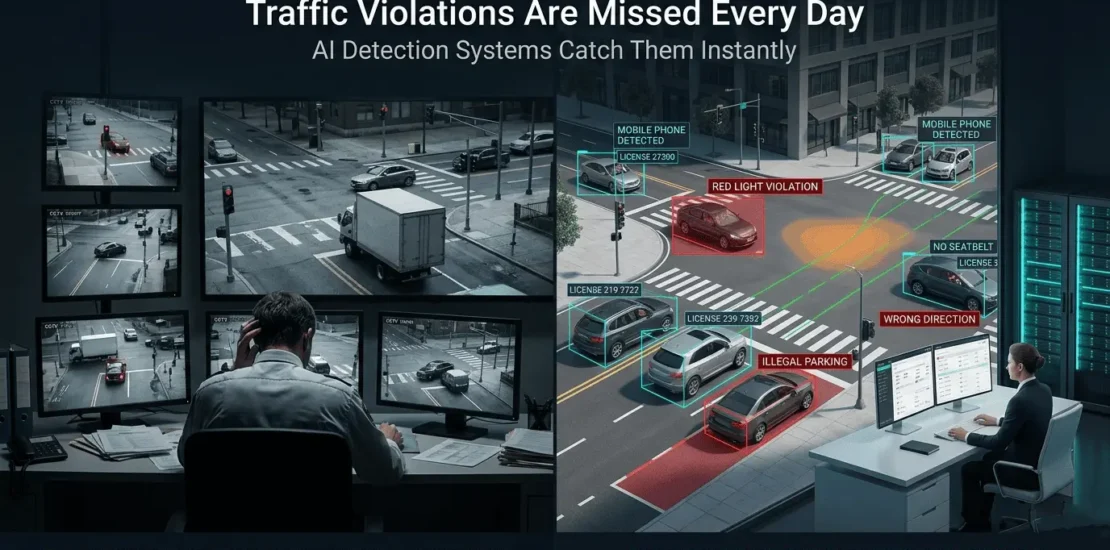
Traffic operations teams face a version of the same problem every day: the footage exists, the violations happened, and nobody caught them in time. A traffic violation detection system built on server-based AI analytics changes that equation by processing every camera feed continuously, flagging violations the moment they occur, and feeding structured data into enforcement and planning workflows.
AvidBeam‘s AvidAuto suite delivers this through two tightly integrated products:
- AB-Vehicle Analytics handles automatic license plate recognition, vehicle classification, count analytics, watchlist management, and forensic search.
- AB-ITS (Intelligent Traffic Systems) covers the enforcement layer: red-light violations, wrong-way driving, lane switching, illegal parking, mobile phone and seatbelt detection, slow or stopped Vehicle Recognition Technology, and traffic density analytics.
Both products run on a server-based architecture that operators can deploy on existing camera infrastructure without new investments. VMS integration covers Milestone, NetworkOptix, and Genetec platforms across on-premise, private cloud, public cloud, and hybrid deployments.
6 Operational Problems Vs. Smart Traffic Violation Detection System
The foundational question is: how does AvidBeam‘s traffic violation detection system bridge the gap between traditional and intelligent through server-based AI video analytics?
The following are six specific operational problems that traffic managers, enforcement coordinators, and infrastructure directors face, and what AvidBeam‘s traffic violation detection system does about each one.
1. Operators Cannot Watch Every Feed at Once
A control room operator or surveillance operations manager cannot maintain consistent attention across a large number of cameras simultaneously. Human focus is not built for this level of multitasking. A red-light violator may appear on camera 23 at the same moment a wrong-way driver appears on camera 51, and neither gets flagged in time.
What AvidBeam offers:
AB-Vehicle Analytics and AB-ITS (Intelligent Traffic Systems) run detection continuously across every connected camera feed without attention constraints. The traffic violation detection system applies deep learning models to each video stream in real time, identifying specific violation events and generating alerts the moment they occur:
- Traffic light violation detection fires the instant a vehicle crosses an intersection against a red signal
- Wrong direction detection alerts operators immediately when a vehicle moves against the configured permitted direction for that road segment
- Slow and stopped vehicle detection surfaces hazards in live lanes, tunnel approaches, and merge zones before field response is needed
2. Enforcement Documentation Breaks Down Before Cases Are Filed
Field enforcement teams frequently receive reports that suffer from one of the following:
- They arrive too late
- They lack precise location data
- They are missing footage timestamps and vehicle details needed to issue citations
A traditional system records the detected violation but documents it poorly. With these basic gaps, cases get dropped because the evidentiary chain broke somewhere between the camera and the report.
What AvidBeam offers:
Every event flagged by the traffic violation detection system is logged automatically with:
- Timestamp of the violation
- Camera source and location identifier
- Vehicle plate number and plate type (private, commercial, tourist)
- Vehicle color and model via AB-Vehicle Analytics
- Clip of the event with metadata overlay
AB-Vehicle Analytics also supports forensic search by date, time, location, plate number, and plate type, so enforcement coordinators can pull the specific footage they need without manually scrubbing through hours of raw video.
3. Watchlists Are Not Connected to Real-Time Detection
Most traffic management setups maintain vehicle watchlists, reported plates, unauthorized vehicles, VIP lists, but these lists exist in separate systems that are not connected to live camera feeds. A reported vehicle can pass through a monitored intersection and nothing happens because the plate recognition layer is not cross-referencing in real time.
What AvidBeam offers:
AB-Vehicle Analytics integrates watchlist management directly into the traffic violation detection system pipeline:
- Deny lists trigger immediate alerts for reported or unauthorized vehicles when detected at any monitored point
- Allow lists let authorized vehicles clear automated checkpoints without manual verification
- VIP lists give designated vehicles priority routing or access permissions based on operator configuration
When a vehicle on any of these lists passes through a monitored zone, the intelligent traffic violation detection system fires an alert with the plate read, vehicle data, and location, in real time, not in the next day’s review report.
4. Detection Performance Drops at Night and in Adverse Conditions
Traffic violations do not stop when lighting conditions deteriorate. Wrong-way driving, red-light running, and illegal parking in emergency lanes happen across all hours, all weather conditions, and all lighting conditions. Camera-embedded or edge-based detection systems are constrained by each unit’s local processing capacity, which degrades under low-light, fog, rain, and high-speed vehicle conditions.
What AvidBeam offers:
AvidBeam‘s server-based traffic violation detection system processes all video feeds through a centralized infrastructure with computational resources that individual camera hardware cannot match. Detection models run consistently across:
- Low-light and nighttime conditions
- Variable weather including fog and rain
- High-speed vehicle movement across multiple lanes
- Mixed traffic environments with pedestrians, motorcycles, and heavy vehicles in the same frame
5. Lane-Specific and Zone-Specific Violations Go Unenforced
Bus lanes, emergency vehicle lanes, high-occupancy vehicle lanes, and no-stopping zones require enforcement that is consistent and location-specific. In all of these cases, manual patrol teams cannot maintain continuous presence at all designated zones simultaneously.
What AvidBeam offers:
AB-Vehicle Analytics and AB-ITS (Intelligent Traffic Systems) handle lane-specific and zone-specific enforcement through two targeted detection capabilities:
1. Lane Switching Violation Detection
- Identifies vehicles that improperly change lanes or enter restricted lanes
- Flags the violation with plate data, timestamp, and camera source
- Covers bus lanes, emergency lanes, and HOV lanes with operator-configured lane boundaries
2. Illegal Parking Detection
- Alerts when a vehicle parks in a prohibited zone based on configured area rules
- Covers fire lanes, bus stops, loading zones, emergency access points, and no-stopping areas
- Detects in real time and reduces the window during which the obstruction affects traffic flow and emergency access
Both detection types operate continuously.
6. Safety Compliance Violations Are Invisible Without Direct Observation
Seatbelt non-compliance and mobile phone use while driving are among the most common traffic safety violations and among the hardest to enforce at scale. Both require direct observation, which limits enforcement to intersections where officers are physically stationed. For road safety program managers who need to report on compliance rates across a network, spot-check data is insufficient and self-reported data is unreliable.
What AvidBeam offers:
AB-Vehicle Analytics and AB-ITS (Intelligent Traffic Systems) detect both violation types through video analytics at camera-covered intersections and road segments:
- Mobile phone detection identifies drivers holding a phone to their ear or actively using a device while driving
- Seatbelt detection identifies drivers not wearing seatbelts and supports safety regulation enforcement
Detection data is logged per event with location, time, and vehicle information, giving compliance program managers the dataset they need to report violation rates by location and time period, across the full monitored network, not just at manually checked points.
Frequently Asked Questions
What is a traffic violation detection system?
An AI-powered traffic violation detection system analyzes camera feeds in real time to automatically detect and record traffic violations.
What types of violations can traffic detection systems detect?
AvidBeam’s system detects multiple traffic violations, like red-light running, wrong-way driving, illegal parking, and seatbelt or phone misuse, while logging each incident with time, camera, and vehicle data for enforcement.
3 Comments
Comments are closed.
[…] Traffic Violation Detection system: AvidAuto is an impressive traffic violation detection system that identifies and flags common violations like red light running, speeding, illegal parking, and even improper lane changes. By instantly notifying the right parties, this feature alone can make a big dent in accident rates. […]
[…] Also you can learn more about: Traffic Violation Detection System […]
[…] (Intelligent Traffic Systems) for violation detection and traffic flow […]