
For Decision-Makers: 8 FAQs on AvidAuto’s Vehicle Recognition Technology
- December 2, 2025
- Posted by:
- Categories: Articles, Articles & Blogs
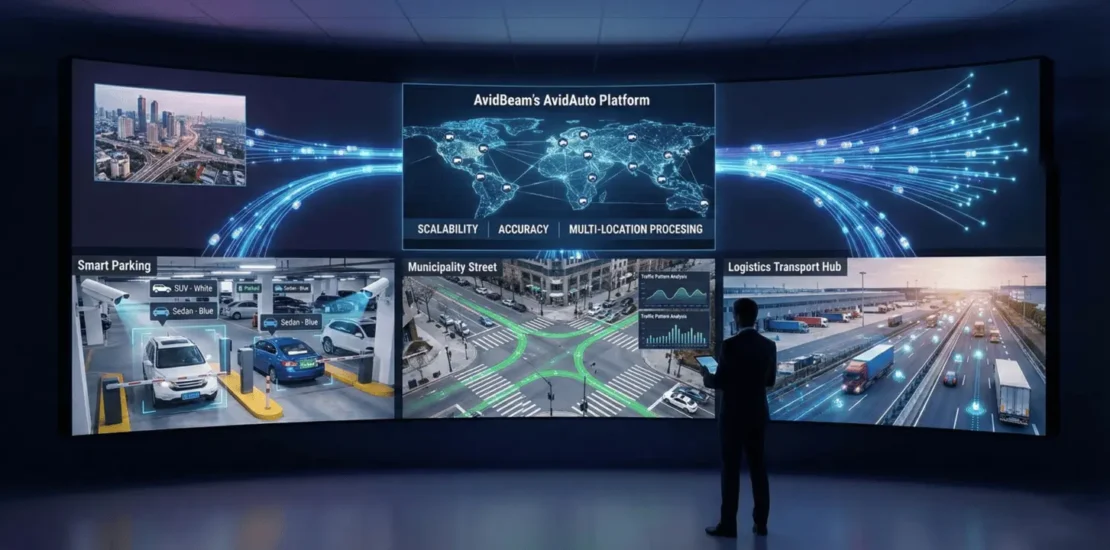
When Riyadh Municipality, Kingdom of Saudi Arabia, needed to deploy smart vehicle recognition technology to manage a parking facility processing 18,000 vehicles daily, they chose AvidBeam‘s AvidAuto platform. AvidAuto was selected for many reasons, including:
- Accuracy
- Flexibility and scalability
- Integration capabilities with existing CCTV infrastructure
- High return on investment
But the question here is: what distinguishes AI-powered vehicle recognition technology? And how does AvidBeam‘s AvidAuto platform work on the ground and in its applications across the Middle East, Gulf region, and North America?
AI-Powered Vehicle Recognition Technology via AvidAuto
First and foremost, the foundation of the technology must be clarified to understand the framework through which it operates. In the case of AI-powered vehicle recognition technology, it transforms visual data from surveillance cameras into a comprehensive understanding of natural events and the ability to detect anomalies and any unusual patterns. Accordingly, this technology converts surveillance operations from devices with limited capabilities into interactive platforms that (understand) contexts, (predict) problems, maintain security, control access, and facilitate operational processes.
AvidAuto represents AvidBeam‘s AI-powered platform built on ATUN, the company’s scalable video analytics solutions framework that processes vehicle license plates, vehicle characteristics, and traffic patterns across facilities.
The following sections address the most common questions that come to mind for organizations (executives specifically) before implementing vehicle recognition technology in their institutions and facilities:
1. What Makes AvidAuto Different from Traditional Surveillance Systems?
AvidAuto transforms existing surveillance cameras into systems that recognize license plates, vehicle characteristics, and behavioral patterns in real-time. AvidAuto can process visual information through computer vision algorithms to achieve detection accuracy exceeding 98% for Arabic plates and 92% accuracy for English character recognition (yes, AvidAuto is bilingual, which is a competitive advantage, especially given the difficulty of the Arabic language and its being unsupported in many other platforms).
Unlike traditional surveillance systems, AvidAuto‘s intelligent vehicle recognition technology extracts operational data through three processing stages:
- Image acquisition from cameras (AvidAuto works efficiently with cameras ranging from 2 megapixels to 4K resolution).
- Character processing via Optical Character Recognition (OCR) technology that handles challenging conditions such as partial obstructions, varying lighting between day and night and fog, or angled shots.
- Data analysis is then used to compare plates and that data against multiple databases simultaneously for comprehensive identity verification.
Note: When adopting the AvidAuto solution, organizations benefit from their existing IP camera investments without needing to replace specialized equipment at every surveillance location, due to the system’s flexibility and ability to analyze multiple camera streams simultaneously via its centralized processing infrastructure.
2. How does multi-language recognition work in AvidAuto?
AvidAuto processes both Arabic and English license plates through specialized OCR (Optical Character Recognition) algorithms trained on character sets from each language. Dual-language capability proves critical in Middle Eastern deployments where vehicles display plates in either Arabic or English, depending on registration jurisdiction.
Recognition algorithms accommodate various plate formats across different countries and regions. Gulf Cooperation Council states use different plate designs, yet AvidAuto identifies characters correctly regardless of format variations through pattern recognition rather than rigid template matching, and the system switches recognition modes automatically without manual configuration when encountering mixed plate types.
Also you can learn more about: License Plate Recognition Camera
3. What vehicle information does AvidAuto identify?
AvidAuto delivers intelligent information extending beyond basic plate recognition:
Primary Identification
- License plate numbers with Arabic and English character support.
- Vehicle plate types (private, bus, police, commercial, diplomatic).
- Registration validation against authorized databases.
Physical Characteristics
- Vehicle color recognition for secondary identification.
- Make and model detection supporting forensic searches.
- Vehicle classification by size category.
Behavioral Analytics
- Movement patterns tracking specific vehicles across locations.
- Access frequency analysis identifying regular versus occasional visitors.
- Time-based access patterns reveal peak usage periods.
4. What hardware does AvidAuto intelligent vehicle recognition technology solution require?
AvidAuto, as an AI-powered vehicle recognition technology solution, operates with modest specifications that most facilities already possess, such as:
- Camera Requirements: 2MP minimum up to 4K support, lens specifications of 3-12mm for parking applications or 24-55mm for traffic monitoring, OnVIF compliance for standardized integration, day/night operation to maintain recognition across lighting conditions.
- Processing Infrastructure: 2GB memory per camera minimum, 2.4GHz CPU processing power, GPU support for various card types.
- Storage Considerations: A single database record requires approximately 150-200KB based on camera resolution and selected region of interest. Minimal requirements compared to typical VMS footage retention enable maintaining extensive historical records for forensic searches. And built-in retention policies allow specifying a duration for database records with automatic archival or deletion based on organizational requirements.
5. How does watchlist functionality work in AvidAuto?
Watchlist capabilities enable proactive security management through automated alerts when specific vehicles enter monitored areas. Allow lists grant authorized vehicles automatic access without manual verification and maintain full access logs. AvidAuto, the intelligent vehicle recognition technology solution, tracks access patterns for allow-listed vehicles, identifying anomalies such as unusual entry times or excessive frequency.
Deny lists trigger immediate rejection at access points with real-time alerts when flagged vehicles approach the facilities. Alert priorities vary based on threat levels, with critical matches generating immediate notifications while lower-priority flags create logged events for review.
Temporary credentials manage time-limited access that automatically expires after specified durations, such as delivery vehicles, contractors, or short-term visitors. They receive authorization that removes itself from allow lists when validity periods end, eliminating manual credential revocation requirements.
Also you can learn more about: LPR
6. What forensic search capabilities exist?
Organizations use forensic searches during incident investigations to identify vehicles present when security breaches occurred, and to track suspect vehicle movements across facility areas. The intelligent vehicle recognition technology solution AvidAuto transforms weeks of investigation work into hours through smart search functions:
Search Options
- Complete or partial plate numbers with wildcard searches.
- Date and time ranges identify all vehicles accessing facilities during specific periods.
- Vehicle color/make/model filters when plate information proves unavailable.
- Movement pattern tracking across multiple entry/exit points.
Analysis Functions
- Access frequency identification reveals vehicles that accessed facilities multiple times within specified periods.
- Compound queries combine multiple search criteria simultaneously.
- Visualization tools reconstruct vehicle movements throughout facilities.
7. What deployment options does AvidAuto support?
AvidAuto accommodates various deployment models based on organizational requirements:
- Private Cloud: Enables centralized processing across distributed locations and maintains organizational control over data storage. Multi-site operations achieve unified management without relying on external service providers.
- Public Cloud: Delivers cost-effective deployment for organizations lacking substantial IT infrastructure. Processing scales automatically based on camera counts and query volumes, eliminating capacity planning challenges.
- Hybrid Architecture: Combines on-premise processing for security-critical applications with cloud-based analytics for less sensitive functions.
Also you can learn more about: automated license plate recognition
8. How accurate is AvidAuto’s vehicle recognition technology in challenging conditions?
AvidAuto maintains performance across diverse operational conditions through specialized processing:
Lighting Variations
- Day/night recognition ensures consistent performance regardless of illumination levels.
- Algorithms compensate for glare from headlights, reflections from wet surfaces, and backlighting scenarios.
- Multi-frame analysis captures plates across multiple images, selecting optimal frames for character recognition.
Weather Challenges
- Rain, snow, fog, and dust affect visual clarity, yet AvidAuto processes degraded images through enhancement algorithms.
- AvidAuto adapts recognition thresholds based on environmental conditions.
Angle Compensation
- AvidAuto handles captures at angles up to 45 degrees from perpendicular through perspective transformation algorithms, normalizing character shapes.
Speed Handling
- Fast-moving vehicles present motion blur challenges, but AvidAuto captures plates at highway speeds through high-speed image acquisition and motion compensation processing.
Also you can learn more about: license plate reader