
PPE Compliance That Depends on Observation Has a Coverage Gap. PPE Detection Closes It.
- July 19, 2026
- Posted by:
- Category: Articles
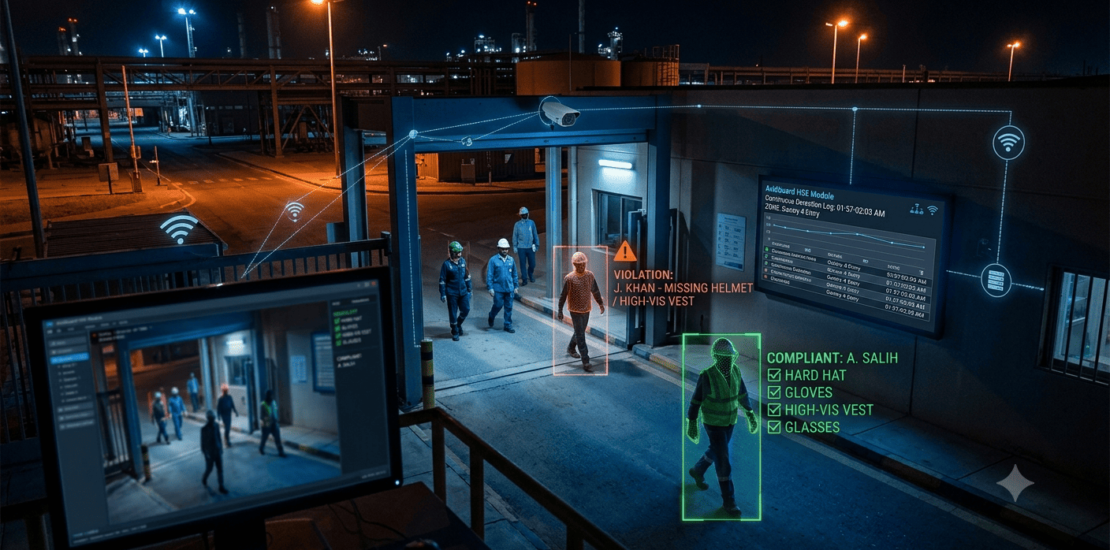
Personal Protective Equipment (PPE) compliance rates in most industrial facilities reflect one thing above all others: who was watching at the time. During a scheduled inspection, compliance is high. At 02:00 on a night shift in a zone without a supervisor present, the picture is different.
That gap is not a workforce problem. It is a structural limitation of observation-dependent compliance. A supervisor cannot physically be at every entry point, in every high-risk zone, across every shift. Consequently, compliance data collected through spot checks and manual inspection logs represents a fraction of actual behavior across the full facility footprint.
AvidBeam’s AvidGuard platform closes this gap through the AB – Health, Safety and Environment (HSE) Compliance module. It runs automated PPE verification through existing Closed-Circuit Television (CCTV) camera networks, checking for required equipment as workers approach designated zones. Detection is continuous. It covers every camera-monitored area simultaneously, across every shift, without requiring a supervisor to be present.
Why Manual PPE Compliance Has a Structural Ceiling
Manual PPE compliance monitoring is not ineffective because supervisors are careless. It is structurally limited because human observation cannot scale to match the coverage that a large industrial facility requires. Two specific limitations define where that ceiling sits.
Observer Dependency
Compliance rates in observer-dependent systems reflect compliance when someone is watching. Workers entering a high-risk zone without a required safety helmet generate a safety exposure regardless of whether a supervisor notices. The incident risk does not change based on observation. However, the detection and response do.
Furthermore, manual observation is inconsistent by nature. Different supervisors apply different levels of scrutiny. Inspection frequency varies by shift and by zone. As a result, compliance data from manual programs describes what was observed, not what actually occurred across the full facility.
Shift Coverage Gaps
Night shifts, shift transitions, and breaks create coverage gaps that manual PPE monitoring cannot address without significantly increasing staffing costs. Additionally, facilities with multiple production zones, access corridors, and entry points cannot maintain supervisor coverage at every point simultaneously.
As covered in AvidBeam’s oil and gas video surveillance analysis, these gaps are most consequential in environments where the consequence of a missed PPE violation extends beyond a compliance penalty into operational safety. A worker entering a high-voltage room without safety gloves, or a contractor approaching a chemical handling area without a face mask, represents a safety exposure that begins the moment the violation occurs, not when someone notices.
| To find out how AvidGuard’s PPE detection applies to your facility’s existing camera infrastructure, send an email to [email protected] and the technical team will follow up. |
How AvidGuard’s PPE Detection Works
AvidGuard’s AB – HSE Compliance module applies Artificial Intelligence (AI) computer vision models to existing camera feeds. It identifies PPE items through shape, color, and texture recognition within each video frame. Detection runs continuously across every connected camera simultaneously, without requiring a dedicated monitoring staff member to watch each feed.
AI Video Analysis on Existing Cameras
The PPE detection layer runs on AvidGuard’s server-based architecture. All analysis happens centrally, not at the camera. Therefore, the detection models are not constrained by individual camera hardware capacity. Any Open Network Video Interface Forum (ONVIF) compliant camera already covering a monitored zone connects to the platform without hardware replacement.
Additionally, detection capabilities update through software across the full network simultaneously. Consequently, new PPE item types or updated detection thresholds apply to every camera at once without per-device configuration.
What AvidGuard Detects
AvidGuard’s PPE detection module identifies required equipment as workers approach or enter designated zones. The detection fires against the zone-specific compliance rules configured by the operator. Consequently, a zone requiring helmets and vests generates a separate alert from a zone requiring full respiratory protection, without applying a single global rule across the entire facility.
When the system detects a non-compliant individual, it generates an immediate alert with the camera source, timestamp, zone identifier, and the specific PPE violation detected. The alert fires before the worker reaches the hazard area, not after. Furthermore, every detection event is logged automatically, producing compliance documentation without manual record-keeping.
PPE Detection Across Environments
AvidGuard’s PPE detection applies across industrial environments where manual compliance monitoring faces the structural limitations described above. The specific PPE items required and the consequences of non-compliance differ by environment. However, the underlying detection approach stays consistent across all of them.
Oil and Gas Facilities
Oil and gas facilities represent the highest-consequence PPE compliance environment. Non-compliance near processing units, tank farms, or chemical handling areas carries direct safety risk to workers and operational risk to the facility. Furthermore, facilities span hundreds of acres, making manual supervisor coverage across all zones physically and economically impractical.
AvidGuard’s AB – HSE Compliance module verifies safety helmets, face masks, safety gloves, safety shoes, safety vests, and safety glasses at zone entry points across the facility. SABIC deployed AvidGuard across petrochemical facilities in Saudi Arabia specifically for this purpose, enforcing PPE regulations through automated video analysis without requiring supervisors at every monitored zone.
Industrial and Manufacturing
Manufacturing environments carry PPE requirements that vary by zone and process. Grinding and cutting areas require safety glasses. Chemical handling zones require gloves and face masks. High-noise machinery areas require ear protection. Manual compliance monitoring across this variety of zone-specific requirements creates inconsistency and documentation gaps.
AvidGuard applies zone-specific compliance rules per camera, so the detection threshold and required PPE items reflect the actual hazard profile of each area. Additionally, the platform generates violation rate data by location, shift, and time period, giving safety managers a factual basis for identifying where compliance programs need reinforcement.
Construction and Infrastructure
Construction sites present a PPE compliance challenge specific to their environment: worker populations change daily, zones evolve as construction progresses, and site access is often controlled at entry points rather than continuously monitored throughout the site.
AvidGuard’s PPE detection at site entry points verifies that workers are equipped with required helmets and high-visibility vests before they access the site. Detection at zone-specific entry points verifies additional equipment requirements as workers move deeper into the site. Consequently, compliance verification happens at the point of entry to each hazard zone rather than relying on workers to self-report or supervisors to patrol.
PPE Item Detection Breakdown
The table below maps every PPE item AvidGuard’s AB – HSE Compliance module detects, how the detection works, and the primary environments where each applies.
| PPE Item | How AvidGuard Detects It | Primary Application Environments |
|---|---|---|
| Safety helmets | Shape, color, and position on head detected per individual | Oil and gas, construction, manufacturing, and mining environments |
| Face masks | Presence and correct coverage verified per detected face | Healthcare, food production, chemical processing, and clean room environments |
| Safety gloves | Glove presence on hands detected per individual in monitored zones | Chemical handling, manufacturing, and high-voltage electrical areas |
| Safety shoes | Footwear type and compliance verified at zone entry points | Industrial floors, loading areas, and construction sites |
| Ear protection | Earmuff or earplug presence detected in high-noise zones | Manufacturing, aviation ground operations, and heavy machinery areas |
| Safety vests | High-visibility vest presence verified per individual in frame | Road work zones, logistics facilities, and outdoor construction sites |
| Safety glasses | Protective eyewear presence detected per individual | Chemical laboratories, grinding and cutting zones, and welding areas |
| Hairnets | Head covering compliance verified at entry to controlled zones | Food processing, pharmaceutical manufacturing, and clean room environments |
Manual Compliance vs. AvidGuard PPE Detection — Comparison
The table below sets out where AvidGuard’s automated PPE detection diverges from manual compliance monitoring at the coverage, consistency, and documentation level. For a broader look at how behavioral AI changes compliance monitoring, see AvidBeam’s analysis of anomaly detection in video surveillance.
| Dimension | Manual PPE Compliance | AvidGuard PPE Detection |
|---|---|---|
| Coverage | Zones where a supervisor happens to be present | Every camera-covered zone simultaneously, across every shift |
| Consistency | Varies by supervisor; higher during inspections | Identical detection standard applied continuously regardless of time or shift |
| Night shift coverage | Reduced; fatigue affects observation quality | Unaffected; AI detection does not fatigue or lose focus |
| Response time | After the supervisor notices and reaches the worker | Alert fires at the moment of detection; before the worker enters the hazard zone |
| Documentation | Manual inspection logs; incomplete without dedicated observer | Automated per-event record with timestamp, camera source, and violation type |
| Scalability | Additional supervisors required per new zone | Software extension to cameras already covering the new zone |
| Compliance reporting | Spot check data; unreliable for network-level rates | Continuous violation rate data by location, shift, and time period |
In short, manual PPE compliance reflects who was watching. AvidGuard’s PPE detection reflects what actually happened, across every monitored zone, on every shift.
Infrastructure and Deployment
AvidGuard’s PPE detection module runs as part of the server-based AvidGuard platform. No dedicated PPE detection hardware is required. The detection layer processes existing camera feeds centrally alongside every other AvidGuard capability.
The infrastructure baseline per camera processed:
- 2GB RAM minimum; one virtual core at 2.4 GHz minimum
- Multiple Graphics Processing Unit (GPU) configurations supported for higher-density deployments
- Camera resolution: 2MP up to 4K; lens focal length 3mm to 25mm
- Pitch -15° to +15°; roll -180° to +180°; yaw -15° to +15°
Video Management System (VMS) integration covers Milestone, NetworkOptix, and Genetec platforms. Deployment options include on-premise, private cloud, public cloud, and hybrid. N+1 redundancy maintains continuous PPE detection coverage despite individual hardware failures.
Verified Deployment
SABIC deployed AvidGuard across petrochemical facilities in Saudi Arabia to enforce PPE safety regulations through automated video analysis. The deployment covered the full range of PPE items required in petrochemical environments: safety helmets, face masks, safety gloves, safety shoes, ear protection, safety vests, safety glasses, and hairnets.
The deployment verified compliance continuously across facility zones without requiring supervisors at every monitored entry point. Consequently, PPE compliance data reflected actual behavior across all shifts rather than behavior during observed inspection periods.