
LPR Analytics: Transforming Vehicle Data into Operational Intelligence
- December 14, 2025
- Posted by:
- Categories: Articles, Articles & Blogs
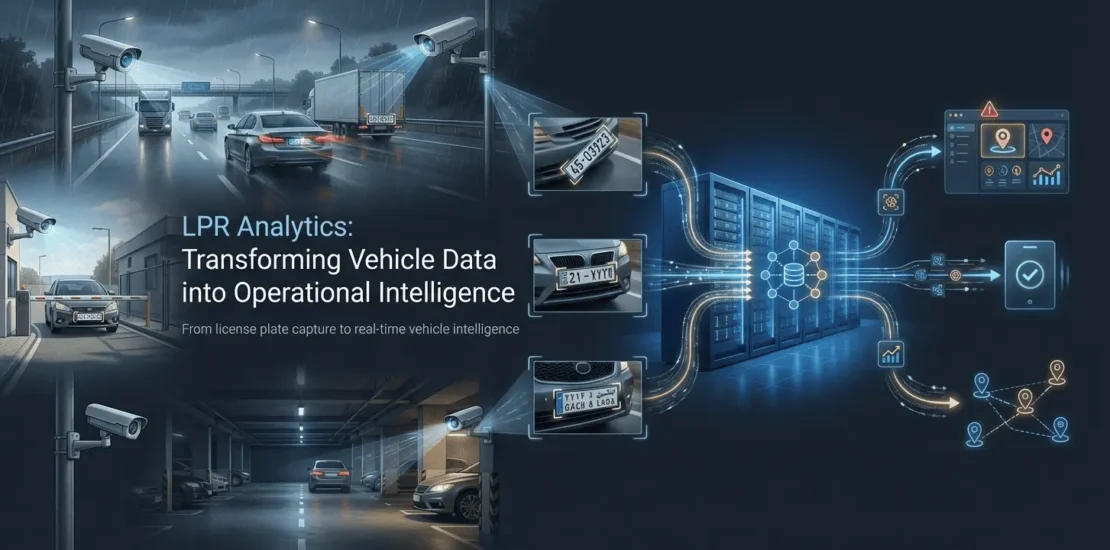
License plate recognition (LPR) analytics now process visual surveillance data into actionable intelligence through computer vision algorithms that identify plates & vehicle characteristics. Movement patterns across distributed locations, smart solutions are particularly advantageous because they leverage existing IP cameras without requiring the replacement of specialized equipment at each surveillance point (enabling organizations to gain analytical capabilities and maintain their current surveillance investments).
How LPR Analytics Processes Vehicle Information
The technology for License plate recognition (LPR) analytics operates through 3 stages:
- Image acquisition captures vehicle information under varying conditions, including day, night, fog, and rain (AvidAuto from AvidBeam works efficiently with cameras ranging from 2 megapixels to 4K resolution).
- Character processing via Optical Character Recognition (OCR) handles challenging scenarios such as partial obstructions, backlighting, angled shots up to 45 degrees from perpendicular, and motion blur from fast-moving vehicles at highway speeds.
- Data analysis then compares plates against multiple databases simultaneously for identity verification. And the system, such as AvidAuto, switches recognition modes automatically when encountering mixed plate types, processing both Arabic and English characters through specialized OCR algorithms trained on character sets from each language without manual configuration.
For more details about LPR Camera
LPR Analytics: Primary Identification and Physical Characteristics Detection
LPR analytics delivers information extending beyond basic plate recognition through integrated detection systems. License plate numbers receive validation against authorized databases while the platform identifies vehicle plate types including private, bus, police, commercial, and diplomatic registrations.
Physical characteristic detection includes:
- Vehicle color recognition for secondary identification when plate information proves unavailable.
- Make and model detection supporting forensic searches during incident investigations.
- Vehicle classification by size category enabling traffic pattern analysis.
Movement pattern tracking follows specific vehicles across locations, revealing access frequency that distinguishes regular visitors from occasional entries, time-based access patterns identify peak usage periods, and compound queries combine multiple search criteria simultaneously to reconstruct vehicle movements throughout facilities.
LPR Analytics and Forensic Search Capabilities for Investigation Support
Organizations benefit from forensic searches in LPR analytics during security breach investigations to identify vehicles present when incidents occurred. Complete or partial plate numbers with wildcard searches enable queries even when full registration information remains unknown, while date and time ranges identify all vehicles accessing facilities during specific periods.
Access frequency identification reveals vehicles that entered facilities multiple times within specified periods, patterns that prove valuable for tracking organized operations across multiple locations.
For example, AvidAuto’s solution can differentiate between vehicle color, make, and model & filters work when plate information proves unavailable, while visualization tools reconstruct movements throughout facilities, transforming weeks of investigation work into hours through its intelligent search functions.
Click here to learn more about Camera with Face Recognition
Watchlist Management and Proactive Security Protocols in LPR Analytics
Watchlist functionality in AvidAuto enables automated alerts when specific vehicles enter monitored areas, supporting proactive security management rather than reactive responses.
Allow lists grant authorized vehicles automatic access without manual verification and maintain complete access logs, tracking patterns for allow-listed vehicles to identify anomalies such as unusual entry times or excessive frequency.
| Watchlist Type | Function | Alert Configuration |
| Allow Lists | Automatic access authorization | Full access logging with anomaly detection |
| Deny Lists | Immediate rejection at access points | Real-time alerts with priority levels based on threat assessment |
| Temporary Credentials | Time-limited access management | Automatic expiration after specified durations |
Deny lists trigger immediate rejection at access points with real-time alerts when flagged vehicles approach facilities, while alert priorities vary based on threat levels. Critical matches generate immediate notifications, and lower-priority flags create logged events for review. Temporary credentials manage delivery vehicles, contractors, and short-term visitors through authorization that removes itself from allow lists when validity periods end, eliminating manual credential revocation requirements.
Click here for more details about License Plate Recognition
Scalability Through License Plate Recognition Server-Based Architecture
Server-based platforms such as AvidBeam’s enable coordination across public and private sectors through shared infrastructure where multiple organizations access centralized processing through secure interfaces, capabilities that hardware-embedded systems cannot deliver. And these smart LPR analytics solutions accommodate various deployment models based on organizational requirements.
- Private cloud deployment enables centralized processing across distributed locations & maintains organizational control over data storage, allowing multi-site operations to achieve unified management without relying on external service providers.
- Public cloud delivery provides cost-effective deployment for organizations lacking substantial IT infrastructure, where processing scales automatically based on camera counts and query volumes, eliminating capacity planning challenges.
- Hybrid architecture combines on-premise processing for security-critical applications with cloud-based analytics for less sensitive functions.
AvidAuto’s Technical Requirements and Storage Considerations
AvidAuto’s processing infrastructure operates with specifications that most facilities already possess:
- 2GB memory per camera minimum
- 2.4GHz CPU processing power
- GPU support for various card types
- Camera requirements include 2MP minimum up to 4K support
- Lens specifications of 3-12mm for parking applications or 24-55mm for traffic monitoring, and OnVIF compliance for standardized integration
Storage demands remain modest compared to traditional video management systems. A single database record requires approximately 150-200KB based on camera resolution and selected region of interest, enabling organizations to maintain extensive historical records for forensic searches. Built-in retention policies specify the duration for database records with automatic archival or deletion based on organizational requirements.
AvidBeam’s Vehicles Management and LPR Analytics Solutions – Real-World Implementation
AvidBeam‘s vehicle analytics platform demonstrates LPR analytics and vehicle monitoring capabilities through deployments spanning entertainment venues, residential communities, hotels, and urban developments across Saudi Arabia and Egypt.
Implementations at locations including Qiddiya, the Sawaher Project, Mostakbal City, New Alamein City Tower 007, Four Seasons Hotel Sharm El Sheikh, and Madinaty’s smart communities showcase the technology’s versatility across parking management, access control, vehicle counting, watchlist management, and traffic efficiency monitoring.
Also you can learn more about: License Plate Recognition Camera
LPR Analytics and Generative AI Integration
Generative AI integration, developed by AvidBeam’s top minds, enables conversational interfaces where users query systems uses natural language rather than structured database searches. Operators could request: “Show vehicles matching the stolen Nissan description entering downtown between 2-4 PM yesterday” rather than constructing complex search parameters, as the system would interpret intent, execute appropriate queries, and present results with contextual explanations.
During investigations, analysts could request: “Track this license plate’s movements over the past week and identify other vehicles frequently appearing at the same locations.” The generative AI would recognize the request, while seeking pattern analysis, execute temporal correlation queries, and generate reports highlighting potentially related vehicles.
All in All
LPR analytics technology is shifting from hardware-embedded systems to server-based platforms. Reflecting organizational recognition that centralized processing delivers superior scalability and coordination capabilities while transforming existing surveillance infrastructure into intelligent recognition networks. AvidBeam Technologies delivers these capabilities through its vehicle management systems, such as AvidAuto, AvidParking and AvidITS. AI video analytics platforms built on ATUN, the company’s scalable analytics framework that translates vehicle data into operational intelligence supporting security. Parking management, and traffic coordination applications across facilities worldwide.
Also you can learn more about: Oil and Gas Surveillance
1 Comment
Comments are closed.
[…] Learn more about: LPR Analytics […]