
Server-Based Analytics and Making Smoke Detectors Smarter Than Ever
- September 21, 2025
- Posted by:
- Categories: Articles, Articles & Blogs
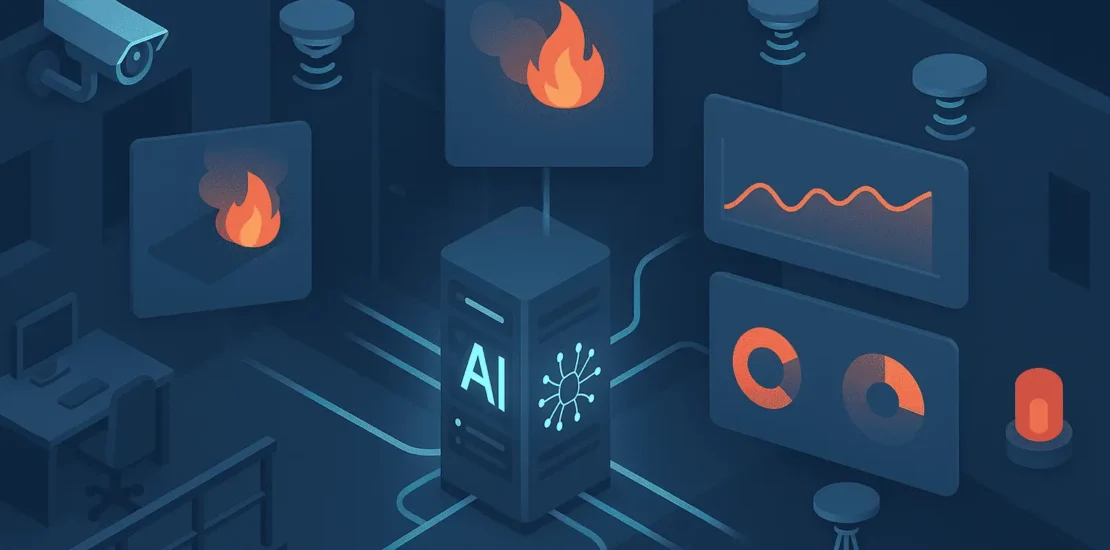
Billions of dollars are lost annually due to fire damage around the world, despite the widespread availability of traditional smoke detectors. As buildings collapse and operations cease, the first moments determine survival rates, yet most facilities still rely on simple alarms that react to the situation rather than predict it. They overlook the transformation taking place in fire safety with smoke detection via server-based video analytics platforms.
The video analytics market is projected to surge from USD 15.11 billion in 2025 to USD 94.56 billion by 2034. That’s a 22.6% annual climb (Precedence Research, 2025). |
What Traditional Smoke Detectors Actually Miss?
Decades of smoke detector installations haven’t solved fundamental detection gaps, here are how:
- Traditional systems catch fast-flaming fires effectively but overlook slow-burning incidents entirely.
- Some systems, like photoelectric versions, trigger smoldering fires, while rapid combustion doesn’t.
- False alarms create another headache, as nuisance alerts occur frequently enough that users disconnect detectors completely, eliminating protection altogether.
- Power failures expose additional vulnerabilities. Battery-dependent systems fail silently, leaving facilities unprotected without warning.
- Closed doors muffle alarm sounds between rooms, and distance reduces audio clarity substantially.
How Server-Based Smoke Detectors Change Detection Fundamentals
Server-based smoke detectors (using video analytics tech) analyze vast incident databases to spot patterns humans ignore. Machine learning algorithms study normal facility operations continuously, then flag deviations indicating potential hazards.
Here’s where server-based video analytics processing transforms everything:
1. Systems aggregate data from multiple detection points simultaneously. Smoke spikes near electrical equipment trigger predictive alerts before traditional smoke detectors activate.
Same happens with:
- Unusual smoke patterns from machinery.
- Air composition shifts prompt notifications.
2. Server-based video analytics with AI differentiates between harmless steam plus dangerous smoke automatically. The platform pinpoints fire locations at the source before smoke disperses widely.
3. Individual smoke detectors operate independently, analyzing only their immediate environment. Server-based platforms process facility-wide data collectively, identifying correlations plus patterns impossible for standalone devices to detect.
Technology Comparison: AI Server-Based Smoke Detector Vs. Traditional Devices
Each facility type and safety priorities determine which smoke detector approach works best.
For AI server-based systems:
- Outdoor spaces plus large areas (warehouses, industrial facilities) benefit most.
- Long-range detection covers extensive zones from centralized monitoring.
- Computer vision and AI video analytics identify threats through visual analysis.
- Easy to implement on existing CCTV Infrastructure.
- Cost-efficient for large-scale, scalable projects.
- Wide, scalable coverage expands easily as facilities grow.
- Low false alarm rates through intelligent analysis.
- Visual alerts with precise location data integrate into management systems.
- Systems learn continuously, improving detection accuracy over time.
For traditional smoke detectors:
- Indoor small areas (offices, stairwells) where localized detection suffices.
- Short-range sensing covers limited spaces.
- Physical smoke sensing mechanisms respond to particle presence.
- Localized coverage requires multiple units for larger spaces.
- Higher false alarm frequency from non-threat triggers (cooking, steam).
- Simple audible alarms without location specificity.
- Static technology unchanged after installation.
Server-based architectures scale efficiently, adding detection points requires minimal infrastructure changes, whereas traditional detectors need individual installation and maintenance at each location.
5 Ways Server-Based Smoke Detectors Outperform Basic Alarms
Smoke detection via server-based video analytics platforms’ advantages extend beyond simple fire identification:
- Early warning windows: Predictive analysis provides evacuation time before fires start, not just after smoke appears.
- False positive reduction: Sophisticated algorithms distinguish actual threats from harmless triggers, maintaining operational efficiency without unnecessary disruptions.
- Predictive maintenance: Systems identify equipment overheating or electrical anomalies before fires ignite, enabling preventive intervention that traditional smoke detectors cannot provide.
- Automated coordination: Intelligent networks communicate with building management, emergency services, and evacuation systems simultaneously.
- Centralized management: Security teams monitor entire facilities from a single interface rather than checking individual detector statuses manually. Server-based video analytics processing makes this facility-wide awareness possible.
Also you can learn more about: AI Smoke Detector
AvidGuard: Complete Server-Based Safety Ecosystem
AvidBeam‘s AvidGuard (The server-based video analytics platform) transcends traditional smoke detector limitations through intelligent video analytics for comprehensive safety detection.
The platform integrates Fire and Smoke Detection with over 20 specialized monitoring features, such as:
- Tracking intrusion attempts
- Monitoring PPE compliance
- Detecting abandoned objects
- Identifying loitering behavior
All from one intelligent system rather than multiple separate installations.
- AvidGuard supports cameras from 2-megapixel devices up to 4K resolution, working with existing infrastructure without complete overhauls. Computer vision algorithms optimized for GPUs plus CPUs ensure reliable performance across different hardware configurations. The system maintains effectiveness in varying lighting conditions.
- Organizations kick off with a few cameras in high-risk zones, then expand to hundreds of monitoring points as needs evolve. Server-based architecture makes expansion easy without replacing existing equipment.
- Connect with major video management systems like Genetec, or run independently. Deploy on-premise, in private clouds, or through public cloud configurations based on organizational requirements.
AvidBeam Solutions and Real-World Implementation
Organizations across the Middle East and North Africa demonstrate server-based video analytics solutions’ effectiveness through measurable results using AvidBeam’s:
- King Abdullah Petroleum Studies and Research Center (Saudi Arabia) integrates AvidBeam‘s multi-technology detection to protect sensitive research operations. AI-driven analytics ensure uninterrupted safety compliance in critical zones where traditional smoke detectors would generate excessive false alarms.
- SABIC (Saudi Arabia), the petrochemical giant, relies on dual-capability systems. AI-powered PPE compliance monitoring runs alongside real-time fire risk detection through thermal analysis. The integrated approach prevents incidents and maintains regulatory standards.
- ADNOC-EFC (Egypt) uses video analytics solutions for proactive PPE detection in hazardous zones and instant alerts for safety violations that could escalate to fires.
- Coca-Cola (Egypt) balances safety and efficiency through intelligent monitoring that protects high-speed production lines without disruptions.
Natural Language Meets Fire Safety: AvidBeam’s Conversational Approach
AvidBeam is currently developing systems that combine artificial intelligence with GenAI (Generative Artificial Intelligence) technology. Using these systems, facility managers will be able to communicate with detection networks using everyday language rather than complex codes. Asking “Current alarm queue” or “Where is the nearest fire extinguisher?” will prompt the system to respond with informed information.
As accuracy is critical in emergency situations, generic “Zone 3 alarm” warnings waste critical seconds. Instead, an AvidBeam analytics report will indicate “A thermal anomaly detected 3 meters northwest of conveyor belt 2.” This accuracy enables faster resource allocation.
GenAI integration will adapt to different industry requirements. While oil facilities need to detect gas leaks alongside fire monitoring, manufacturing environments require tracking PPE compliance with safety checks, and construction sites require implementing hazard zone procedures with worker proximity alerts.
Also you can learn more about: Fire Protection System
All in All
Upgrading from traditional smoke detectors to intelligent server-based systems requires strategic thinking. Remember, server-based systems connect with existing building management systems, emergency notification platforms, plus access control infrastructure. These integrations multiply system value but require planning during deployment.