
Face Recognition Camera Systems in 2026: What AvidBeam’s AvidFace Actually Delivers
- May 19, 2026
- Posted by:
- Categories: Articles, Articles & Blogs
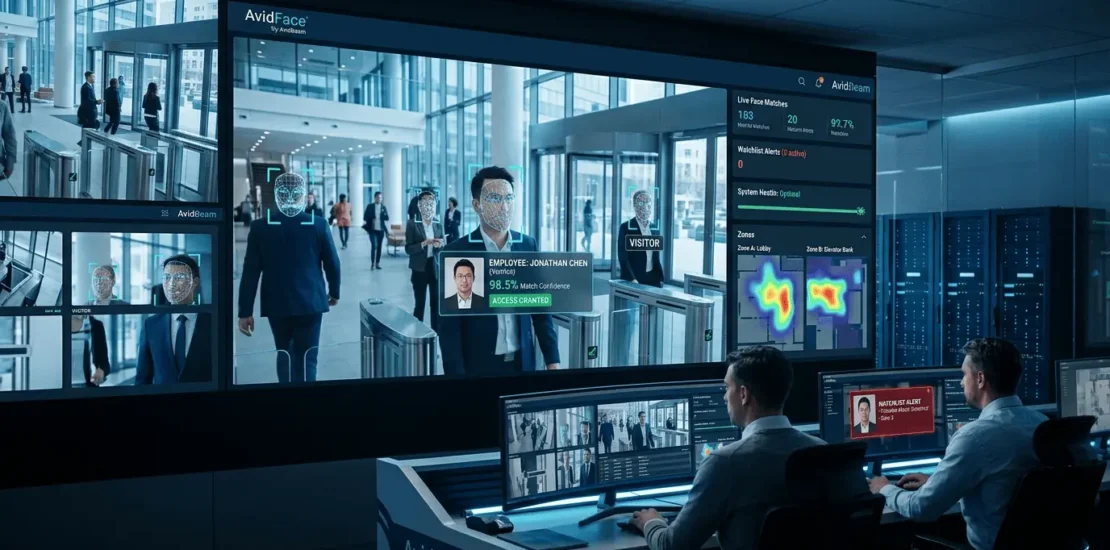
A face recognition camera is not a product. It is a camera connected to a recognition platform, and the camera is the easy part.
Standard IP cameras have always been capable of capturing faces. What they cannot do on their own is identify who those faces belong to, cross-reference them against watchlists in real time, track their movement across facility zones, or generate an alert the moment a flagged individual appears at an access point. That requires an analytics layer running behind the camera, and the architecture of that layer determines everything about how useful the system actually is in practice.
AvidBeam’s AvidFace platform is that analytics layer. It connects to existing camera infrastructure, processes facial data centrally at the server level, and delivers real-time identity verification across personnel categories, staff, contractors, vendors, VIPs, and watch listed individuals, at over 90% accuracy, even with partially covered faces. No dedicated facial recognition hardware required. No camera replacement. The recognition capability layers onto the network already in place.
How a Server-Based Face Recognition Camera Works
The distinction between edge-based and server-based facial recognition is where most platform evaluations are decided, and the difference is not marginal.
Edge-based recognition runs the identification process on the camera itself or on a local device at the point of capture. That architecture constrains processing power, limits model complexity, and produces accuracy that degrades with partial occlusions, non-frontal angles, and changing lighting conditions, because each unit is working with whatever compute the hardware can offer locally.
Server-based recognition processes facial data centrally, which means:
- Complex, regularly updated recognition models run across every connected camera simultaneously, without per-camera hardware limitations
- New recognition capabilities deploy through software across the full network, no hardware replacement at individual camera points
- Multi-site organizations manage all face recognition camera outputs through a single unified interface
- Any ONVIF-compliant camera already on the network becomes a face recognition point without additional investment
AvidFace runs a four-stage process on every face that enters a monitored frame: detection and facial landmark mapping, faceprint generation via mathematical conversion of geometric features, database matching against stored identity records, and automated response, access granted, alert triggered, event logged, in fractions of a millisecond. No operator input required at any stage.
Self-learning algorithms improve with each interaction. They adapt to aging, hairstyle changes, and partial obstructions like masks or glasses, sustaining detection accuracy above 90% across long-term deployments where enrolled faces change over time.
What AvidFace Detects, Full Capability Breakdown
The recognition capability alone is not what makes a face recognition camera deployment operationally useful. What matters is what the system does with each identification, and across how many simultaneous scenarios it can do it reliably.
| Capability | What It Does | Where It Applies |
| Multi-face detection | Processes multiple faces simultaneously within a single video frame | High-traffic lobbies and building entrances |
| Non-frontal angle recognition | Identifies faces without requiring direct camera alignment | Corridors, open floor plans, and vehicle cabin views |
| Partial obstruction handling | Sustained accuracy above 90% with masks, glasses, hats, and scarves | Healthcare, industrial, and event environments |
| Reverse image search | Historical footage query returning top five ranked matches by confidence | Post-incident investigation across distributed camera networks |
| Mask detection | Identifies individuals wearing or not wearing face coverings | Health compliance monitoring alongside access control functions |
| Attribute detection | Age range, gender, eyewear, and headwear profiling per detected face | Restricted zone access profiling and demographic reporting |
| Self-learning adaptation | Algorithms update with each interaction; adapt to aging and appearance changes | Long-term deployments where enrolled faces change over time |
Each detection event is logged automatically with a timestamp, camera source, location identifier, and the recognized individual’s identity data , producing an audit trail that covers every access event across the full facility without any manual logging.
Watchlist Management, The Layer That Makes Recognition Operational
Recognition without watchlist integration produces identifications. Watchlist integration turns those identifications into operational alerts.
AvidFace’s watchlist management supports three list categories that cover the full spectrum of identity-based access scenarios:
- Deny lists: flagged individuals trigger a security alert the moment they appear at any monitored access point across the full network, before they reach interior zones, restricted areas, or sensitive infrastructure
- Allow lists: authorized personnel receive automated entry without manual checkpoint processing, reducing queue formation at high-traffic access points and removing the dependency on credential verification staff
- VIP lists: designated individuals trigger service alerts before they reach the counter or service point, the face recognition camera identifies them at the building entrance and notifies the relevant staff ahead of arrival
When a face on any list is detected, the alert fires with the recognized identity, camera source, timestamp, and location, in real time, not in the next day’s access log review. For security operations that maintain active watchlists as a core operational function, that real-time cross-referencing is what separates a face recognition camera system from a more sophisticated recording infrastructure.
Zone-Level Movement Tracking and Post-Incident Search
Entry point verification is one layer of what a face recognition camera system delivers. What happens after individuals clear the entrance matters as much operationally, particularly in facilities with multiple access tiers, restricted zones, and compliance requirements around who was where at which time.
AvidFace tracks individual movement across facility zones by date, time, and location. When an individual authorized for one zone appears in a restricted area without a corresponding access event, the platform surfaces the anomaly automatically, without requiring anyone to be watching that specific camera feed. The detection fires against the individual’s access profile, not against a generic motion rule.
The image-based historical search capability extends this tracking layer into post-incident investigation. Security teams query the full recorded network by uploaded image and receive the top five matches ranked by confidence level, across every camera that detected that individual, with timestamps and location data attached. What previously required hours of sequential footage review across multiple feeds becomes a minutes-long query.
Use Cases by Environment
The underlying recognition mechanics stay consistent across deployment environments. What changes is which capability layer delivers the most immediate operational return.
Commercial Buildings and Corporate Campuses
Corporate environments handle continuous personnel movement across access tiers with different authorization levels, staff, contractors, maintenance crews, and visitors each carrying different permissions for different zones. Manual badge checks at every transition point are not operationally viable at scale.
AvidFace handles identity verification at building entrances, floor access points, server rooms, and executive areas automatically. Contractors receive access to authorized zones only. Visitors are tracked from entry to escort point. Staff movement across access tiers is logged continuously without manual intervention, and the deny list fires immediately if a flagged individual attempts entry at any monitored point across the full campus.
Government and High-Security Facilities
Government environments carry requirements that badge systems alone cannot meet: visitor tracking within authorized areas, immediate detection of unauthorized zone access, and dynamic watchlist management that updates in real time as threat profiles change.
AvidFace’s zone-level tracking and deny list alerting are directly suited to these requirements. The Ministry of Foreign Affairs deployment in Saudi Arabia, which required visitor tracking, intrusion detection, and VIP watchlist management simultaneously, is the clearest illustration of how the platform performs in a high-security government context.
Hospitality and VIP Environments
Hospitality requires a different application of the same recognition capability. When a recognized guest approaches the building entrance, the face recognition camera identifies them before they reach the front desk, and the system alerts the assigned relationship manager or concierge ahead of arrival. The guest is greeted by name before the interaction begins.
That level of personalization previously required dedicated concierge staff stationed at entry points. AvidFace delivers it automatically, across every monitored entrance, without additional staffing, and logs every VIP arrival event with timestamp and camera source for service quality reporting.
Mass Events and Public Venues
Large-scale events present a face recognition camera challenge that commercial building deployments do not: crowd density, continuous high-volume entry flow, and the need to identify flagged individuals across multiple simultaneous entry points in real time.
AvidBeam has deployed AvidFace across two consecutive seasons of Soundstorm in Riyadh, 450,000+ attendees per edition, alongside BaladBeast in Jeddah’s Al-Balad district. Both deployments ran facial recognition, demographics detection, and people counting simultaneously across multi-stage venues, which means the platform holds its accuracy and alerting capability under exactly the crowd density and entry flow conditions where edge-based systems degrade.
Banking and Financial Institutions
Banks carry a specific set of identity-based vulnerabilities that general surveillance was never built to address: vault access by unauthorized personnel, ATM fraud attempts that bypass PIN authentication, insider access to server rooms, and compliance failures when two-person entry protocols are not followed.
AvidFace addresses each of these through the same recognition layer deployed across the facility’s existing camera network. Vault areas configured for two-person entry protocols generate an immediate alert when a single individual enters. Server rooms log every access event against the individual’s identity rather than their badge. ATM areas flag clusters of individuals around a single machine in real time. And VIP clients are recognized at the branch entrance before they reach the counter, a service capability that previously required dedicated staff.
Standard IP Camera vs. AvidFace, Capability Comparison
The table below sets out where AvidFace diverges from what a standard IP camera setup, even one connected to basic motion detection, delivers at the identity verification and access management level.
| Capability | Standard IP Camera Setup | AvidBeam AvidFace Platform |
| Identity verification | Badge or manual credential check at entry points | Facial recognition at 90%+ accuracy; no credential required; zero manual steps |
| Watchlist alerting | No live cross-referencing; reviewed retrospectively | Real-time alert the moment a listed face appears at any monitored access point |
| Tailgating detection | Invisible to badge systems; requires human observation | AvidFace detects multiple individuals entering on a single authorization event |
| VIP recognition | Requires staff to recognize guests manually | Pre-enrolled faces trigger service alerts before the individual reaches the desk |
| Zone movement tracking | Not available in standard camera setups | Individual location tracked by zone, timestamp, and camera ID across the full facility |
| Partial face obstructions | Masks and glasses defeat most edge-based systems | Detection accuracy sustained above 90% with masks, glasses, hats, and non-frontal angles |
| Post-incident search | Manual footage scrub across multiple feeds; hours per case | Image-based search returns ranked matches across the full recorded network in minutes |
| Hardware requirement | Often requires dedicated facial recognition hardware | Layers onto existing ONVIF-compliant cameras; no camera replacement needed |
The gap is not about camera hardware. Most facilities already have cameras that can capture faces at sufficient resolution. The gap is the analytics layer, and that is what AvidFace adds to the infrastructure already in place.
Infrastructure and Deployment Requirements
AvidFace’s server-based architecture connects to any ONVIF-compliant IP camera via standard network protocols. The recognition processing runs centrally, not at the camera level , which means organizations extend face recognition camera coverage to their existing network without hardware replacement at individual access points.
The infrastructure baseline per camera processed:
- 2GB RAM minimum
- One virtual core at 2.4 GHz minimum; multiple GPU configurations supported for higher-density deployments
- Camera resolution: 2MP up to 4K
- Lens focal length: 3mm to 25mm
- Pitch -15° to +15°; roll -180° to +180°; yaw -15° to +15°
VMS integration covers Milestone, NetworkOptix, and Genetec platforms. Deployment options, on-premise, private cloud, public cloud, or hybrid, are configurable based on data governance requirements. For government facilities and organizations with strict data sovereignty requirements, on-premise processing keeps biometric data local without any external transmission.
For multi-site organizations, the same watchlist infrastructure, deny lists, allow lists, and VIP lists, extends across every new location as it comes online, without per-site configuration. An individual added to a deny list at headquarters is flagged at every monitored access point across all facilities simultaneously.
AvidBeam’s Verified Face Recognition Camera Deployments
Soundstorm 2024 & 2025, Riyadh
AvidBeam deployed facial recognition, demographics detection, crowd management, and people counting across two consecutive Soundstorm editions, 450,000+ attendees per edition across a multi-zone venue. The face recognition camera layer operated continuously across all entry points throughout each three-day event.
BaladBeast, MDLBeast, Jeddah (2025)
Facial recognition, demographics detection, crowd management, and people counting across a two-day festival in Jeddah’s historic Al-Balad district featuring 70+ artists across four stages, a face recognition deployment inside a heritage urban environment with constrained sightlines and continuous crowd flow.
Ministry of Foreign Affairs, Saudi Arabia
AvidFace covered visitor identification and tracking across the facility alongside AvidGuard for zone intrusion detection, a deployment requiring simultaneous management of allow lists, deny lists, and VIP watchlists across a high-security government environment.
Four Seasons Hotel, Madinah
AvidFace and AvidAuto ran in combination across all property access points, blacklist, whitelist, and VIP recognition for guests and vehicles, with identity tracking at every entrance without disrupting guest flow.
Qiddiya, Saudi Arabia (2024)
AvidFace handled blacklist, whitelist, and VIP recognition across the entertainment destination’s facilities, alongside AvidAuto’s vehicle access management layer at site entrances.
KAPSARC, Saudi Arabia (2024)
AvidFace tracked and recognized individuals within specific facility locations at the King Abdullah Petroleum Studies and Research Center, alongside AvidGuard’s early-warning alert layer for anomalies and access violations.