
Data Center Security 2026: 8 Myths That Are Costing Operators Millions
- April 28, 2026
- Posted by:
- Categories: Articles, Articles & Blogs
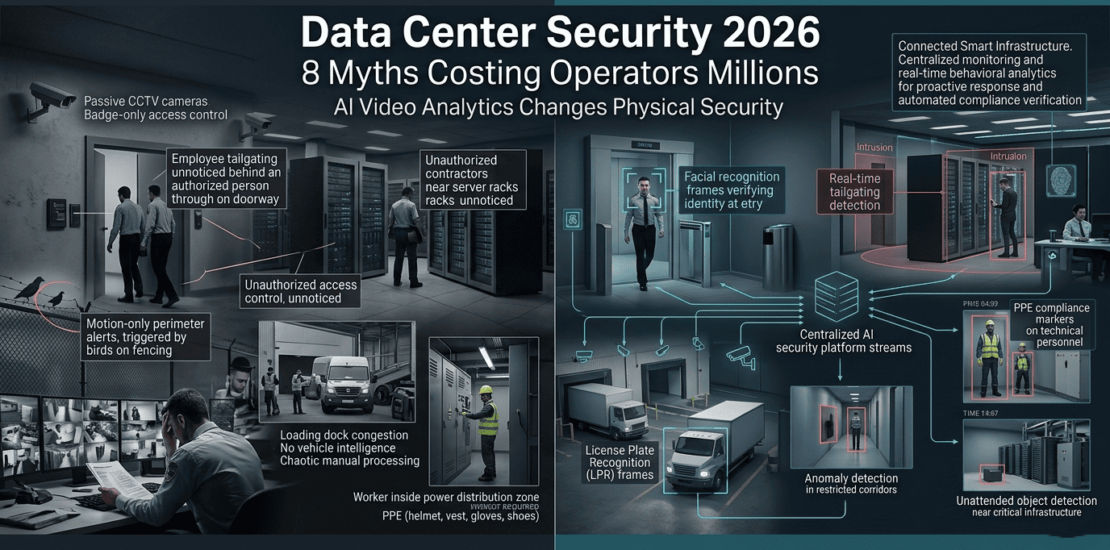
Data center security operators and managers often make safety decisions based on assumptions that haven’t been tested in practice. They treat badge access logs as proof of access control, and camera coverage as effective surveillance. But in reality, none of these assumptions stand up to scrutiny, and the resulting vulnerabilities are often exposed during incidents.
The 8 myths below are drawn from real patterns in how facilities plan and operate their physical security layers. Each one comes with the facts that AI video analytics, specifically AvidBeam‘s platform, brings to the table.
Data Center Security: 8 Myths vs. Facts
The following myths show up in budget decisions, security architecture reviews, and compliance documentation across facilities at every tier level, and what AvidBeam‘s platform does about it.
Myth 1: Badge access control is sufficient to secure all entry points in a data center
Fact: Badge systems log credentials. They do not detect how many people pass through a door on a single swipe.
Tailgating, one individual entering directly behind an authorized person, is among the most common physical security failures in access-controlled data center security environments, and badge readers produce no alert for it. The credential log shows one authorized entry. The physical reality may be two or three people in the corridor.
AvidBeam‘s AvidGuard addresses this directly through behavioral tailgating detection, which identifies individuals entering access points without separate verification, in real time, not after a post-incident footage review.
Myth 2: Having cameras everywhere means the facility is under active surveillance
Fact: Cameras record. Surveillance requires active analysis, which passive CCTV does not provide. A camera without a video analytics layer is an evidence collection device.
In most data center security setups, footage is reviewed only after an incident is already known to have occurred. Threats that do not trigger a separate alert go undetected until manual review, sometimes days later.
AvidBeam‘s platform converts existing camera infrastructure into a real-time detection system. The baseline technical requirement per camera is 2GB RAM and one virtual core at 2.4 GHz minimum.
Myth 3: Motion detection alerts are reliable enough to cover perimeter security
Fact: Motion-only detection generates false-positive rates that erode response discipline over time. Perimeter zones near access roads and loading docks generate constant environmental motion, including vehicles, maintenance equipment, birds, and shifting light.
Motion-based systems trigger on all of it. When security teams receive dozens of false alerts per shift, confirmed threats start getting treated with the same low urgency as everything else.
AvidGuard applies behavioral analysis to perimeter monitoring within data center security environments. The difference is that it interprets what is happening in the frame. The result is a detection signal that security teams can act on without conditioning themselves to ignore it.
Myth 4: PPE compliance in technical areas is not a data center security issue
Fact: Personal Protective Equipment (PPE) non-compliance in high-voltage rooms and mechanical plant areas creates both personnel risk and regulatory exposure, both of which fall within the data center security and compliance brief.
Raised-floor zones and cooling plant corridors carry defined PPE requirements for every person who enters. Enforcement through scheduled inspections leaves unverified windows between visits.
AvidGuard‘s PPE compliance module runs continuously across
designated zones, verifying:
- Helmets, safety vests, gloves, safety goggles, and protective footwear in real time.
- Zone-specific alerts for non-compliant individuals.
- Compliance records per zone and per time window, audit-ready without manual data entry.
Myth 5: Facial recognition requires a full security system overhaul to deploy
Fact: AvidBeam‘s AvidFace runs on existing ONVIF-compliant camera infrastructure with no hardware replacement required in most data center security deployments.
The deployment concern that most often delays facial recognition adoption is the assumption that it requires new cameras, dedicated hardware at every entry point, or a parallel access control system.
In practice, AvidFace layers onto the camera network already present and integrates with Milestone, NetworkOptix, and Genetec VMS platforms through standard protocols.
What it adds to data center security operations:
- Identity verification with over 90% accuracy at entry points, even with partially covered faces.
- Watchlist management across whitelist, blacklist, and event-specific lists with real-time alerts.
- Zone-level movement tracking by date, time, and location for compliance audits.
- Image-based historical search that returns the top five matches ranked by confidence level across recorded footage.
| To find out how AvidBeam solutions map to your facility’s existing cameras, send an email to AvidBeam‘s technical team for a deployment assessment. |
Myth 6: Post-incident investigation is a minor operational task that does not need dedicated tooling
Fact: Manual footage review across large camera networks can take hours, and in regulated data center security environments, that timeline directly affects compliance reporting obligations.
When a physical security incident needs to be investigated:
- The standard process involves identifying the relevant cameras
- Pulling footage for the relevant time window
- Reviewing it sequentially
In a facility with dozens of cameras across multiple zones, that process compounds quickly, especially when the incident location is not immediately known.
AvidBeam‘s AvidGenAI module, a Vision Language Model, converts that process into a natural-language query. The system searches the full network and returns timestamped, contextual results. Investigation timelines compress from hours to minutes, and the output is directly usable for audit and compliance documentation.
Myth 7: Vehicle access at loading docks is low-risk compared to personnel access points
Fact: Delivery bays and access roads are operationally active entry vectors that data center security planning regularly underweights.
Hardware deliveries, generator fuel deliveries, cooling system maintenance vehicles, and contractor access create a continuous inbound vehicle flow. Manual gate checks at this volume produce both throughput delays and verification gaps, particularly for deny-listed vehicles or unscheduled contractor arrivals.
AvidBeam‘s AvidAuto suite covers this layer with:
- License Plate Recognition (LPR) at 98%+ accuracy for Arabic plates and 92%+ for English.
- Vehicle classification by make, model, and type.
- Real-time occupancy across staging areas: double-parking detection/blocking entrance and exit alerts.
Myth 8: AI-based physical security only works for new facilities built with it in mind
Fact: AvidBeam‘s platform has been deployed across operational environments, government facilities, industrial plants, commercial properties, and hospitality venues that were built and running well before AI video analytics was part of the security conversation.
The deployments that support this for data center security evaluations:
- Egyptian Tax Authority: security and compliance monitoring across government facilities.
- SABIC, Saudi Arabia: PPE compliance verification and perimeter monitoring at industrial facilities with active operations.
- ADNOC-EFC Factories, Ain Sokhna, Egypt: safety compliance and perimeter security across multi-zone manufacturing sites.
- Cairo Festival City Mall: occupancy analytics and multi-tier access control across a large commercial property.
- Four Seasons Madinah, Saudi Arabia: VIP recognition and vehicle flow management for a high-value hospitality environment.
To kick off a technical assessment for your facility’s specific camera setup and physical security requirements, reach out to AvidBeam‘s technical team directly via email.