
AI Based Video Analytics in 2026: What It Actually Detects and How AvidBeam Delivers It
- July 12, 2026
- Posted by:
- Category: Articles
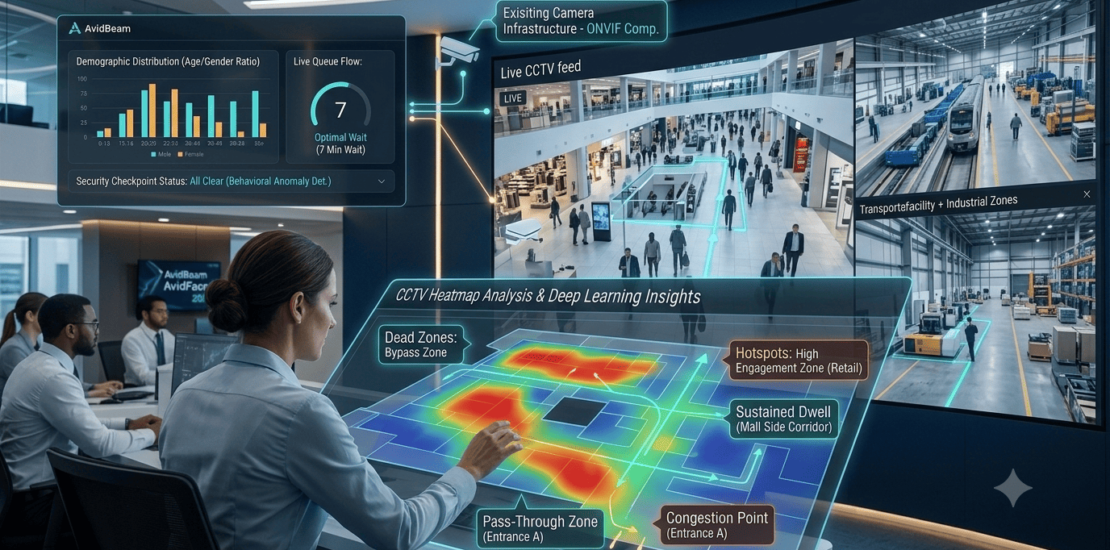
Many surveillance vendors describe their platforms as AI based video analytics. However, the term gets applied loosely. A camera that triggers on motion is not running Artificial Intelligence (AI). It is running a pixel change detector with a marketing label attached.
Advanced AI based video analytics applies deep learning models to camera feeds, extracting structured detections rather than raw footage. The distinction matters because it determines whether a system catches a threat before it escalates, or simply records it for later review.
AvidBeam delivers AI based video analytics across five integrated product suites: AvidGuard for behavioral threat detection, AvidFace for identity verification, AvidAuto for vehicle intelligence, AvidSight for commercial analytics, and AvidGenAI for natural language investigation. All five run on existing camera infrastructure, without requiring hardware replacement.
What Separates AI Based Video Analytics From Motion Detection
The gap between AI based video analytics and basic motion detection is architectural. Understanding it is the foundation for evaluating any platform that claims the AI label.
Learned Baselines vs. Triggered Rules
Motion detection triggers on any pixel change in a monitored zone. As a result, weather, wildlife, and passing shadows generate the same alert as a genuine security event. Security teams quickly learn to treat these alerts as noise.
AI based video analytics works differently. It establishes a behavioral baseline for each monitored zone, learned from observed activity over time. This is one of the core distinctions covered in AvidBeam’s comparison of operational intelligence platforms versus recording infrastructure. Consequently, the system distinguishes between a delivery truck passing through a loading zone at 9 AM, which is normal, and the same truck appearing at 2 AM, which is not. The detection fires on deviation from the baseline, not on movement itself.
Server Based Processing
Where the analysis happens matters as much as what it analyzes. Edge based systems process video locally at each camera, which limits model complexity and accuracy under adverse conditions. AvidBeam’s platform, including AvidGuard, processes all detection centrally on dedicated server infrastructure.
Therefore, accuracy stays consistent across low light, adverse weather, and high traffic density, regardless of individual camera hardware. Furthermore, new detection capabilities deploy through software across every connected camera simultaneously, without per-device updates.
To find out how AvidBeam’s AI based video analytics platform applies to your existing camera infrastructure, send an email to [email protected] and the technical team will follow up. |
AI Based Video Analytics Across AvidBeam’s Suites
AI based video analytics is not a single capability. It spans five distinct layers within AvidBeam’s platform, each applying deep learning to a different operational problem.
Behavioral and Perimeter Detection
AvidGuard applies AI based behavioral analysis to perimeter zones, access corridors, and restricted areas. The approach is covered in more depth in AvidBeam’s anomaly detection in video surveillance solutions article. It generates alerts for loitering, intrusion, tailgating, crowd density deviations, and left object detection, each calibrated to the specific zone and time window rather than applied as a blanket rule.
Identity and Vehicle Intelligence
Identity verification and vehicle recognition both depend on AI based pattern matching at scale. AvidFace delivers facial recognition above 90% accuracy, sustained under masks and non-frontal angles. AvidAuto applies the same AI architecture to license plate recognition, reaching 98%+ accuracy for Arabic plates and 92%+ for English, with real time watchlist cross-referencing at every monitored point.
Commercial Analytics and Natural Language Investigation
AI based video analytics extends beyond security into commercial intelligence. AvidSight applies the same deep learning models to extract heatmaps, dwell time, and demographic data from existing cameras. AvidGenAI adds a Vision Language Model layer that converts video into natural language, letting operators query the full camera network in plain language instead of navigating separate dashboards.
Full Capability Breakdown
The table below maps each AI based detection layer to the AvidBeam suite that delivers it, and what the analysis produces operationally.
| Detection Layer | AvidBeam Suite | What AI Based Analysis Delivers |
|---|---|---|
| Behavioral threat detection | AvidGuard | Learns the normal activity pattern per zone; flags genuine deviations instead of motion |
| Identity verification | AvidFace | 90%+ accuracy at access points, sustained under masks and non-frontal angles |
| Vehicle intelligence | AvidAuto | Plate recognition at 98%+ (Arabic) / 92%+ (English) with live watchlist matching |
| Commercial analytics | AvidSight | Heatmaps, dwell time, and demographic data extracted from existing cameras |
| Natural language investigation | AvidGenAI | Converts video into text; answers operator questions across the full network |
Motion Detection vs. AI Based Analytics – Comparison
The table below sets out where genuine AI based video analytics diverges from basic motion detection at the architecture and operational level.
| Capability | Motion Detection Surveillance | AI Based Video Analytics |
|---|---|---|
| Detection trigger | Motion in frame; fires on anything that moves | Behavioral deviation from a learned zone baseline |
| False positive rate | High; weather and wildlife trigger alerts | Low; baselines filter environmental noise |
| Processing location | At the camera; limited by local hardware | Centralized server; consistent across all cameras |
| Identity layer | Not available | Facial recognition with real time watchlist matching |
| Investigation speed | Manual footage review; hours per case | Natural language query; results in minutes |
| Hardware requirement | Often requires camera replacement | Layers onto existing Open Network Video Interface Forum (ONVIF) compliant cameras |
In short, motion detection reacts to movement. AI based video analytics understands context, distinguishing genuine threats from environmental noise across every connected camera, continuously.
Infrastructure and Deployment
AvidBeam’s AI based video analytics platform connects to any ONVIF compliant camera via standard network protocols. All processing runs centrally, not at the camera. Therefore, no dedicated AI hardware is required at individual coverage points.
The infrastructure baseline per camera processed:
- 2GB RAM minimum; one virtual core at 2.4 GHz minimum
- Multiple Graphics Processing Unit (GPU) configurations supported for higher density deployments
- Camera resolution: 2MP up to 4K; lens focal length 3mm to 25mm
Video Management System (VMS) integration covers Milestone, NetworkOptix, and Genetec platforms. Deployment options include on-premise, private cloud, public cloud, and hybrid, configurable based on data governance requirements.
Frequently Asked Questions
How is AI based video analytics different from motion detection?
Motion detection triggers on any pixel change; AI based analytics learns a behavioral baseline per zone and flags genuine deviations, producing far fewer false positives.
Does AI based video analytics require new cameras?
No. AvidBeam's platform layers onto any existing ONVIF compliant camera; the minimum requirement is 2GB RAM and one virtual core at 2.4 GHz per camera processed.