
AI Analytics and Automated Intervention in Intelligent Transportation Systems
- January 15, 2026
- Posted by:
- Categories: Articles, Articles & Blogs
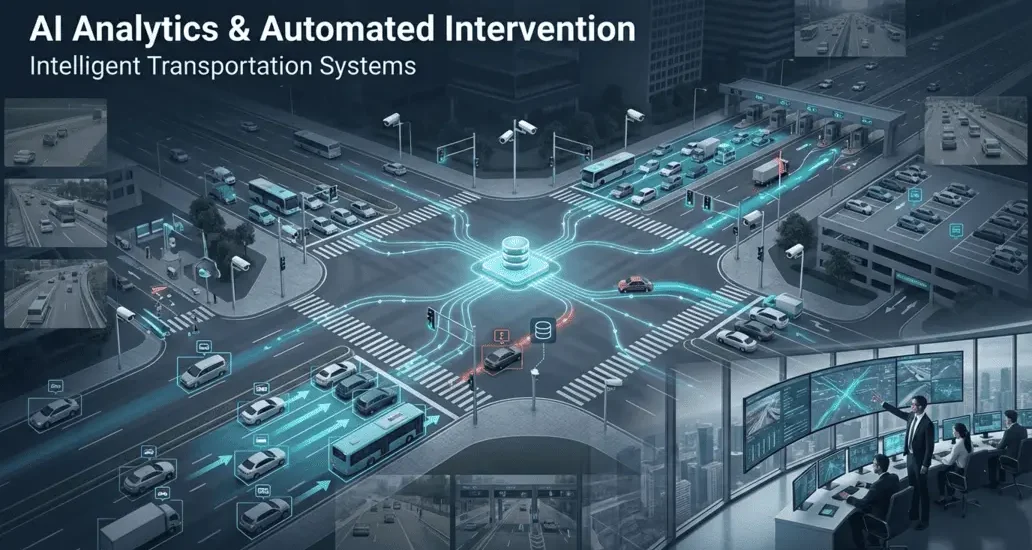
Intelligent transportation systems address the pressure of vehicle populations expanding and infrastructure approaches capacity limits in big cities through AI-driven platforms. The AI tech converts surveillance cameras into recognition networks that process visual data into operational intelligence for traffic coordination and security enforcement.
The technology in intelligent transportation systems transforms reactive monitoring into a predictive type of surveillance to identify violations and enhance vehicle access across distributed facilities.
Why Intelligent Transportation Systems Are Important: Global Case Studies
Adoption patterns across all the continents reveal how municipalities, law enforcement agencies, and private facilities leverage intelligent transportation systems to address distinct operational requirements, and the following implementations showcase these practical applications:
1. Abu Dhabi’s AI-Powered Traffic Management Initiative
Abu Dhabi introduced a traffic light system designed to enhance management and reduce congestion at seven key entry points leading to Sheikh Zayed bin Sultan Street. The system addresses transportation efficiency for the city’s growing population and economy through:
- Advanced sensors monitor traffic in real-time
- AI-driven cameras analyze vehicle flow patterns
- Signal timing adjustments responding to traffic density fluctuations
- Smoother travel during peak hours through adaptive coordination
- Optimized vehicle flow when traffic lightens
(Travel and Tour World, August 2025)
2. Saudi Arabia’s Smart Parking Market Expansion
Saudi Arabia’s smart parking sector demonstrates the economic momentum behind intelligent transportation systems infrastructure. The market is projected to top $400 million by 2030, driven by Vision 2030 initiatives and giga-projects densifying cities like Riyadh and Jeddah. (ITP, December 2025).
3. License Plate Recognition Supporting Law Enforcement in Alabama
Police officials in Alabama cities, US, report that license plate readers deployed throughout their jurisdictions have proven instrumental in aiding patrol officers. The technology assists in locating stolen vehicles, wanted suspects, and missing people through automated recognition integrated with national databases.
Hartselle Interim Police Chief Alan McDearmond acknowledged that some citizens raise privacy concerns about the cameras but noted the technology’s tangible benefits. In April 2023, Hartselle police located a vehicle reported stolen from Massachusetts through data integration with the National Crime Information Center. McDearmond tracked down the vehicle through the technology and located Antonio Jose Concepcion Ferrer and a woman police say was kidnapped (GovTech, 2025).
Learn more about: License plate recognition
4. Toronto Police Service’s Automated License Plate Recognition Expansion
Toronto police characterize their automated license plate recognition (LPR) deployment as one of the biggest advances in the force’s history. The system now operates in more than 600 police vehicles, alerting officers to offences tied to license plates as they patrol throughout the city.
Det. Sgt. Jeff Bassingthwaite, the Toronto Police Service’s ALPR capability lead, reports that officers have described the technology as a game-changer, with some comparing the shift to the transition from typewriters to computers. The system notifies officers when vehicles on hot lists pass in front of forward-facing cameras, whether related to criminal investigations or public safety alerts (CBC News, 2025).
Learn more about: Automated license plate recognition
AvidBeam’s Intelligent Transportation Systems
AvidBeam Systems leverages existing IP camera investments without requiring specialized equipment replacement at surveillance locations. Here’s how:
1. Processing Architecture for Vehicle Recognition
Intelligent transportation systems powered by AvidAuto operate through three-stage processing frameworks that transform visual data into actionable intelligence:
- Image acquisition captures vehicle information under varying conditions, including day, night, fog, and rain, operating efficiently with cameras ranging from 2 megapixels to 4K resolution.
- Character processing via Optical Character Recognition (OCR) handles partial obstructions, backlighting, angled shots up to 45 degrees from perpendicular, and motion blur from vehicles at highway speeds.
- Data analysis compares plates against multiple databases simultaneously for identity verification, switching recognition modes automatically when encountering mixed plate types.
2. Forensic Search Capabilities for Investigation Support
Organizations benefit from forensic searches during security breach investigations to identify vehicles present when incidents occurred. AvidAuto transforms weeks of investigation work into hours through intelligent search functions:
- Complete or partial plate numbers with wildcard searches enable queries when full registration information remains unknown.
- Date and time ranges identify all vehicles accessing facilities during specific periods.
- Vehicle color, make, and model filters function when plate information proves unavailable.
- Access frequency identification reveals vehicles that entered facilities multiple times within specified periods.
- Compound queries combine multiple search criteria.
- Visualization tools reconstruct movements throughout facilities.
Learn more about: LPR Analytics
AvidAuto Suite as A Vehicle Management Platform
AvidBeam’s AvidAuto platform delivers vehicle management capabilities through 3 integrated products built on the ATUN framework. These are the AvidAuto suite:
1. Vehicle Analytics
The Vehicle Analytics product from AvidBeam extends beyond basic plate recognition through multi-dimensional detection systems:
- License plate identification: Processes Arabic and English characters through specialized OCR (Optical Character Recognition) algorithms trained on character sets from each language, achieving detection accuracy exceeding 98% for Arabic plates and 92% for English character recognition.
- Vehicle classification: Identifies plate types including private, bus, police, commercial, and diplomatic registrations, with validation against authorized databases.
- Physical characteristic detection: Recognizes vehicle color for secondary identification, detects make and model to support forensic searches, and classifies vehicles by size category.
- Behavioral analytics: Tracks movement patterns for specific vehicles across locations, analyzes access frequency to distinguish regular visitors from occasional entries, and identifies time-based patterns revealing peak usage periods.
2. Intelligent Traffic Systems
AvidBeam’s ITS product addresses traffic violations and flow management through AI-powered detection:
- Traffic light violation detection: Identifies vehicles crossing intersections illegally.
- Wrong direction monitoring: Detects vehicles moving contrary to designated flow patterns.
- Lane switching analysis: Identifies improper lane changes or restricted lane entry.
- Illegal parking alerts: Triggers notifications when vehicles occupy prohibited areas based on configuration parameters.
- Mobile and seatbelt violations: Detects drivers using phones or failing to wear restraints, supporting traffic safety regulation enforcement.
- Slow/stopped vehicle identification: Flags vehicles moving too slowly or stopped in inappropriate zones, managing traffic flow and identifying potential hazards.
- Vehicle Traffic Density & Analytics Dashboard: Provides clear insights into vehicle traffic patterns by analyzing vehicle attributes and license plate types through visual dashboards, enabling precise traffic monitoring and informed decision-making.
3. Smart Parking
AvidBeam’s Smart Parking product delivers real-time occupancy monitoring and violation detection:
- Parking lot occupancy detection: Provides visibility into occupied versus empty spaces across facilities.
- Entrance/exit blocking alerts: Detects and flags obstructions at building access points and emergency routes.
- Double-parking identification: Monitors violations where vehicles block access to parking spaces or driving lanes.
Generative AI Integration for Natural Language Queries
AvidGenAI integration enables conversational interfaces where users query intelligent transportation systems through natural language rather than structured database searches.
Operators could request: “Show intrusions detected around zone B occured between 2-4 PM yesterday,” rather than constructing search parameters. The system interprets intent, executes queries, and presents results with contextual explanations.
The capability extends to urban safety monitoring, where AvidGenAI detects hazards including trash accumulation, debris, rocks, and environmental conditions such as fog or reduced visibility. The system converts observations into human-readable alerts for municipal response, enabling cities to respond quickly with cleaning, maintenance, traffic management, or emergency actions.
Also you can learn more about: Perimeter Security Systems