
Advanced Facial Recognition in 2026: What AvidBeam’s AvidFace Delivers Beyond Basic Identificationz
- July 7, 2026
- Posted by:
- Category: Articles
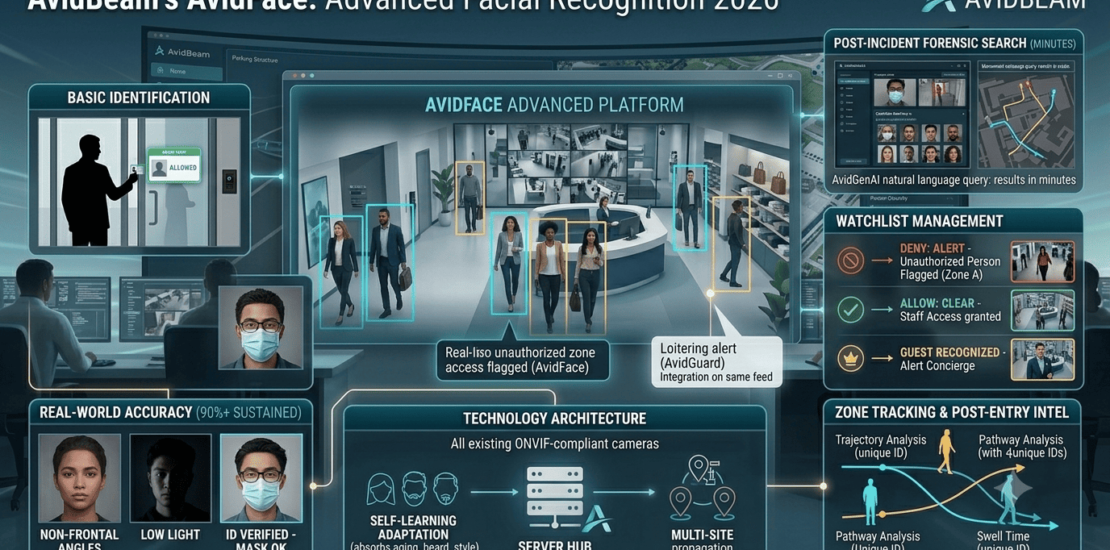
Basic facial recognition identifies a face at a door. That is useful. However, it is a narrow capability relative to what the technology can deliver when the architecture behind it is built for operational depth rather than entry-point verification alone.
Advanced facial recognition does more. It tracks individuals across facility zones after entry. It integrates with behavioral threat detection on the same camera feeds. It adapts to appearance changes over time without re-enrollment. Furthermore, it compresses post-incident investigation from hours to minutes through natural language queries across the full network.
AvidBeam’s AvidFace platform delivers all of this through Artificial Intelligence (AI) video analytics running on existing camera infrastructure. No new hardware is required. Additionally, every capability scales across multiple sites through the same management interface, watchlist updates, detection configurations, and investigation queries apply everywhere simultaneously.
What Makes Facial Recognition Advanced
The word ‘advanced’ carries real operational meaning when applied to facial recognition. It is not about accuracy alone. Several platforms now achieve acceptable accuracy in controlled environments. However, the gap between platforms becomes visible in production — under adverse conditions, across multiple zones, and in the investigation workflows that follow a detected event.
Beyond the Entry Point
Basic facial recognition verifies identity at a door and stops there. Consequently, what happens after entry is invisible to the system. An authorized individual who accesses a restricted zone outside their permitted area generates no alert. A recognized visitor who separates from their escort triggers no notification.
Advanced facial recognition extends the identification layer across the full facility. Moreover, it operates continuously — not just at the moment of entry. Zone movement tracking by timestamp and camera ID surfaces anomalies automatically. As a result, the security picture includes not just who entered, but where they went afterward.
Self-Learning and Sustained Accuracy
Basic systems use static recognition, models. These require periodic re-enrollment as enrolled individuals’ appearances change over time. Advanced systems, in contrast, use self-learning algorithms that adapt continuously. They absorb aging, hairstyle changes, and variations in partial obstructions without requiring manual re-enrollment.
Furthermore, server-based processing removes the hardware ceiling that limits edge-based systems. Detection models run on centralized infrastructure. Therefore, accuracy holds consistently across low light, non-frontal angles, masks, and glasses — conditions where edge-based systems degrade.
To find out how AvidFace’s advanced facial recognition applies to your facility’s existing camera infrastructure, send an email to [email protected], and the technical team will follow up. |
AvidFace – Advanced Facial Recognition in Practice
AvidFace connects to existing cameras via standard network protocols and runs all recognition processing centrally at the server level. This server-based architecture is what enables the capabilities that distinguish advanced from basic, multi-face processing, watchlist depth, zone tracking, and multi-site management, without additional hardware at individual access points.
Multi-Face Detection and Obstruction Handling
AvidFace processes multiple faces simultaneously in a single video frame. Consequently, high-traffic entry points and event venues are covered without per-face processing delays. Recognition accuracy stays above 90% across partial obstructions, masks, glasses, hats, and scarves included. Additionally, non-frontal face angles are handled without requiring subjects to face the camera directly.
These capabilities matter because real access points do not produce ideal conditions. However, basic systems perform as if they do. AvidFace’s accuracy figures reflect real-world deployment conditions, not controlled test environments.
Watchlist Management at Scale
AvidFace manages three watchlist categories in parallel across every monitored access point simultaneously. Each produces a distinct automated response:
- Deny lists: flagged individuals trigger a security alert before reaching interior zones; alert includes confirmed identity, camera source, timestamp, and location
- Allow lists: authorized personnel receive automated access without manual credential checks; no queue formation at high-traffic entry points
- Very Important Person (VIP) lists: recognized individuals trigger service notifications before reaching the desk; relevant staff alerted at entrance, not at counter
Moreover, watchlist updates propagate instantly across all connected sites. Therefore, a deny list change at one location applies everywhere on the network at the same moment — without per-site reconfiguration.
Zone-Level Intelligence After Entry
Zone-level movement tracking is the capability that most clearly separates advanced facial recognition from basic identification. It extends the system’s intelligence past the entry event and into the facility’s interior, producing a continuous record of who was where, and when.
AvidFace tracks individuals across facility zones by zone ID, timestamp, and camera ID after entry verification. When an individual appears in a zone outside their authorization profile, without a corresponding access event at the boundary, the platform surfaces the anomaly automatically. Notably, this detection fires against the individual’s specific access record, not against a generic motion rule.
Additionally, reverse image search extends zone tracking into post-incident investigation. Security teams upload an image. AvidFace queries the full recorded network and returns the top five ranked matches with timestamps and camera sources. As a result, establishing a specific individual’s movements across a multi-camera facility takes minutes, not hours.
Integration With Behavioral Detection
Advanced facial recognition delivers the most operational value when it shares a platform with behavioral threat detection. Identity-based anomalies and behavioral anomalies are different threat types. However, they often co-occur, and addressing both requires integrating their detection outputs into a single operations view.
AvidFace feeds directly into AvidGuard’s behavioral anomaly detection layer. Both run on the same camera feeds. Consequently, a zone access anomaly detected by AvidFace and a loitering alert generated by AvidGuard for the same individual in the same timeframe appear together, giving the security team identity confirmation and behavioral context simultaneously.
Furthermore, AvidGenAI enables natural language investigation across both layers. An operator can ask which individuals were in a specific zone in the 90 minutes before an incident, and receive an answer that includes both identity records from AvidFace and behavioral detection context from AvidGuard, without switching between separate interfaces.
Advanced Facial Recognition Across Environments
The core recognition mechanics stay consistent across deployment environments. However, the primary operational return varies by context. The following environments represent the most common advanced facial recognition deployments.
- Government and high-security facilities: zone movement tracking and dynamic deny list management are the primary requirements; AvidFace surfaces unauthorized zone access automatically against each individual’s authorization profile
- Corporate campuses: multi-tier access control across staff, contractors, and visitors; AvidFace automates entry verification at every level while logging movements continuously against confirmed identities
- Mass events: AvidBeam deployed AvidFace across two consecutive Soundstorm editions in Riyadh, 450,000+ attendees per edition, sustaining accuracy above 90% at all entry points throughout each three-day event
- Hospitality: VIP recognition at building entrances triggers staff notifications before clients reach the desk; Four Seasons Madinah deployed this alongside AvidAuto’s vehicle recognition across all property access points
- Banking: vault access protocol enforcement, teller zone monitoring, and VIP client recognition through the same platform; AB – Smart Banking extends the recognition layer into branch-specific compliance monitoring
Full Advanced Facial Recognition Capability Breakdown
The table below maps every advanced facial recognition capability AvidFace delivers, what it does, and the operational output it produces.
| Advanced Capability | What It Does | Operational Output |
|---|---|---|
| 90%+ recognition accuracy | Sustained under masks, glasses, non-frontal angles, and low light | Reliable identification under real facility conditions, not only in controlled environments |
| Multi-face detection | Multiple faces processed simultaneously in one frame | High-traffic entries and event venues covered without per-face delays |
| Self-learning adaptation | Algorithms update with each interaction; adapt to appearance changes | Accuracy sustained across aging, hairstyle changes, and partial obstructions over time |
| Deny / Allow / VIP lists | Three watchlist categories running in parallel at every access point | Correct automated response fires instantly, grant, alert, or notify, without operator input |
| Zone movement tracking | Individual tracked by zone, timestamp, and camera ID after entry | Unauthorized zone access surfaces automatically against authorization profile |
| Behavioral integration | AvidFace feeds AvidGuard’s anomaly detection layer | Identity-based anomalies combined with behavioral alerts in one operations view |
| Reverse image search | Historical footage queried by uploaded image across the full network | Top five ranked matches returned with timestamps, investigation in minutes |
| Attribute detection | Age, gender, eyewear, and headwear identified per detected face | Demographic reporting and restricted zone access profiling |
| AvidGenAI investigation | Natural language queries across all facial recognition events | Post-incident investigation without manual footage review |
| Multi-site propagation | Watchlist updates apply instantly across all connected locations | A deny list change at headquarters applies everywhere simultaneously |
Basic vs. Advanced Facial Recognition – Comparison
The table below sets out where AvidFace’s advanced facial recognition platform diverges from basic identification systems across the dimensions that determine operational value in production.
| Dimension | Basic Facial Recognition | AvidBeam Advanced Facial Recognition |
|---|---|---|
| Identification scope | Entry point only; no tracking after access granted | Continuous tracking across all facility zones after entry |
| Watchlist depth | Single list; basic match or no-match response | Three parallel lists, deny, allow, Very Important Person (VIP), each with a distinct automated response |
| Behavioral integration | Separate security system required | Feeds AvidGuard’s anomaly detection layer on the same camera feeds |
| Obstructions handling | Accuracy drops significantly with masks and glasses | Accuracy sustained above 90% across masks, glasses, hats, and non-frontal angles |
| Multi-site management | Per-location configuration and watchlist updates | Unified interface; instant propagation to all connected locations |
| Investigation capability | Manual footage scrub; hours per incident | AvidGenAI natural language query; ranked results in minutes |
| Adaptation over time | Static model; re-enrollment required as faces change | Self-learning algorithms adapt continuously without re-enrollment |
| Hardware requirement | Dedicated facial recognition units per access point | Layers onto existing Open Network Video Interface Forum (ONVIF)-compliant cameras |
In short, basic facial recognition identifies. AvidFace’s advanced facial recognition identifies, tracks, integrates, adapts, investigates, and scales across the cameras already installed, across every site simultaneously.
Infrastructure and Deployment
AvidFace connects to any Open Network Video Interface Forum (ONVIF)-compliant camera via standard network protocols. All processing runs centrally, not at the camera. Therefore, no dedicated facial recognition hardware is required at individual access points.
The infrastructure baseline per camera processed:
- 2GB RAM minimum; one virtual core at 2.4 GHz minimum
- Multiple Graphics Processing Unit (GPU) configurations supported for high-density deployments
- Camera resolution: 2MP up to 4K; lens focal length 3mm to 25mm
- Pitch -15° to +15°; roll -180° to +180°; yaw -15° to +15°
Video Management System (VMS) integration covers Milestone, NetworkOptix, and Genetec platforms. Deployment options include on-premise, private cloud, public cloud, and hybrid. Notably, on-premise processing keeps biometric data local; the recommended configuration for government and high-security environments.
Frequently Asked Questions
What is advanced facial recognition?
A facial recognition platform that goes beyond entry-point identification, tracking individuals across zones, integrating with behavioral detection, adapting accuracy over time, and enabling natural language investigation across the full camera network.
How does AvidFace differ from basic facial recognition systems?
AvidFace tracks individuals after entry, manages three parallel watchlist categories, integrates with AvidGuard's behavioral detection, adapts to appearance changes without re-enrollment, and supports post-incident investigation through AvidGenAI, capabilities that basic systems do not offer.