
A Vehicle Tracking System That Stops at the Gate Misses Everything That Matters After It.
- July 1, 2026
- Posted by:
- Category: Articles
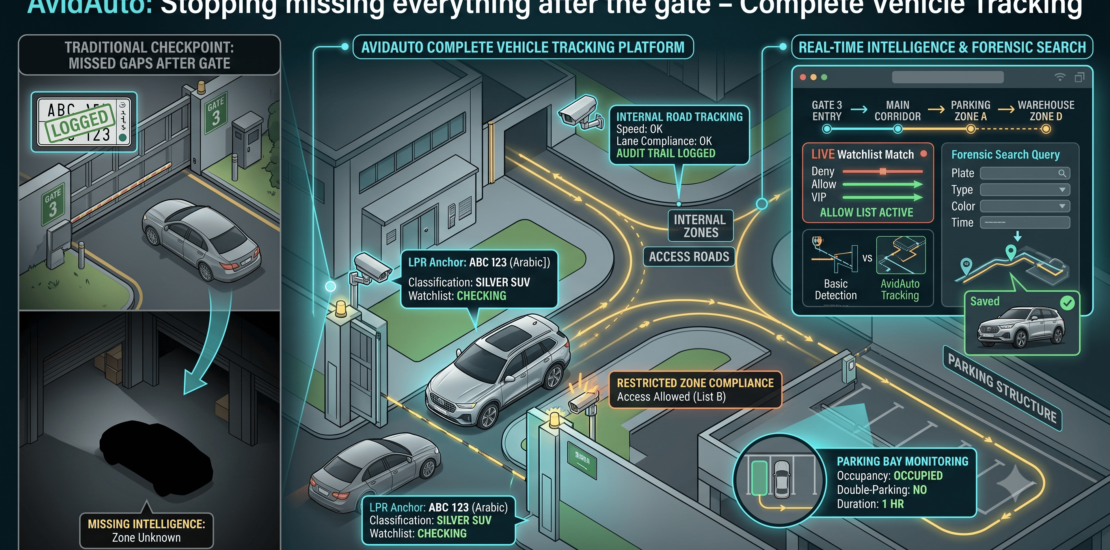
A vehicle enters at Gate 3. The plate is read. The log records the timestamp. Then the vehicle disappears into the facility, and nobody knows where it went, which zones it accessed, how long it stayed, or whether it appeared on a deny list at any point after entry.
That is the gap between vehicle detection and vehicle tracking. Detection tells you a vehicle was present at one point. Tracking tells you the full story, where the vehicle went, what it did, and when it left, across every camera it passed throughout its time on site.
AvidBeam’s AvidAuto platform delivers this through Artificial Intelligence (AI) video analytics running on existing camera infrastructure. The tracking layer covers gates, access roads, internal routes, and parking structures simultaneously. Consequently, every vehicle that enters a monitored network generates a complete movement record, in real time and for post-incident investigation.
Detection vs. Tracking – The Operational Gap
Most facilities that describe themselves as having a vehicle tracking system have detection at the gate. That distinction matters operationally. A detection system answers one question: was this vehicle here at this time? A tracking system answers a different and more operationally valuable set of questions:
- Where did the vehicle go after entry?
- Which internal zones did it access?
- Did it appear at any other monitored camera point after clearing the gate?
- How long did it remain on site?
- Did its movement pattern match what was expected for its vehicle category?
Furthermore, detection without tracking creates investigation gaps. When an incident occurs, security teams need to reconstruct a vehicle’s movements across the facility. Without cross-camera tracking, that reconstruction requires manually reviewing footage from every camera the vehicle might have passed. As a result, investigations that should take minutes run to hours.
How AvidAuto’s Vehicle Tracking System Works
AvidAuto’s vehicle tracking runs on a server-based architecture; all processing happens centrally, not at individual cameras. This is the architectural decision that makes cross-camera tracking operationally viable. Any Open Network Video Interface Forum (ONVIF) – compliant camera already on the network feeds into the tracking platform. Additionally, the same vehicle identity anchor, the plate read, links appearances across every camera point the vehicle passes.
License Plate Recognition as the Tracking Foundation
Every tracking record starts with a License Plate Recognition (LPR) event. AvidAuto delivers 98%+ accuracy for Arabic plates and 92%+ for English, across high speed, low light, adverse weather, and partially obscured plates. Alongside the plate read, the system identifies vehicle type, make, model, and color. It also saves a vehicle image per detection event.
Consequently, the tracking record is not just a plate number appearing at multiple timestamps. It is a full vehicle profile, with visual confirmation, at every camera point the vehicle passes. Therefore, the audit trail reflects both what the system detected and what the camera captured.
Cross-Camera Movement Pattern Reconstruction
When a specific vehicle is identified at any monitored camera, AvidAuto links that appearance to all previous and subsequent appearances of the same plate across the full network. The result is a continuous movement record, entry point, route through the facility, dwell locations, and exit point, assembled automatically without manual cross-referencing.
Moreover, this reconstruction works both in real time and retrospectively. Security teams can query a specific vehicle’s movements during an active incident. Additionally, they can reconstruct movements from historical footage for post-incident investigation, using the same platform, the same interface, and the same plate-based identity anchor.
Real-Time Tracking and Watchlist Integration
Real-time vehicle tracking adds the operational dimension that makes tracking security-relevant rather than just analytically interesting. A movement record tells you where a vehicle went. Real-time watchlist matching tells you whether that vehicle should have been there at all. AvidAuto connects both layers, so the tracking system is not just recording movement, it is acting on it.
Live Watchlist Matching Across Every Camera Point
AvidAuto’s watchlist matching runs at every camera point the vehicle passes, not only at the entry gate. Three list categories operate in parallel:
- Deny lists: flagged vehicles trigger a security alert at the first camera they appear on across the full network; the alert includes plate, vehicle profile, camera source, timestamp, and location
- Allow lists: authorized vehicles are tracked continuously; their movement record is logged automatically for compliance and audit purposes
- Very Important Person (VIP) lists: designated vehicles receive priority routing or access notifications; the tracking layer confirms the vehicle’s presence and location at each relevant point
Notably, a deny-listed vehicle that enters on a legitimate-looking delivery during a busy period still triggers an alert; because the watchlist matching fires at every camera point, not just the gate.
Access Control and Automated Gate Response
At access control points, the tracking system connects directly to gate authorization. Allow-listed vehicles clear automatically. Deny-listed vehicles trigger alerts before clearing. Furthermore, unknown vehicles, not on any list, generate a manual review flag. Consequently, every vehicle that passes through a monitored gate generates a response, not just a log entry.
Forensic Vehicle Tracking and Post-Incident Investigation
Post-incident vehicle investigation without a tracking system means reviewing footage feed by feed, camera by camera, to reconstruct where a specific vehicle went. AvidAuto replaces that process with a forensic search query.
Search parameters include plate number, vehicle make, model, color, date, time, and location. The query runs across the full recorded network simultaneously. As a result, the investigation output includes:
- Every camera point where the vehicle appeared, with timestamps and location IDs
- The complete movement route is reconstructed in chronological order
- A saved vehicle image per detection event, with visual confirmation at each point
- Duration data, how long the vehicle spent at each location
- Any watchlist matches that occurred at any point during the tracked journey
Moreover, the forensic search works across attribute combinations. A security team investigating a vehicle with an unknown plate can search by make, model, and color within a defined time window. Therefore, tracking is not dependent on a complete plate read at the point of entry.
Traffic and Parking Tracking Intelligence
Vehicle tracking does not stop at the building entrance. AvidAuto’s AB – ITS (Intelligent Traffic Systems) module extends tracking to internal roads and access routes. AB – Smart Parking extends it further into parking structures. Together, they produce a complete picture of vehicle movement across the full facility footprint.
On internal roads, AB – ITS tracks vehicle behavior continuously:
- Wrong-way movement on internal access roads, alert fires immediately
- Vehicles stopped in active lanes or emergency zones are detected and flagged in real time
- Speed threshold violations on internal routes, logged per vehicle with full profile
In parking areas, AB – Smart Parking tracks:
- Vehicle entry into parking levels, movement continues from the gate into the structure
- Zone compliance, vehicles accessing restricted parking areas trigger alerts
- Overtime monitoring, vehicles remaining beyond authorized timeframes are flagged automatically
- Double-parking and entrance blocking, detected in real time with precise location data
Consequently, the tracking record covers the vehicle’s full journey — from approach at the gate through internal routes to parking bay and back to exit. Furthermore, every event in that journey is timestamped and linked to the same vehicle identity anchor.
| To find out how AvidAuto’s vehicle tracking system applies to your facility’s existing camera infrastructure, send an email to [email protected] and the technical team will follow up. |
Full Vehicle Tracking Capability Breakdown
The table below maps every tracking capability AvidAuto delivers across its three integrated modules; AB – Vehicle Analytics, AB – ITS, and AB – Smart Parking, along with the operational output each produces.
| Tracking Capability | AvidAuto Module | What It Delivers |
|---|---|---|
| License Plate Recognition (LPR) | AB – Vehicle Analytics | 98%+ (Arabic) / 92%+ (English) — the identity anchor for every tracking event across the network |
| Vehicle classification | AB – Vehicle Analytics | Type, make, model, color, and plate type identified per tracking event — full profile, not just plate number |
| Cross-camera movement tracking | AB – Vehicle Analytics | Specific vehicle followed across multiple camera points with timestamped location data at each appearance |
| Real-time watchlist matching | AB – Vehicle Analytics | Deny, allow, and VIP lists checked at every camera point the vehicle passes, alert fires on first detection |
| Forensic vehicle search | AB – Vehicle Analytics | Search by plate, make, model, color, date, time, location, movement pattern reconstructed across the full network |
| Traffic violation tracking | AB – ITS (Intelligent Traffic Systems) | Violations logged per vehicle with plate, timestamp, and event clip, tracking continues after each violation event |
| Parking zone tracking | AB – Smart Parking | Vehicle followed into parking structure; unauthorized zone entry, double-parking, and overnight stays flagged |
| Vehicle density analytics | AB – Vehicle Analytics | Volume and distribution patterns per location and time window, feeds congestion forecasting and planning |
| Saved vehicle images | AB – Vehicle Analytics | Image captured per detection event, every tracking record includes visual confirmation alongside structured data |
| Audit trail generation | AB – Vehicle Analytics | Full timestamped log of every camera point the vehicle passed, compliance documentation without manual steps |
Basic Detection vs. AvidAuto Tracking – Comparison
The table below sets out where AvidAuto’s vehicle tracking system diverges from basic point-detection setups at the tracking depth, watchlist integration, and investigation level.
| Capability | Basic Detection System | AvidBeam Vehicle Tracking System |
|---|---|---|
| Tracking scope | Single camera point; no cross-camera continuity | Vehicle tracked across every camera it passes, full journey reconstruction |
| Vehicle identity | Plate number only | Full profile: plate, type, make, model, color, and plate type |
| Watchlist matching | Checked at gate only; missed at subsequent points | Checked at every camera point in real time, alert fires on first detection anywhere |
| Post-incident search | Manual footage scrub per camera; hours per case | Multi-attribute forensic query returning movement pattern in minutes |
| Parking tracking | No coverage after gate clearance | Vehicle tracked into parking structure; violations and overtime flagged automatically |
| Audit trail | Manual log entries; incomplete without observer | Automated timestamped record per camera appearance, complete without manual intervention |
| Hardware requirement | Dedicated tracking units per coverage zone | Layers onto existing Open Network Video Interface Forum (ONVIF) – compliant cameras |
| Scalability | New hardware per additional tracking point | Software extension to cameras already on the network |
In short, basic detection records a vehicle’s presence at one point. AvidAuto’s vehicle tracking system records the full journey, across every camera, in real time, with forensic search capability and continuous watchlist matching at every step.
Infrastructure and Deployment
AvidAuto connects to any ONVIF-compliant camera via standard network protocols. All tracking processing runs centrally, not at individual cameras. Therefore, no dedicated tracking hardware is required at each coverage point.
The infrastructure baseline per camera processed:
- 2GB RAM minimum; one virtual core at 2.4 GHz minimum
- Multiple Graphics Processing Unit (GPU) configurations supported for high-density deployments
- Camera resolution: 2MP up to 4K; lens focal length 3mm to 25mm
Video Management System (VMS) integration covers Milestone, NetworkOptix, and Genetec platforms. Deployment options include on-premise, private cloud, public cloud, and hybrid. Notably, for organizations with data sovereignty requirements, on-premise processing keeps all vehicle tracking data local without external transmission.
Verified Deployments
AvidBeam’s vehicle tracking deployments across Saudi Arabia demonstrate the platform across different operational scales and contexts.
- Riyadh Smart Parking: AvidAuto tracked vehicle movements across 18,000 cameras from a single centralized interface. Movement patterns, occupancy data, and watchlist matching all ran through one platform.
- STC Sawaher Project: vehicle tracking, LPR, watchlist management, and traffic flow monitoring combined with AvidFace and AvidGuard in a unified centralized operations view.
- Qiddiya: vehicle tracking across multiple entry points at the entertainment destination; movement records, access control, and vehicle counts running simultaneously.
- KAPSARC: vehicle tracking and traffic monitoring at the King Abdullah Petroleum Studies and Research Center, alongside personnel access management through AvidFace.
Frequently Asked Questions
What is a vehicle tracking system?
An AI-powered platform that follows specific vehicles across multiple camera points — reconstructing movement patterns in real time and for post-incident investigation, with watchlist matching at every detection point.
How does AvidAuto track vehicles across multiple cameras?
License Plate Recognition links every camera appearance of the same plate into a continuous movement record, timestamped, with saved images, across the full network simultaneously.