
Why Traditional Oil and Gas Video Surveillance Fails and How to Fix It?
- March 29, 2026
- Posted by:
- Categories: Articles, Articles & Blogs
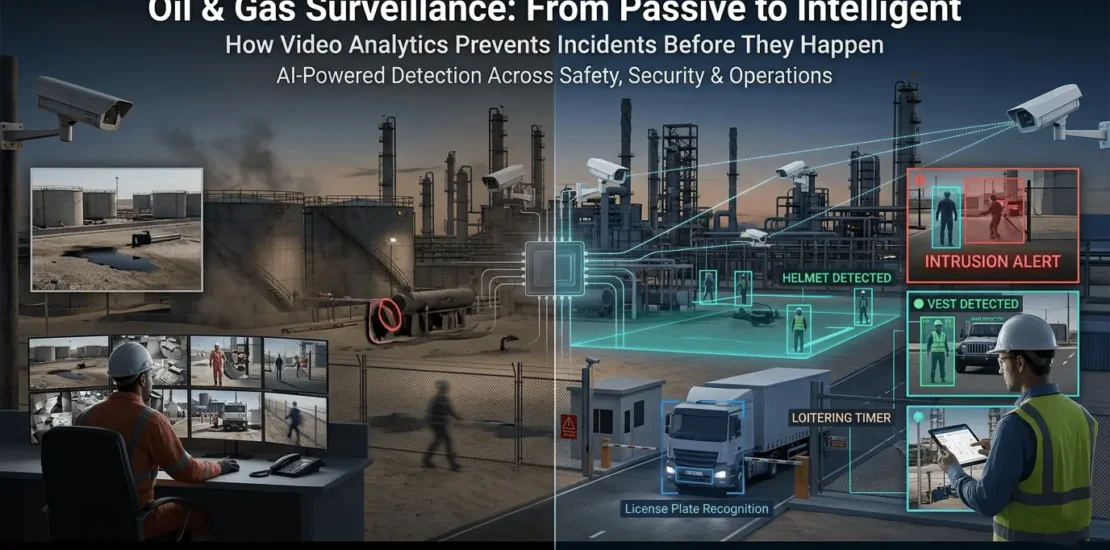
Oil and gas video surveillance systems have well-documented limitations that most facility managers know about but rarely address directly. The cameras are in place, yet incidents keep happening:
- Liquid leaks in facilities
- Workers entering high-risk zones without respiratory protection
- Vehicles approaching loading docks without verified authorization
- Perimeter breaches going undetected until someone reviews footage after the fact
The analytical layer that would have caught these events in real time is typically absent, because many companies still rely on traditional surveillance systems. AvidBeam‘s server-based video analytics platform addresses these gaps across all critical safety and security functions in oil and gas operations, from perimeter monitoring and access control through to personal protective equipment (PPE) compliance verification and vehicle management.
A Deeper Understanding of Oil and Gas Video Surveillance
The standard oil and gas video surveillance setup was built for documentation, not detection. The model depends on security personnel monitoring screens displaying feeds from dozens or hundreds of cameras, and it carries several structural problems:
- Human attention degrades after 20 minutes of continuous monitoring
- Night shifts compound fatigue and reduce detection accuracy
- Response times depend entirely on whether someone was watching the right camera at the right moment
- Coverage gaps appear during shift changes and breaks
The consequences compound across different risk categories. Companies need AI-powered oil and gas video surveillance platforms that address each of these failure points at the detection layer, not after the fact. The following sections cover the most important capabilities AvidBeam‘s detection and monitoring systems deliver.
1. Perimeter Security
Oil and gas facilities span hundreds of acres. Fencing every boundary with physical barriers and guard posts is not economically viable. Traditional motion-based oil and gas video surveillance generates false alerts from wildlife, weather, and vegetation movement at a rate that erodes security team vigilance over time.
AvidBeam‘s AvidGuard platform applies behavioral analysis to perimeter monitoring, establishing a baseline for authorized activity in each zone and flagging deviations rather than raw motion. The detection capabilities available through AvidGuard that oil and gas facilities benefit from include:
- Intrusion detection monitors designated zones and generates alerts when unauthorized individuals cross predefined boundaries, before they reach processing units, control rooms, or tank farms
- Loitering detection flags individuals who remain near perimeter boundaries beyond configurable time thresholds
- Fence crossing detection identifies barrier breach attempts with precise location data
- Tailgating detection identifies individuals entering access points behind authorized personnel without separate verification
- Left object detection alerts when unattended items appear near access points or critical infrastructure for a defined period
- Scene change detection monitors predefined zones for the unexpected removal of stationary equipment or assets
AvidGuard‘s N+1 redundancy configuration maintains continuous oil and gas video surveillance coverage despite hardware failures, which matters for facilities where monitoring gaps are not acceptable.
To find out how AvidBeam‘s oil and gas video surveillance capabilities apply to your facility’s existing camera infrastructure and operational requirements, send an email and a team of specialists will follow up with a deployment assessment.
2. Access Control
Petrochemical facilities face a specific challenge: managing a continuous flow of employees, contractors, maintenance crews, and visitors across zones with different authorization requirements. These facilities need to bring together platforms such as AvidFace and AvidGuard to build a layered access control model across the oil and gas video surveillance infrastructure. AvidFace verifies identity at over 90% accuracy at entry points before access is granted, and creates timestamped audit trails that document exactly who entered which zone and at what time.
AvidFace‘s watchlist management supports three list categories:
- Allow lists authorized personnel receive automated entry without manual checkpoint processing
- Deny lists flagged individuals trigger security alerts before reaching sensitive areas
- VIP lists designated personnel receive priority routing or specific access permissions
Beyond individual entry points, the same facial recognition layer applies across multiple security tiers within the facility:
- Perimeter gates verify vehicle occupants before they access the site
- Building entrances confirm authorization for specific structures
- Control rooms validate credentials before personnel reach critical infrastructure
3. Personal Protective Equipment (PPE) Compliance
Manual personal protective equipment (PPE) compliance monitoring in oil and gas environments has a structural problem. Supervisors cannot physically verify every worker at every zone entry across a large facility on every shift. Compliance rates end up reflecting who happens to be watching rather than what is actually happening across the full facility footprint.
AvidGuard‘s AB – Health, Safety and Environment Compliance module runs automated PPE verification through the existing oil and gas video surveillance camera network, checking for required equipment as workers approach designated zones. SABIC deployed AvidGuard across petrochemical facilities in Saudi Arabia specifically to enforce safety regulations through this automated detection approach, which verifies:
- Safety helmets
- Face masks
- Safety gloves
- Safety shoes
- Ear protection
- Safety vests
- Safety glasses
- Hairnets
4. Vehicle Management
Oil and gas facilities handle continuous vehicle traffic across multiple categories:
- Tanker trucks collecting product
- Delivery vehicles supplying materials
- Contractor fleets servicing equipment
- Employee vehicles
Each category carries different facility access permissions, routing requirements, and operational risk profiles. AvidBeam‘s AvidAuto platform handles vehicle intelligence across the full oil and gas video surveillance infrastructure through three functional areas.
Gate Access Control
At facility gates, AvidAuto reads approaching vehicle plates and cross-references against authorization databases in real time:
- Scheduled tanker trucks receive automated entry and routing instructions to designated loading bays
- Unauthorized vehicles trigger security alerts before entering the facility
- Audit trails log which vehicles accessed which areas across specific timeframes
- Integration with existing access control systems provides regulatory compliance documentation
Parking and Zone Management
AvidAuto‘s Smart Parking module applies vehicle tracking across parking areas, contractor staging zones, and visitor areas:
- Real-time occupancy detection for occupied versus empty parking spots
- Entrance and exit blocking detection with alerts for obstructions at emergency access points
- Double-parking detection to keep driving lanes clear in operational areas
- Overnight monitoring with alerts for vehicles remaining beyond expected timeframes
Traffic Flow Analytics
AvidAuto‘s Intelligent Traffic Systems (ITS) module extends oil and gas video surveillance coverage to vehicle behavior within the facility:
- Wrong direction detection on access roads and internal routes
- Slow or stopped vehicle detection in inappropriate zones
- Mobile phone and seatbelt detection for safety enforcement
- Traffic density analytics across loading areas and maintenance zones
Frequently Asked Questions
What is an oil and gas video surveillance system?
Oil and gas video surveillance systems combine cameras with AI analytics to monitor perimeters, access points, and operations in real time. Platforms like AvidBeam go beyond recording to detect unauthorized access, PPE violations, and suspicious activity instantly.
Why do oil and gas companies need specialized surveillance?
Standard surveillance isn’t built for the high-risk, high-value nature of oil and gas, which demands proactive, context-aware monitoring to prevent incidents before they happen.