
What a Modern Building Security System Actually Requires
- May 19, 2026
- Posted by:
- Categories: Articles, Articles & Blogs
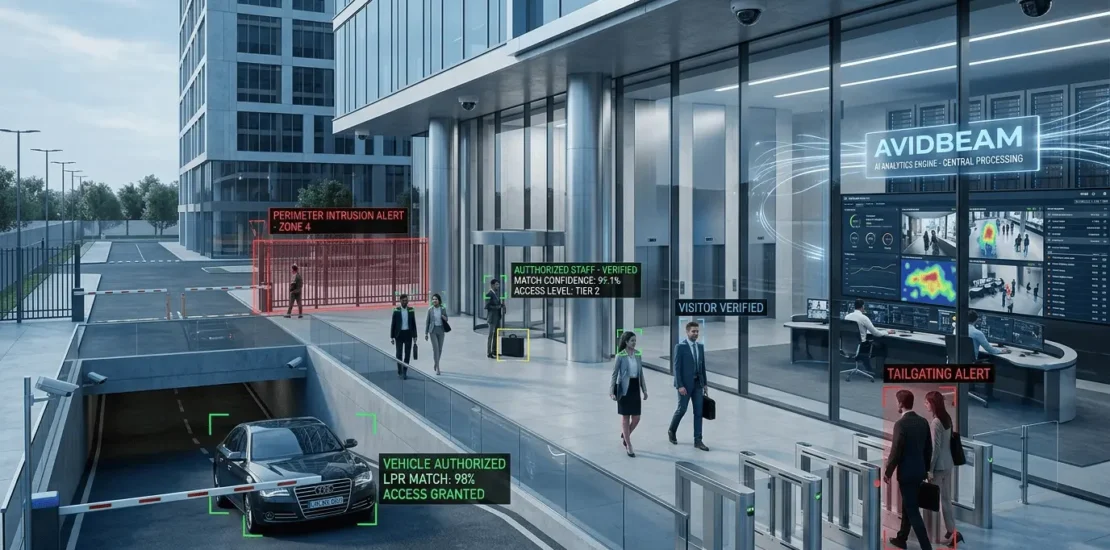
Most building security systems share the same structural problem: they are built around cameras that record and guards that watch. The camera infrastructure is real, the footage exists, and the incidents still happen, because the system was never designed to detect anything on its own.
The gap is not hardware. Most facilities already have cameras. The gap is the analytical layer that turns those feeds into real-time detections, structured alerts, and operational intelligence, rather than raw footage that gets reviewed after something has already gone wrong.
AvidBeam’s server-based video analytics platform addresses this gap across every layer of a building security system: perimeter monitoring, identity verification, vehicle access, behavioral threat detection, and post-incident investigation. All of it runs on the camera infrastructure organizations already have in place.
What a Modern Building Security System Actually Requires
Traditional building security was designed around two assumptions: that guards could watch feeds consistently, and that recorded footage was sufficient evidence after an incident. Neither assumption holds at the operational level.
Human attention degrades after 20 minutes of continuous monitoring. Shift changes create coverage gaps. A tailgating event at the loading dock and a perimeter breach at the east wing can happen simultaneously, and without an automated detection layer, neither gets caught in time.
What a modern building security system needs to resolve each of these failure points:
- Continuous detection across every camera feed, without attention constraints or coverage gaps
- Behavioral analysis that distinguishes genuine threats from environmental noise, not motion detection, which triggers on everything
- Identity verification at entry points that works faster and more reliably than manual badge checks
- Vehicle access control that cross-references plates against watchlists in real time, not after vehicles have already entered the facility
- A post-incident investigation capability that compresses hours of footage review into a single query
AvidBeam’s platform is built around these requirements, not around the assumption that more cameras solve the problem.
AvidGuard: Perimeter and Behavioral Threat Detection
Perimeter monitoring in most building security deployments depends on motion-triggered alerts. The problem with motion detection at scale is the false-positive rate: wildlife, weather, vehicle headlights, and HVAC movement all trigger the same alert as a genuine perimeter breach. Security teams that receive hundreds of false alerts per shift stop treating alerts as actionable.
AvidBeam’s AvidGuard platform applies behavioral analysis to perimeter zones, establishing a learned baseline for each monitored area and surfacing deviations from it, rather than triggering on any movement in frame. The detection events AvidGuard generates across a building security system:
- Intrusion detection monitors designated zones and generates alerts when unauthorized individuals cross predefined boundaries, before they reach access corridors, server rooms, or restricted operational areas
- Loitering detection flags individuals who remain near perimeter boundaries or building access points beyond configurable time thresholds, catching threats at the reconnaissance stage, not after entry
- Tailgating detection identifies multiple individuals entering on a single authorization event; the event is invisible to badge systems and requires human observation to catch without a behavioral analytics layer
- Fence crossing detection identifies barrier breach attempts with precise location data
- Left object detection alerts when unattended items appear near building entrances or critical infrastructure for a duration that exceeds the zone-specific threshold
- Scene change detection monitors predefined zones for the unexpected removal or addition of stationary equipment or assets
- Crowd detection alerts when group size in a monitored zone exceeds configurable limits, relevant for building lobbies, event spaces, and emergency exits
- Fire and smoke detection for early facility emergency response
AvidGuard’s N+1 redundancy configuration maintains continuous building security coverage despite hardware failures, which matters for facilities where monitoring gaps are not acceptable across any shift.
AvidFace: Identity Verification Across Every Access Tier
Badge-based access control has a ceiling. It verifies that a credential was presented, not that the right person presented it. A stolen badge, a borrowed access card, or a door held open after a legitimate entry all bypass the system entirely without triggering any alert.
AvidBeam’s AvidFace platform connects to the existing camera network and handles identity verification at over 90% accuracy at entry points, even with partially covered faces, masks, glasses, and hats included. The system runs a four-stage process on every face that enters a monitored frame: detection, faceprint generation, database matching, and automated response in fractions of a millisecond. No operator input required.
Watchlist Management
AvidFace’s watchlist management supports three list categories that cover the full spectrum of access scenarios in a commercial or institutional building security system:
- Allow lists: Authorized personnel receive automated entry without manual checkpoint processing, which reduces queue formation at high-traffic access points
- Deny lists: Flagged individuals trigger security alerts the moment they appear at any monitored entry point, before they reach interior zones
- VIP lists: Designated individuals receive priority routing or specific access notifications, which is relevant for executive floors, sensitive meeting rooms, and guest management workflows
Zone-Level Movement Tracking
Beyond entry point verification, AvidFace tracks individual movement across building zones by date, time, and location. When an individual authorized for Zone A appears in Zone C without a corresponding access event, the system surfaces the anomaly automatically. That layer of identity-based intelligence is what separates AvidFace from standard facial recognition deployments that stop at the door.
The image-based historical search capability lets security teams pull footage of a specific individual across the full recorded network, returning results ranked by confidence level, without manually scrubbing through hours of raw video feed.
AvidAuto: Vehicle Management at Building Entry Points
Commercial and institutional buildings handle continuous vehicle traffic across multiple categories: employee vehicles, visitor cars, contractor fleets, delivery vehicles, and emergency services. Each category carries different access permissions and different risk profiles, and most building security systems manage all of them through the same manual gate check.
AvidBeam’s AvidAuto platform handles vehicle intelligence across the full building security infrastructure through three integrated products.
Gate Access Control
At building entry points, AvidAuto reads approaching vehicle plates and cross-references against authorization databases in real time:
- Authorized vehicles receive automated entry without requiring a guard to verify credentials manually
- Deny-listed plates trigger security alerts before the vehicle clears the gate, not after it has entered the parking structure or loading area
- Audit trails log which vehicles accessed which areas across specific timeframes, producing documentation that supports compliance and investigation workflows
- Integration with existing access control systems provides regulatory compliance documentation without separate logging infrastructure
License Plate Recognition accuracy reaches 98%+ for Arabic plates and 92%+ for English, which means the watchlist cross-referencing layer operates reliably under real building traffic conditions, not just in controlled test environments.
Parking and Zone Management
AvidAuto’s AB-Smart Parking module extends vehicle tracking across parking structures, visitor areas, and contractor staging zones:
- Real-time occupancy detection distinguishes occupied from empty spaces across all monitored levels
- Entrance and exit blocking detection triggers alerts when vehicles obstruct emergency access points or loading bay approaches
- Double-parking detection keeps driving lanes clear in operational areas and underground parking structures
- Overnight monitoring generates alerts for vehicles remaining beyond expected timeframes, relevant for security audits and unauthorized overnight access patterns
AvidGenAI: The Investigation Layer That Changes Response Times
Detection generates events. Investigation turns those events into answers. For building security teams managing large multi-zone environments, the time between an incident and a confirmed understanding of what happened frequently runs to hours, because it depends on someone manually reviewing footage across dozens of camera feeds.
AvidBeam’s AvidGenAI module is a Vision Language Model that converts the investigation process into a conversational query across the full camera network. An operator types a natural-language question, the system returns timestamped results with behavioral detection context, specific camera sources, and location data. What previously required hours of sequential footage review becomes a minutes-long query.
AvidGenAI also generates KPI reports and structured insight summaries from video observations, which means building operations teams get structured data from their camera network without dedicating staff to manual review cycles.
The query capability scales with the deployment. As the building security system extends to more cameras, more floors, or additional sites, AvidGenAI’s investigation layer covers the full network through the same interface, without requiring additional investigation staff proportionally.
How AvidBeam Deploys Across Building Environments
The most common deployment objection in building security evaluations is infrastructure compatibility: whether an AI analytics platform requires replacing existing cameras or adding new hardware. AvidBeam’s server-based architecture was specifically designed to eliminate that objection.
The analytics processing runs on centralized servers, not at the camera or edge level. Any ONVIF-compliant camera, regardless of brand, model, or age, feeds into the central analytics server. No camera replacement required. The software handles recognition and detection processing at the server level, which means organizations extend intelligent building security coverage to cameras already on the network rather than committing to a hardware refresh.
The infrastructure baseline per camera processed:
- 2GB RAM minimum
- One virtual core at 2.4 GHz minimum; multiple GPU configurations supported for higher-density deployments
- Camera resolution: 2MP up to 4K
- Lens focal length: 3mm to 25mm
- Pitch -15° to +15°; roll -180° to +180°; yaw -15° to +15°
VMS integration covers Milestone, NetworkOptix, and Genetec platforms. Deployment options, on-premise, private cloud, public cloud, or hybrid, are a configuration choice based on the facility’s data governance requirements, not a constraint imposed by the platform.
For multi-building organizations managing different infrastructure profiles across their estate, AvidBeam’s deployment flexibility means a headquarters running on-premise servers and a regional office on cloud infrastructure can both operate through the same platform without a standardized hardware baseline.
AvidBeam vs. Traditional Building Security
The table below sets out where AvidBeam’s platform diverges from what most traditional building security systems deliver at the operational level.
| Capability | Traditional Building Security Monitoring | AvidBeam Server-Based Platform |
| Perimeter detection | Motion-triggered alerts; high false-positive rate | Behavioral analysis per zone; configurable thresholds via AvidGuard |
| Access control | Manual badge checks; no identity verification layer | Facial recognition at 90%+ accuracy; watchlist alerts via AvidFace |
| Vehicle management | Manual gate checks; no plate cross-referencing | LPR at 98%+ (Arabic) / 92%+ (English); real-time watchlist matching via AvidAuto |
| Tailgating detection | Invisible to badge systems; requires human observation | Real-time behavioral detection via AvidGuard |
| Post-incident investigation | Manual footage review; hours per incident | Natural-language query via AvidGenAI; minutes per incident |
| Hardware requirement | Often requires new camera installations | Layers onto existing ONVIF-compliant cameras; 2GB RAM / 2.4 GHz per camera |
| VMS integration | Varies; often proprietary | Milestone, NetworkOptix, Genetec |
The distinction is not incremental. Most building security systems deliver a recording infrastructure. AvidBeam delivers an operational intelligence platform, one that happens to use the cameras already installed.
AvidBeam’s Verified Deployments in High-Security Environments
The deployments below span mass-attendance events, government facilities, hospitality properties, and entertainment destinations, each one reflecting the same platform running in a different operational context, including environments where building security failure carries consequences well beyond a recorded incident.
Ministry of Foreign Affairs, Saudi Arabia
The Ministry required visitor tracking within authorized areas, immediate detection of unauthorized intrusions, and dynamic VIP watchlist management. AvidBeam deployed AvidFace for facial recognition and visitor identification across the facility, AvidGuard for perimeter and zone intrusion detection with dynamic watchlist alerts, and AvidAuto‘s vehicle detection layer for access control at all vehicle entry points.
KAPSARC, Saudi Arabia (2024)
At the King Abdullah Petroleum Studies and Research Center, AvidBeam deployed a platform focused on access control and early incident detection. AvidFace tracked and recognized individuals within specific facility locations. AvidGuard enabled fast video search and early-warning alerts for anomalies and traffic violations across the research center’s operations.
Four Seasons Hotel, Madinah
Four Seasons Madinah required reliable vehicle and identity monitoring at its access points to improve both guest experience and security across the property. AvidFace, alongside AvidAuto’s detection capabilities, covered blacklist, whitelist, and VIP recognition for guests and vehicles, identity and vehicle tracking at all access points without disrupting guest flow.
Soundstorm 2024 & 2025, Riyadh
AvidBeam deployed AI video analytics across two consecutive seasons of Soundstorm, an event attended by 450,000+ fans per edition. Crowd management and density monitoring ran across event zones. Facial recognition and demographics detection covered attendee security. People counting operated at entry and exit points across the full venue footprint, the same building security logic applied at mass-event scale.