
AvidBeam and the 2027 Challenge: Video Analytics Scaling Without Hardware Replacement
- May 12, 2026
- Posted by:
- Category: Articles
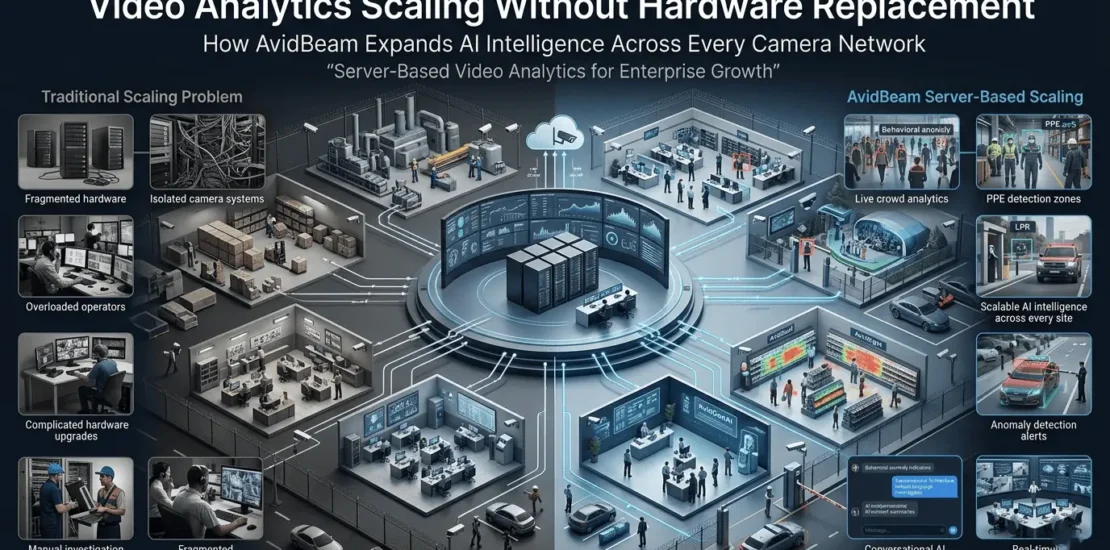
Video analytics scaling, the ability to extend analytical coverage across more cameras, more sites, and more detection use cases without starting from scratch, is where most platforms fall short and where AvidBeam‘s server-based architecture was specifically designed to hold up.
The sections below break down what video analytics scaling actually requires at the infrastructure level, how AvidBeam‘s product suites handle it across different facility types, and where the operational gains show up as an organization’s camera network grows.
Why Video Analytics Scaling Fails in Most Deployments
The scaling problem in video analytics is that most analytics platforms are tied to proprietary hardware or cloud pipelines that create hard limits on how far the analytical layer can extend, and at what cost per camera.
AvidBeam‘s server-based architecture was built to sidestep constraints. The analytics processing runs on centralized servers, which means adding cameras adds load to the server.
Server-Based Video Analytics: The Architecture Behind AvidBeam Solutions
Server-based video analytics processes camera feeds centrally, not at the camera or edge level. The architectural choice has direct consequences for how video analytics scaling works in practice, consequences that show up in flexibility and detection capability as deployments grow.
What server-based processing makes possible:
- Camera feeds from any ONVIF-compliant camera, regardless of brand, model, or age, feed into the central analytics server; new cameras added to the network are immediately processable without new endpoint hardware.
- Detection models run on server-grade compute, more complex behavioral models and multi-stream analysis run at the same accuracy level across 10 cameras or 500.
- The full camera network is queryable as a single data set, cross-zone and cross-site intelligence, forensic search, and centralized alerting all operate across the entire deployment from one interface.
- Deployment models (on-premise, private cloud, public cloud, or hybrid) are a configuration choice.
- VMS integration with Milestone, NetworkOptix, and Genetec means the analytics layer connects to whichever management system a site already runs.
The baseline infrastructure requirement per camera processed: 2GB RAM minimum and one virtual core at 2.4 GHz minimum, with multiple GPU configurations supported for higher-density deployments.
| To find out how AvidBeam‘s server-based platform scales to your current camera network and planned expansion, send an email to AvidBeam‘s technical team for a deployment assessment. |
About AvidBeam’s Product Suites
Video analytics scaling is only operationally meaningful if the analytics capabilities that scale are actually relevant to the environments being covered. AvidBeam‘s platform covers five product suites, each targeting a distinct operational layer:
AvidGuard
AvidGuard handles behavioral threat detection across perimeter boundaries and internal zones. As a deployment scales to more zones or sites, AvidGuard‘s detection coverage extends across every new camera feed without per-zone rule reconfiguration.
- Intrusion, tailgating, loitering, and fence-crossing detection across all monitored zones.
- Left object detection, fire and smoke detection, and crowd density alerts per zone with configurable thresholds.
- Personal Protective Equipment (PPE) compliance verification (helmets, vests, gloves, goggles, and footwear) is continuously verified in industrial and technical areas across every shift.
- Scene change detection and anomaly detection based on per-zone behavioral baselines.
- Weapons detection within the camera’s field of view for immediate response triggering.
AvidFace
AvidFace scales identity verification across access tiers, sites, and personnel categories without per-site watchlist reconfiguration. As new locations come online, the same whitelist, blacklist, and VIP list infrastructure extends across every new access point.
- Facial recognition with over 90% accuracy at entry points.
- Watchlist management with real-time alerts when listed individuals appear at any monitored point across the full deployment.
- Zone-level individual movement tracking by date, time, and location.
- Image-based historical search across the full recorded footage network.
- Attribute detection covering age, gender, eyewear, and headwear for access profiling in restricted zones.
AvidAuto
AvidAuto covers vehicle management at gates, access roads, and parking across any number of sites through three integrated products. Watchlist management extends across all monitored entry points as new sites are added.
- AB-Vehicle Analytics – License Plate Recognition (LPR) at 98%+ accuracy for Arabic plates and 92%+ for English.
- AB-ITS – wrong-direction detection, illegal parking alerts, slow and stopped vehicle detection, and traffic density analytics through configurable dashboards.
- AB-Smart Parking – real-time occupancy visibility, double-parking detection, and blocking entrance and exit alerts across all monitored parking and staging areas.
AvidSight
AvidSight is AvidBeam‘s video analytics suite for retail and banking environments, the product suite where video analytics scaling produces direct commercial intelligence gains as more store locations or branch sites come online. It runs two specialized modules.
AB-Retail delivers operational and behavioral intelligence for retail environments:
- Visitor counting and traffic forecasting
- Customer pathway analysis
- Heatmap analysis
- Dwell time analysis
- Occupancy management
AB-Smart Banking covers operational risk and service monitoring in banking environments:
- ATM usage violation detection
- Employee presence monitoring
- Unattended cash detection
- Customer service counting
- Vault access policy enforcement
For retail chains and banking networks expanding across new branches or store locations, AvidSight is where video analytics scaling turns a growing camera network into a growing commercial intelligence asset.
AvidGenAI
AvidGenAI is a Vision Language Model that converts video footage into natural-language text and enables two-way conversational queries across the full analytics platform. Its value in video analytics scaling contexts is direct: as the camera network grows, the investigation and query capability scales with it without adding investigation staff proportionally.
Where Video Analytics Scaling Produces the Clearest Operational Gains
The operational gains break down differently by environment type:
| Environment | Primary Scaling Gain | AvidBeam Suite |
| Retail chains | Cross-location customer behavior intelligence; unified occupancy and pathway data across all stores | AvidSight (AB-Retail) |
| Banking networks | Branch-level ATM, vault, and service compliance monitoring at scale without additional audit staff | AvidSight (AB-Smart Banking) |
| Industrial campuses | Continuous PPE compliance and perimeter behavioral detection across multiple production zones and shifts | AvidGuard |
| Multi-site government facilities | Unified identity verification and zone intrusion detection across all locations; single watchlist management layer | AvidFace + AvidGuard |
| Logistics and distribution | LPR and vehicle watchlist coverage scaling to every gate across multiple facilities without per-site hardware | AvidAuto |
| Event venues | Crowd density and behavioral detection scaling from one venue to multiple simultaneous event zones without per-venue reconfiguration | AvidGuard + AvidSight |
| Mixed-use developments | Single analytics platform covering retail, parking, access control, and security across a full property portfolio | All five suites unified |
Frequently Asked Questions
What is video analytics?
Video analytics is the automated processing of camera footage through AI and machine learning models to extract structured, actionable intelligence from what the cameras record.
A camera on its own produces footage. Video analytics produces detections, alerts, counts, patterns, and records in real time and across every camera feed without requiring a human to watch each one.
What are the different types of video analytics?
Video analytics breaks down across several distinct capability categories, each targeting a different layer of operational or security intelligence:
- Behavioral detections
- Identity outputs
- Vehicle intelligence
- Occupancy and flow data
- Compliance verification
For organizations evaluating video analytics scaling, the relevant question is which platform architecture supports adding new capability categories as operational requirements evolve, without replacing infrastructure each time.
AvidBeam‘s server-based video analytics platform processes all of these across existing ONVIF-compliant camera infrastructure, with 2GB RAM and one virtual core at 2.4 GHz minimum per camera.
Is video analytics considered AI?
Yes, modern video analytics is built on AI, specifically on computer vision models trained to recognize objects, behaviors, identities, and spatial patterns within video frames. The AI layer is what separates video analytics from motion detection or basic pixel-change alerting, which preceded it and operates without any learned intelligence.
The specific AI technologies that underpin video analytics platforms like AvidBeam‘s:
- Deep learning and neural networks
- Computer vision
- Machine learning for baseline modeling
- Vision Language Models (VLMs)
- Optical Character Recognition (OCR)
To kick off a technical evaluation for your organization’s video analytics scaling requirements, reach out to AvidBeam‘s technical team directly via email. The team will follow up with a deployment assessment matched to your current camera infrastructure.
1 Comment
Comments are closed.
[…] Also you can learn more about: Scaling Video Analytics […]