
Camera Software Architecture: 6 Critical Questions Every Security Director Must Answer
- January 11, 2026
- Posted by:
- Categories: Articles, Articles & Blogs
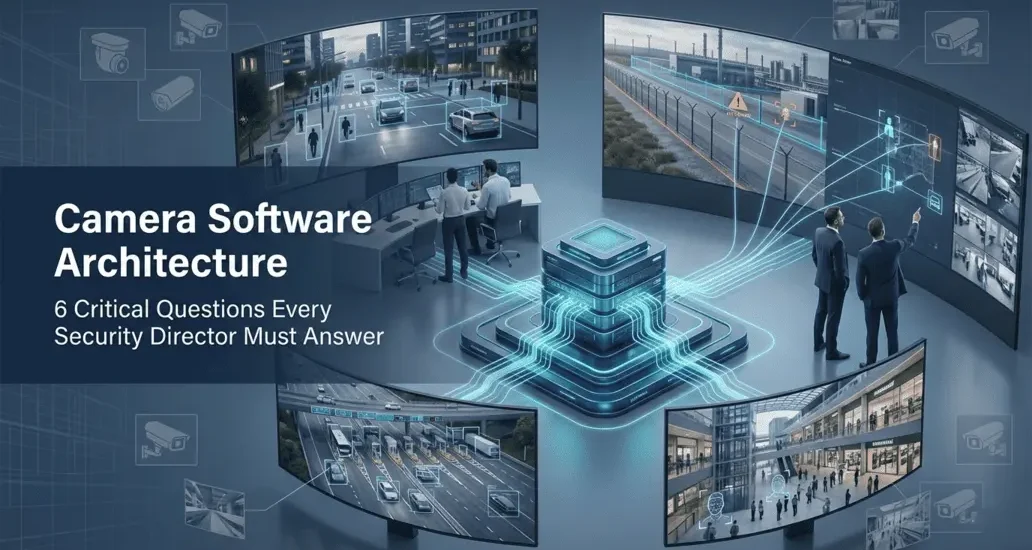
Organizations deploying traditional surveillance cameras rather than smart camera software across enterprise environments encounter a persistent challenge: surveillance systems generate massive video data without extracting actionable intelligence, and security teams monitor hundreds of feeds manually, missing critical incidents.
AvidBeam addresses this operational gap through AI-powered video analytics camera software that transforms passive recording into active intelligence, processing millions of video frames daily across deployments spanning smart cities, industrial facilities, transportation infrastructure, and commercial environments.
As the fundamental problem extends beyond detection capabilities, companies invest substantially in camera hardware expecting comprehensive security coverage, yet discover their systems cannot correlate data across multiple sites, distinguish genuine threats from false alarms, or coordinate responses between security layers. These operational limitations stem from architectural decisions made during initial deployment. Organizations face a critical choice when evaluating camera software: localized processing embedded within individual hardware units versus centralized platforms that coordinate intelligence across entire camera networks. This distinction matters far more than most decision-makers initially recognize, particularly when scaling across multiple locations, integrating with complex security ecosystems, or managing operations where real-time coordination between systems determines success.
Q1: What Core Functions Does Smart Camera Software Perform Across Modern Security Deployments?
- Smart camera software transforms raw video streams into structured intelligence through multiple analytical layers. These video analytics platforms execute object detection, tracking movement patterns across frames, and identifying vehicles, individuals, or specific behaviors within monitored zones.
- Beyond basic detection and recognition, camera software manages system coordination, and smart video analytics platforms synchronize multiple video feeds, correlate data across camera networks, and trigger automated responses when specific conditions materialize.
Also you can learn more about: Scaling Video Analytics
Q2: How Does Smart Camera Software Architecture Impact Multi-Site Security Management?
Server-based camera software platforms deliver centralized administrative control that transforms how security teams manage distributed deployments. Updates, configuration changes, and security patches are deployed at the same time across entire camera networks from unified interfaces.
Data aggregation capabilities separate architectural approaches most distinctly. When facial recognition operates independently on individual cameras, each unit identifies faces within its local field of view. But server-based video analytics correlates recognition data across multiple locations, tracking individual movement patterns and detecting when the same person appears at separate facilities, and the cross-site correlation enables behavioral analysis impossible within hardware constraints.
Server-Based Video Analytics Operational Advantages:
- Synchronized alert protocols across distributed facilities
- Historical pattern analysis drawing from multiple camera feeds
- Coordinated response activation spanning security zones
- Centralized audit trail generation for compliance requirements
Manufacturing facilities demonstrate these advantages practically, and when server-based camera software detects unauthorized individuals at perimeter cameras, the platform alerts security personnel, activates recording at specific zones, and locks relevant entry points through integrated access control systems (Hardware-embedded alternatives lack this coordination capability because each camera operates as an isolated unit, making autonomous decisions).
Learn more about: Camera with Face Recognition
Q3: What Role Does Camera Software Play in Real-Time Operational Coordination?
Enterprise operations depend on synchronized intelligence flowing from security systems to operational management. Smart camera software coordinates access control systems with recognition capabilities, creating unified response protocols.
When unauthorized individuals attempt facility entry, smart video analytics platforms execute coordinated responses: alerting security personnel, locking relevant entry points, and activating recording on specific camera zones.
Success Story: Sound Storm Festival 2024 & 2025 in Riyadh managed 450,000+ attendees (each) through AvidBeams intelligent monitoring systems that analyzed crowd density across multiple zones, identified bottleneck formations before dangerous conditions emerged, and coordinated security responses across distributed personnel teams. |
Q4: How Does Camera Software Enable Predictive Operations Beyond Reactive Response?
Server-based video analytics architecture processes historical and current data, establishes baseline operational patterns, and flags deviations immediately. Smart camera software analyzes facility operations across weeks and months, determining what normal behavior looks like. When anomalies occur (unusual loitering, unexpected access patterns, equipment operating outside typical cycles), the platform identifies deviations before human operators detect irregularities.
Manufacturing environments benefit from visual pattern recognition that identifies equipment degradation. Machinery operating incorrectly generates observable signatures: vibrations causing positioning shifts and movement characteristics altering. Server-based camera software detects these patterns before equipment failure materializes, enabling preventive maintenance rather than emergency repair.
Server-Based Video Analytics Predictive Capabilities Extend to:
- Safety compliance monitoring through automated Personal Protective Equipment (PPE) detection
- Access pattern analysis identifying potential security vulnerabilities
- Behavioral anomaly detection across multiple facility zones
- Equipment operational monitoring through visual signature analysis
Success Stories:
|
Q5: What Distinguishes Camera Software Failure Resilience Between Processing Architectures?
System failure scenarios reveal architectural resilience differences that impact operational continuity. If a hardware-embedded camera fails, organizations lose complete analytical capability at that specific location. Replacing failed cameras requires reconfiguring parameters and redeploying credentials. Security teams choose between accepting operational gaps or incurring emergency replacement costs.
Server-based video analytics software maintains analytical capabilities independent of individual hardware failures. Camera hardware failure affects only that single input stream while centralized intelligence remains fully operational. The platform (such as AvidBeam’s) deploys immediately to replacement cameras without software reinstallation or parameter reconfiguration because processing logic persists on centralized infrastructure rather than residing within individual camera units. This architectural distinction creates different total cost of ownership profiles.
Server-Based Video Analytics Resilience Factors Include:
- Centralized backup and disaster recovery protocols
- Fast hardware replacement without software reconfiguration
- Persistent intelligence independent of camera failures
- Reduced emergency response costs and operational downtime
Success Stories: Madinaty, serving 600,000 people, relies on AvidBeam platforms for integrated security and operational management. Also, New Alamein City and Knowledge City in Egypt’s New Capital implement similar AvidBeam solutions. |
Q6: Which Video Analytics Features Drive Enterprise Adoption?
Modern video analytics solutions extend far beyond basic video recording through integrated analytical suites addressing specific operational requirements.
- License plate recognition (LPR) supports mobility management, security verification, and enforcement across traffic networks.
- Vehicle classification identifies make, model, and type while tracking entry and exit patterns.
- Watchlist management maintains allow, deny, and VIP categories with automated alert generation.
- Facial recognition platforms provide individual tracking by name, date, time, and location while supporting partial face recognition.
- Intelligent traffic systems detect violations automatically: traffic light violations, wrong direction travel, lane change infractions, illegal parking, mobile phone usage while driving, and seatbelt non-compliance.
- Parking management capabilities monitor occupancy in real-time, distinguishing empty versus occupied spaces and detecting blocking violations at entrance and exit points.
Learn more about: Face recognition systems
All in All
Smart camera software represents an architectural choice with operational consequences extending across security effectiveness, system scalability, maintenance requirements, and total ownership costs.
AvidBeam processes millions of video frames daily through an AI-powered video analytics solution spanning multiple analytical domains. Deployments across smart cities (Mostakbal City, Estates by Sodic), industrial facilities (Coca-Cola Egyptian facilities), entertainment venues (Qiddiya), and retail environments (Cairo Festival City Mall, City Stars Mall) demonstrate platform versatility across operational contexts.
Also you can learn more about: Guest Analytics