
Traffic Detection in 2026: How AvidBeam’s AI Platform Catches What Manual Monitoring Misses
- May 18, 2026
- Posted by:
- Categories: Articles, Articles & Blogs
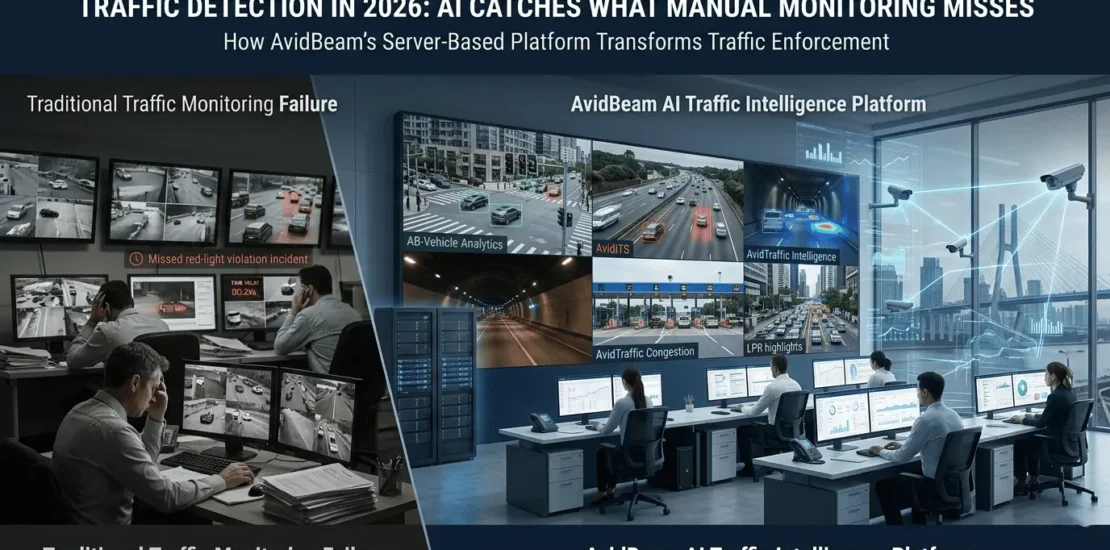
The footage exists. The violations happened. Nobody caught them in time.
That is the operational reality behind most traffic detection setups in use today. Cameras cover intersections, access roads, and highway segments, but without an analytical layer processing those feeds continuously, detection depends entirely on whether the right operator was watching the right screen at the right moment. At scale, that is not a detection system. It is a documentation system.
AvidBeam’s server-based AI platform changes that equation through two tightly integrated products: AB-Vehicle Analytics, which handles license plate recognition, vehicle classification, watchlist management, and forensic search; and AB-ITS (Intelligent Traffic Systems), which covers the enforcement layer, red-light violations, wrong-way driving, lane switching, illegal parking, mobile phone detection, seatbelt detection, and traffic density analytics. Both process every connected camera feed continuously, without attention constraints, without coverage gaps during shift changes, and without the false-positive rates that erode operator response discipline over time.
How Server-Based Traffic Detection Closes the Gap
The architecture behind a traffic detection platform determines its ceiling. Camera-embedded or edge-based analytics are constrained by each unit’s local compute capacity, which degrades under low-light conditions, adverse weather, and high-speed multi-lane traffic. Server-based platforms apply consistent, updatable AI models across every connected camera from a centralized infrastructure, which is the only architecture that holds detection accuracy steady as environmental conditions shift.
AvidBeam’s platform runs all detection processing at the server level, which means:
- New detection capabilities and updated AI models deploy across all connected cameras through software, no hardware replacement required
- Detection accuracy is not limited by what individual camera hardware can compute locally
- Multi-site traffic networks manage all analytics through a single unified interface
- Any ONVIF-compliant camera already on the network becomes part of the traffic detection infrastructure without additional investment
The practical consequence: organizations extend intelligent traffic detection coverage to cameras already installed across road networks, intersections, and access corridors, rather than committing to a hardware refresh before analytics can begin.
AB-Vehicle Analytics: The Intelligence Layer Beneath Every Detection
Effective traffic detection starts with accurate vehicle identification. Without a reliable vehicle intelligence layer, enforcement documentation breaks down before cases are filed, missing plate reads, misclassified vehicle types, and timestamp gaps that make citations unenforceable.
AB-Vehicle Analytics handles this foundation across every AvidBeam traffic detection deployment:
- License Plate Recognition (LPR): 98%+ accuracy for Arabic plates and 92%+ for English, across moving vehicles at real road speeds
- Vehicle classification: identifies vehicle type, color, and model alongside the plate read, giving enforcement coordinators the full vehicle profile without manual review
- Watchlist management: deny lists, allow lists, and VIP lists cross-referenced against every plate detected at every monitored point in real time, not in the next day’s batch report
- Forensic search: post-incident investigation by date, time, location, plate number, and plate type across the full recorded network, pulling the specific footage needed without manually scrubbing hours of raw video
Every detection event is logged automatically with a timestamp, camera source and location identifier, plate number, plate type, vehicle color and model, and a clip of the event with metadata overlay. That documentation chain is what makes enforcement cases fileable rather than dropped.
AB – ITS: Enforcement-Grade Traffic Detection Across Every Violation Type
AB – ITS (Intelligent Traffic Systems) is the enforcement layer that sits on top of the vehicle intelligence AB-Vehicle Analytics provides. It applies deep learning models trained on specific violation types to each video stream in real time, generating alerts the moment a violation occurs, not when someone reviews the footage at the end of shift.
Red-Light and Intersection Violations
Traffic light violation detection fires the instant a vehicle crosses an intersection against a red signal. The alert includes the plate read, timestamp, camera source, and an event clip, the complete documentation package that enforcement coordinators need to issue a citation without additional manual steps.
The detection logic applies per-lane and per-intersection rules, which means it distinguishes between vehicles clearing an intersection on amber and vehicles running a red, rather than generating alerts on every vehicle that crosses the stop line.
Wrong-Way and Lane-Based Violations
Wrong-direction detection alerts operators immediately when a vehicle moves against the configured permitted direction for that road segment. The detection is continuous and covers every monitored road at once, the wrong-way driver on segment 14 and the lane violation on segment 31 are both flagged simultaneously, without requiring anyone to be watching either feed.
Lane switching violation detection identifies vehicles that improperly change lanes or enter restricted lanes, bus lanes, emergency lanes, and HOV lanes, with operator-configured lane boundaries per road segment. Each flagged event includes plate data, timestamp, and camera source, which is the documentation enforcement teams need for lane-specific citations.
Stopped and Slow Vehicle Detection
Slow and stopped vehicle detection surfaces hazards in live lanes, tunnel approaches, and merge zones before field response is needed. A vehicle stopped in an active highway lane is a secondary accident risk; detecting it in real time and alerting the operations center within seconds of the stop, rather than when a following driver reports it, changes the response window materially.
The same detection logic covers vehicles parking in prohibited zones: fire lanes, bus stops, loading zones, and emergency access points. Detection is continuous. The alert fires the moment the vehicle stops in a restricted area, not when a patrol vehicle happens to pass.
Driver Behavior Violations
Mobile phone detection identifies drivers holding a phone to their ear or actively using a device while driving. Seatbelt detection identifies drivers not wearing seatbelts at camera-covered intersections and road segments. Both violation types are logged per event with location, time, and vehicle information, giving compliance program managers the dataset they need to report violation rates by location and time period across the full monitored network, rather than at manually checked points only.
Watchlist Integration: When Traffic Detection Meets Access Control
Most traffic management setups maintain vehicle watchlists, reported plates, unauthorized vehicles, VIP lists, but these lists exist in separate systems that are not connected to live camera feeds. A reported vehicle can pass through a monitored intersection and nothing happens because the plate recognition layer is not cross-referencing in real time.
AB – Vehicle Analytics integrates watchlist management directly into the traffic detection pipeline:
- Deny lists, trigger immediate alerts for reported or unauthorized vehicles the moment they are detected at any monitored point across the full network
- Allow lists, let authorized vehicles clear automated checkpoints without manual verification, which reduces queue formation at access-controlled road segments
- VIP lists, give designated vehicles priority routing or access permissions based on operator configuration
When a vehicle on any of these lists passes through a monitored zone, the alert fires with the plate read, vehicle data, and location, in real time, not in the next day’s review report. For law enforcement and security operations that run vehicle watchlists as part of their operational mandate, that real-time cross-referencing is what makes the list operationally useful rather than retrospectively interesting.
Traffic Density Analytics and Operational Planning
Enforcement is one output of traffic detection. Operational planning is the other, and it depends on structured density data rather than violation events.
AB – ITS includes traffic density analytics that processes volume and distribution patterns across monitored road segments continuously. The data feeds directly into:
- Congestion forecasting by hour, day, and location, which gives traffic operations teams the lead time to deploy field resources before congestion develops, not after it has already affected incident response times
- Incident response planning, identifying which segments carry the highest density at which times, so that field team positioning reflects actual traffic patterns rather than historical assumptions
- Infrastructure decision support, producing the structured dataset that road planning and transport engineering teams need to evaluate intersection timing, lane configuration, and network capacity
The same density data that supports enforcement workflow also supports planning workflow, through the same platform and the same camera network, without requiring a separate traffic counting infrastructure.
Night – Weather and High-Speed Conditions
Traffic violations do not stop when lighting conditions deteriorate. Wrong-way driving, red-light running, and illegal parking in emergency lanes happen across all hours, all weather conditions, and all lighting environments. Camera-embedded detection systems are constrained by each unit’s local processing capacity, which degrades under low-light, fog, rain, and high-speed vehicle conditions.
AvidBeam’s server-based traffic detection platform processes all video feeds through centralized infrastructure with computational resources that individual camera hardware cannot match. Detection models run consistently across:
- Low-light and nighttime conditions across all monitored road segments
- Variable weather including fog and rain, conditions where edge-based systems see the sharpest accuracy drops
- High-speed vehicle movement across multiple lanes simultaneously
- Mixed traffic environments with pedestrians, motorcycles, and heavy vehicles in the same frame
The consistency matters operationally because enforcement programs that only work reliably during daylight and clear weather are not programs that road safety managers can report against with confidence.
Traditional vs. AvidBeam Traffic Detection
The table below sets out where AvidBeam’s platform diverges from what traditional traffic detection infrastructure delivers at the operational level.
| Violation Type | Traditional Traffic Detection | AvidBeam AB – ITS + AB-Vehicle Analytics |
| Red-light violations | Requires an officer at the intersection | AB – ITS fires an alert the instant a vehicle crosses against a red signal, with plate, timestamp, and clip |
| Wrong-way driving | Spotted only if someone is watching the right feed | Wrong-direction detection generates a real-time alert across every monitored road segment simultaneously |
| Lane switching violations | No automated enforcement in standard setups | AB – ITS identifies improper lane changes and restricted-lane entries with plate data and camera source |
| Illegal parking | Patrol-dependent; intermittent coverage | Continuous zone-based detection with real-time alerts the moment a vehicle parks in a prohibited area |
| Mobile phone & seatbelt | Requires a stationed officer for direct observation | AB – ITS detects both violations through video analytics at every camera-covered road segment |
| Watchlist vehicles | No live cross-referencing against plate databases | AB-Vehicle Analytics fires an alert at the moment a listed plate is detected at any monitored point |
| Post-incident investigation | Manual footage scrub; hours per case | Forensic search by date, time, location, plate, and vehicle type; minutes per case |
| Night and adverse conditions | Detection accuracy degrades at camera level | Server-based processing maintains consistent detection across low-light, fog, rain, and high-speed traffic |
The distinction is not incremental. Traditional traffic detection produces footage. AvidBeam’s platform produces enforcement-ready events, watchlist alerts, density data, and forensic search, across every camera feed, continuously, without the coverage gaps that manual monitoring cannot avoid.
Deployment and Infrastructure Requirements
AvidBeam’s traffic detection platform layers onto camera infrastructure organizations already have in place. The analytics processing runs at the server level, not at the camera or edge level, which means any ONVIF-compliant camera already covering a road segment, intersection, or access point feeds directly into the platform without hardware replacement.
The baseline infrastructure requirement per camera processed:
- 2GB RAM minimum
- One virtual core at 2.4 GHz minimum; multiple GPU configurations supported for higher-density deployments
- Camera resolution: 2MP up to 4K
- Lens focal length: 3mm to 25mm
- Pitch -15° to +15°; roll -180° to +180°; yaw -15° to +15°
VMS integration covers Milestone, NetworkOptix, and Genetec platforms. Deployment options, on-premise, private cloud, public cloud, or hybrid, are configurable based on the organization’s data governance and operational requirements. For traffic authorities and municipalities with strict data sovereignty requirements, local on-premise processing means footage and detection data never leave the facility.
AvidBeam’s Verified Traffic and ITS Deployments
AvidBeam has deployed its traffic detection and ITS capabilities across operational environments in Saudi Arabia and the wider Middle East region, environments where the camera infrastructure was already in place and the requirement was adding an intelligence layer on top of it.
STC Sawaher Project KSA (2024)
AvidBeam implemented a full combination of solutions across the STC Sawaher project, including AvidAuto for License Plate Recognition (LPR) and traffic flow monitoring. AvidGuard provided early-warning alerts for anomalies and unusual behavior. CCTV heatmap data fed directly into the centralized operations view, a deployment that combined traffic detection with broader facility intelligence in a single platform.
KAPSARC Saudi Arabia (2024)
At the King Abdullah Petroleum Studies and Research Center, AvidBeam deployed AvidGuard for early-warning alerts covering traffic violations across the research center’s road and access network, alongside AvidFace for individual tracking within facility locations.
Qiddiya Saudi Arabia (2024)
AvidAuto managed vehicle count, license plate recognition, and access control at entrances across the entertainment destination’s facilities, a deployment that combined traffic detection with vehicle access management across a large multi-zone site.