
Smart Data Center 2026: A 9-Question Guide to AI Video Analytics
- April 21, 2026
- Posted by:
- Categories: Articles, Articles & Blogs
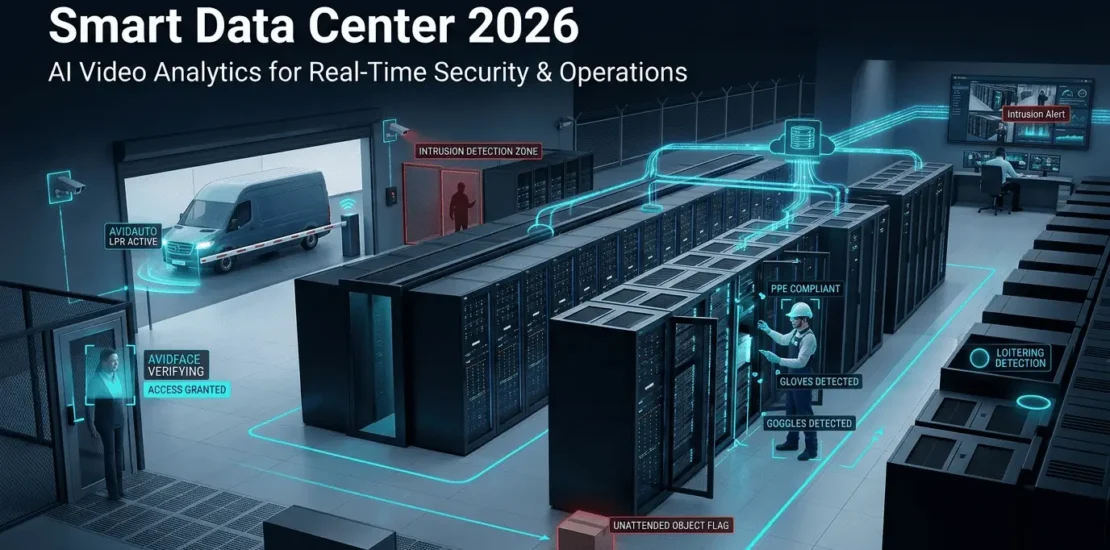
Physical security in a smart data center carries operational and compliance weight that passive surveillance was never designed to handle.
- Cameras record.
- Incidents get investigated hours later.
- Access violations get flagged after the fact.
Meanwhile, the hardware, personnel, and regulatory obligations inside the facility demand continuous, verified oversight.
Smart Data Center Physical Security: Questions and Answers
AvidBeam‘s AI video analytics platform addresses the specific physical security gaps that affect smart data center operations:
- Access verification
- Perimeter integrity
- Personal Protective Equipment (PPE) compliance
- Vehicle management
- Forensic investigation speed
The following questions break down exactly how:
1. What are the key use cases of video analytics in smart data centers?
A smart data center generates operational and security data continuously, through camera feeds, access events, vehicle movements, and personnel activity across multiple zones.
Video analytics converts that raw footage into structured, actionable intelligence across several operational layers:
Access point security
Tailgating detection at server rooms and power zones.
Perimeter monitoring
Behavioral intrusion detection that distinguishes actual threats from environmental motion.
Identity verification
Facial recognition for permanent staff, contractors, hardware vendors, and authorized visitors.
PPE compliance
Automated verification of helmets, gloves, safety goggles, and footwear in raised-floor zones and cooling corridors.
Vehicle and delivery management
License plate recognition (LPR) at facility access roads, with watchlist cross-referencing at the gate.
Forensic investigation
Natural-language video search across the full camera network.
Anomaly detection
Baseline behavioral learning per monitored zone.
2. Can video analytics improve operational efficiency in data center infrastructure?
The efficiency gains from AI video analytics in a smart data center environment are operational. Manual workflows that consume significant staff time get replaced by continuous automated detection:
- Post-incident investigation drops from hours of sequential footage review to minutes of query-based results through AvidBeam‘s AvidGenAI module.
- Gate vehicle management with License Plate Recognition (LPR) removes manual identity verification steps at delivery and contractor access points.
- Security team dispatching becomes event-driven rather than patrol-based.
- Access logs generated automatically across every zone provide audit-ready records without manual data assembly.
3. Can AI video analytics improve physical security without replacing existing camera infrastructure?
AvidBeam‘s platform is a server-based analytics layer. For most smart data center environments, the existing camera infrastructure supports full deployment without new installations. The baseline technical requirements per camera processed:
| Requirement | Specification |
| Memory per camera | 2GB RAM minimum |
| Processing | One virtual core at 2.4 GHz minimum; multiple GPU configurations supported |
| Camera resolution supported | 2MP up to 4K |
| Protocol compliance | ONVIF-compliant |
| VMS integration | Milestone, NetworkOptix, Genetec |
| Deployment models | On-premise, private cloud, public cloud, or hybrid |
4. What specific operational problems in data center infrastructure does AvidGuard solve?
AvidGuard is AvidBeam‘s behavioral threat detection product. In a smart data center context, it directly addresses the access and perimeter security gaps that motion-only detection systems cannot close:
- Tailgating at controlled access points
- Loitering near restricted zones
- Intrusion detection
- Fence crossing detection
- Left object detection
- Fire and smoke detection
- Crowd detection
- Scene change detection
5. How does AvidFace enhance access management in a data center?
A smart data center manages access across personnel categories that each carry different zone permissions.
Credential checks create throughput delays at entry points and leave verification gaps that badge-only systems do not resolve.
AvidFace automates identity verification across these categories:
- Facial detection and recognition verify identity with over 90% accuracy at entry points, even when faces are partially covered.
- Watchlist management: whitelist, blacklist, and event-specific lists; automatic real-time alerts when any listed individual is detected at a monitored access point.
- Zone-level movement tracking: full movement history by date, time, and location for post-incident review or compliance audits.
- Attribute detection: age, gender, eyewear, and headwear for access profiling and restricted-zone compliance verification.
- Image-based historical search: upload a reference photo and locate matching individuals across historical footage.
6. How does AvidGenAI reduce investigation time and improve compliance?
AvidBeam‘s AvidGenAI module is a Vision Language Model that converts video footage into natural-language text and enables two-way conversational queries across the full analytics platform.
For a smart data center operations team managing large camera networks across distributed zones, the query capability removes the manual data extraction bottleneck from incident response entirely.
From a compliance standpoint, this capability matters in several specific ways:
- Audit requests that previously required manual footage assembly can be fulfilled through direct query-based retrieval.
- Access logs tied to specific incidents are generated automatically, with location and timestamp data that meets documentation requirements for regulated industries.
- Anomaly reports across zones can be pulled on demand, supporting periodic compliance reviews without manual data preparation.
7. Can AI video analytics reduce the number of physical security guards needed in a data center?
AI video analytics does not eliminate the need for security personnel, but it changes what those personnel need to do. In a smart data center environment, the shift is from patrol-based coverage to event-driven response:
- Guards no longer need to monitor every camera feed; automated detection surfaces real events that require human response.
- Perimeter patrol rounds get replaced by real-time alerts from AvidGuard‘s intrusion, loitering, and fence-crossing detection, and coverage becomes continuous rather than periodic.
- Access point verification at entry points can run through AvidFace‘s automated identity checks, reducing the need for manual credential review at each gate.
- Incident investigation that previously required dedicated staff hours becomes a query-based task through AvidGenAI.
8. How does PPE compliance verification reduce risk in data center technical areas?
Power rooms and cooling corridors in a smart data center present consistent physical hazards for maintenance and contractor personnel. Personal Protective Equipment (PPE) requirements in these areas are defined, but enforcement through supervisor presence or inspection schedules creates unverified windows between checks.
AvidGuard‘s PPE compliance module runs continuously across designated zones:
- Detects the presence or absence of safety goggles, helmet and protective footwear in real time.
- Generates zone-specific alerts when non-compliant individuals are detected, allowing immediate corrective action rather than after-the-fact documentation.
- Produces compliance records per zone and per time window, providing the audit trail that safety regulations require without manual data entry.
- Operates across the full shift; coverage does not depend on inspector availability or schedule.
9. How does vehicle analytics prevent supply chain attacks on data center infrastructure?
Loading docks and delivery access points are the most operationally active entry vectors into a smart data center campus. Hardware deliveries, contractor vehicles, and service provider access create a continuous inflow that manual gate checks struggle to verify consistently.
AvidBeam‘s AvidAuto suite covers this layer through three integrated products:
AB-Vehicle Analytics
LPR processes both Arabic and English characters with 98%+ accuracy for Arabic plates and 92%+ for English; vehicle classification by make, model, and type.
AB-ITS (Intelligent Traffic Systems)
Wrong-direction detection on access roads; illegal parking alerts in emergency lanes and restricted zones; slow and stopped vehicle detection in active traffic zones; traffic density analytics through configurable dashboards.
AB-Smart Parking
Real-time occupancy across staging areas; double-parking detection; blocking entrance and exit alerts for obstructions at critical access points.
To kick off a technical assessment for your facility’s specific camera setup and access control requirements, reach out to AvidBeam‘s technical team directly via email. The team will follow up with a deployment evaluation tailored to your environment.