
How Server-Based Loitering Detection Analyzes Behavior Across Multiple Locations
- November 18, 2025
- Posted by:
- Categories: Articles, Articles & Blogs
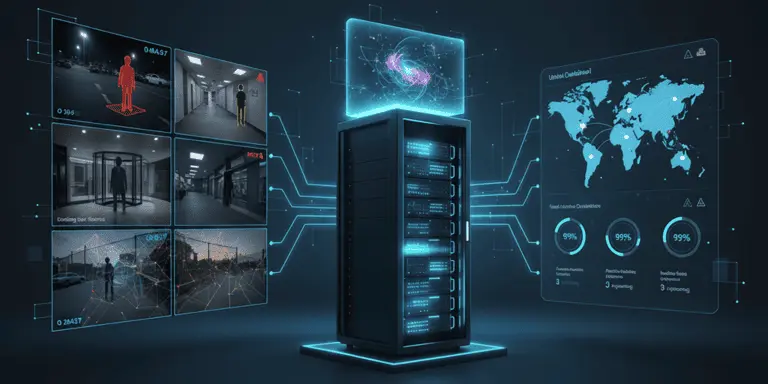
Business owners and security professionals understand a fundamental truth: loitering detection technology is critical when discussing facility security and operational continuity. Security threats emerge from ordinary patterns, hiding within everyday routines until suspicious behaviors escalate into serious incidents. Traditional surveillance infrastructure waits passively, recording loitering after individuals have already established a presence near facilities.
On the contrary, deploying loitering detection through server-based video analytics equals converting passive cameras into predictive intelligence networks capable of behavioral pattern recognition and threat identification before escalation occurs, and with generative AI integration on the horizon, these systems will soon explain their findings in natural human language.
What Is Loitering Detection and Why Does Architecture Matter?
Loitering detection automatically identifies individuals remaining in specific locations beyond expected durations through video analytics, distinguishing between legitimate activities and suspicious behaviors requiring investigation. However, the fundamental architecture, hardware-embedded processing versus server-based video analytics, determines accuracy, scalability, and total cost of ownership over deployment lifespans.
Traditional systems integrate processing within individual cameras, where built-in algorithms analyze behavior locally. Server-based loitering detection centralizes intelligence on dedicated infrastructure, processing video streams from multiple camera feeds through unified algorithms and coordinated logic.
The Technology Powering Modern Loitering Detection
Systems integrate several technologies working together to distinguish legitimate presence from suspicious lingering:
1. Computer Vision and Object Tracking
Computer vision processes visual information at speeds impossible for human observers, analyzing multiple video streams.
Server-based solutions track individuals moving between multiple camera zones and maintain continuous identity rather than treating each camera observation as an independent event.
2. Machine Learning Algorithms
Machine learning algorithms learn from data patterns to recognize behaviors and predict outcomes with remarkable accuracy. Deep learning networks differentiate between individuals waiting for legitimate purposes versus suspicious loitering.
3. Behavioral Pattern Recognition
Beyond simple duration thresholds, sophisticated analysis examines movement patterns revealing intent. Individuals engaged in reconnaissance exhibit distinct behaviors such as repeated approaches to entry points. AvidGuard: AvidBeam‘s Server-Based Solution
AvidGuard from AvidBeam Technologies represents a comprehensive server-based video analytics software platform integrating loitering detection with multi-threat recognition capabilities. Rather than deploying separate specialized systems, multiplying costs and maintenance requirements, AvidGuard delivers unified security intelligence through centralized processing.
AvidGuard Features
AvidGuard transcends single-purpose loitering detection to deliver comprehensive threat recognition through a unified platform:
- Intrusion Detection: Unauthorized access to restricted areas triggers immediate alerts
- Abandoned Object Identification: Suspicious packages left unattended generate security notifications
- Crowd Monitoring: Unusual gatherings or overcrowding situations receive proactive management
- Anomaly Detection: Atypical behaviors indicating potential threats flag security attention
- Smoke and Fire Detection: Early warning for emergencies enables rapid response
- PPE Compliance Verification: Industrial environments ensure workers wear the required safety equipment
Also you can learn more about: Suspicious object detection
AvidBeam Real-World Success Stories
Here are some success stories of AvidBeam:
1. SABIC, Saudi Arabia
SABIC, one of the world’s largest petrochemical companies, deployed AvidGuard across facilities, managing thousands of workers in highly sensitive environments. Capabilities enhance perimeter security by identifying unauthorized individuals lingering near restricted zones.
2. MARS Factory, Egypt
MARS Factory utilizes AvidGuard for facility security in food manufacturing environments requiring strict hygiene and access control protocols. The system monitors employee presence at designated locations while identifying unauthorized individuals lingering near restricted production areas.
Server-based architecture enables MARS to coordinate loitering detection with facial recognition and access control systems.
3. Cairo Festival City Mall, Egypt
Cairo Festival City Mall deployed AvidBeam‘s AI-driven crowd management tools to optimize visitor flow, enhance security, and prevent overcrowding. The system distinguishes between customers browsing merchandise (expected loitering) versus individuals exhibiting loss prevention concerns (suspicious lingering near exits, coordination with accomplices, repeated presence without purchases).
Generative AI and The Future of Loitering Detection
AvidBeam is pioneering next-generation loitering detection through Generative AI (GenAI) integration, currently under development. This advancement will enable conversational interfaces where security personnel query systems using natural language and receive detailed explanations of events.
1. Natural Language Investigation
Rather than generic alerts stating “Loitering detected in Zone 3,” future AvidBeam Gen AI systems will support conversational investigation:
Below is a conceptual example illustrating how future GenAI-enabled systems may communicate with operators.
| Operator: “Describe the loitering alert in the Loading Dock area.” AvidBeam System: “Unknown individual, approximately 35-45 years old, wearing a dark jacket and cap, has been present near the north loading dock entrance for 23 minutes. Subject has approached the door three times, appearing to test the handle, then retreated to a position partially concealed by the dumpster. No apparent legitimate purpose. Similar appearance pattern detected Tuesday evening at the same location.” Operator: “Show me the individual’s complete path today.” AvidBeam System: “Subject first appeared at 19:47, entering from the parking area, moved directly to the loading dock perimeter, and has remained within a 15-meter radius since. No interaction with facility personnel. The vehicle associated with the subject is a blue sedan, license plate [redacted], parked in the visitor section. No authorized access credentials on record.” |
2. Proactive Threat Intelligence
Beyond responding to queries, future GenAI-enhanced systems are expected to anticipate follow-up questions, suggest related footage, and provide historical context:
- “This individual appeared at this facility twice last week at similar hours”
- “Movement pattern suggests reconnaissance rather than legitimate waiting”
- “Three other individuals exhibited similar behaviors near different entrances this month”
- “Recommended action: Deploy security personnel for direct observation and identification request”
Also you can learn more about: Camera with Face Recognition
Implementation Best Practices for Loitering Detection
Organizations deploying server-based solutions should consider these factors to ensure successful implementation:
1. Strategic Camera Placement
Position cameras covering areas where loitering presents security concerns, building perimeters, loading docks, parking facilities, and restricted zone approaches. Ensure adequate coverage, minimizing blind spots while maintaining appropriate angles for behavioral analysis. Camera positioning significantly impacts detection accuracy and false positive rates.
2. Baseline Calibration Period
Allow sufficient time for systems to establish behavioral baselines before relying on alerts for security response. Initial deployment periods (typically within 2-4 weeks, depending on environmental activity levels) enable systems to learn normal patterns, reducing false positives once operational.
Organizations should review initial alerts with security personnel to provide feedback and refine logic for specific environments.
3. Zone-Specific Configuration
Customize thresholds appropriate to each monitored area. Public lobbies tolerate extended presence; secure perimeters demand rapid alerts. Server-based architecture enables sophisticated zone configuration.
4. Integration with Existing Infrastructure
Assess existing camera systems for integration potential. AvidBeam’s solution is compatible with leading Video Management Systems, including Milestone and Genetec, plus supports OnVIF-compliant cameras from various manufacturers.
5. Staff Training and Response Protocols
Ensure security personnel understand alerts and appropriate response procedures. Training should cover system capabilities, alert interpretation, escalation protocols, and documentation requirements.
Also you can learn more about: Face recognition systems
1 Comment
Comments are closed.
[…] Loitering Detection: AvidGuard‘s specialized capability identifies individuals remaining in locations beyond expected durations and distinguishes between legitimate waiting and reconnaissance behavior that may indicate security threats. […]