
Point Sensors Trigger When Smoke Arrives. Video-Based Smoke Detection Triggers When Fire Begins.
- June 11, 2026
- Posted by:
- Category: Articles
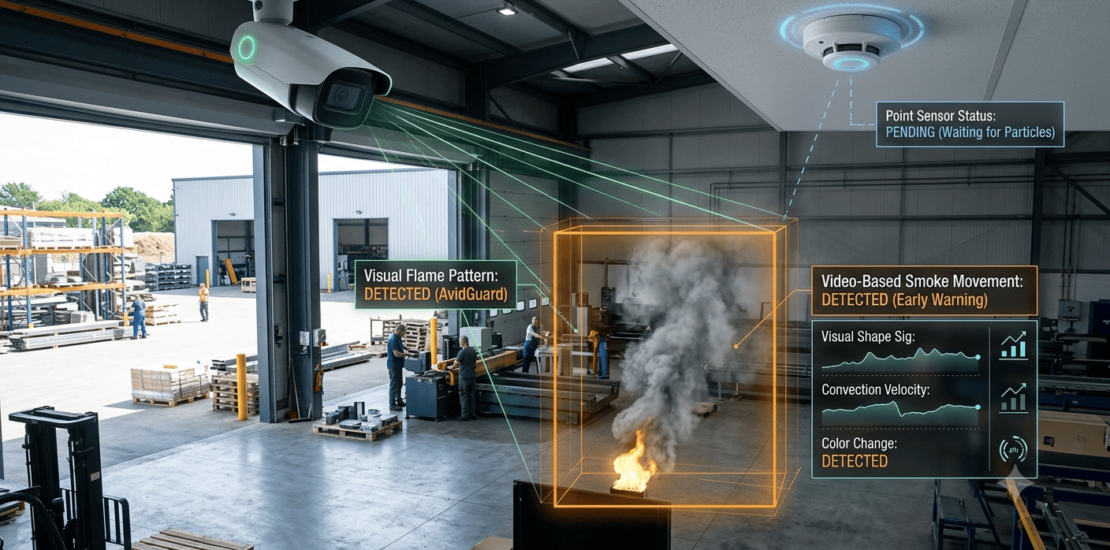
A traditional smoke Detection has one job: to detect smoke particles when they reach the sensor. It performs that job reliably under the conditions it was designed for – indoor spaces, predictable airflow, and smoke concentrations that build gradually enough to reach ceiling height before anyone needs to respond. In most facilities where fire risk is highest, none of those conditions reliably apply.
Oil and gas processing zones, large warehouse facilities, industrial manufacturing areas, outdoor loading docks, and high-ceiling storage spaces all share the same structural problem with point-based smoke sensor coverage: the sensor can only detect what reaches it, which means the response window opens after smoke has already spread enough to build concentration at sensor height – not when the fire begins.
AvidGuard’s video-based smoke and fire detection addresses this gap by moving detection upstream – analyzing camera feeds for the visual characteristics of flame and smoke the moment they appear in frame, before particles travel to a sensor. The detection layer runs on the surveillance cameras already installed across a facility, alongside AvidGuard’s behavioral threat detection, PPE compliance, and anomaly detection capabilities, through the same server-based platform and the same management interface.
How Traditional Smoke Sensors Work – and Where They Fall Short
Understanding the operational limitations of point-based smoke sensors is the starting point for any facility that is evaluating whether video-based detection adds genuine value to an existing setup – or whether it is redundant coverage over infrastructure that already works. The answer depends almost entirely on the environment in question, and in high-risk industrial and large-format facilities, the limitations are structural rather than incidental.
Point Detection and Coverage Gaps
A smoke sensor detects particles within a defined proximity of the sensor itself. Coverage in a large facility requires installing sensors at sufficient density to ensure no significant area is left without a nearby detection point. In high-ceiling warehouses, open industrial zones, and outdoor processing areas, that density is either economically prohibitive or physically impossible to achieve at the coverage level the risk profile demands.
The consequence is coverage gaps – zones where a fire can develop past the early stage before any sensor triggers, because the smoke has not yet traveled far enough horizontally or vertically to reach the nearest sensor. In a warehouse with 12-meter ceilings, a fire at floor level may burn for several minutes before smoke density at ceiling height reaches the detection threshold of a ceiling-mounted sensor.
False Positives in Industrial Environments
Industrial environments produce airborne particulates that smoke sensors cannot distinguish from fire smoke: dust in manufacturing and processing zones, steam in food production and chemical processing facilities, exhaust from machinery, and chemical vapors in petrochemical environments. Each of these can trigger a point-based smoke sensor’s detection threshold – generating false alarms that disrupt operations, erode response team confidence in the alerting system, and, over time, produce the behavioral pattern where alarms are treated as likely false positives rather than genuine emergencies.
A detection system that produces frequent false alarms is operationally worse than a system with lower sensitivity, because the response discipline it requires from security and facility teams degrades with each nuisance alarm.
The Response Window Problem
The response window of a smoke sensor begins after the smoke has reached the sensor. In a point-based detection setup, that moment is always downstream of the fire’s origin – sometimes by a significant margin depending on facility dimensions, airflow patterns, and the sensor’s placement relative to the ignition source. The response window that video-based detection opens begins when flame or smoke first appears in a camera frame – earlier in the incident timeline, and with a visual record of the location and spread direction rather than just a zone alarm.
| To find out how AvidGuard’s video-based smoke and fire detection applies to your facility’s existing camera infrastructure, send an email to [email protected], and the technical team will follow up with a deployment assessment. |
How AvidGuard’s Video-Based Smoke and Fire Detection Works
AvidGuard processes live camera feeds through AI video analytics models trained to identify the visual characteristics of fire and smoke – not the chemical or particulate characteristics that point sensors detect. The detection runs continuously across every connected camera feed simultaneously, without requiring smoke to travel to a sensor location and without the particulate sensitivity that produces false alarms in industrial environments.
Visual Pattern Analysis – Shape, Movement, and Color
AvidGuard’s fire and smoke detection analyzes three visual dimensions simultaneously to distinguish genuine fire-related events from environmental sources that could produce a false alert:
- Shape analysis – flame and smoke exhibit distinctive shape characteristics – irregular, rapidly changing outlines that differ from steam columns, dust clouds, and other airborne materials. AvidGuard’s models identify these shape signatures in each video frame
- Movement analysis – fire and smoke move in patterns that are visually distinct from most other environmental motion – the upward convection of heated air, the turbulent spread of smoke, and the flicker characteristics of flame. The movement detection layer identifies these patterns against the behavioral baseline for each monitored zone
- Color change detection – the color shift that accompanies combustion – orange and yellow flame, grey and black smoke, and the illumination changes a fire produces in the surrounding environment – provides a third detection signal that the visual analysis layer processes alongside shape and movement
The combination of all three signals running simultaneously is what produces the precision that keeps false positive rates at an operationally manageable level in environments where dust, steam, and industrial particulates are present continuously.
Early Warning Before Hardware Sensors Trigger
The most operationally significant advantage of video-based smoke and fire detection is the timing of the alert. AvidGuard identifies visual fire and smoke characteristics the moment they appear in a camera frame – which in most facility environments is earlier than the moment smoke concentration reaches the threshold of a ceiling-mounted point sensor. That earlier detection expands the response window available to facility security teams and, where configured, triggers automated suppression systems before the fire has developed past its earliest stage.
When AvidGuard’s detection layer identifies potential fire-related motion characteristics, it immediately dispatches alerts to security personnel and can trigger automated fire suppression systems – effectively preventing potential disasters and minimizing damage by acting at the earliest detectable point in the incident timeline rather than after smoke has spread through the zone.
What Video-Based Detection Adds to a Smoke Sensor Setup
Video-based fire and smoke detection does not replace point-based smoke sensors in all facility environments – in standard indoor spaces with controlled airflow and moderate ceiling heights, traditional sensors perform their function reliably. What AvidGuard adds is coverage where point sensors structurally cannot provide it, and earlier warning where they can. Three specific capability gaps that video-based detection closes are worth examining directly.
Wider Coverage Area Per Camera
A single smoke sensor covers the area within its detection radius. A single camera running AvidGuard’s fire and smoke detection covers everything within its field of view – which in a warehouse, processing zone, or large indoor space can represent a coverage area that would otherwise require multiple sensor units to match. For facilities where dense sensor grids are cost-prohibitive or physically impractical, camera-based detection extends fire monitoring coverage without additional hardware investment beyond the cameras already installed.
Outdoor and Open-Air Detection
Most point-based smoke sensors are not rated or calibrated for outdoor or open-air environments, where airflow disperses smoke before it can build to detection concentration near a sensor. Loading docks, outdoor processing areas, tank farms, and open storage yards all fall outside the reliable coverage envelope of standard smoke sensor installations.
AvidGuard’s video-based detection covers outdoor areas through existing outdoor cameras without the airflow sensitivity that limits point sensors in these environments. The visual detection layer identifies flame and smoke patterns regardless of airflow conditions – because it is analyzing what the camera sees, not waiting for particles to reach a sensor.
Automated Response Integration
AvidGuard’s fire and smoke detection layer integrates with automated suppression systems where facilities have that infrastructure in place. When the detection layer identifies a confirmed fire visual signature, it can trigger the suppression response automatically – without requiring a human operator to review the alert, confirm the event, and initiate the response manually. That automation matters in unmanned zones, overnight periods, and environments where response time is the operationally decisive factor in damage limitation.
Smoke and Fire Detection as Part of a Unified Security Platform
One of the structural limitations of standalone smoke sensor installations is that they operate in isolation from the rest of the facility’s security infrastructure. A smoke sensor triggers an alarm. That alarm goes to a fire panel. The fire panel notifies whoever is responsible for responding. The CCTV system is a separate layer that security teams turn to after the alarm fires – to visually confirm the event and identify the location.
AvidGuard integrates smoke and fire detection directly into the broader security platform, which changes the information picture available to the operations team the moment an alert fires:
- The fire and smoke detection alert includes the camera source and visual zone – precise location data rather than a zone alarm that still requires visual confirmation
- The same camera feed that triggered the fire alert is immediately available in the operations interface alongside the alert – no switching to a separate CCTV system to locate the event
- Fire and smoke alerts appear in the same alert management interface as intrusion detections, PPE violations, crowd density alerts, and behavioral anomalies – the full security picture stays unified during a response rather than fragmented across separate systems
- AvidGenAI’s natural-language query layer extends to fire and smoke event history – operators can query what was happening in an affected zone in the 30 minutes before a fire alert was fired, supporting post-incident investigation alongside the immediate response
For facilities that already run AvidGuard for perimeter security, behavioral detection, or PPE compliance, adding smoke and fire detection extends the same platform rather than deploying a separate fire detection system alongside it.
Environment-Specific Advantages
The operational advantage of video-based smoke detection over point sensors varies significantly by environment type. The table below maps the specific limitations of point-based smoke sensor coverage in each context against what AvidGuard’s camera-based detection delivers instead.
| Environment | Point Sensor Limitation in This Context | AvidGuard Video-Based Detection Advantage |
|---|---|---|
| Oil and gas facilities | Open processing zones, tank farms, loading areas – environments where point sensors face particulate interference and large coverage gaps | AvidGuard covers wide-area outdoor and semi-outdoor zones through existing camera infrastructure; it integrates with PPE compliance and perimeter detection on the same feeds |
| Industrial and manufacturing | High-heat production areas, chemical storage, and machinery zones, where traditional smoke sensors produce excessive false positives | Visual shape and movement analysis distinguishes fire from steam, dust, and industrial particulates – precision alerting in high-noise environments |
| Warehouses and logistics | High-ceiling storage areas where smoke must travel a significant distance before reaching ceiling-mounted sensors | Camera-based detection identifies flame and smoke at floor level, the moment they appear – response window extended before smoke rises to sensor height |
| Government and critical infrastructure | Server rooms, control centers, and communications facilities require early detection with minimal false positive disruption | Precise visual fire detection triggers immediate alerts and, where configured, automated suppression systems – without nuisance alarms from environmental particulates |
| Retail and commercial buildings | Large open floor plans, back-of-house storage, and loading areas, where smoke sensor grids are expensive to maintain at sufficient density | Existing surveillance cameras extend fire detection coverage without additional hardware; unified with AvidGuard’s behavioral and security detection layer |
| Event venues and public spaces | Large indoor and outdoor spaces with variable occupancy and limited sensor coverage per square meter | Camera-based detection scales to the full venue footprint through existing camera infrastructure; integrated with crowd management and security monitoring |
Traditional Smoke Sensor vs. AvidGuard – Capability Comparison
The table below sets out where AvidGuard’s video-based smoke and fire detection diverges from traditional point-based smoke sensor installations at the detection, coverage, and integration levels.
| Capability | Traditional Point Smoke Sensor | AvidGuard Video-Based Detection |
|---|---|---|
| Detection trigger | Smoke or heat particles must physically reach the sensor | Visual flame patterns, smoke movement, and color changes are detected the moment they appear in the camera frame |
| Detection range | Limited to sensor proximity; large spaces require dense sensor grids | Covers any area within the camera’s field of view – one camera can monitor a large open zone |
| Response time | Triggers after smoke concentration reaches the detection threshold | Early visual warning before smoke density builds to the hardware sensor threshold |
| False positive rate | High in dusty, steamy, or high-particulate environments | Shape, movement, and color change analysis filters non-fire sources from genuine alerts |
| Location data | Sensor location only – does not indicate fire spread direction | Camera source and visual zone provide a precise location with directional spread context |
| Outdoor coverage | Most smoke sensors are not rated for outdoor or open-air environments | AvidGuard covers outdoor areas, loading docks, and open industrial zones through existing camera feeds |
| Integration with security | Separate fire detection system; no link to CCTV or access control | Unified platform: fire and smoke detection alongside intrusion, PPE, and anomaly detection on the same feed |
| Maintenance | Individual sensor calibration and replacement cycles per unit | Software-based detection layer; no sensor hardware maintenance per monitored zone |
| Scalability | Additional sensors required per new coverage area | New zones covered by extending the software to cameras already on the network |
A traditional smoke sensor is a hardware unit that detects smoke when it arrives. AvidGuard’s video-based detection is an analytics layer that identifies fire and smoke the moment they appear in a camera frame – across larger coverage areas, at an earlier point in the incident timeline, and within the same platform that manages the rest of the facility’s security intelligence.
Infrastructure and Deployment
AvidGuard’s smoke and fire detection capability runs as part of the server-based AvidGuard platform – no dedicated fire detection hardware required beyond the cameras already covering the monitored zones. The detection layer processes camera feeds centrally alongside every other AvidGuard capability, which means adding smoke and fire monitoring to an existing AvidGuard deployment is a software configuration rather than a hardware installation project.
For facilities deploying AvidGuard for the first time, the infrastructure baseline per camera processed applies across all detection capabilities, including smoke and fire:
- 2GB RAM minimum; one virtual core at 2.4 GHz minimum per camera
- Multiple GPU configurations supported for higher-density deployments
- Camera resolution: 2MP up to 4K; ONVIF-compliant cameras across manufacturers
- Lens focal length: 3mm to 25mm
- Pitch -15° to +15°; roll -180° to +180°; yaw -15° to +15°
VMS integration covers Milestone, NetworkOptix, and Genetec platforms. Deployment options – on-premise, private cloud, public cloud, or hybrid – are configurable based on data governance and operational requirements. The N+1 redundancy configuration that AvidGuard maintains across all detection capabilities applies to smoke and fire monitoring as well – continuous coverage is maintained despite individual hardware failures, without monitoring gaps during maintenance periods.
New zones are covered by extending AvidGuard’s software layer to cameras already covering those areas – no sensor installation per additional monitored zone, and no recalibration cycle when the facility layout changes.
also you can read about : AvidSight , AvidAuto & AvidFace
Frequently Asked Questions
How does video-based smoke detection differ from a traditional smoke sensor?
A smoke sensor waits for smoke to reach it; video-based detection identifies flame patterns, smoke movement, and color changes in camera frames the moment they appear - earlier in the incident timeline and across a wider coverage area per detection point.
Does video-based smoke detection produce high false positive rates?
No - AvidGuard's simultaneous shape, movement, and color change analysis distinguishes genuine fire characteristics from steam, dust, and industrial particulates, keeping false positive rates operationally manageable even in high-particulate environments.