
Latest Facial Recognition Technology in 2026: What AvidBeam’s AvidFace Delivers at the Cutting Edge
- June 16, 2026
- Posted by:
- Category: News
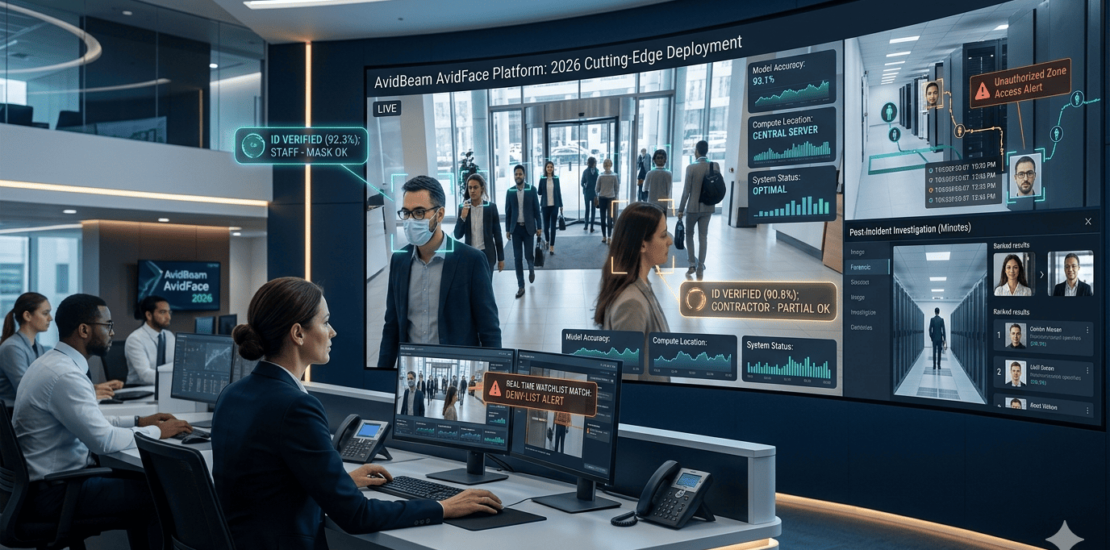
Early facial recognition deployments had a reliability problem. Accuracy dropped sharply under low light. Masks and glasses defeated the system entirely. High-traffic entry points overwhelmed the processing capacity. As a result, many organizations installed the technology and quietly stopped trusting it.
The latest facial recognition technology is a fundamentally different product. Accuracy above 90% is now sustained under partial obstructions, non-frontal angles, and variable lighting. Processing has moved from the camera to the server, which removes the hardware ceiling entirely. Additionally, watchlist management now operates in real time — alerts fire at the moment a listed face appears, not in the next day’s review report.
AvidBeam’s AvidFace platform delivers this latest generation of facial recognition technology on the Artificial Intelligence (AI) video analytics infrastructure organizations already have. No new camera hardware is required. The recognition layer connects to existing Open Network Video Interface Forum (ONVIF)-compliant cameras via standard network protocols and runs all processing centrally at the server level.
What Changed in Facial Recognition Technology
Two architectural shifts drove the accuracy and reliability improvements that separate the latest facial recognition technology from earlier generations. Understanding both is essential for any evaluation, because the gap between a modern platform and an older deployment is not incremental. It is structural.
The Accuracy Leap
Older facial recognition systems used shallow machine learning models. These required near-ideal conditions: frontal face angles, good lighting, and unobstructed views. Consequently, real-world performance fell far below lab results.
The latest technology uses deep learning neural networks. These models extract complex facial geometry, distance between eyes, jawline curvature, cheekbone depth, and convert it into a unique numerical faceprint. Moreover, self-learning algorithms adapt over time. They handle aging, hairstyle changes, and partial obstructions without re-enrollment. As a result, accuracy above 90% is sustained across the conditions that real access points produce.
Server-Based vs. Edge Processing
Earlier deployments processed recognition at the camera or at a local edge device. That architecture has a hard ceiling. The compute available locally limits model complexity. Furthermore, accuracy degrades under adverse conditions because the camera cannot run sophisticated models fast enough.
The latest facial recognition technology processes everything centrally on dedicated server infrastructure. Therefore, model complexity is no longer limited by camera hardware. Updated algorithms deploy across all connected cameras simultaneously through software. Additionally, any ONVIF-compliant camera already on the network becomes a recognition point — no hardware replacement needed.
To find out whether your existing cameras are compatible with AvidFace’s server-based deployment, send an email to [email protected], and the technical team will follow up. |
AvidFace – The Latest Facial Recognition Technology in Practice
AvidBeam’s AvidFace platform applies the latest facial recognition technology across every access tier a facility operates. It handles identity verification, watchlist management, zone tracking, and post-incident investigation, all through the same server-based platform and the same Video Management System (VMS) interface.
How the Recognition Pipeline Works
AvidFace runs four stages on every face that enters a monitored frame. First, the algorithm detects the face and maps its structural geometry. Second, it converts those measurements into a unique digital faceprint. Third, the faceprint runs against stored identity databases in fractions of a millisecond. Finally, the system responds automatically, granting access, triggering an alert, or logging the event, without operator input.
Notably, self-learning algorithms improve with each interaction. They adapt to aging and appearance changes. As a result, accuracy stays above 90% throughout the full deployment lifecycle.
Watchlist Management
AvidFace manages three list categories in parallel across every access point simultaneously. Deny lists trigger security alerts before flagged individuals reach interior zones. Allow lists clear authorized personnel automatically – no manual credential checks required. VIP lists notify relevant staff before a recognized individual reaches the service point.
Furthermore, list updates propagate to every connected access point instantly. An individual added to a deny list at one location is flagged everywhere on the network at the same moment.
Full Capability Breakdown
The table below maps every capability the latest facial recognition technology delivers through AvidFace, what it does, and what it produces operationally.
| Capability | What It Does | Operational Result |
|---|---|---|
| Multi-face detection | Processes multiple faces simultaneously in one frame | High-traffic lobbies and event entrances are covered without delays |
| Non-frontal recognition | Identifies faces without direct camera alignment | Corridors and open floor plans are covered reliably |
| Partial obstruction handling | Accuracy above 90% with masks, glasses, and hats | Healthcare, industrial, and event environments are supported |
| Watchlist cross-referencing | Deny, allow, and VIP lists are checked per face in real time | Alert fires before flagged individuals reach interior zones |
| Zone movement tracking | Individual tracked by zone, timestamp, and camera ID | Unauthorized zone access surfaces automatically |
| Reverse image search | Historical footage query returning top five ranked matches | Post-incident investigation completed in minutes |
| Attribute detection | Age, gender, eyewear, and headwear profiling per face | Demographic reporting and restricted zone profiling |
| Self-learning adaptation | Algorithms update with each interaction | Accuracy sustained as enrolled faces change over time |
Use Cases Across Environments
The latest facial recognition technology applies across different environment types. However, the primary operational return varies by context. The sections below cover the five most common deployment environments.
Commercial Buildings
AvidFace verifies identity at entrances, floor access points, and server rooms automatically. Contractors access only authorized zones. Additionally, zone movement tracking flags anomalies without requiring anyone to watch the relevant camera feed.
Government and High-Security Facilities
Government environments require real-time zone tracking and dynamic watchlist management. AvidFace surfaces unauthorized zone access automatically, against each individual’s access profile, not a generic motion rule. The Ministry of Foreign Affairs deployment in Saudi Arabia illustrates this at scale.
Hospitality
VIP list management identifies recognized guests at the building entrance. Consequently, relevant staff receive a notification before the guest reaches the reception desk. This capability previously required dedicated concierge staff at every entrance.
Mass Events
AvidBeam deployed AvidFace across two consecutive Soundstorm editions in Riyadh — 450,000+ attendees per edition. The platform sustained accuracy above 90% across all entry points throughout each three-day event. Similarly, the BaladBeast festival in Jeddah ran the same technology across four stages in a dense heritage environment.
Banking
Vault areas configured for two-person entry protocols generate an immediate alert when a single individual enters. Moreover, recognized clients trigger service notifications before they reach the counter, a capability that replaces dedicated concierge staff at the branch entrance.
Older vs. Latest Facial Recognition Technology – Comparison
The table below sets out where AvidFace diverges from older generation facial recognition systems at the accuracy, architecture, and operational capability level.
| Capability | Older Facial Recognition Technology | AvidBeam AvidFace – Latest Generation |
| Recognition accuracy | Typically 70–85% under real-world conditions; performance degrades with masks, glasses, poor lighting, and non-frontal angles | 90%+ recognition accuracy with advanced AI models designed to maintain performance across masks, glasses, varying lighting conditions, and non-frontal angles* |
| Processing location | Often processed at the camera or edge device, constrained by onboard computing resources | Centralized server architecture enabling consistent processing and analytics across connected cameras |
| Watchlist alerting | Often limited to local camera-level matching or retrospective review workflows | Real-time watchlist alerting across multiple cameras and entry points |
| Zone tracking | Primarily focused on face capture at designated checkpoints | Continuous person tracking and re-identification across configured zones after initial detection |
| Post-incident search | Manual review of recorded footage, often requiring significant investigation time | Image-based forensic search with ranked candidate matches generated within minutes |
| Hardware requirement | Typically requires dedicated facial recognition cameras or edge processing devices | Can be deployed over existing ONVIF-compliant camera infrastructure, minimizing hardware replacement |
| Scalability | Expansion often requires additional recognition hardware and configuration at each point | Software-based scaling across existing camera networks and server resources |
In short, older technology recorded who entered. The latest facial recognition technology identifies who entered, tracks where they went, and alerts on anomalies – automatically, across every connected camera.
Infrastructure Requirements
AvidFace connects to any ONVIF-compliant camera via standard network protocols. All recognition processing runs on centralized servers, not at the camera. Therefore, no hardware replacement is required for most existing installations.
The baseline per camera processed:
- 2GB RAM minimum; one virtual core at 2.4 GHz minimum
- Multiple Graphics Processing Unit (GPU) configurations supported for high-density deployments
- Camera resolution: 2MP up to 4K; lens focal length 3mm to 25mm
- Pitch -15° to +15°; roll -180° to +180°; yaw -15° to +15°
VMS integration covers Milestone, NetworkOptix, and Genetec platforms. Deployment options include on-premise, private cloud, public cloud, and hybrid – configurable based on data governance requirements. Notably, on-premise processing keeps all biometric data local – recommended for government and high-security facilities.
Frequently Asked Questions
Does the latest facial recognition technology require new cameras?
No, AvidFace layers onto any existing ONVIF-compliant camera; the minimum is 2GB RAM and one virtual core at 2.4 GHz per camera.
Can the system track individuals across zones after entry?
Yes, AvidFace tracks individuals by zone, timestamp, and camera ID across the full facility, surfacing anomalies automatically against each person's authorization profile.