
GenAI and Video Analytics in 2026: How AvidBeam’s AvidGenAI Turns Surveillance Into a Conversation
- June 1, 2026
- Posted by:
- Categories: Articles, Articles & Blogs, Blogs
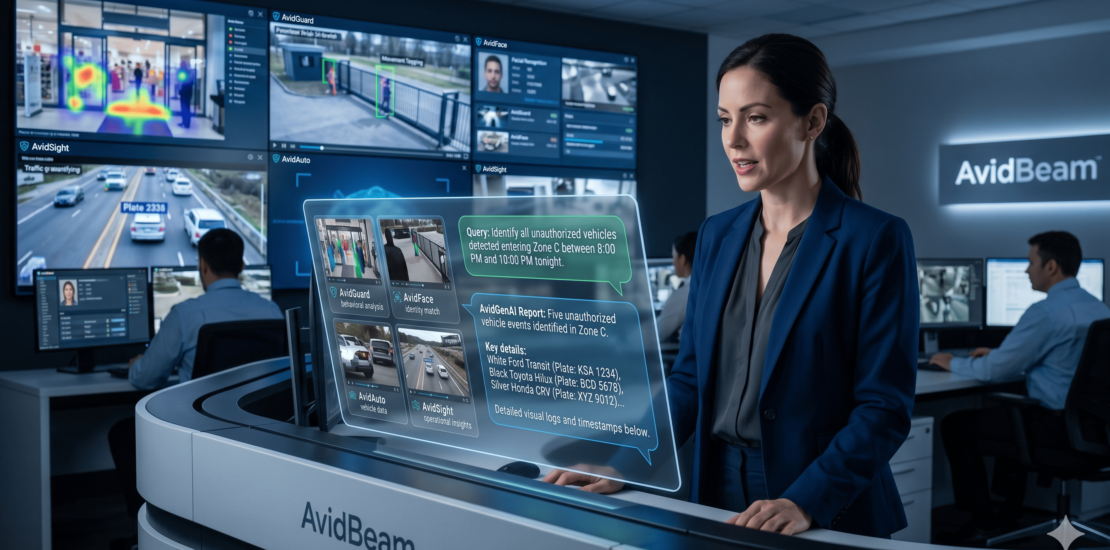
Video analytics platforms generate detections. Thousands of them, across hundreds of cameras, every hour of every operational day. The detection layer works. The problem that most platforms leave unresolved is what happens after a detection fires, when a security manager needs to understand not just that something was flagged, but what it means, where it fits in the broader operational picture, and what happened in the 90 minutes before it.
That is the gap GenAI fills in a video analytics platform. Not by replacing the detection layer, but by sitting on top of it, converting structured detection outputs, behavioral alerts, and raw footage into natural-language intelligence that operations teams can query, report on, and act on without navigating separate dashboards or reviewing footage manually.
AvidBeam’s AvidGenAI is a Vision Language Model that does exactly this across the full AvidBeam platform. It runs on top of AvidGuard, AvidFace, AvidAuto, and AvidSight simultaneously, pulling detection outputs from each into a single queryable intelligence layer. The result is a camera network that does not just alert. It explains, responds, and reports.
What Video Analytics Produces Without GenAI
A video analytics platform without a GenAI layer produces accurate detections and structured alert logs. Both are operationally valuable. Neither is enough on its own for the investigation and reporting workflows that large facilities actually require.
The operational gaps that exist in a video analytics deployment before GenAI is introduced:
- Post-incident investigation requires manually reviewing footage feed by feed, a process that runs to hours even with metadata tagging, because the system can flag events but cannot answer questions about them
- Operational reporting requires extracting data from multiple product dashboards separately and aggregating it manually into a coherent picture
- Scene understanding stays locked inside detection events, the system flags a loitering alert but cannot explain the broader behavioral context around it
- Analytics accessibility is limited to staff with the technical background to navigate the platform, which creates a bottleneck between detection data and the operations managers who need to act on it
- Cross-zone queries require reviewing individual feeds rather than querying the full camera network as a unified dataset
None of these gaps reflect a failure of the detection layer. They reflect the absence of an interface layer between what the platform knows and what the people managing it need to ask.
What AvidGenAI Adds to the Platform
AvidGenAI addresses each of these gaps through a single capability: it makes the video analytics platform conversational.
Concretely, AvidGenAI delivers four things that the detection layer alone cannot:
- Natural-language scene descriptions, AvidGenAI translates video footage into human-readable text, producing real-time descriptions of what is happening in each monitored zone without requiring an operator to watch the feed
- Two-way query interaction, operators ask questions in plain language and receive contextual answers tied to activity type, camera sources, and locations across the full camera network
- Accelerated post-incident investigation, what previously required hours of manual footage review across dozens of feeds becomes a single query; AvidGenAI returns timestamped results with detection context, location data, and video clip references in minutes
- Automated KPI and insight reporting, AvidGenAI generates structured performance reports and operational insight summaries from video observations across all connected product suites, without manual data aggregation
Together, these capabilities change the relationship between a video analytics platform and the operations teams that run it. The platform stops being a system that alerts and starts being one that answers.
How AvidGenAI Works – The Vision Language Model Layer
AvidGenAI is built on a Vision Language Model (VLM), an AI architecture that processes visual input and produces linguistic output. The distinction from standard video analytics models is functional: where detection models identify events and generate structured alerts, a Vision Language Model interprets visual scenes and produces human-readable descriptions and responses.
The process runs in two directions:
- Video to text, AvidGenAI continuously processes camera feeds across the full platform, converting what each camera sees into natural-language descriptions. An operator monitoring a retail floor does not need to watch the feed; AvidGenAI describes what is happening in real time
- Text to video intelligence, operators submit queries in plain language, a question about current crowd density at a specific gate, a request to identify all vehicles that entered a zone in the past two hours, a question about PPE compliance on the current shift, and AvidGenAI returns answers drawn from the live and recorded camera network with timestamps and location data attached
The model runs across all five AvidBeam product suites simultaneously. A single query can pull detection context from AvidGuard’s behavioral alerts, identity records from AvidFace, vehicle data from AvidAuto, and occupancy metrics from AvidSight, synthesizing outputs from across the platform into a single, coherent response.
AvidGenAI Across AvidBeam’s Product Suites
AvidGenAI’s value multiplies with the number of product suites it covers. Each suite it connects to adds another data layer the query interface can reach, which means the investigation and reporting capability scales with the deployment, not with the investigation staff.
AvidGuard – From Behavioral Alerts to Explainable Intelligence
AvidGuard detects behavioral anomalies: loitering, intrusion, crowd density deviations, left objects, tailgating. Each of these generates a structured alert with a timestamp and camera source. What AvidGenAI adds is the context layer: an operator can ask for a description of current crowd behavior at a specific zone,and receive a natural-language response rather than a list of detection logs to manually interpret.
AvidFace – Identity Events That Answer Questions
AvidFace generates facial recognition events: identity matches, watchlist alerts, zone movement records, and access logs. AvidGenAI converts those events into queryable intelligence. A security manager investigating an unauthorized zone access can ask which individuals were detected in Zone C, receive ranked results with confidence levels , and follow up with a question about whether any of those individuals appeared at the east perimeter in the same window, all through a single conversational interface rather than separate access log reviews.
AvidAuto – Vehicle Intelligence Queried in Plain Language
AvidAuto produces plate reads, vehicle classification data, gate access logs, parking occupancy records, and traffic violation events. AvidGenAI makes all of it queryable in plain language. An operations coordinator managing a logistics facility can ask how many vehicles accessed Loading Bay 3, whether any deny-listed plates were detected at any gate today, or what the current parking occupancy is across the east structure, without navigating separate reporting views for LPR, gate access, and parking management.
AvidSight – Retail and Banking Data Without the Dashboard
AvidSight generates retail and banking analytics: heatmaps, pathway data, dwell time metrics, queue performance, ATM compliance events, and vault access records. AvidGenAI surfaces this data through conversational queries that operations staff without analytics backgrounds can use directly. A store manager can ask if the staff are present currently, or can ask if there are any bottlenecks around the store entry, exit, or within the store layout, and receive a direct answer without pulling separate reports for each metric.
GenAI and Video Analytics Use Cases by Environment
The table below sets out how AvidGenAI’s query capability applies across the operational environments AvidBeam’s platform covers.
| Environment | Monitoring Context | Example AvidGenAI Queries |
|---|---|---|
| Retail operations | Customer and staff behavior monitoring | “What is the staff currently focused on?” / “Describe the customer flow through the store layout.” |
| Urban safety | Streets, expressways, public spaces, transport corridors | “Identify unauthorized vehicles in the pedestrian zone.” / “Describe crowd density near the transport corridor entrance.” |
| Structural compliance | Construction sites, infrastructure zones | “Are the load-bearing supports aligned with the blueprint?” / “Describe any visible degradation in the concrete reinforcement.” |
| Security operations | Multi-zone facilities, government sites, campuses | “Describe any anomalous behavior near the east perimeter” |
| Event management | Mass-attendance venues, multi-stage events | “What is the crowd density at Gate/ “Flag any individuals lingering near restricted access points.” |
| Industrial facilities | Petrochemical, manufacturing, logistics | “Describe PPE compliance in the high-voltage zone over the current shift.” / “Identify any stopped vehicles on the internal access road.” |
The queries above illustrate the core distinction that GenAI and video analytics together produce: operators stop reviewing footage and start asking questions. The camera network stops being a recording infrastructure and starts being an intelligence layer that responds.
Post-Incident Investigation – The Clearest Operational Return
Post-incident investigation is where the operational gap between video analytics with and without GenAI is most measurable. The investigation workflow without GenAI follows a predictable and costly pattern: identify the relevant time window, identify the relevant cameras, review footage feed by feed, extract clips manually, compile a report. For a facility with 50 cameras and a two-hour incident window, that process runs to hours regardless of how good the underlying detection layer is.
AvidGenAI compresses the same investigation into a query. An operator types a natural-language question describing what they are looking for, a description of who was present in a specific zone, a request for all vehicle movements at a specific gate.,. AvidGenAI processes the query across the full camera network and returns:
- Camera source and location data for each result
- Behavioral detection context from AvidGuard, where relevant
- Identity records from AvidFace, where individuals are enrolled
- Video clip references for each event returned
The investigation that previously required a dedicated security analyst working for hours becomes an interaction that a shift supervisor can complete in minutes. That compression matters not just for efficiency; it matters for the speed at which evidence is packaged, and response decisions are made.
Video Analytics Without GenAI vs. AvidBeam
The table below sets out where AvidGenAI changes the operational output of a video analytics deployment at the investigation, reporting, and accessibility levels.
| Capability | Video Analytics Without GenAI | AvidBeam GenAI and Video Analytics |
|---|---|---|
| Post-incident investigation | Manual footage review across multiple feeds; hours per incident | Natural-language query across the full camera network; results in minutes |
| Operational reporting | Separate dashboards per product suite; manual data aggregation | Single conversational query generates KPI reports and insight summaries across all suites |
| Scene understanding | Detection events flagged but not explained | Human-readable descriptions of what is happening in each monitored zone in real time |
| Staff accessibility | Analytics require dedicated technical staff to interpret | Operations staff query in plain language; no analytics training required |
| Cross-zone queries | Feed-by-feed review; no unified query layer | Single query covers all connected cameras across all zones and sites simultaneously |
| Proactive monitoring | Alerts fire on pre-defined rules only | Operators can ask open-ended questions about current conditions without pre-written rules |
| Evidence packaging | Manual clip extraction and documentation | Query returns timestamped clips, detection context, and location data in a single structured response |
The detection layer stays the same. What GenAI and video analytics together change is who can access that detection layer, how fast they can get answers from it, and how much of the investigation process the platform handles rather than the people managing it.
The STC Partnership and AvidGenAI in Practice
AvidBeam’s April 2026 webinar with solutions by stc, titled “The Future of Video Analytics”, brought together Eslam Ahmed, Senior Staff Software Engineer at AvidBeam, alongside the AI and Data Director from solutions by stc, to walk through exactly where GenAI and video analytics intersect in real-world deployments.
The session covered three dimensions of AvidGenAI’s practical application:
- The evolution of video analytics, from rule-based motion detection through behavioral AI to the Vision Language Model layer that AvidGenAI represents, and what each inflection point changed operationally for facilities running the technology
- The GenAI inflection point, why Generative AI represents a structural shift rather than an incremental improvement in video analytics, and what that means for organizations evaluating platforms now versus platforms built on earlier AI generations
- AvidGenAI in production, specific use cases across retail, urban safety, and structural compliance environments, with example queries that illustrate how the conversational interface changes the speed and accessibility of operational intelligence
The partnership between AvidBeam and STC is where AvidGenAI’s capabilities connect to enterprise infrastructure at scale across the Kingdom of Saudi Arabia. The STC Sawaher project, where AvidFace, AvidGuard, and AvidAuto ran in parallel inside a centralized operations view, is the clearest existing illustration of what a full-stack deployment looks like before AvidGenAI’s investigation layer is layered on top of it.
Infrastructure and Deployment
AvidGenAI runs as a layer on top of AvidBeam’s existing server-based platform. It does not require separate hardware or a standalone deployment; it connects to the same camera network and analytics infrastructure already in place, extending the query and reporting capability across every product suite without additional camera-level investment.
The platform-level infrastructure requirements apply:
- 2GB RAM minimum and one virtual core at 2.4 GHz minimum per camera processed
- Any ONVIF-compliant camera on the existing network is immediately covered by AvidGenAI’s query layer
- VMS integration with Milestone, NetworkOptix, and Genetec platforms
- Deployment options: on-premise, private cloud, public cloud, or hybrid, based on the organization’s data governance requirements
For organizations already running one or more AvidBeam product suites, AvidGenAI extends the value of the existing deployment without a hardware refresh or a parallel infrastructure build. The query layer scales with the camera network, as new cameras or new sites come online, AvidGenAI’s investigation capability covers them through the same interface without additional configuration.
Frequently Asked Questions
What is GenAI in video analytics?
A Vision Language Model layer that converts video footage and detection outputs into natural-language text, and enables operators to query the full camera network in plain language, making investigation, reporting, and scene monitoring accessible without manual footage review.
How does AvidGenAI differ from standard video analytics AI?
Standard video analytics AI detects and alerts; AvidGenAI explains, responds, and reports, converting what the detection layer knows into answers operators can query conversationally rather than extracting manually from dashboards.