
From Entry Point to Intelligence: How a Facial Camera Becomes an Access Control and Security Asset
- June 8, 2026
- Posted by:
- Categories: Articles, Articles & Blogs
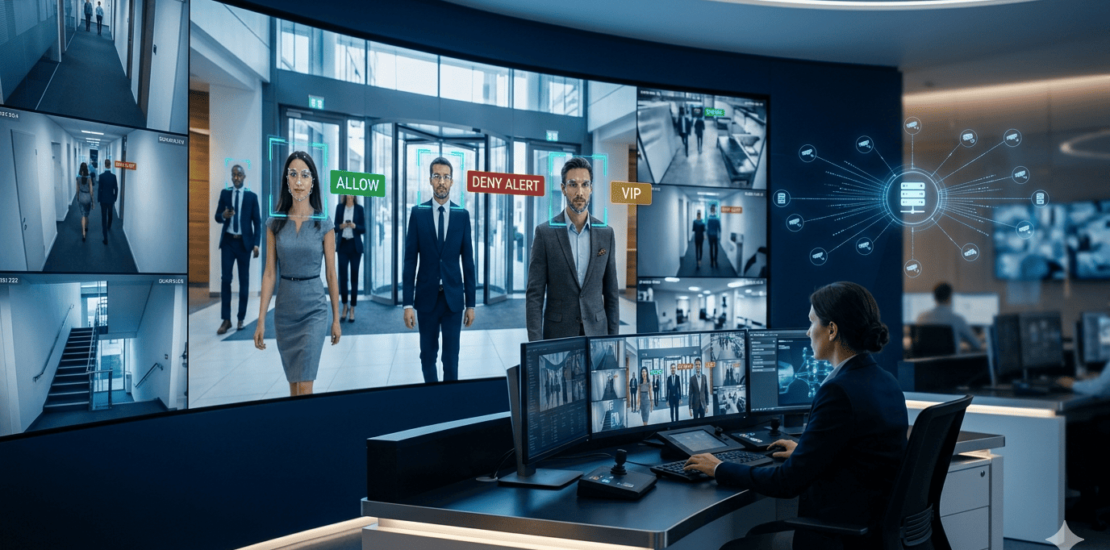
Every IP camera in a modern facility captures faces. The question is never whether the camera sees the face. The question is what happens next, whether the system identifies who that face belongs to, cross-references it against a watchlist in real time, tracks the individual across facility zones after entry, and generates an automated access decision without an operator manually reviewing the feed.
That sequence is the difference between a facial camera and a facial recognition platform. The hardware is almost always already there. What most facilities are missing is the analytics layer that turns a captured image into an identity match, an access event, and a structured audit record, automatically, at every monitored entry point, across every shift.
AvidBeam’s AvidFace platform is that analytics layer. It connects to existing ONVIF-compliant cameras via standard network protocols, processes all facial recognition centrally at the server level, and delivers identity verification at over 90% accuracy across personnel categories, staff, contractors, visitors, VIPs, and watchlisted individuals, without new camera hardware at individual access points.
What a Facial Camera System Needs to Do Operationally
A facial camera system that only captures and stores faces adds surveillance footage to a facility’s archive. It does not add security. The operational requirements that separate a useful facial camera deployment from an expensive recording upgrade are specific, and each one depends on the analytics layer, not the camera hardware.
- Identity verification must be automatic — no operator should need to watch a feed, recognize a face manually, or initiate a database check. The system matches, decides, and logs without human input at the entry point
- Watchlist cross-referencing must happen in real time; a deny-listed individual who appears at Gate 3 while a VIP is arriving at Gate 7 must trigger simultaneous, independent responses without either alert, depending on an operator dividing attention between feeds
- Accuracy must hold under real facility conditions; partial face obstructions, non-frontal angles, variable lighting, and high-traffic volumes are not edge cases. They are the standard operating environment of every entrance, lobby, and corridor that a facial camera covers
- Zone tracking must extend beyond the entry point. Knowing who entered is the start of the intelligence picture, not the end; knowing where that individual went after entry, and whether that movement matches their authorization profile, is where the security value compounds
- Post-incident investigation must be queryable; manually scrubbing footage across a 14-camera network to find a specific individual across a two-hour window is not an investigation process; it is a time cost that an image-based search capability eliminates
AvidFace addresses all five requirements through a single server-based platform that layers onto the camera infrastructure already in place.
How AvidFace Turns Any Camera Into a Facial Camera Platform
The distinction between a camera that captures faces and a platform that acts on them runs through two architectural decisions: where the processing happens, and how the recognition pipeline handles the range of real-world conditions that facility environments produce. Both decisions determine the ceiling of what the system can do, and both are where AvidFace’s server-based architecture diverges from edge-based or dedicated facial recognition hardware approaches.
Server-Based Processing: Why Architecture Determines Accuracy
Edge-based facial recognition runs the identification process at the camera or at a local gateway device. That architecture constrains what detection models can run, limits the complexity of the matching operation, and produces accuracy that degrades under the conditions that real access points generate, partial obstructions, non-frontal angles, changing lighting across the day, and simultaneous multi-face frames during peak entry flow.
AvidFace processes all facial recognition centrally at the server level. The operational consequences of that architectural choice are direct:
- Complex, regularly updated recognition models run across every connected camera simultaneously, not constrained by individual camera hardware limits
- New detection capabilities and improved recognition models are deployed through software across the full network without hardware replacement at individual facial camera points
- Multi-site organizations manage all facial camera outputs through a single unified interface, with watchlists propagating to every access point simultaneously when updated
- Any ONVIF-compliant camera already on the network becomes a facial camera point without additional hardware investment at the access point level
The Recognition Pipeline
AvidFace runs a four-stage process on every face that enters a monitored frame, automatically, without operator input, across every access point simultaneously. The process completes in fractions of a millisecond per face:
- Detection and landmark mapping: the algorithm locates a face in the video frame and maps its structural geometry: the distance between eyes, jawline curvature, cheekbone depth, and related biometric reference points that remain consistent across lighting changes and partial obstructions
- Faceprint generation: mathematical equations convert those mapped points into a unique numerical identity signature, compact, consistent, and tied to one individual, regardless of changes in hairstyle, facial hair, or aging over the deployment period
- Database matching: the faceprint runs against stored identity records in fractions of a millisecond, cross-referencing against deny lists, allow lists, and VIP lists simultaneously
- Automated response: access is granted, an alert fires, an event is logged, or a policy breach is flagged: based on the match result and the access rules configured for that specific entry point, without any operator initiating the response
Self-learning algorithms improve the recognition pipeline with each interaction. Aging, hairstyle changes, and partial obstructions like masks or glasses are absorbed into the model over time, which means accuracy above 90% is sustained across the full deployment lifecycle without re-enrollment cycles.
Full Facial Camera Capability Breakdown
AvidFace’s facial camera platform delivers recognition capabilities that span identity verification, behavioral intelligence, access management, and post-incident investigation, all running on the same camera infrastructure and the same management interface. The table below maps each capability to what it does and what it produces operationally.
| Capability | What It Does | Operational Output |
|---|---|---|
| Real-time face matching | Faceprint matched against stored identity database in fractions of a millisecond | Access granted, alert triggered, or event logged — automatically, without operator input |
| Multi-face detection | Processes multiple faces simultaneously in a single video frame | High-traffic lobbies, event entrances, and busy corridors covered without per-face delays |
| Non-frontal angle recognition | Identifies faces without requiring direct camera alignment | Corridors, open floor plans, and stairwells — environments where subjects do not face the camera |
| Partial obstruction handling | Sustained accuracy above 90% with masks, glasses, hats, and scarves | Healthcare, industrial, event, and hospitality environments where face coverings are common |
| Watchlist cross-referencing | Deny list, allow list, and VIP list checked simultaneously per face detected | Real-time alert with identity confirmation, camera source, and timestamp the moment a listed face appears |
| Zone movement tracking | Individual tracked by zone, timestamp, and camera ID after entry point verification | Unauthorized zone access surfaces automatically against each individual’s authorization profile |
| Reverse image search | Historical footage query returning top five matches ranked by confidence | Post-incident investigation across the full recorded network without manual footage scrubbing |
| Attribute detection | Age range, gender, eyewear, and headwear profiling per detected face | Demographic reporting, restricted zone profiling, and compliance monitoring alongside access control |
| Self-learning adaptation | Algorithms update with each interaction; adapt to aging and appearance changes | Long-term deployments remain accurate as enrolled individuals change over time without re-enrollment |
| Mask detection | Identifies individuals wearing or not wearing face coverings | Health compliance monitoring running alongside security functions on the same camera feed |
Each capability runs continuously across every monitored camera simultaneously. An identity match at the main entrance, a zone movement anomaly in a restricted corridor, and a VIP recognition event at a side entrance fire as independent, parallel responses, without any of them depending on an operator watching the relevant feed at the relevant moment.
Watchlist Management: From Identification to Operational Response
Identification without watchlist integration produces face matches. Watchlist integration is what converts those matches into access decisions and security alerts. AvidFace manages three list categories in parallel across every monitored facial camera point: deny lists, allow lists, and VIP lists, each configured to produce a different automated response the moment a listed face is detected.
Deny Lists
Deny-listed individuals trigger a security alert the moment their face appears at any monitored access point across the full network, before they reach interior zones, restricted areas, or sensitive infrastructure. The alert delivers the confirmed identity, camera source, timestamp, and location data to the security team in real time. A deny-list update at the central management interface propagates to every facial camera point across all connected sites simultaneously, without per-location configuration and without a time lag between the list update and the enforcement layer.
Allow Lists
Allow-listed personnel receive automated entry at every authorized access point without manual credential checks, guard verification, or queue formation from processing delays. The facial camera matches the face, confirms the identity against the allow list, and clears entry, in fractions of a millisecond, across every access point where that individual is authorized, without any staff involvement at the entry point itself. For high-volume facilities handling continuous personnel flow across multiple access tiers, automation removes the bottleneck that manual verification creates at peak entry periods.
VIP Lists
VIP-listed individuals trigger service or access notifications before they reach the reception point, desk, or service area. The facial camera identifies them at the building entrance and alerts the relevant staff ahead of arrival. The relationship manager, the concierge, or the access coordinator receives the notification while the individual is still approaching the desk. That level of recognition previously required dedicated staff stationed at entry points. AvidFace delivers it automatically, across every monitored entrance, logged with timestamp and camera source for service quality reporting.
Zone-Level Tracking: What Happens After the Entry Point
Entry point verification covers one moment in an individual’s movement through a facility. The security and compliance value of a facial camera platform compounds significantly when that verification extends to zone-level tracking after entry, which is where most standard facial recognition deployments stop providing data and where AvidFace continues to generate intelligence.
AvidFace tracks individual movement across facility zones continuously by date, time, and camera ID. The tracking layer uses the same camera network that handles entry verification; no additional hardware required. When an individual authorized for one zone appears in a restricted area without a corresponding access event at the boundary between them, the platform surfaces the anomaly automatically against that individual’s authorization profile.
The operational value of that tracking layer across specific scenarios:
- Contractors: an authorized contractor who accesses a restricted server room outside their permitted hours or without a supervisor escort is detected and flagged before any physical damage or data access occurs
- Visitors: a visitor who separates from their escort and moves into a non-public zone is detected against their authorization record, not against a generic motion rule, with the confirmed identity attached to the alert
- Post-incident investigation: when an incident is reported in a zone covered by multiple cameras, AvidFace’s image-based historical search reconstructs exactly which individuals were present across the full time window, returning the top five matches ranked by confidence level without manual footage review
Facial Camera Use Cases Across Environments
The recognition mechanics behind AvidFace stay consistent across deployment environments. What changes is which capability layer produces the most immediate operational return, and which access tier carries the highest consequence if the facial camera system fails to identify correctly or flag a watchlist match in real time.
Commercial Buildings and Corporate Campuses
Corporate environments handle continuous personnel movement across access tiers with different authorization levels, staff, contractors, maintenance crews, and visitors, each carrying different permissions for different zones. A facial camera at every access tier automates the verification that manual badge checks attempt to do at scale.
AvidFace handles identity verification at building entrances, floor access points, server rooms, and executive areas without guard intervention. Contractors access authorized zones only. Staff movement is logged continuously against confirmed identity rather than badge ID. The deny list fires the moment a flagged individual approaches any monitored entry point across the full campus, regardless of which access point they choose.
Government and High-Security Facilities
Government environments require a facial camera platform that goes beyond entry point verification: real-time detection of unauthorized zone access, dynamic watchlist management that updates as threat profiles change, and audit trails that confirm individual identity rather than credential use. AvidFace’s zone-level tracking and deny list alerting are built for exactly these requirements.
The Ministry of Foreign Affairs deployment in Saudi Arabia combined AvidFace’s identity verification layer with AvidGuard’s behavioral detection and AvidAuto’s vehicle access control, all three running in a unified operations view across a high-security government environment that required every access tier to be covered simultaneously.
Hospitality and Guest Experience
Hospitality requires a facial camera deployment that is invisible to the guest while remaining operationally active behind it. VIP recognition at the building entrance alerts the assigned relationship manager or concierge before the guest reaches the front desk. The guest is greeted by name without any visible checkpoint or credential verification process.
Security monitoring continues in parallel across the same facial camera network without disrupting the experience for authorized arrivals. The Four Seasons Madinah deployment ran AvidFace and AvidAuto in combination across all property access points, blacklist, whitelist, and VIP recognition for guests and vehicles simultaneously, with zero visible friction at the entrance for recognized individuals.
Mass Events and Public Venues
Mass events present a facial camera challenge that commercial buildings do not: continuous high-volume entry flow across multiple simultaneous access points, crowd density that creates multi-face frames at every camera, and the need to identify flagged individuals in real time under exactly these conditions.
AvidBeam deployed facial camera capabilities across two consecutive Soundstorm editions in Riyadh, 450,000+ attendees per edition, and BaladBeast in Jeddah’s Al-Balad district. Both deployments ran facial recognition, demographics detection, and people counting simultaneously across multi-stage venues, which means AvidFace’s accuracy held above 90% under the crowd density and entry flow conditions where edge-based facial camera systems consistently degrade.
Banking and Financial Institutions
Banking environments carry identity-based vulnerabilities that standard CCTV was never designed to address. Vault areas require two authorized personnel simultaneously; server rooms require access logs tied to confirmed identity rather than badge ID; ATM zones require detection of suspicious clustering around a single machine; and VIP clients require recognition before they reach the counter.
AvidFace covers all four through the same facial camera platform deployed across the facility’s existing camera network. Vault entry protocols generate an immediate alert when a single individual enters a two-person zone. Server room access logs tie every event to a confirmed face. ATM areas flag clusters in real time. And recognized clients trigger service notifications before they reach the desk, a capability that previously required dedicated concierge staff at every branch entrance.
Standard CCTV vs. AvidBeam Facial Camera Comparison
The table below sets out where AvidFace’s facial camera platform diverges from what a standard CCTV camera network delivers, with or without basic motion detection, at the identity verification and access management level.
| Capability | Standard CCTV Camera | AvidBeam Facial Camera Platform |
|---|---|---|
| Face capture | Records faces in footage; no identification layer | Identifies every face against stored databases in fractions of a millisecond |
| Watchlist alerting | No live cross-referencing; retrospective review only | Deny list alert fires the moment a flagged face appears at any monitored point across the full network |
| Access decisions | Requires human operator to verify and act | Automated access grant or denial; no operator input required at the entry point |
| Tailgating detection | Not detected without a dedicated behavioral layer | AvidFace detects multiple individuals entering on a single authorization event in real time |
| Zone tracking post-entry | No individual tracking after the entry event | Continuous zone-level movement tracking by timestamp and camera ID across the full facility |
| Partial obstructions | Accuracy drops significantly with masks and glasses | Accuracy sustained above 90% with masks, glasses, hats, and non-frontal face angles |
| VIP and guest recognition | Staff must recognize VIPs manually at the entrance | Pre-enrolled faces trigger service alerts before the individual reaches the reception point |
| Post-incident search | Manual footage scrub; hours per investigation | Image-based search returns ranked matches across the full recorded network in minutes |
| Hardware requirement | Dedicated facial recognition hardware often required | Layers onto any existing ONVIF-compliant camera; no hardware replacement needed |
The gap is not in the hardware. Most facilities already have cameras positioned at access points with sufficient resolution to capture faces clearly. The gap is in what happens to those captured faces, and that is the analytics layer that AvidFace adds to the infrastructure already in place.
Infrastructure and Deployment
AvidFace’s server-based architecture connects to any ONVIF-compliant IP camera via standard network protocols. All facial recognition processing runs centrally, not at the camera, which means organizations extend facial camera intelligence to their existing network without hardware replacement at individual access points.
The infrastructure baseline per camera processed:
- 2GB RAM minimum
- One virtual core at 2.4 GHz minimum; multiple GPU configurations supported for higher-density deployments
- Camera resolution: 2MP up to 4K; lens focal length 3mm to 25mm
- Pitch -15° to +15°; roll -180° to +180°; yaw -15° to +15°
VMS integration covers Milestone, NetworkOptix, and Genetec platforms. Deployment options, on-premise, private cloud, public cloud, or hybrid, are configurable based on data governance requirements. For government and high-security facilities, on-premise processing keeps all biometric data local without external transmission.
For multi-site organizations, the same watchlist infrastructure extends across every new facial camera point and every new site as the deployment grows, without per-location configuration. A deny list update at the central interface propagates to every connected access point simultaneously.
Verified Deployments
AvidBeam’s facial camera deployments span government facilities, hospitality properties, mass-attendance events, entertainment destinations, and research centers, each one a different operational context, each one running the same AvidFace platform under real conditions.
Soundstorm 2024 & 2025, Riyadh
Facial recognition, demographics detection, crowd management, and people counting deployed across two consecutive editions, 450,000+ attendees per edition over three days. The facial camera layer operated continuously across all entry points throughout each event, under maximum crowd density conditions.
BaladBeast, MDLBeast, Jeddah (2025)
Facial camera deployment across a two-day festival in Jeddah’s historic Al-Balad district, 70+ artists across four stages, identity verification running inside a heritage urban environment with constrained sightlines and continuous high entry flow.
Ministry of Foreign Affairs, Saudi Arabia
AvidFace covered visitor identification and zone tracking alongside AvidGuard and AvidAuto, managing deny lists, allow lists, and VIP watchlists simultaneously across a high-security government environment requiring identity verification at every access tier.
Four Seasons Hotel, Madinah
AvidFace and AvidAuto in combination across all property access points, blacklist, whitelist, and VIP recognition for guests and vehicles simultaneously, with facial camera tracking at every entrance without disrupting guest flow.
Qiddiya, Saudi Arabia (2024)
AvidFace handled blacklist, whitelist, and VIP recognition across the entertainment destination’s multi-zone facilities, facial camera coverage at every access tier alongside AvidAuto’s vehicle management layer.
KAPSARC, Saudi Arabia (2024)
AvidFace tracked and recognized individuals across specific facility locations at the King Abdullah Petroleum Studies and Research Center, facial camera intelligence integrated with AvidGuard’s early-warning anomaly alert layer.
Frequently Asked Questions
How accurate is AvidFace's facial camera system?
AvidFace sustains recognition accuracy above 90% at access points, including with partial obstructions such as masks and glasses, non-frontal face angles, and variable lighting conditions.
Can a facial camera system track individuals across multiple zones?
Yes, AvidFace tracks individual movement by zone, timestamp, and camera ID across the full facility after entry, surfacing zone access anomalies automatically against each individual's authorization profile.