
Car Recognition Technology in 2026: How AvidBeam’s AvidAuto Reads, Classifies, and Acts on Every Vehicle in Frame
- May 24, 2026
- Posted by:
- Categories: Articles, Articles & Blogs
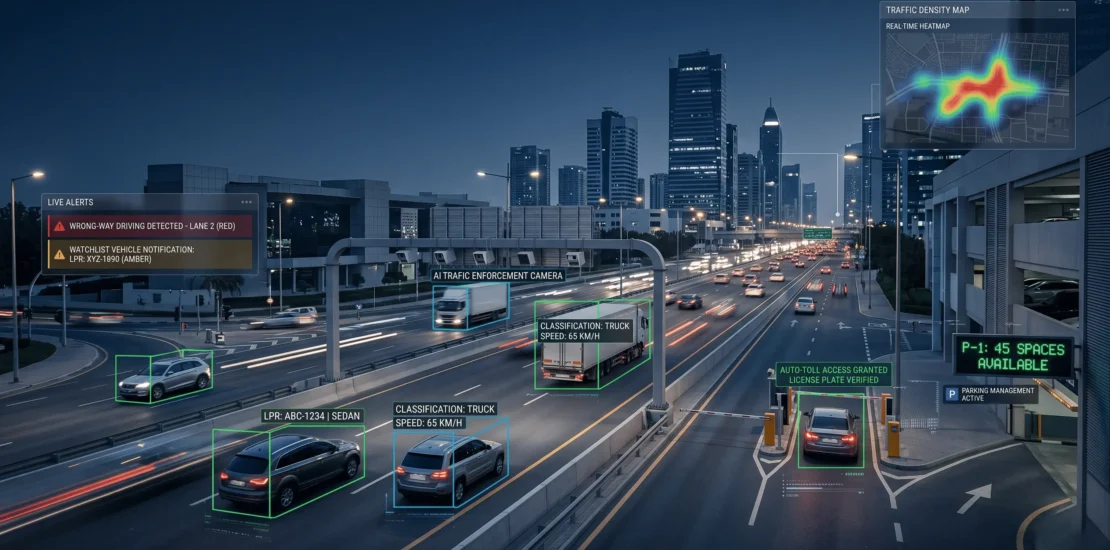
Reading a license plate is the starting point of car recognition, not the destination. A plate read tells you what the vehicle is registered as. What enforcement coordinators, gate operators, and facility managers actually need is what happens next: does that plate match a watchlist, what type of vehicle is it, where is it going, and what should the system do about it, automatically, in real time, without a guard making that decision manually at the gate.
That is the gap between a license plate reader and a car recognition system built on AI video analytics. AvidBeam’s AvidAuto platform closes it through three integrated products: AB – Vehicle Analytics for plate recognition, vehicle classification, watchlist management, and forensic search; AB – ITS (Intelligent Traffic Systems) for road-level violation detection and traffic density analytics; and AB-Smart Parking for occupancy management, double-parking detection, and entrance and exit blocking alerts.
All three run on a server-based architecture that layers onto existing ONVIF-compliant cameras. No dedicated LPR (License Plate Recognition) hardware required. No camera replacement. The car recognition capability extends to the infrastructure already covering gates, roads, and parking areas.
Also, you can read about: AI video analysis
Reading a Plate vs. Recognizing a Car
Most facilities that describe themselves as having car recognition have license plate readers at one or two entry points. The plate gets read. The read gets logged. And that is where the system stops.
The operational problems that a plate-read-only setup leaves unresolved:
- A deny-listed vehicle enters the facility because nobody was cross-referencing against the watchlist in real time
- A contractor vehicle accesses a restricted zone because the system distinguishes plates but not vehicle types or authorization levels
- A parked vehicle blocks an emergency access lane for 40 minutes because no detection layer covers the parking area continuously
- A post-incident investigation requires manually scrubbing footage across multiple camera feeds because the car recognition layer does not support forensic search by vehicle attributes
Each of these is a gap between plate reading and car recognition. AvidBeam’s AvidAuto platform addresses all four through the three integrated products that form its car recognition architecture.
AB – Vehicle Analytics – The Car Recognition Foundation
AB – Vehicle Analytics is the intelligence layer that transforms a plate read into a full vehicle identification event. Every detection produces a structured record rather than a string of characters from a license plate.
License Plate Recognition
AB – Vehicle Analytics delivers LPR at 98%+ accuracy for Arabic plates and 92%+ for English, across moving vehicles at real road speeds, in low-light conditions, and across the vehicle types a mixed-traffic facility actually handles. Plate type is identified per detection event: private, commercial, and tourist plates are distinguished automatically, which feeds directly into enforcement and access workflows that apply different rules by category.
Vehicle Classification
Alongside every plate read, AB – Vehicle Analytics identifies vehicle type, color, and model. The combination produces a complete vehicle profile per detection event, the documentation that enforcement coordinators and security teams need for post-incident reporting, citation filing, and access audit trails. A plate number alone is insufficient when the vehicle associated with that plate has changed hands, carries false plates, or requires type-specific routing at the gate.
Watchlist Management
The car recognition system’s watchlist layer is what connects identification to operational response. AB – Vehicle Analytics cross-references every detected plate against three list categories in real time:
- Deny lists: flagged, reported, or unauthorized vehicles trigger a security alert at the moment they are detected at any monitored point across the full network, before the vehicle clears the gate or reaches the facility
- Allow lists: authorized vehicles receive automated entry without a guard manually verifying credentials, which eliminates queue formation at high-volume access points and removes the dependency on human verification at each entry
- VIP lists: designated vehicles receive priority routing, reserved bay allocation, or specific access permissions based on operator configuration
When a vehicle on any list is detected, the alert fires with the plate read, vehicle classification data, camera source, and location, in real time. For security operations that run vehicle watchlists as a core operational function, that live cross-referencing is what makes the list actionable rather than retrospectively consulted.
Forensic Vehicle Search
Post-incident investigation in facilities without a forensic car recognition layer means manually reviewing footage across multiple camera feeds, hour by hour, looking for a specific vehicle. AB – Vehicle Analytics compresses that process into a structured query: date, time, location, plate number, and plate type, returning the specific footage and detection records without manual scrubbing. For security teams managing incidents across multi-zone facilities or distributed road networks, that compression from hours to minutes is operationally significant.
Gate Access Control – Where Car Recognition Meets Security
The gate is where car recognition produces its most immediate operational return. A facility handling continuous vehicle inflow across multiple categories, employee vehicles, contractor fleets, delivery trucks, tanker vehicles, cannot manage each category through the same manual gate check without creating queues, verification gaps, and security exposures.
AB – Vehicle Analytics handles gate access control through the car recognition pipeline:
- Scheduled and authorized vehicles receive automated entry and routing instructions to designated bays or zones, no guard intervention required
- Deny-listed plates trigger security alerts before the vehicle clears the gate, not after it has reached the interior of the facility
- Audit trails log which vehicles accessed which areas across specific timeframes, producing the documentation that compliance and security reporting workflows require
- Integration with existing access control systems provides regulatory compliance documentation without separate logging infrastructure
The car recognition layer operates continuously across every monitored gate simultaneously. An unauthorized vehicle attempting entry at Gate 3 while a scheduled delivery clears Gate 7 generates two independent, simultaneous responses, without requiring a guard to divide attention between them.
AB – ITS – Car Recognition Extended to Road Enforcement
Car recognition does not stop at the gate. On internal roads, highway segments, and intersection approaches, the same vehicle intelligence that manages access control becomes the foundation for traffic violation enforcement and road safety monitoring.
AB – ITS (Intelligent Traffic Systems) extends AvidBeam’s car recognition capabilities to the road enforcement layer:
- Wrong-direction detection: alerts operators the moment a vehicle moves against the configured permitted direction for a road segment; fires across every monitored segment simultaneously
- Red-light violation detection: fires the instant a vehicle crosses an intersection against a red signal, with plate read, timestamp, camera source, and event clip generated automatically
- Lane switching violation detection: identifies vehicles entering bus lanes, emergency lanes, and HOV lanes with operator-configured lane boundaries per road segment
- Illegal parking detection: continuous zone-based monitoring; alert fires the moment a vehicle stops in a fire lane, bus stop, loading zone, or emergency access point
- Slow and stopped vehicle detection: surfaces hazards in active lanes and tunnel approaches before field response is needed
- Traffic density analytics: volume and distribution patterns per road segment, feeding congestion forecasting and infrastructure planning workflows
Every violation event generated by AB-ITS carries the same documentation structure as a gate access event: plate number, vehicle type, timestamp, camera source, and event clip; the complete record enforcement teams need to act without additional manual steps.
AB – Smart Parking – Car Recognition Across Every Space
Parking management without a car recognition layer produces two outcomes: spaces that appear available but are not, and violations, double parking, blocked access lanes, unauthorized overnight vehicles, that go undetected until they affect operations.
AB – Smart Parking applies AvidBeam’s car recognition capabilities across parking structures, visitor areas, and contractor staging zones:
- Real-time occupancy detection distinguishes occupied from empty spaces across every monitored level and zone, giving operations teams accurate availability data without manual counts
- Double-parking detection keeps driving lanes clear in underground structures and operational areas, with alerts generated the moment a vehicle parks across a marked space boundary
- Entrance and exit blocking detection triggers alerts when vehicles obstruct emergency access points, loading bay approaches, or gate clearance zones
- Overnight monitoring generates alerts for vehicles remaining beyond expected timeframes, relevant for security audits and unauthorized overnight access patterns
The same plate that grants a vehicle access at the gate tracks that vehicle through the parking structure and flags it if it remains beyond its authorized window or parks in a restricted zone. The car recognition layer is continuous, not just present at the point of entry.
Also, you can read about: Smart Mobility Solutions
Car Recognition Across Environments
The underlying car recognition mechanics stay consistent across deployment environments. What changes is which layer, gate access, road enforcement, or parking management, delivers the most immediate operational return.
Commercial and Industrial Facilities
Large commercial and industrial sites handle vehicle traffic across multiple categories with different access permissions and different risk profiles. AB – Vehicle Analytics manages gate access automatically: scheduled vehicles clear without manual verification, unauthorized plates trigger alerts before entry, and audit trails document every vehicle movement across the full site. AB – Smart Parking extends car recognition to parking and staging areas, maintaining occupancy visibility and flagging obstructions in real time.
Government and High-Security Sites
Government environments require car recognition that connects vehicle identity directly to access authorization, not just a plate read at the entrance. AB – Vehicle Analytics cross-references every approaching vehicle against deny lists and allow lists in real time, with alerts generated before the vehicle reaches the security perimeter. The Ministry of Foreign Affairs deployment in Saudi Arabia combined AvidAuto’s vehicle access layer with AvidFace and AvidGuard across a single unified operations view.
Hospitality Properties
Hospitality car recognition operates across two requirements simultaneously: guest experience and security. VIP list management gives designated guests and vehicles frictionless access without manual credential checks, the gate recognizes the vehicle before it stops. Deny list monitoring maintains security across the same access points without affecting the guest experience for authorized arrivals. The Four Seasons Madinah deployment ran both layers in combination through AvidFace and AvidAuto across all property access points.
Oil and Gas Facilities
Oil and gas facilities handle continuous vehicle traffic across categories with distinct authorization requirements and safety risk profiles, tanker trucks, delivery vehicles, contractor fleets, and employee vehicles each requiring different routing and access permissions. AB – Vehicle Analytics handles gate access control for each category automatically, with scheduled tanker trucks receiving routing instructions to designated loading bays and unauthorized vehicles triggering alerts before entry. AB – ITS extends car recognition to internal access roads, wrong-direction detection, stopped vehicle alerts in operational zones, and mobile phone detection for safety enforcement.
AvidAuto Car Recognition Layers
| Car Recognition Layer | AvidBeam Product | What It Delivers |
| License Plate Recognition (LPR) | AB – Vehicle Analytics | 98%+ accuracy for Arabic plates; 92%+ for English; plate type identification (private, commercial, tourist); real-time watchlist cross-referencing at gate level |
| Vehicle classification | AB – Vehicle Analytics | Vehicle type, color, and model identified per detection event; complete vehicle profile logged alongside every plate read |
| Gate access control | AB – Vehicle Analytics | Authorized vehicles cleared automatically; deny-listed plates trigger alerts before the vehicle enters; audit trails logged per access event |
| Forensic vehicle search | AB – Vehicle Analytics | Post-incident search by date, time, location, plate number, and plate type across the full recorded network |
| Traffic violation detection | AB – ITS | Wrong-way driving, red-light violations, lane switching, illegal parking, slow and stopped vehicle detection, mobile phone and seatbelt detection |
| Traffic density analytics | AB – ITS | Volume and distribution patterns per road segment; congestion forecasting by hour and location; infrastructure planning data |
| Smart parking management | AB – Smart Parking | Real-time occupancy across all monitored spaces; double-parking detection; entrance and exit blocking alerts; overnight vehicle monitoring |
Standard Setup vs. AvidBeam – Capability Comparison
The table below sets out where AvidBeam’s car recognition platform diverges from what a standard gate camera or basic LPR setup delivers operationally.
| Capability | Standard Gate / Camera Setup | AvidBeam AvidAuto Platform |
|---|---|---|
| Plate reading accuracy | Variable; degrades at night, rain, and high speed | 98%+ (Arabic) / 92%+ (English); consistent across all conditions via server-based processing |
| Watchlist cross-referencing | Batch review; no live matching at the gate | Real-time alert the moment a listed plate appears at any monitored point |
| Vehicle classification | Plate only; no type, color, or model data | Full vehicle profile per detection: type, color, model, and plate type |
| Parking management | Manual checks; no occupancy visibility | Real-time occupancy, double-parking detection, and entrance blocking alerts |
| Traffic violation enforcement | Officer-dependent; inconsistent coverage | Continuous detection across every monitored road segment simultaneously |
| Post-incident investigation | Manual footage scrub; hours per case | Forensic search by plate, date, time, and location; minutes per case |
| Hardware requirement | Dedicated LPR cameras often required | Layers onto existing ONVIF-compliant cameras; no hardware replacement |
A standard LPR setup reads plates. AvidBeam’s car recognition platform reads plates, classifies vehicles, cross-references watchlists in real time, manages parking, enforces road violations, and compresses post-incident investigation from hours to minutes, across the cameras already installed.
Also, you can read about: Traffic Monitoring Systems
Infrastructure and Deployment Requirements
AvidBeam’s car recognition platform processes all vehicle intelligence at the server level, not at the camera or gate hardware level. Any ONVIF-compliant camera already covering a gate, road segment, or parking area feeds directly into the platform without hardware replacement.
The infrastructure baseline per camera processed:
- 2GB RAM minimum
- One virtual core at 2.4 GHz minimum; multiple GPU configurations supported for higher-density deployments
- Camera resolution: 2MP up to 4K
- Lens focal length: 3mm to 25mm
- Pitch -15° to +15°; roll -180° to +180°; yaw -15° to +15°
VMS integration covers Milestone, NetworkOptix, and Genetec platforms. Deployment options, on-premise, private cloud, public cloud, or hybrid, are configurable based on data governance and operational requirements. For facilities with strict data sovereignty requirements, on-premise processing keeps all vehicle recognition data local without external transmission.
AvidBeam’s Verified Car Recognition Deployments
Qiddiya, Saudi Arabia (2024)
AvidAuto managed vehicle count, license plate recognition, and access control at entrances across the entertainment destination’s multi-zone site, car recognition operating continuously across all vehicle entry points throughout the facility.
STC Sawaher Project – KSA (2024)
AvidAuto handled LPR and traffic flow monitoring as part of a full-stack deployment combining AvidFace, AvidGuard, and AvidAuto across a centralized operations view. Car recognition feeding directly into the broader facility intelligence layer.
Four Seasons Hotel – Madinah
AvidFace and AvidAuto ran in combination across all property access points, blacklist, whitelist, and VIP recognition for both guests and vehicles, with car recognition and identity verification operating simultaneously at every entrance.
Ministry of Foreign Affairs – Saudi Arabia
AvidAuto’s vehicle detection layer covered access control at all vehicle entry points alongside AvidFace and AvidGuard. A government deployment requiring car recognition integrated with personnel identity verification and perimeter threat detection in a single unified platform.
KAPSARC – Saudi Arabia (2024)
AvidAuto handled vehicle access management at the King Abdullah Petroleum Studies and Research Center alongside AvidFace and AvidGuard’s early-warning alert layer, car recognition operating as part of a multi-layer facility security platform.
Frequently Asked Questions
What is car recognition?
A video analytics system that reads license plates, classifies vehicle type, color, and model, cross-references against watchlists in real time, and feeds gate access, parking management, and road enforcement workflows automatically, without manual gate checks.
How accurate is AvidBeam's car recognition system?
AB - Vehicle Analytics delivers LPR at 98%+ accuracy for Arabic plates and 92%+ for English, consistent across varying speeds, lighting conditions, and weather.