
A Terminal Operator’s Guide to the Port Security System (7 Myths vs. Facts)
- April 16, 2026
- Posted by:
- Categories: Articles, Articles & Blogs
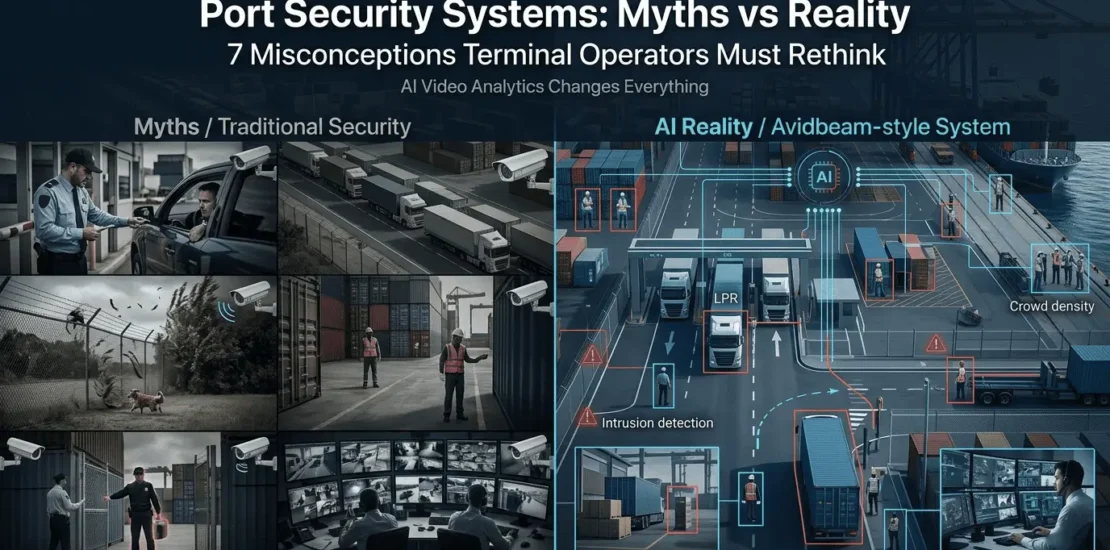
Most port security system decisions are made under a layer of assumptions that were formed around older/traditional technology.
- Guard patrols
- Manual watchlist checks
- Motion-triggered alarms
- Post-incident footage review
These were the defaults for so long for port security. AI-powered video analytics has changed the performance baseline on nearly every dimension of port security.
7 Myths vs. Facts About Port Security Systems
AvidBeam‘s platform, built by former Intel engineers and deployed across the Middle East and Africa, runs across:
- Gate management
- Perimeter monitoring
- Personnel identity verification
- Operational forensics from a single server-based architecture
The myths below reflect what port security system evaluations consistently get wrong, and what the evidence and current deployments (server-based video analytics from AvidBeam) actually show.
Myth 1: A Port Security System Is Primarily a Perimeter Problem
Fact: Perimeter monitoring is one layer. The deeper operational exposure sits inside the port.
Gate queues form without early warning because throughput data is not measured in real time. Unauthorized vehicles enter yard areas because watchlist cross-referencing happens after the fact. Cargo dwell time in specific yard zones goes untracked, creating congestion blind spots that compound across shifts. Personal Protective Equipment (PPE) compliance on berths depends on supervisor presence, not automated verification.
A traditional port security system that only addresses the outer boundary leaves the following gaps unmonitored:
- Internal vehicle routing violations on access roads and yard lanes
- Tailgating at access points between secured zones
- Left objects near critical infrastructure and cargo areas
- Crowd density anomalies at berths during vessel operations
- Personnel entering restricted zones with insufficient credentials
AvidBeam‘s AvidGuard addresses all of these through zone-specific detection rules that apply the same behavioral analysis logic inside the facility as it does at the perimeter.
| To find out how AvidBeam‘s port security system capabilities apply to your facility’s existing infrastructure, send your questions via email and the technical team will respond with a deployment-specific assessment |
Myth 2: Cameras Already Covering the Port Mean the Security System Is in Place
Fact: Recording infrastructure and analytical infrastructure are two different things.
Ports are among the most data-rich and analytically underserved environments in logistics. Cameras cover every gate, berth, yard section, and access road. The footage accumulates continuously. The operational intelligence locked inside those feeds (vehicle identity, access patterns, dwell times, compliance violations, perimeter breaches) stays largely invisible as the analytical layer was never added.
A port security system built on AvidBeam‘s server-based platform layers onto existing camera infrastructure without hardware replacement in most deployments. AvidBeam’s analytical layer runs on:
- Memory per camera: 2GB RAM minimum
- Processing: one virtual core at 2.4 GHz minimum; multiple GPU configurations supported
- Camera support: 2MP up to 4K resolution
- ONVIF compliance for standardized integration
- VMS integration: Milestone, NetworkOptix, and Genetec platforms
Myth 3: Manual Watchlist Checks at the Gate Are Sufficient for Vehicle Access Control
Fact: Manual cross-referencing cannot operate at gate speed without creating either queues or gaps.
Every vehicle that clears without proper authorization or routes incorrectly through the yard creates downstream delays that accumulate across shifts. AvidBeam‘s AvidAuto suite handles vehicle access control as a core component of port security system operations through three integrated modules:
AB-Vehicle Analytics
- License plate recognition (LPR) classifies plates by type & covers private, commercial, and transport categories.
- Arabic and English character processing through specialized Optical Character Recognition (OCR) algorithms; accuracy is 98%+ for Arabic plates and 92%+ for English.
- Watchlist management with deny lists, allow lists, and VIP lists.
- Vehicle tracking and search with entry and exit timestamps searchable by date, time, location, plate number, and plate type.
AB-ITS (Intelligent Traffic Systems)
- Wrong direction detection on access roads and internal yard routes.
- Illegal parking alerts for vehicles stopped in operational lanes or restricted zones.
- Slow and stopped vehicle detection in active traffic zones.
- Traffic density analytics by vehicle color, make, and plate type.
AB-Smart Parking
- Real-time visibility into occupied versus available yard spaces.
- Blocking entrance and exit detection at critical access points.
- Double-parking detection to maintain clear operational lanes.
Myth 4: AI-Powered Port Security System Cannot Distinguish Real Threats From Environmental False Alarms
Fact: Behavioral analysis, not motion detection, is what separates genuine alerts from noise.
Traditional motion-based port security systems generate false alerts from wildlife, weather conditions, and vehicle movement near the boundary at a rate that erodes security team response discipline over time.
AvidBeam‘s AvidGuard applies behavioral analysis to perimeter monitoring across the full port security system. The platform establishes a baseline for authorized activity in each zone and flags deviations. Confirmed detection capabilities include:
- Intrusion detection generates alerts when unauthorized individuals cross predefined boundaries before reaching cargo zones.
- Loitering detection flags individuals beyond configurable time thresholds near restricted areas.
- Fence crossing detection with precise location data for fast security team response.
- Anomaly detection that learns the behavioral baseline for each monitored zone and surfaces deviations automatically.
- Fire and smoke detection providing early warning for facility emergencies across port infrastructure.
- Scene change detection monitoring for unexpected removal of stationary equipment or assets.
Myth 5: Personal Protective Equipment (PPE) Compliance Monitoring Does Not Belong in a Port Security System
Fact: Safety compliance monitoring and security monitoring run through the same camera infrastructure and the same platform.
Cargo handling areas and restricted operational zones require Personal Protective Equipment (PPE) compliance that manual supervision cannot sustain across all shifts. AvidBeam‘s AB-Health, Safety and Environment Compliance module runs automated PPE verification through the existing camera network as part of the port security system.
The system verifies:
- Safety helmets in cargo handling and processing areas
- High-visibility vests in vehicle traffic zones
- Safety gloves and safety shoes in operational areas
- Face masks and hair covers in enclosed environments
- Ear protection in high-noise zones
Myth 6: Identity Verification at Port Access Points Only Applies to High-Security Zones
Fact: Port access management involves multiple personnel categories, each with different zone permissions, across every access point.
Permanent staff, contractors, vessel crews, customs officials, and authorized visitors all move through port access points. Manual credential verification at that volume creates both throughput delays and security gaps. AvidBeam‘s AvidFace integrates with the port security system to automate identity verification:
- Facial recognition identifies individuals even when faces are partially covered, with over 90% accuracy at entry points.
- Whitelist, blacklist, and VIP list management with automatic alerts when listed individuals are detected.
- Individual movement history by date, time, and location for security investigations or post-incident review.
- Search by image capability returning the top five matches ranked by confidence level across historical footage.
Myth 7: Post-Incident Investigation Is Always a Manual, Time-Intensive Process
Fact: Natural language queries against a centralized camera network reduce investigation timelines from hours to minutes.
Manual footage review across dozens of cameras is how most port security systems’ post-incident investigations currently operate. Analysts pull footage from multiple camera feeds, cross-reference timestamps, and build a movement picture by hand.
AvidBeam‘s AvidGenAI module replaces that process with conversational queries against the full analytics platform.
The system interprets the query, executes the search across the full camera network, and returns results with contextual explanations. For port security system operations managing large camera networks across distributed zones, this capability removes manual data extraction from daily investigative workflows.