A badge-based security system verifies that someone has the right credential. It does not verify who that person is. A stolen badge, a borrowed access card, or a door held open after a legitimate swipe all pass through the system undetected. The record shows authorized access. The person who accessed the facility may not have been authorized at all.
A face recognition security system closes that gap by making the face itself the credential. Every access event is tied to a confirmed biometric identity, not a credential that could belong to anyone. Consequently, the audit trail reflects who actually accessed each area, zone movement anomalies surface automatically, and deny-listed individuals trigger alerts at the moment they appear at any monitored point.
AvidBeam’s AvidFace platform delivers face recognition as a complete security system: identity verification at access points, watchlist management across every zone, behavioral integration with AvidGuard‘s anomaly detection layer, and post-incident forensic search across the full camera network. All of this runs on Artificial Intelligence (AI) powered server-based processing on the cameras already installed.
What a Face Recognition Security System Adds to Physical Security
The security value of face recognition is not limited to identifying who is present. It changes what the security system can detect, what it can prevent, and what evidence it produces. Two distinctions define where face recognition adds the most direct security value over credential-based systems.
Identity Confirmation vs. Credential Verification
Credential verification checks whether the right badge, card, or PIN was presented at the right reader. It produces a log entry attributed to a credential, not to a person. Consequently, the log is only as reliable as the assumption that the credential was used by its authorized holder.
As covered in AvidBeam’s analysis of where facial recognition access control begins and conventional systems end, identity confirmation changes that assumption into a verified fact. The face recognition security system confirms the individual at the point of access. The audit trail reflects biometric identity per event, not credential use. Consequently, investigations, compliance audits, and access disputes rest on verified evidence rather than credential logs.
The Security Gaps Credentials Cannot Close
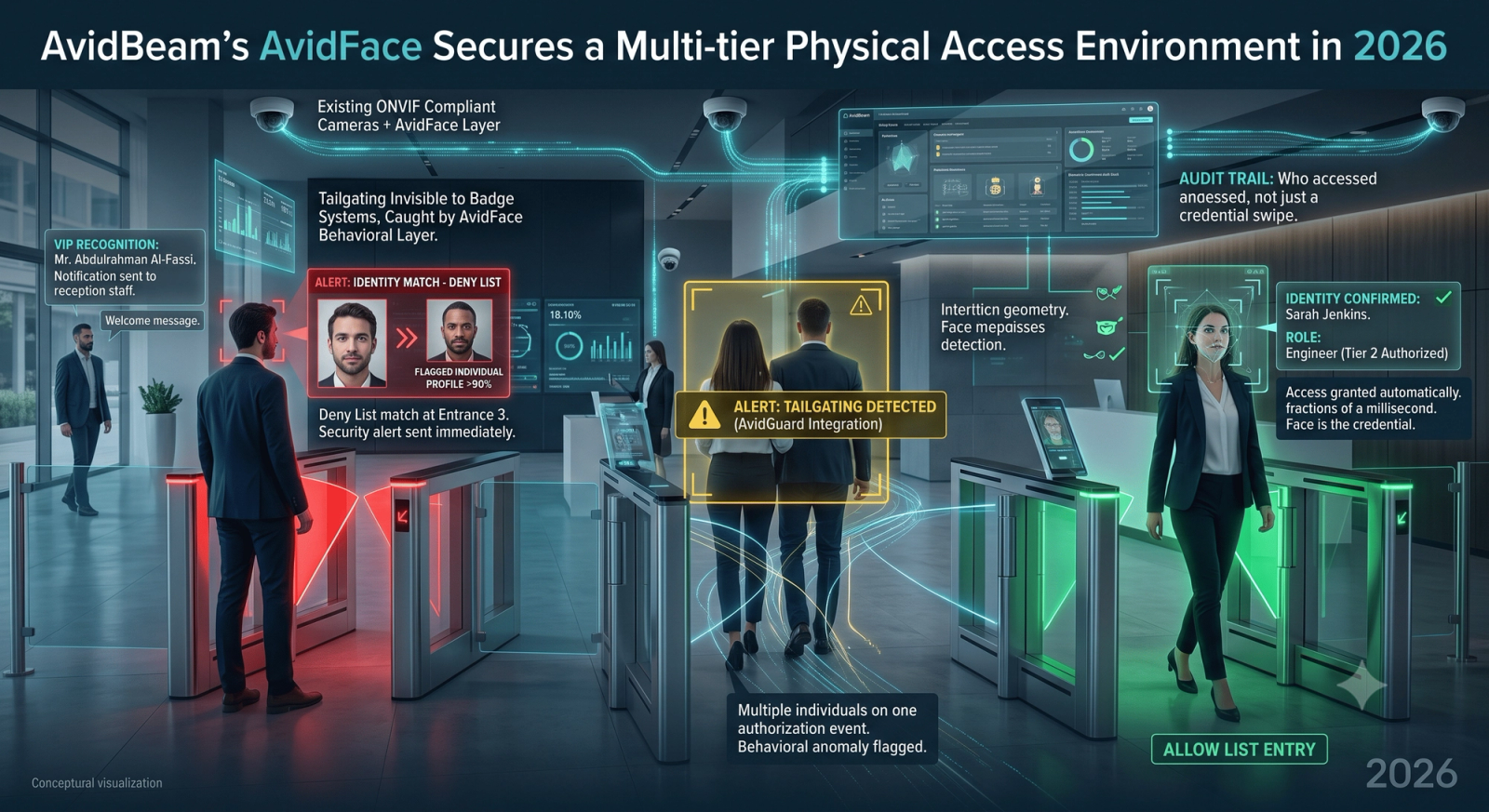
Three security gaps exist in every credential-based system that a face recognition security system addresses directly. First, tailgating: an individual following an authorized person through a door on a single badge swipe is invisible to credential systems and requires a human observer to catch. Second, credential transfer: a badge presented by someone other than its authorized holder passes through undetected. Third, zone access anomalies: a credential system logs that a badge was used at a reader but cannot detect when an individual appears in a zone without a corresponding access event at the boundary between zones.
AvidFace addresses all three. Tailgating detection runs as a behavioral layer through AvidGuard. Credential transfer is eliminated because the face itself is the credential. Zone movement tracking surfaces boundary anomalies automatically against each individual’s authorization profile.
| To find out how AvidFace’s face recognition security system applies to your facility’s existing cameras, send an email to info@avidbeam.com and the technical team will follow up. |
How AvidFace Works as a Security System
AvidFace runs on a server-based architecture that processes all recognition centrally, not at individual cameras. This is the architectural decision that determines accuracy consistency and scalability. Any Open Network Video Interface Forum (ONVIF) compliant camera already covering an access point connects to the platform without hardware replacement at that point.
The Recognition Pipeline
AvidFace runs four stages on every face that enters a monitored frame. First, it detects the face and maps its structural geometry: the distance between eyes, jawline curvature, and cheekbone depth. Second, mathematical equations convert those measurements into a unique numerical faceprint. Third, the faceprint matches against stored identity databases in fractions of a millisecond. Fourth, the security system responds automatically: access granted, alert triggered, event logged, or policy breach flagged, without operator input at any stage.
Accuracy Under Real Security Conditions
A face recognition security system that performs well in controlled demos but degrades in real access environments is not a security asset. AvidFace sustains accuracy above 90% across the conditions that real security environments produce: partial face obstructions including masks, glasses, and hats; non-frontal face angles in corridors and lobbies; variable lighting across the operating day; and multiple faces simultaneously in high-traffic entry frames.
Additionally, self-learning algorithms improve accuracy with each interaction. They adapt to aging and appearance changes over time. Consequently, re-enrollment cycles are not required to maintain detection accuracy across long-term deployments.
Watchlist Management as the Security Core
A face recognition security system’s watchlist layer is what converts identification into security response. AvidFace manages three list categories in parallel across every monitored access point simultaneously, each configured to produce a distinct automated security response.
- Deny lists: flagged individuals trigger a security alert the moment their face appears at any monitored point across the full network. The alert delivers confirmed identity, camera source, timestamp, and location before the individual reaches interior zones or restricted areas.
- Allow lists: authorized personnel receive automated entry without manual credential checks at every monitored access point. Queue formation at high-traffic entry points is eliminated. The face recognition security system confirms identity and clears entry in fractions of a millisecond.
- Very Important Person (VIP) lists: recognized individuals trigger service notifications before they reach the reception point. The system identifies them at the entrance and alerts the relevant staff ahead of arrival, without any visible checkpoint or credential verification process.
List updates propagate to every connected access point simultaneously. Consequently, a deny list change at the central management interface applies across the full facility network the moment it is made.
Zone-Level Security After Entry
Entry point verification is the first layer of what a face recognition security system delivers. Zone-level security after entry is where the system’s intelligence compounds. AvidFace tracks individual movement across facility zones continuously by zone ID, timestamp, and camera ID after the initial access event.
When an individual authorized for one zone appears in a restricted area without a corresponding access event at the boundary, the platform surfaces the anomaly automatically against that individual’s authorization profile. The alert is identity-specific, not motion-triggered. Furthermore, reverse image search compresses post-incident investigation: security teams upload an image and receive the top five ranked matches with timestamps across the full recorded network, without manually reviewing footage from individual cameras.
Face Recognition Security Across Environments
The recognition mechanics stay consistent across environments. The primary security requirements and the most operationally significant capability layer differ by context. The four environments below represent the most common face recognition security system deployments.
Corporate Buildings and Campuses
Corporate environments handle continuous personnel movement across access tiers with different authorization levels. AvidFace verifies identity at building entrances, floor access points, and restricted areas automatically. Contractors access authorized zones only. Zone movement tracking logs staff movement against confirmed identity continuously. The deny list fires immediately if a flagged individual approaches any monitored entry point across the campus.
Government and High-Security Facilities
Government environments require real-time zone tracking, dynamic watchlist management, and audit trails that confirm individual identity rather than credential use. AvidFace’s zone-level tracking and deny list alerting address all three simultaneously. The Ministry of Foreign Affairs deployment in Saudi Arabia combined AvidFace with AvidGuard for face recognition and behaviour monitoring.
Banking and Financial Institutions
Banking environments carry identity-specific vulnerabilities that credential systems cannot address: vault access without a second authorized person, server room access outside permitted hours, and VIP client recognition before they reach the counter. AvidFace covers all three through the same face recognition security system deployed across the facility’s existing camera network. For a detailed breakdown of banking security applications, see AvidBeam’s analysis of what modern building security systems require.
Hospitality Properties
Hospitality requires a face recognition security system that is invisible to the guest experience while maintaining active security behind it. VIP list management identifies recognized guests at the entrance and notifies the relevant staff before they reach the front desk. Security monitoring continues across the same camera network without any visible checkpoint for authorized arrivals. The Four Seasons Madinah deployment ran AvidFace alongside AvidAuto across all property access points simultaneously.
Full Security System Capability Breakdown
The table below maps every capability AvidFace delivers as a face recognition security system, what triggers each response, and what the security system produces operationally.
| Capability | What Triggers It | Security System Output |
|---|---|---|
| Real-time identity verification | Face matched against database in fractions of a millisecond | Access granted, alert triggered, or event logged automatically |
| Deny list alerting | Flagged individual detected at any monitored point | Alert fires with confirmed identity, camera source, timestamp, and location |
| Allow list automation | Authorized personnel recognized at entry points | Automated entry without manual credential checks; no queue formation |
| VIP recognition | Recognized individual identified at building entrance | Service notification sent to relevant staff before individual reaches the desk |
| Tailgating detection | Multiple individuals entering on one authorization event | Real-time alert; invisible to badge systems without a behavioral layer |
| Zone movement tracking | Individual detected in zone outside their authorization profile | Anomaly alert fires automatically against the person’s access record |
| Reverse image search | Historical footage queried by uploaded face image | Top five ranked matches returned with timestamps across full network |
| Attribute detection | Age, gender, eyewear, and headwear profiled per detected face | Demographic reporting and restricted zone access profiling |
| Mask detection | Face covering presence or absence verified per individual | Health compliance monitoring alongside security functions on the same feed |
| Self-learning adaptation | Algorithms update with each interaction | Accuracy above 90% sustained across aging and appearance changes over time |
Credential-Based vs. Face Recognition Security System
The table below sets out where AvidFace’s face recognition security system diverges from credential-based security systems at the identity verification, detection, and audit trail level.
| Security Dimension | Credential-Based Security System | AvidFace Face Recognition Security System |
|---|---|---|
| Identity verification | Credential presented; person behind it unverified | Face confirmed at 90%+ accuracy; credential is the face itself |
| Tailgating | Invisible to badge systems; requires manual observation | Detected in real time through behavioral analysis |
| Deny list response | No live cross-referencing; retrospective review only | Alert fires before flagged individual reaches interior zones |
| Zone tracking | Badge swipe logs credential use; not individual presence | Continuous zone-level tracking against each person’s authorization profile |
| Unauthorized zone access | Not detected unless a physical barrier fails | Anomaly surfaces automatically against the individual’s access record |
| Audit trail | Credential-based log; does not confirm who used it | Biometric-confirmed log per access event; identity verified per record |
| Post-incident investigation | Manual footage scrub; hours per case | Image-based search returning ranked matches in minutes |
| Hardware requirement | Dedicated access control readers at every point | Layers onto existing Open Network Video Interface Forum (ONVIF) compliant cameras |
In short, credential-based systems verify possession. AvidFace verifies identity, tracks presence across zones, surfaces access anomalies automatically, and produces biometric-confirmed audit trails across the full facility network.
Infrastructure and Deployment
AvidFace connects to any ONVIF compliant camera via standard network protocols. All recognition processing runs centrally, not at the camera. Therefore, no dedicated face recognition hardware is required at individual access points.
The infrastructure baseline per camera processed:
- 2GB RAM minimum; one virtual core at 2.4 GHz minimum
- Multiple Graphics Processing Unit (GPU) configurations supported for higher-density deployments
- Camera resolution: 2MP up to 4K; lens focal length 3mm to 25mm
- Pitch -15° to +15°; roll -180° to +180°; yaw -15° to +15°
Video Management System (VMS) integration covers Milestone, NetworkOptix, and Genetec platforms. Deployment options include on-premise, private cloud, public cloud, and hybrid. Notably, on-premise processing keeps all biometric data local, the recommended configuration for government and high-security facilities.