ANPR Hits: What They Are and How AI Detection Works
Trigger instant alerts and gate automation. Discover how AvidAuto generates real-time ANPR hits with 98%+ Arabic plate accuracy on existing IP cameras.
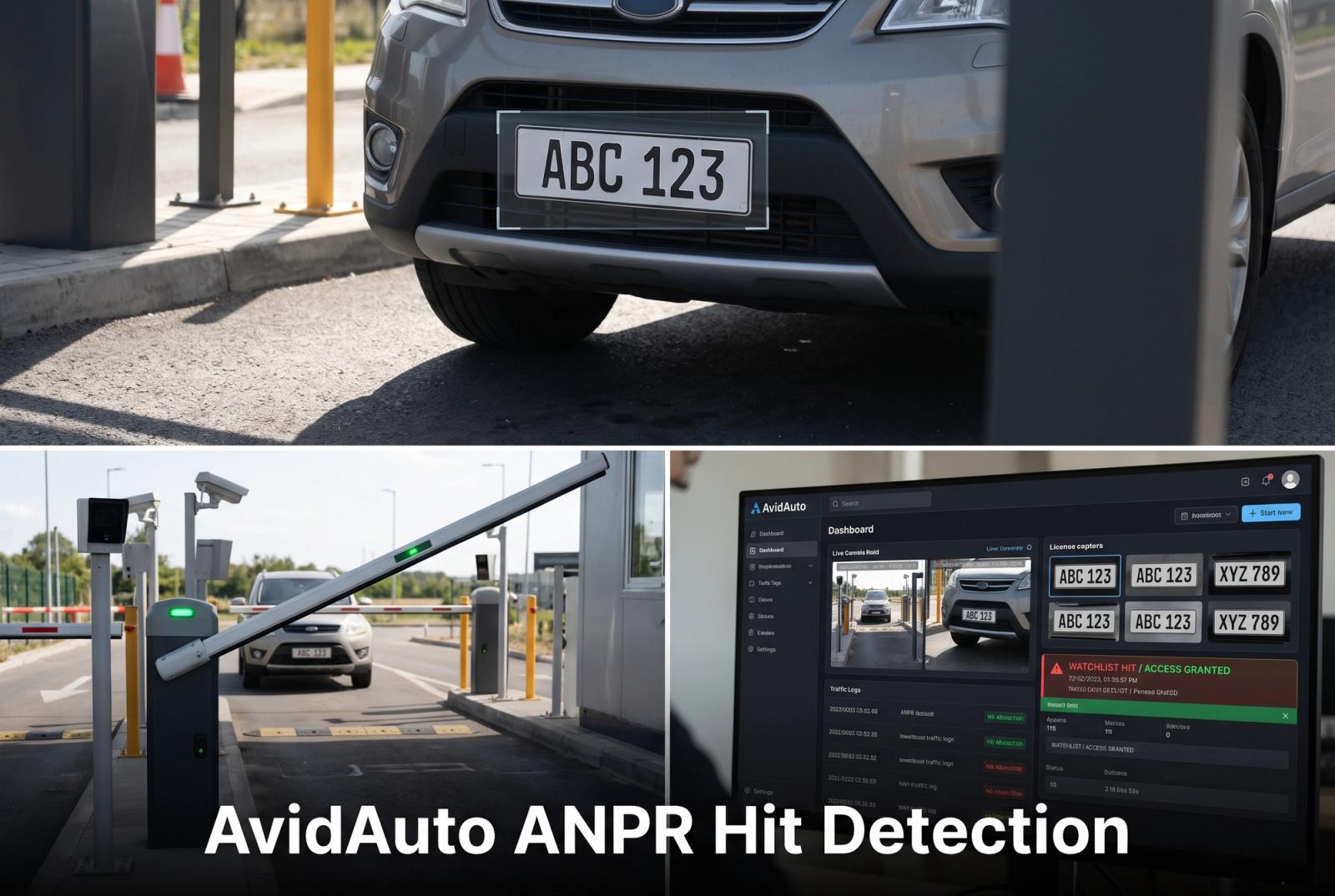
| What Is an ANPR Hit?An ANPR hit is an event generated by an automatic number plate recognition (ANPR) system when a detected license plate matches a condition defined in the system: a watchlist match, an approved or blocked access list entry, a speed threshold, a dwell time limit, or any other rule configured for the deployment. Each hit produces an alert, a log entry, or an automated physical response such as opening or closing a barrier. |
Every vehicle that passes a camera connected to an ANPR system is read. Most reads produce no hit. When a plate matches a configured rule, the system generates a hit and acts on it. That distinction between a read and a hit is what turns automatic number plate recognition from a passive recording tool into an active enforcement and access control mechanism.
This article explains what ANPR hits are, the different types that apply across security and operations contexts, how AvidBeam's server-based platform generates and processes them, and what happens after a hit is triggered.
What Is ANPR and How Does It Work?
Automatic number plate recognition is a technology that uses cameras and optical character recognition (OCR) software to read vehicle license plates in real time. The system captures an image of the plate, isolates the characters, converts them into text, and compares the result against one or more databases or rule sets. When the result matches a defined condition, the system generates a hit.
Modern ANPR systems, including AvidBeam's AvidAuto platform, do not require dedicated ANPR cameras. The recognition engine runs as software on a central analytics server, processing video streams from standard ONVIF (Open Network Video Interface Forum)-compliant cameras already installed in the environment. This server-based approach delivers higher accuracy than edge-based systems and allows multiple detection rules to run simultaneously on each camera feed.
How a Plate Is Read
The recognition process happens in stages. The camera captures a continuous video stream. The ANPR engine detects when a vehicle enters the frame and identifies the plate region within the image. It then applies OCR to extract the character string from the plate image, applying corrections for lighting variation, angle, partial occlusion, and motion blur. The resulting plate number is formatted according to the configured regional standard and passed to the matching engine.
AvidBeam's AvidAuto achieves over 98% accuracy on Arabic plates and over 92% accuracy on English plates under standard deployment conditions. The system processes each plate read in real time, with hit decisions made within milliseconds of the plate being recognized.
What Triggers an ANPR Hit
A hit is triggered when a plate read matches a rule configured in the system. Rules fall into several categories. List-based rules compare the plate against a database of known plates, such as an approved access list, a watchlist of stolen or flagged vehicles, or a blocked vehicle registry. Threshold-based rules apply conditions to behavior, such as speed exceeding a defined limit or dwell time in a zone exceeding a set duration. Event-based rules trigger on specific patterns, such as a plate appearing at two separate entry points within a short time window.
Each rule type produces a different type of hit, and each hit type can trigger a different automated response. The flexibility of the rule engine is what allows a single ANPR deployment to serve access control, enforcement, and security functions simultaneously.
Types of ANPR Hits
ANPR hits are not a single category of event. Different deployment contexts require different hit types, and a well-configured system applies the rules that match the operational priorities of each location. The table below covers the most common hit types, what triggers them, what response they produce, and where they apply.
| Hit Type | Trigger Condition | Automated Response | Primary Use Case |
| Watchlist Hit | Plate matches a flagged or stolen vehicle list | Instant alert to operator or security team | Law enforcement, border control |
| Access Granted | Plate found on approved entry list | Gate or barrier opens automatically | Gated communities, corporate campuses |
| Access Denied | Plate not on approved list or on blocked list | Gate remains closed, alert raised | Secure facilities, parking control |
| Speed Violation | Vehicle exceeds defined speed threshold in zone | Event logged, alert sent, evidence captured | Traffic enforcement, campus roads |
| Wrong Direction | Vehicle traveling against designated flow | Alert issued, incident logged | Parking lots, one-way roads |
| Overstay Hit | Vehicle exceeds permitted dwell time in zone | Alert to parking enforcement, ticket triggered | Paid parking, restricted zones |
| Re-Entry Hit | Same plate detected entering again within defined window | Alert flagged for review | Event venues, logistics yards |
| Unregistered Vehicle | Plate not found in any local database | Alert raised for manual inspection | Border crossings, secure sites |
Watchlist Hits
A watchlist hit occurs when a detected plate matches a database of flagged vehicles. The watchlist can contain stolen vehicles, vehicles associated with known individuals of interest, vehicles flagged by law enforcement, or vehicles banned from a specific site. The hit generates an immediate alert to an operator or security team, and in some deployments it triggers a physical response such as activating a barrier or locking a gate.
Watchlist hit performance depends on the quality and currency of the list. AvidAuto connects to external databases and can be updated in real time, ensuring that the system is always working against the most current information available to the operator.
Access Control Hits
Access control hits govern vehicle entry and exit at defined points. An access granted hit opens a barrier or gate when a recognized plate appears on the approved list. An access denied hit keeps the barrier closed and raises an alert when a plate is not on the approved list or appears on a blocked list. These hits replace manual checkpoint processes and eliminate the delays and inconsistencies associated with human-operated barriers.
In high-traffic environments such as large parking facilities, logistics yards, and corporate campuses, access control hits from AvidAuto process vehicles faster than manual systems and produce a complete, timestamped record of every entry and exit event.
Enforcement Hits
Enforcement hits apply behavioral rules rather than list comparisons. Speed violation hits are triggered when a vehicle's calculated speed in a monitored zone exceeds a configured threshold. Wrong-direction hits are triggered when a vehicle's movement contradicts the designated flow direction for a lane or road. Overstay hits are triggered when a vehicle's dwell time in a zone exceeds the permitted limit.
Each enforcement hit produces a captured image of the plate, a timestamp, and the detected value that triggered the rule. This evidence package supports manual review, fine processing, and integration with external traffic management systems.
How AvidBeam Generates ANPR Hits
AvidBeam's AvidAuto platform generates ANPR hits through a server-based LPR (license plate recognition) architecture that processes camera streams centrally, applies configured rules in real time, and delivers hit results to operators through a dashboard, VMS integration, or API.
Server-Based LPR Architecture
AvidAuto runs on a central analytics server rather than on the camera. Cameras stream video to the server using standard protocols. The server runs the recognition engine and rule matching logic against each stream, generating hits and passing them to the notification and response layer. This architecture allows the system to run multiple rule sets simultaneously on each camera and to update rules, watchlists, and databases centrally without touching individual cameras.
The server-based approach also enables AvidAuto to integrate with leading video management systems (VMS), including Milestone, NetworkOptix, and Genetec. For more on what this architecture enables, see Server-Based Video Analytics.
Accuracy and Speed
AvidAuto achieves over 98% accuracy on Arabic plates and over 92% on English plates. The system processes each plate read and delivers a hit decision in real time, with the response layer acting on the hit within milliseconds. This speed is essential for access control deployments where a gate must open before a vehicle needs to stop, and for enforcement deployments where plate evidence must be captured before the vehicle leaves the monitored zone.
The recognition engine handles challenging conditions including partial occlusion, motion blur, low light, and adverse weather. It supports multiple plate formats and character sets simultaneously, making it suitable for multi-national deployments and border crossing environments where plates from different countries appear on the same camera feed.
For a detailed explanation of the recognition process, see How License Plate Recognition Technology Works.
Where ANPR Hits Are Used
ANPR hits apply across a wide range of environments. Each deployment configures the hit types and rules that match its operational context. The table below maps common deployment environments to the hit types they rely on most.
| Environment | Primary Hit Type | Action Triggered | Outcome |
| Gated Communities | Access granted or denied | Barrier control | Resident access automation |
| Corporate Campuses | Access control, watchlist | Gate control, security alert | Visitor and staff access management |
| Parking Facilities | Overstay, access, unregistered | Barrier, enforcement alert | Revenue protection, compliance |
| Ports and Logistics | Access control, re-entry, watchlist | Gate control, checkpoint alert | Cargo security, truck flow management |
| Traffic Enforcement | Speed, wrong direction, violations | Evidence capture, fine generation | Road safety, violation processing |
| Government and Military | Watchlist, access denied, unregistered | Barrier lockdown, security escalation | Perimeter protection, threat response |
| Event Venues | Access control, re-entry, watchlist | Gate control, alert to security team | Authorized vehicle management |
| Smart Cities | Traffic violation, speed, flow monitoring | Central command alert, evidence log | Urban traffic intelligence |
What Happens After an ANPR Hit
A hit is only as useful as the response it triggers. AvidAuto supports a range of automated and manual response options, and the appropriate response depends on the hit type, the deployment environment, and the operational priorities of the organization.
Automated Responses
For access control hits, the most common automated response is barrier or gate control. An access granted hit sends a signal to the barrier controller to open the gate. An access denied hit keeps the gate closed and can send an alert to a guard station or operator dashboard. Watchlist hits generate an immediate alert and can trigger a lockdown sequence at a facility entry point.
Enforcement hits produce evidence packages automatically: a captured image of the vehicle and plate, the timestamp, the detected value that triggered the rule, and the camera identifier. These packages can be sent directly to a fine-processing system, a traffic management platform, or a security operations center (SOC) for review.
Audit Trails and Reporting
Every hit is logged with a full record: plate number, timestamp, camera location, hit type, the rule that triggered it, and the action taken. These logs support compliance auditing, incident investigation, and operational reporting. Organizations managing large vehicle populations, such as parking operators or logistics companies, use hit logs to track vehicle movement patterns, identify anomalies, and generate utilization reports.
AvidAuto's reporting layer aggregates hit data across all cameras and locations, allowing operators to view hit volumes by site, hit type, time period, and individual plate. This data is accessible through the AvidAuto dashboard and through API integration with external reporting tools.
Frequently Asked Questions
What is an ANPR hit?
An ANPR hit is an event generated when a license plate read by an ANPR system matches a configured rule, such as a watchlist entry, an access list condition, a speed threshold, or a dwell time limit.
What is the difference between an ANPR read and an ANPR hit?
Every plate the camera captures is a read; a hit only occurs when the read matches a defined rule or condition configured in the system.
How fast does AvidAuto generate a hit after reading a plate?
AvidAuto processes plate reads and delivers hit decisions in real time, within milliseconds of the plate being recognized.
Can one camera generate multiple types of ANPR hits?
Yes. AvidAuto's server-based architecture runs multiple rule sets simultaneously on each camera, so a single camera can generate access, watchlist, and enforcement hits independently.
How accurate is AvidBeam's ANPR system?
AvidAuto achieves over 98% accuracy on Arabic plates and over 92% on English plates under standard deployment conditions.
Does AvidAuto work with existing cameras?
Yes. AvidAuto processes video from any ONVIF-compliant camera already installed in the environment without requiring a hardware replacement.
Can ANPR hit lists be updated in real time?
Yes. AvidAuto connects to external databases and supports real-time list updates, ensuring hit matching always uses the most current data.
What evidence does an enforcement hit produce?
Each enforcement hit captures a plate image, timestamp, camera location, detected value, and the rule that triggered it, forming a complete evidence package for review or processing.
AvidBeam's ANPR hit detection is delivered through AvidAuto, the company's server-based vehicle analytics platform, deployed across gated communities, parking facilities, ports, government sites, and smart city traffic infrastructure across the Middle East and internationally.
| See AvidBeam ANPR Hit Detection LiveAvidAuto delivers real-time ANPR hits on your existing cameras with over 98% accuracy on Arabic plates and over 92% on English plates. Request a live demo.Request a Demo at avidbeam.com/contact |
 Article
ai video analytics services: Compare Providers Beyond Features
AI (Artificial Intelligence) video analytics services are engagements covering video analytics software and related work, with each proposal defining what is included.
 Article
AvidBeam Participates in Cairo ICT 2026
AvidBeam Technologies will participate in Cairo ICT 2026, taking place from November 7 to 10, 2026, at the Egypt International Exhibition Center in New Cairo.
 Article
lpr data analytics solutions: Prove Reliability Before You Buy
LPR (License Plate Recognition) data analytics solutions convert captured vehicle plate information into machine-readable text and support workflows for delivering and reviewing vehicle records.
Experience AI Video Analytics
on your existing cameras.
Start with a pilot deployment and scale seamlessly as your operational requirements evolve.