| What Is Railway Video AI?Railway video AI is the application of artificial intelligence to the live camera networks installed across railway infrastructure, including tracks, platforms, stations, depots, level crossings, and tunnels. It processes video feeds in real time to detect safety-critical events such as track intrusions and objects on the line, security threats such as unauthorized zone access and abandoned objects, operational risks such as platform overcrowding, and compliance issues such as PPE non-compliance in maintenance zones. When an event is detected, the system generates an immediate alert and can integrate with signaling systems, access control, and operations management platforms to trigger an automated or operator-guided response. |
Railway networks generate enormous volumes of video footage from cameras distributed across hundreds or thousands of locations. Most of that footage is reviewed only after an incident has occurred, long after the window for prevention has closed. The safety and security consequences of that delay are significant: a person on a track, an object in the path of a train, or an unattended bag on a platform are events where response time is measured in seconds, not hours.
Railway video AI closes that gap by processing every camera feed continuously, flagging events the moment they occur, and delivering alerts to the operators or systems that need to act. The result is a railway network where the cameras already installed become active safety and security sensors rather than passive recording devices. This article covers what railway video AI detects, how it integrates with railway operations, and how AvidBeam's platform deploys across the full range of railway environments.
What Railway Video AI Detects
Railway video AI covers a broad range of detection categories, from safety-critical events on the track to security and compliance monitoring across station infrastructure. The table below maps the most common detection types to the response they trigger and the risk category they address.
| Detection Type | What the System Flags | Response Triggered | Risk Category |
| Track Intrusion | Person or object detected on live track or within danger zone | Immediate alert, signal integration to halt approaching trains | Safety-critical |
| Platform Overcrowding | Crowd density exceeds safe threshold at platform edge or concourse | Operational alert, PA broadcast trigger, gate management | Safety and operations |
| Unauthorized Zone Access | Person enters restricted area: track bed, maintenance zone, control room | Security alert, access control trigger | Security |
| Object on Track | Stationary object detected on live track: luggage, debris, vehicle | Safety alert, nearest signal notification | Safety-critical |
| Aggression and Fights | Physical altercation or aggressive behavior detected on platform or concourse | Security team alert with camera location and timestamp | Passenger safety |
| PPE Non-Compliance | Maintenance worker detected without required personal protective equipment in active work zones | Supervisor alert, work order flagged for review | Worker safety |
| Vandalism Detection | Graffiti, property damage, or destructive behavior detected on rolling stock or station infrastructure | Security alert, footage clip automatically saved for evidence | Asset protection |
| Abandoned Object | Unattended bag or package left on platform or concourse beyond configured dwell time | Security alert with object location, automatic footage flagging | Security |
Track and Platform Safety
Track intrusion and object-on-track detection are the highest-priority use cases in railway video AI because the consequences of a missed event are potentially catastrophic. When a person or object enters the track danger zone, the system flags the event immediately and can integrate with the signaling infrastructure to halt approaching trains before the driver's line of sight reaches the obstruction. This response is automatic and faster than any manual monitoring process.
Platform overcrowding adds a second dimension of safety risk that is particularly acute in metro and subway environments during peak hours. When crowd density at a platform edge exceeds a configured threshold, the system alerts operations staff, who can open additional gates, adjust train frequency, or trigger PA announcements before a crowd surge creates a physical hazard.
Security and Access Control
Station security applications cover unauthorized access to restricted areas, abandoned object detection, aggression and fight detection, and vandalism monitoring. Each of these events is detected in real time, with an alert delivered to the nearest available security team member along with the camera location and a captured image. For a broader overview of what AI security detection covers in built environments, see AI Security Systems: What They Detect and How They Work.
How AvidBeam's Railway Video AI Works
Server-Based Processing on Existing Infrastructure
AvidBeam's railway video AI runs on a central analytics server that processes live feeds from connected cameras. This server-based architecture means the AI processing does not depend on the cameras themselves: any ONVIF-compliant camera already installed across the railway network connects to the analytics server and begins delivering AI-processed detections immediately, without hardware replacement or camera upgrade. For more on how server-based processing supports large-scale camera networks, see Server-Based Video Analytics.
Multiple detection models run simultaneously on the same camera feed. A platform camera can deliver crowd density alerts, abandoned object flags, and fight detection from the same stream without deploying separate systems for each capability. This multi-detection architecture is particularly valuable in railway environments where camera infrastructure is expensive to install and each camera covers a large area of safety-critical space.
VMS and Operations Integration
AvidBeam integrates with Milestone XProtect, NetworkOptix, and Genetec video management systems, embedding railway AI detections directly into the operator interface those platforms provide. For railway operators, this means AI alerts appear in the same interface already used for all other camera events, without requiring a separate monitoring platform or retraining of operations staff. Alert data can also be passed to railway operations management systems, signaling platforms, and incident management tools through standard integration interfaces.
Where Railway Video AI Is Deployed
Railway video AI applies across the full range of environments that make up a modern railway network. The table below maps each environment to its primary AI applications, the AvidBeam module involved, and the key operational outcome.
| Railway Environment | Primary AI Application | AvidBeam Module | Key Outcome |
| Mainline Rail Tracks | Track intrusion detection, object on track, signal zone monitoring | AvidGuard | Collision prevention, incident response time reduction |
| Metro and Subway Platforms | Crowd density management, platform edge proximity, aggression detection | AvidGuard | Passenger safety, controlled overcrowding response |
| Stations and Concourses | Unauthorized access, abandoned objects, perimeter breach, loitering | AvidGuard | Threat detection, security response, evidence capture |
| Train Depots and Yards | PPE compliance, restricted zone access, vehicle movement tracking | AvidGuard | Worker safety compliance, asset security |
| Level Crossings | Vehicle or pedestrian detected on crossing when barrier is active | AvidGuard | Collision prevention, automatic incident logging |
| Tunnels and Bridges | Unauthorized access, structural area monitoring, person detection | AvidGuard | Safety zone enforcement, incident documentation |
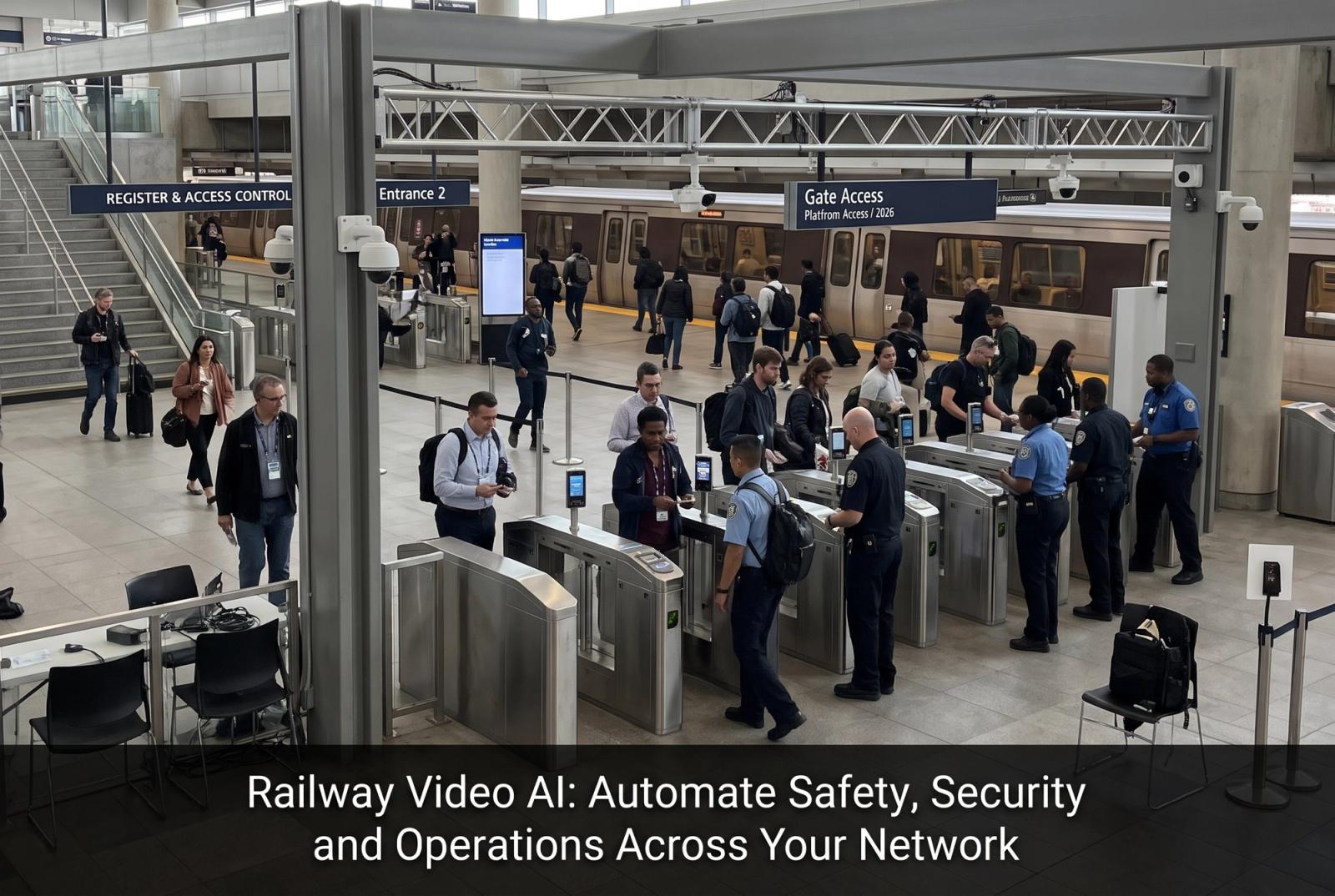
| Ticket Gates and Entry Points | Fare evasion detection, tailgating, access control verification | AvidGuard, AvidFace | Revenue protection, controlled entry, identity verification |
| Control and Operations Rooms | Restricted access, tailgating prevention, unauthorized visitor detection | AvidGuard, AvidFace | Critical facility security, access audit trail |
PPE Compliance in Railway Maintenance Environments
Maintenance zones within railway depots, track-side work areas, and tunnel inspection environments present a distinct safety monitoring challenge: workers operating near live infrastructure must wear appropriate personal protective equipment, but compliance verification has traditionally relied on manual supervisor checks. Railway video AI automates this process, detecting PPE non-compliance in real time and alerting supervisors before a worker enters a hazardous zone without adequate protection.
AvidBeam's AvidGuard module covers PPE detection as one of its standard analytics capabilities, running on the same server infrastructure as the platform's safety and security modules. A depot camera configured for PPE monitoring delivers both safety alerts and standard security detections from the same feed without additional hardware.
Frequently Asked Questions
What is railway video AI?
Railway video AI processes live camera feeds across track, platform, station, and depot environments to detect safety-critical events, security threats, and operational risks in real time, generating immediate alerts and integrating with railway operations and signaling systems.
Can railway video AI detect a person on the track?
Yes. Track intrusion detection is one of the primary safety applications of railway video AI, flagging people or objects within the track danger zone immediately and integrating with signaling systems to halt approaching trains.
Does railway video AI require new cameras?
No. AvidBeam's railway video AI runs on any ONVIF-compliant camera already installed across the network, requiring no hardware replacement.
How does the system alert operators to a detected event?
Alerts are delivered in real time to the VMS interface operators already use, with the camera location, event type, and a captured image. The system integrates with Milestone XProtect, NetworkOptix, and Genetec.
Can railway video AI detect overcrowding on a platform?
Yes. The system monitors crowd density in real time and alerts operations staff when density at a platform edge or concourse exceeds a configured threshold.
What PPE items can railway video AI detect?
The system detects the presence or absence of high-visibility vests, hard hats, safety gloves, and other configured PPE items on workers in designated maintenance and work zones.
Can the system detect fare evasion or tailgating at ticket gates?
Yes. AvidBeam's platform detects tailgating and unauthorized entry at gates and can integrate with access control systems to flag events for security review.
How is AvidBeam's railway video AI deployed?
The platform deploys as a server-based analytics layer connected to the railway's existing camera network, integrating into the VMS and operations management systems already in use. Deployment does not require camera replacement or infrastructure upgrade.
| See Railway Video AI Running on Your Existing InfrastructureAvidBeam's railway video AI deploys on the CCTV cameras your network already has, delivering real-time track, platform, and station intelligence with no hardware replacement required.Request a Demo at avidbeam.com/contact |