Why Large-Scale Video Analytics Belongs on the Server, Not the Camera
Server-based video analytics is an architecture in which AI processing runs on centralized server infrastructure rather than on embedded chips inside individual cameras.

| What is server-based video analytics? Server-based video analytics is an architecture in which AI processing runs on centralized server infrastructure rather than on embedded chips inside individual cameras. The cameras capture and stream video. A dedicated server, equipped with data-center-class processors and Graphics Processing Units (GPUs), runs the detection models across every connected camera simultaneously. This approach separates the intelligence from the hardware that captures the image, enabling model complexity, processing throughput, and capability updates that embedded camera chips cannot support. |
Video analytics has quietly become one of the most demanding workloads in modern infrastructure. What began as simple motion detection now spans people counting, traffic analysis, demographic estimation, biometric identification, and — increasingly — open-ended understanding of a scene through video language models. As the ambition of these deployments grows, so does a foundational architectural question: should the intelligence live on the camera, or on the server?
Both approaches are viable, and each has a legitimate place. However, the two are not interchangeable. Choosing the wrong one for the scale of a project is an expensive mistake. For simple deployments with a handful of cameras, on-camera analytics can be perfectly adequate. For large, evolving, mission-critical projects, server-based analytics wins on performance, flexibility, and — perhaps counterintuitively — total cost of ownership.
The Appeal of Camera-Based Analytics — and Where It Breaks Down
The case for camera-based, or edge, analytics usually starts with capital expenditure. If each camera carries its own accelerator and runs its own inference, you avoid buying a rack of servers and GPUs. The intelligence is distributed, the network carries less raw video, and on paper, the hardware bill looks lean.
That logic holds until you try to scale. On a ten-camera pilot, distributing compute across the devices is manageable. On a project with hundreds or thousands of cameras spread across a city, the picture inverts.
Every camera becomes an independent compute node that must be provisioned, updated, monitored, and eventually replaced. Analytics capability is now welded to hardware that was chosen years ago and is sitting on a pole in the field. When the requirements change — and in video analytics, they always change — you face a hardware refresh across the entire fleet rather than a software update in a data center.
The capital expenditure saving that justified the edge approach erodes as the deployment grows, precisely when budgets are most sensitive to it.
Camera Accelerators Cannot Match Server-Grade Compute
The hard ceiling on edge analytics is silicon. The accelerators embedded in smart cameras — Neural Processing Units (NPUs), Vision Processing Units (VPUs), and similar edge chips — are engineered around tight power and thermal budgets. They typically deliver compute in the single to low tens of INT8 Tera Operations Per Second (TOPS).
That is genuinely impressive for a device drawing a few watts, and it is enough to run a detector or two. It is not in the same universe as a data-center GPU.
A modern server-class GPU can deliver on the order of a thousand INT8 TOPS or more, and a single server can hold several of them. Just as importantly, a server can batch and schedule work across many camera streams at once, keeping expensive silicon fully utilized rather than leaving it idle between frames on a single view.
No camera accelerator can match or beat this: not on raw throughput, not on the size of models it can run, and not on efficiency of utilization across a fleet. The edge chip is optimized to be small, cool, and cheap. The server GPU is optimized to be powerful. When the workload is heavy, power wins.
| To discuss how server-based video analytics applies to your infrastructure, send an email to info@avidbeam.com and the technical team will follow up with an architecture assessment. |
One Camera, Many Use Cases
This compute headroom translates directly into capability. Because a server is not constrained to whatever the camera's chip can handle, a single video stream can drive many analytics pipelines simultaneously. As covered in AvidBeam's analysis of what separates modern video surveillance platforms, the most operationally valuable configurations are those that run multiple detection types on the same camera feed rather than dedicating separate hardware to each use case.
From one camera feed, a server-based system can run multiple directional pathway counts, estimate age and gender, perform biometric identification, detect objects and anomalies, and track dwell time: all at once, and all upgradeable independently.
On the camera, every additional use case competes for the same constrained compute budget, and adding a new one often means reaching the limits of the hardware. On the server, adding a use case is a software decision. The same infrastructure that runs three models today can run six tomorrow without anyone visiting a single pole.
This is the difference between a deployment that is frozen at install time and one that keeps getting more valuable as analytics improve.
The Video Language Model Wave Changes the Math
If there were any remaining ambiguity, the arrival of video language models settles it. AvidBeam's AvidGenAI platform represents this new generation: a Vision Language Model (VLM) that enables natural language queries across the full camera network, open-vocabulary detection, contextual scene understanding, and reasoning about events rather than merely detecting objects.
These models are enormous. Running them requires substantial GPU memory and compute that simply does not exist on a camera and will not for the foreseeable future.
Organizations that want to take advantage of this new generation of analytics have no realistic path to doing so at the edge. The models are best served — often only served — from server infrastructure built to host them. A deployment architected around camera-based analytics is, by construction, cut off from the most important developments in the field. A server-based deployment can adopt them as they mature, on the same infrastructure it already runs.
Heat Is the Enemy of the Edge — Especially in the Gulf
There is a physical dimension to this that is easy to overlook from an air-conditioned office. Cameras with built-in accelerators run hot because inference is power-hungry, and that power turns into heat inside a sealed enclosure.
Place that enclosure on a street in the Gulf, where ambient temperatures routinely climb past 45 to 50 degrees Celsius in summer and the housing bakes in direct sun. The accelerator's own heat stacks on top of an already punishing environment.
The result is elevated junction temperatures, thermal throttling that quietly degrades performance when you need it most, and accelerated aging of components that shortens the camera's service life. Field replacements in harsh outdoor conditions are costly and disruptive, and a fleet that ages faster than planned undermines the entire business case.
Server GPUs, by contrast, live in climate-controlled data centers designed for exactly this thermal load, where cooling is engineered rather than left to chance on a pole.
The Economics Favor the Server at Scale
Put all of this into a total cost of ownership model over the life of a large deployment, and the server-based approach comes out cheaper: not despite the centralized GPUs, but because of them. As covered in AvidBeam's guide to evaluating AI video analytics providers before deployment, the economic case for server-based processing is most visible in multi-site and high-camera-count environments where the cost of per-device hardware maintenance compounds year over year.
Good scheduling algorithms keep server GPUs highly utilized by sharing them across many streams, so you buy compute for the aggregate workload rather than over-provisioning every camera individually. Auto-scaling lets the system expand and contract with demand instead of paying for peak capacity everywhere, all the time.
Maintenance is centralized: upgrades, security patches, and new models roll out from the data center rather than through thousands of field visits. Cameras become simpler, cheaper, longer-lived devices whose job is to capture good video, while the expensive and fast-moving intelligence lives somewhere it can be maintained and refreshed economically.
Over a multi-year horizon — which is the only horizon that matters for infrastructure — that combination of high utilization, elastic scaling, and centralized maintenance consistently beats the distributed alternative on lifetime cost.
AvidBeam's Server-Based Architecture in Production
AvidGuard's behavioral detection, AvidFace's identity verification, AvidAuto's vehicle intelligence, and AvidGenAI's natural language investigation all run on the same server-based architecture. Every detection model, watchlist matching operation, and VLM query runs centrally on dedicated server infrastructure. Consequently, every connected camera benefits from the same model depth and the same capability update cycle regardless of the camera's own hardware specifications.
This architecture has been validated at scale across Saudi Arabia. The Riyadh Smart Parking deployment manages 18,000 cameras from a single centralized interface. The Soundstorm events covered 450,000 or more attendees per edition across three-day continuous operations. Both deployments ran the full analytics stack from server infrastructure without any AI processing at individual camera points.
Furthermore, when new model capabilities become available — whether improved accuracy under adverse conditions, new detection types, or expanded VLM query capability — they deploy across the full connected camera network simultaneously through software. No field visit. No hardware replacement. No deployment window per device.
Matching Architecture to Ambition
None of this makes camera-based analytics wrong. For simple projects with a limited number of cameras and a fixed, modest set of use cases, running analytics on the edge is reasonable. The point is not that one architecture is universally superior. It is that they solve different problems.
Large-scale projects are a different challenge. They demand throughput that edge silicon cannot provide, the flexibility to run many use cases per camera and to add more over time, a path to adopt compute-intensive video language models, resilience against harsh operating environments, and an economic model that holds up over years of operation.
On every one of these dimensions, server-based video analytics is the architecture built for the job. When the deployment is big, evolving, and expected to last, the intelligence belongs on the server.
FAQ
What is server-based video analytics?
An architecture in which AI processing runs on centralized server infrastructure rather than embedded camera chips, enabling complex models, multi-use-case pipelines, and software updates to deploy across the full camera network without per-device hardware changes.
When does camera-based analytics make sense?
For small pilots with a fixed, limited set of use cases and fewer than roughly ten cameras; beyond that scale, the maintenance burden and compute ceiling of edge processing begin to undermine the initial capital cost advantage.
Why can edge cameras not run video language models?
Video language models require GPU memory and compute that far exceeds what embedded camera accelerators provide; these models are only practically hosted on server infrastructure with data-center-class GPUs.
How does server-based processing affect accuracy?
Server-based processing removes the hardware ceiling on model complexity, allowing detection models to sustain accuracy under low light, adverse weather, partial obstructions, and high-speed movement that constrained edge chips handle less reliably.
Why is heat a specific concern for edge analytics in the Gulf?
Ambient temperatures in Gulf countries regularly exceed 45 degrees Celsius in summer; camera-embedded accelerators add their own thermal load inside a sealed housing, producing junction temperatures that throttle performance and accelerate component aging.
How does server-based analytics scale more economically than edge?
Server GPUs are shared across many camera streams simultaneously, so you buy compute for the aggregate workload; maintenance, updates, and new model deployments are centralized rather than requiring per-device field visits across the full camera fleet.
Does server-based video analytics require new cameras?
No. AvidBeam's server-based platform connects to any existing Open Network Video Interface Forum (ONVIF) compliant camera; the minimum is 2GB RAM and one virtual core at 2.4 GHz per camera on the processing server.
| Want to see AvidBeam's server-based video analytics in action? Request a live demo and see how server-based video analytics applies to your existing camera infrastructure at any scale. Send an email to info@avidbeam.com to schedule a session with the technical team. |
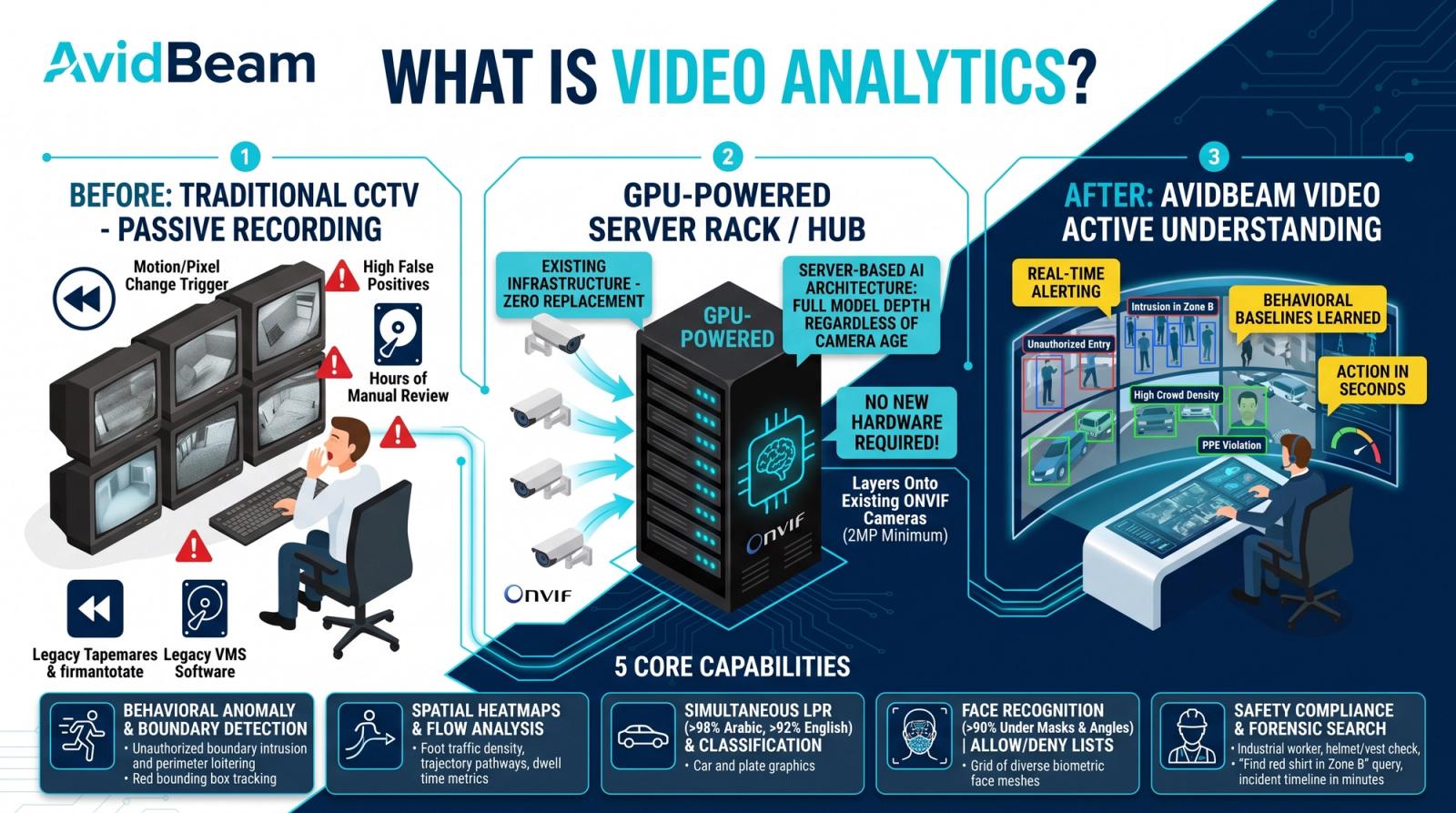 Article
Video Analytics: Turn Camera Feeds Into Operational Intelligence
Your camera infrastructure already captures everything that happens across your facilities. The question is whether anything is actually done with that footage, or whether it sits on a server, reviewed only after something goes wrong.
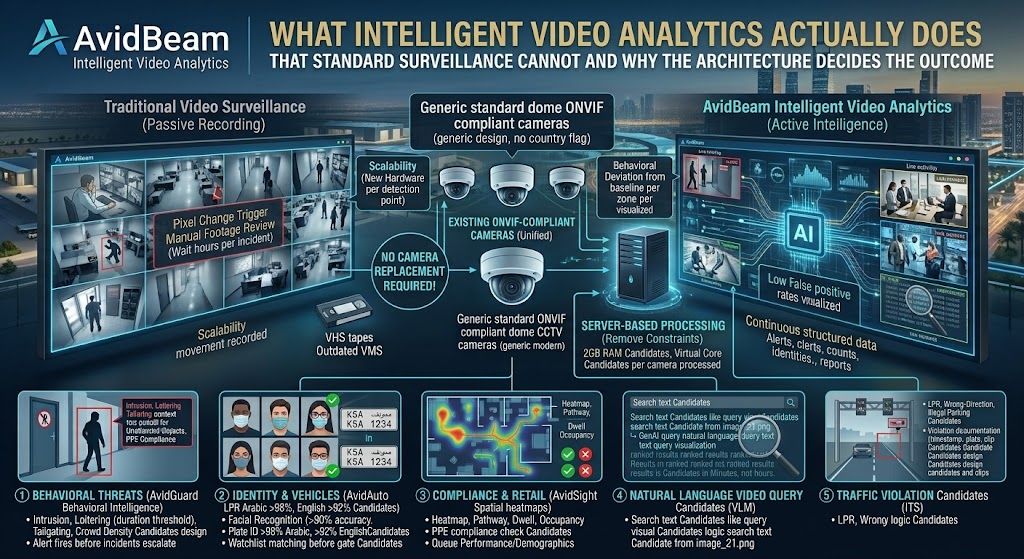 Article
What Intelligent Video Analytics Actually Does That Standard Surveillance Cannot and Why the Architecture Decides the Outcome
Intelligent video analytics is the application of Artificial Intelligence (AI), deep learning, and computer vision to camera feeds to automatically detect security threats, identify individuals, verify compliance, and generate operational intelligence without human review of footage
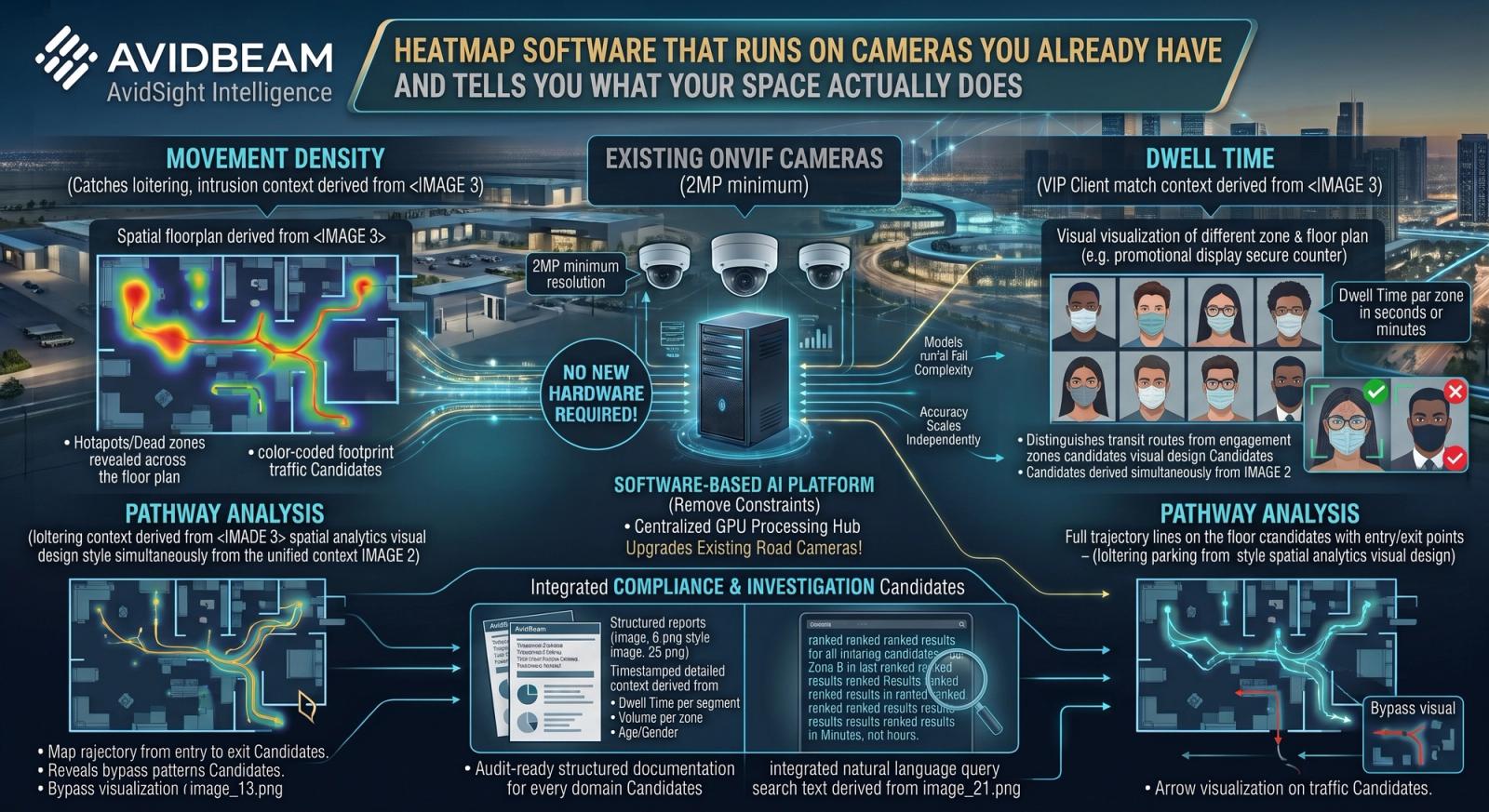 Article
Heatmap Software That Runs on Cameras You Already Have and Tells You What Your Space Actually Does
If you are evaluating heatmap software, you probably already know that something about your space is not working the way you expected. Customers are not finding a product zone. A service counter has inconsistent wait times
Experience AI Video Analytics
on your existing cameras.
Start with a pilot deployment and scale seamlessly as your operational requirements evolve.