AI Security Systems: What They Detect, How They Work and Why They Run on Cameras You Already Have
An AI security system is a platform that applies artificial intelligence to camera feeds to detect threats, verify identities, and generate security alerts automatically, without requiring a person to monitor screens continuously.
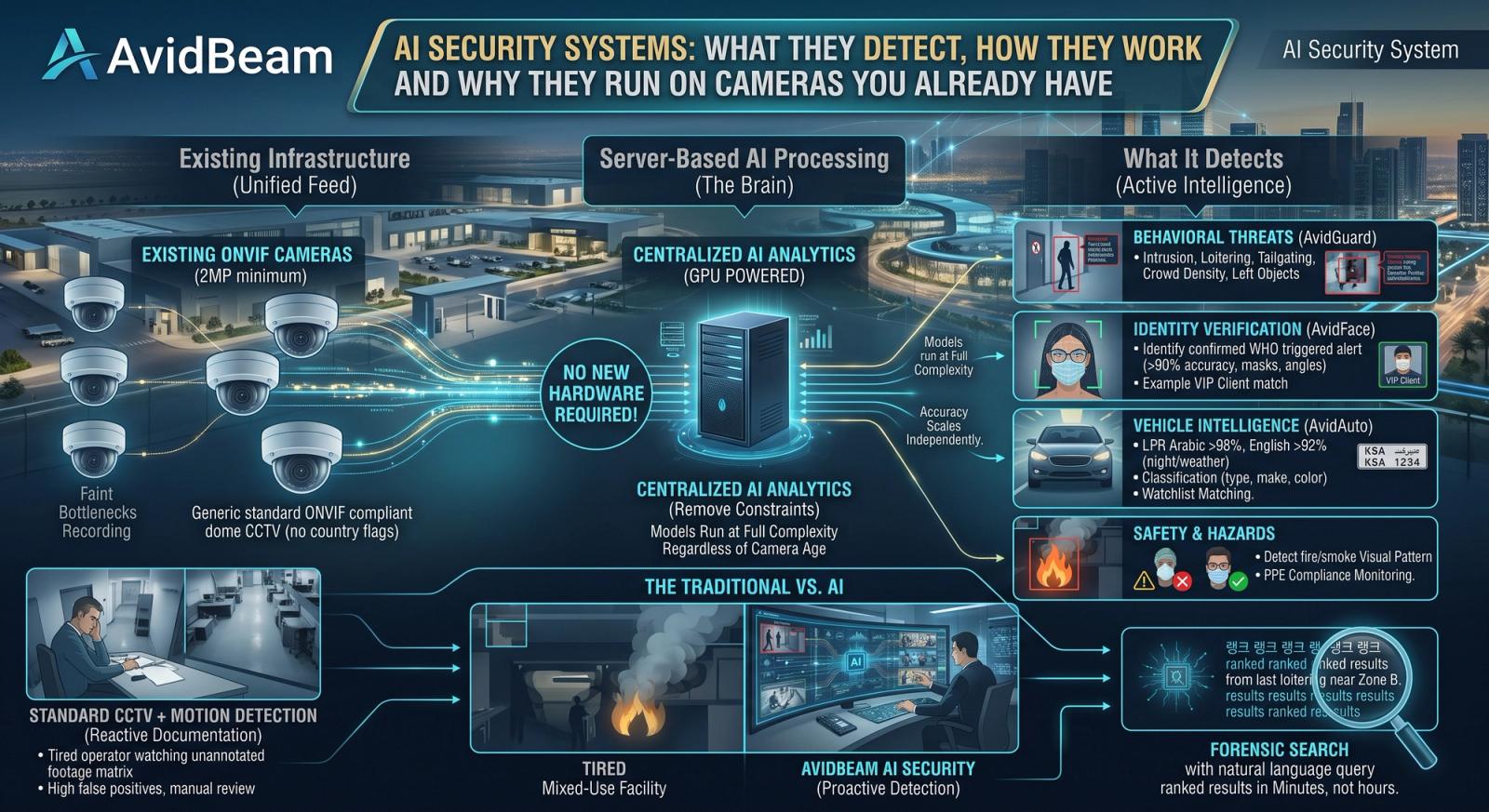
| What is an AI security system?An AI security system is a platform that applies artificial intelligence to camera feeds to detect threats, verify identities, and generate security alerts automatically, without requiring a person to monitor screens continuously. Unlike traditional security systems that rely on motion detection or badge access logs, AI security systems understand context: they learn what normal activity looks like in each monitored zone and alert only when genuine deviations occur. They connect to existing cameras and run on central server infrastructure, requiring no hardware replacement at individual camera points. |
Traditional security systems have two problems that most security managers know well. The first is false alerts. Motion detection fires on anything that moves: a shadow, an animal, a door blown by wind, a staff member on a legitimate errand. Teams that receive dozens of false alerts per shift stop treating them as urgent, and the genuine events arrive in the same stream.
The second problem is post-incident discovery. When something does happen, the security team reviews footage to find out what. That process takes hours across multiple cameras and is only valuable after the fact. The system recorded the event but did not understand it when it could still be stopped.
AI security systems address both. They replace pixel triggers with behavioral understanding and replace post-incident review with real-time alerts. Critically, they do this on the cameras already installed, because the intelligence lives in the analytics platform running on a server, not in the camera hardware.
How Is an AI Security System Different From a Traditional One?
The difference is not the cameras. It is what happens to the footage those cameras produce. A traditional security system records video and generates alerts when motion is detected. An AI security system analyzes video in real time and alerts when behavior deviates from what is expected in that specific location at that specific time.
Behavioral Baselines vs. Motion Triggers
As covered in AvidBeam's analysis of what modern building security systems require, the gap between motion detection and behavioral understanding is the gap between a system that reacts to pixels and one that understands what is happening in the frame.
AvidGuard detects behavioral anomalies by comparing live activity against a learned baseline per zone. This covers intrusion across defined boundaries, loitering near access points or ATMs, tailgating at controlled entries, crowd density exceeding safe thresholds, unattended bags near critical infrastructure, fire and smoke from visual patterns, and Personal Protective Equipment (PPE) compliance violations in industrial environments. The alert fires when the behavior crosses the threshold, not after an incident has occurred.
Identity at the Point of Alert
AvidFace adds identity confirmation to every security event. When a behavioral alert fires, the system already knows who triggered it at above 90% accuracy, sustained under masks, glasses, and non-frontal angles. Deny-listed individuals generate alerts with confirmed identity before they reach an interior zone. Authorized individuals clear access points automatically without stopping for manual verification.
Vehicle Intelligence at the Gate
AvidAuto extends AI security to every vehicle entry point. Arabic and English license plates are read at 98%+ and 92%+ accuracy respectively alongside vehicle type, make, model, and color classification. Watchlist matching runs in real time at every camera the vehicle passes. Authorized vehicles clear automatically. Flagged vehicles generate alerts before the gate opens.
| Want to know which cameras in your existing network qualify for AvidBeam's AI security system? Send an email to info@avidbeam.com for a free assessment. |
Do AI Security Systems Require New Cameras?
No. This is the most common misconception when organizations evaluate AI security systems. The AI processing happens on a central server connected to existing cameras through standard network protocols, not inside the camera hardware itself.
Any Open Network Video Interface Forum (ONVIF) compliant camera with a minimum 2 Megapixel resolution connects to AvidBeam's platform. The server processes every connected camera's feed simultaneously. Consequently, upgrading from a traditional security system to an AI security system is a software and server deployment, not a camera replacement project. Most organizations are surprised by how much of their existing infrastructure already qualifies.
What Does an AI Security System Actually Detect?
The table below maps every detection capability AvidBeam's AI security system delivers, how each one works, and what it prevents or produces. As covered in AvidBeam's analysis of what separates modern video surveillance platforms, the value of an AI security system comes from the combination of detection types running simultaneously on the same camera feeds, not from any single capability in isolation.
| Security Capability | How It Works | What It Prevents or Produces |
|---|---|---|
| Behavioral intrusion detection | Learns the activity baseline per zone and flags deviations | Alerts fire before incidents escalate, not during a post-incident footage review |
| Loitering and pre-intrusion detection | Identifies individuals remaining near access points beyond the zone threshold | Staging behavior flagged before an access attempt is made |
| Tailgating detection | Detects multiple individuals entering a controlled zone on one authorization | Invisible to badge systems; detected in real time from camera feeds |
| Facial recognition access control | Identifies individuals at above 90% accuracy against deny, allow, and VIP lists | Automated access decisions with identity confirmation; no credential to clone or share |
| Vehicle access and LPR | Reads Arabic and English plates at 98%+ and 92%+ accuracy with watchlist matching | Gate automation for authorized vehicles; flagged vehicles stopped before entry |
| Fire and smoke detection | Detects visual fire and smoke patterns from camera feeds | Early warning before sensor-based systems trigger; faster response window |
| Left object detection | Flags unattended items near access points or critical infrastructure | Alert fires on duration threshold without manual observation required |
| Crowd density monitoring | Tracks group size in monitored zones against configured thresholds | Overcrowding alerts enable proactive response before safety thresholds are breached |
| Post-incident investigation | Natural language queries across the full camera network | Movement timelines reconstructed in minutes without manual footage review per camera |
Traditional Security System vs. AI Security System
The table below maps the specific differences between a traditional security system and an AI security system across the dimensions that determine operational value in a real deployment.
| Dimension | Traditional Security System | AI Security System |
|---|---|---|
| Alert trigger | Motion or pixel change regardless of context | Behavioral deviation from the learned baseline for that zone and time window |
| False positive rate | High; teams learn to ignore alerts | Low; AI baselines filter weather, animals, and normal activity from genuine threats |
| Identity at alert | Unknown; requires post-incident footage review | Confirmed in real time at above 90% accuracy with watchlist match status |
| Vehicle at gate | Presence only; no plate or identity | Plate, classification, and watchlist status per detection event in fractions of a second |
| Night performance | Same sensitivity regardless of hour | Baselines adjust per time window; after-hours thresholds applied automatically |
| Tailgating | Not detectable without a separate sensor | Detected in real time from existing camera feeds with behavioral analytics |
| Post-incident investigation | Manual footage review; hours per case | Natural language query returns results across full network in minutes |
| Scalability | New hardware or sensors per new zone | Software configuration extends to cameras already covering new areas |
The operational shift is from reactive documentation to proactive detection. Traditional security systems tell you what happened after it has happened. AI security systems alert you while there is still time to respond.
How Accurate Is an AI Security System?
Accuracy in AI security systems depends on where the processing happens. Systems that embed AI in camera hardware are constrained by what the embedded chip can run. Those models degrade under low light, rain, partial obstructions, and high camera speeds.
Server-based AI security systems process all analysis centrally on dedicated server infrastructure with Graphics Processing Unit (GPU) acceleration. The detection models run at full depth regardless of individual camera age or hardware specification. AvidBeam's platform sustains facial recognition accuracy above 90% under masks and non-frontal angles, License Plate Recognition (LPR) accuracy at 98%+ for Arabic and 92%+ for English, and behavioral detection with significantly reduced false positive rates compared to motion-based systems.
Which Industries Use AI Security Systems?
- Commercial buildings and corporate campuses: behavioral threat detection, identity-verified access control, tailgating prevention, and incident investigation across office towers and multi-tenant developments
- Government and critical infrastructure: perimeter security with behavioral detection, biometric access control at restricted tiers, and vehicle watchlist enforcement at approach roads and entry points
- Industrial facilities and petrochemical plants: Personal Protective Equipment (PPE) compliance monitoring, perimeter intrusion detection, and zone access control in environments where manual supervision cannot achieve full coverage
- Retail and shopping centers: loss prevention through behavioral anomaly detection, crowd density management, and identity-based security at high-value zones
- Banking and financial services: Automated Teller Machine (ATM) fraud detection, vault access monitoring with identity confirmation, and teller compliance monitoring
- Events and large venues: crowd density monitoring at critical thresholds, facial recognition access control, perimeter security, and Very Important Person (VIP) identification
- Hospitality and hotels: guest identity recognition for personalized service, vehicle access management, perimeter security across external grounds, and incident investigation across property cameras
FAQ
What is an AI security system?
A platform that applies AI to camera feeds to detect behavioral threats, verify identities, and generate real-time security alerts automatically on cameras already installed.
How does an AI security system differ from traditional security?
Traditional systems use motion detection and badge logs; AI systems learn behavioral baselines per zone and alert only on genuine deviations, dramatically reducing false positives and enabling proactive response.
Do AI security systems require new cameras?
No. AvidBeam's platform connects to any existing ONVIF compliant camera with 2MP minimum resolution; the AI processing runs on a central server, not inside the cameras.
How accurate is facial recognition in an AI security system?
AvidBeam's AvidFace sustains above 90% accuracy under masks, glasses, hats, and non-frontal angles through server-based centralized processing regardless of camera age.
Can an AI security system detect tailgating?
Yes. AvidGuard detects multiple individuals entering a controlled zone on one authorization event from camera feeds in real time; this is invisible to badge systems without a behavioral analytics layer.
How does post-incident investigation work in an AI security system?
AvidGenAI accepts natural language queries across the full camera network, returning ranked, timestamped results in minutes rather than requiring manual footage review per camera.
Which environments benefit most from AI security systems?
Any environment with existing cameras where security teams receive too many false alerts, cannot identify who triggered events in real time, or spend significant time on post-incident footage review.
| Want to see an AI security system in action?Request a live demo of AvidBeam's platform on your existing cameras. Send an email to info@avidbeam.com to schedule a session with the technical team. |
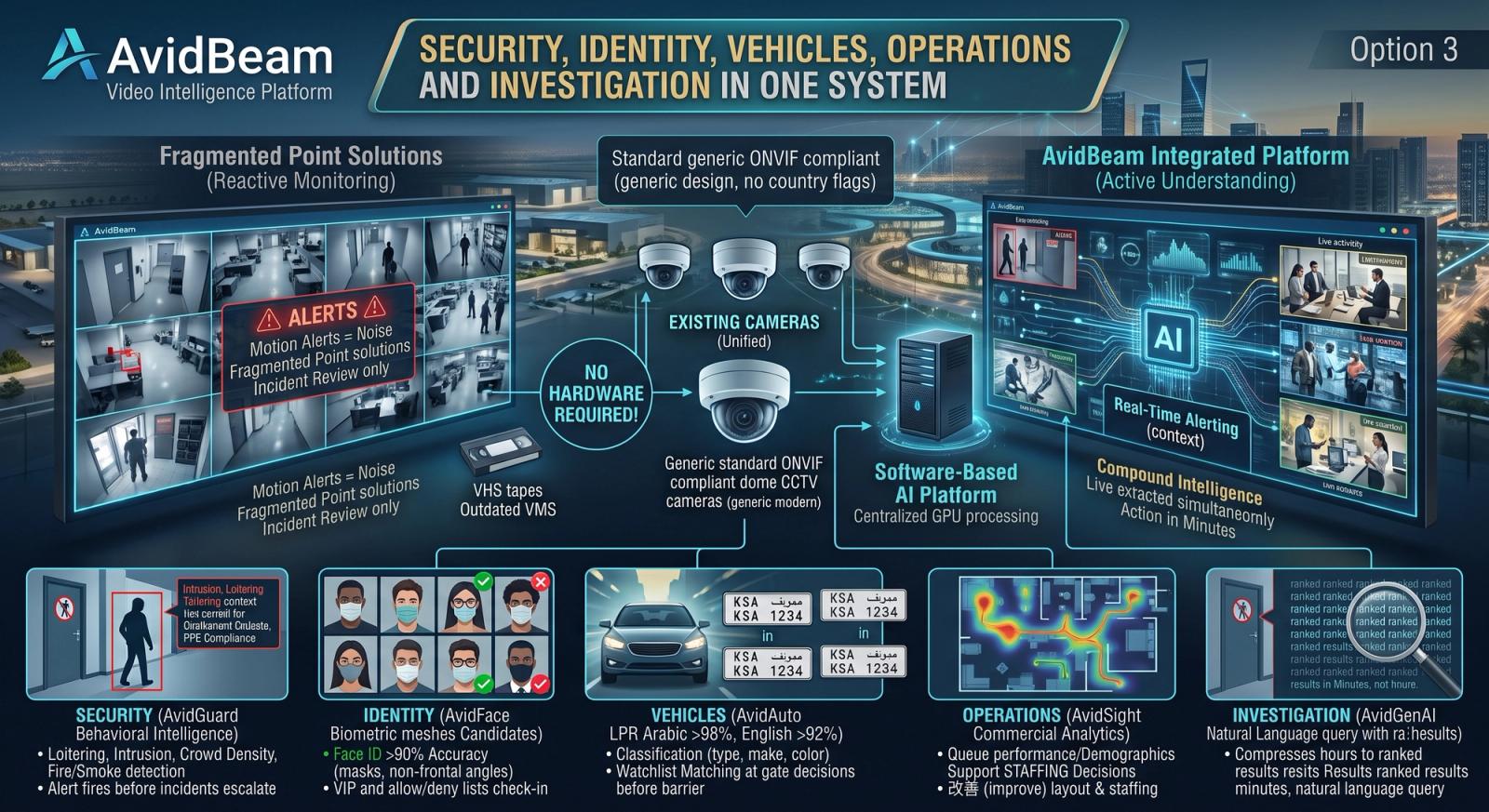 Article
Video Intelligence Platform Explained: Security, Identity, Vehicles, Operations and Investigation in One System
A video intelligence platform is a software system that extracts multiple categories of structured intelligence from camera feeds simultaneously: behavioral security alerts, identity verification
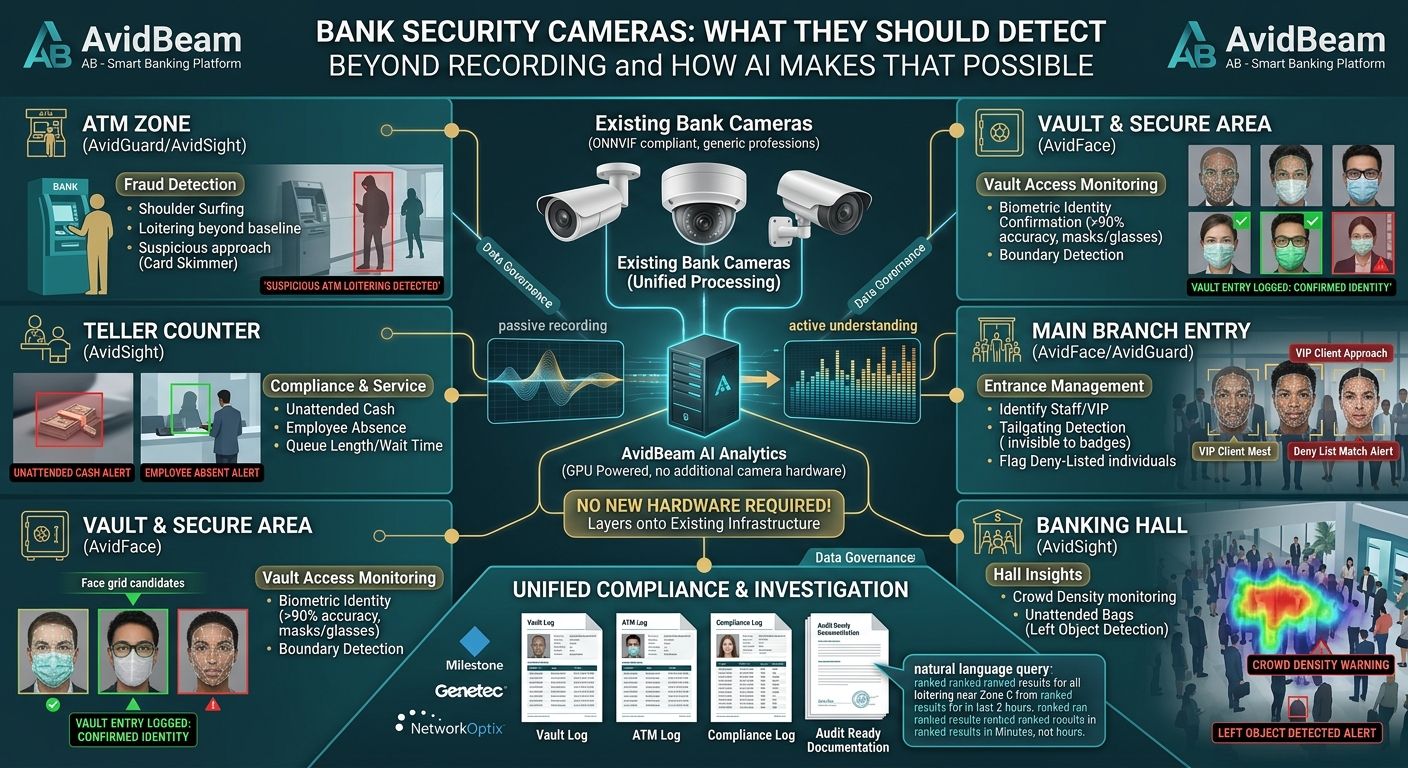 Article
Bank Security Cameras: What They Should Detect Beyond Recording and How AI Makes That Possible
Bank security cameras should do more than record. In a modern branch, they should detect Automated Teller Machine (ATM) fraud attempts before the next customer approaches
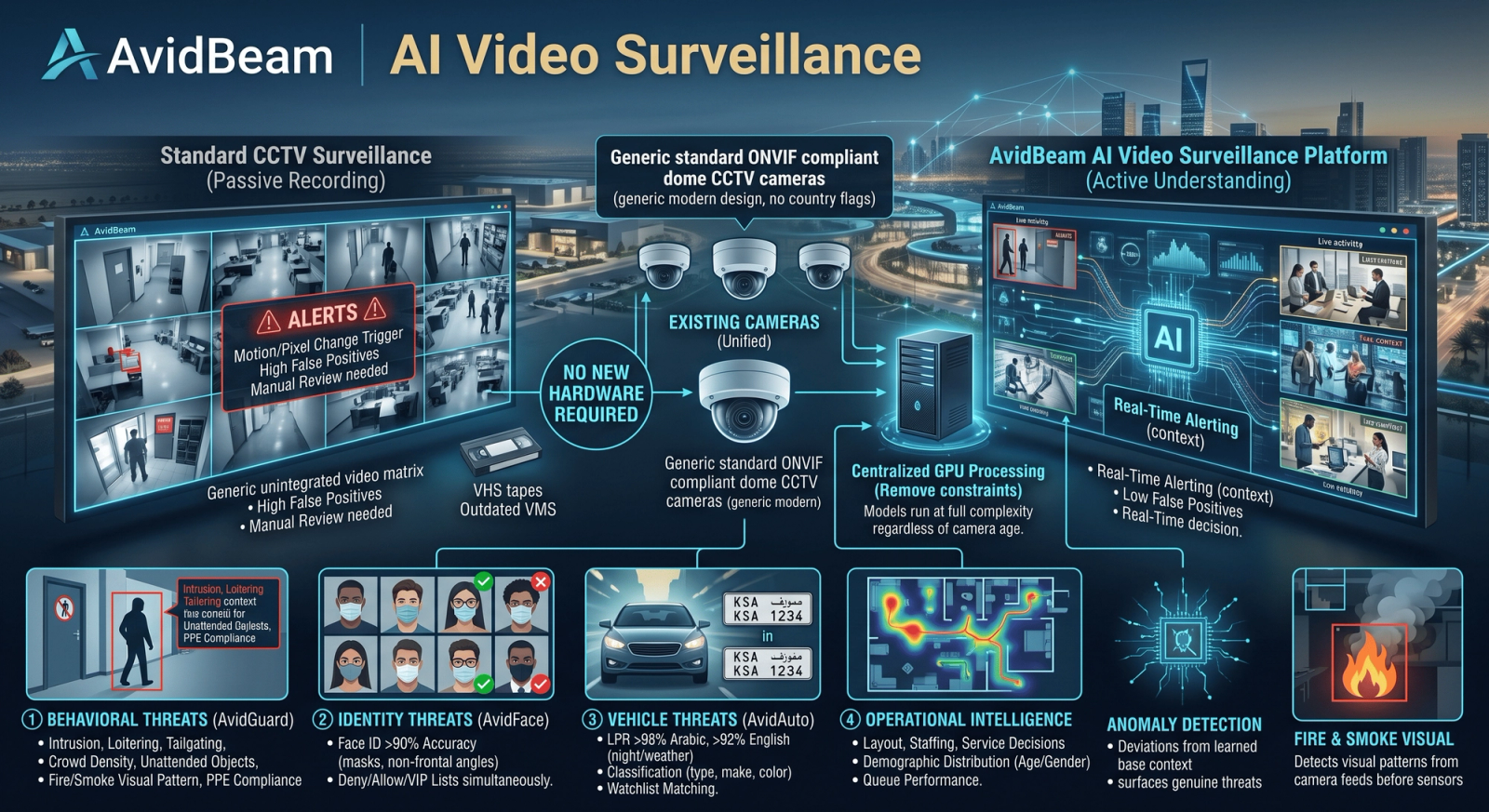 Article
AI Video Surveillance Explained: From Passive Recording to Active Threat Detection
AI video surveillance is a system that uses artificial intelligence to analyze live camera feeds and automatically detect threats, verify identities, and generate security alerts — without requiring a person to watch a screen.
Experience AI Video Analytics
on your existing cameras.
Start with a pilot deployment and scale seamlessly as your operational requirements evolve.