How an Automatic Vehicle Detection System Identifies, Classifies, and Logs Every Vehicle in Real Time
An automatic vehicle detection system is a camera-based platform that uses artificial intelligence (AI) to detect, classify, and identify vehicles as they enter a monitored area, without requiring inductive loops, radar sensors, or any physical roadway infrastructure.
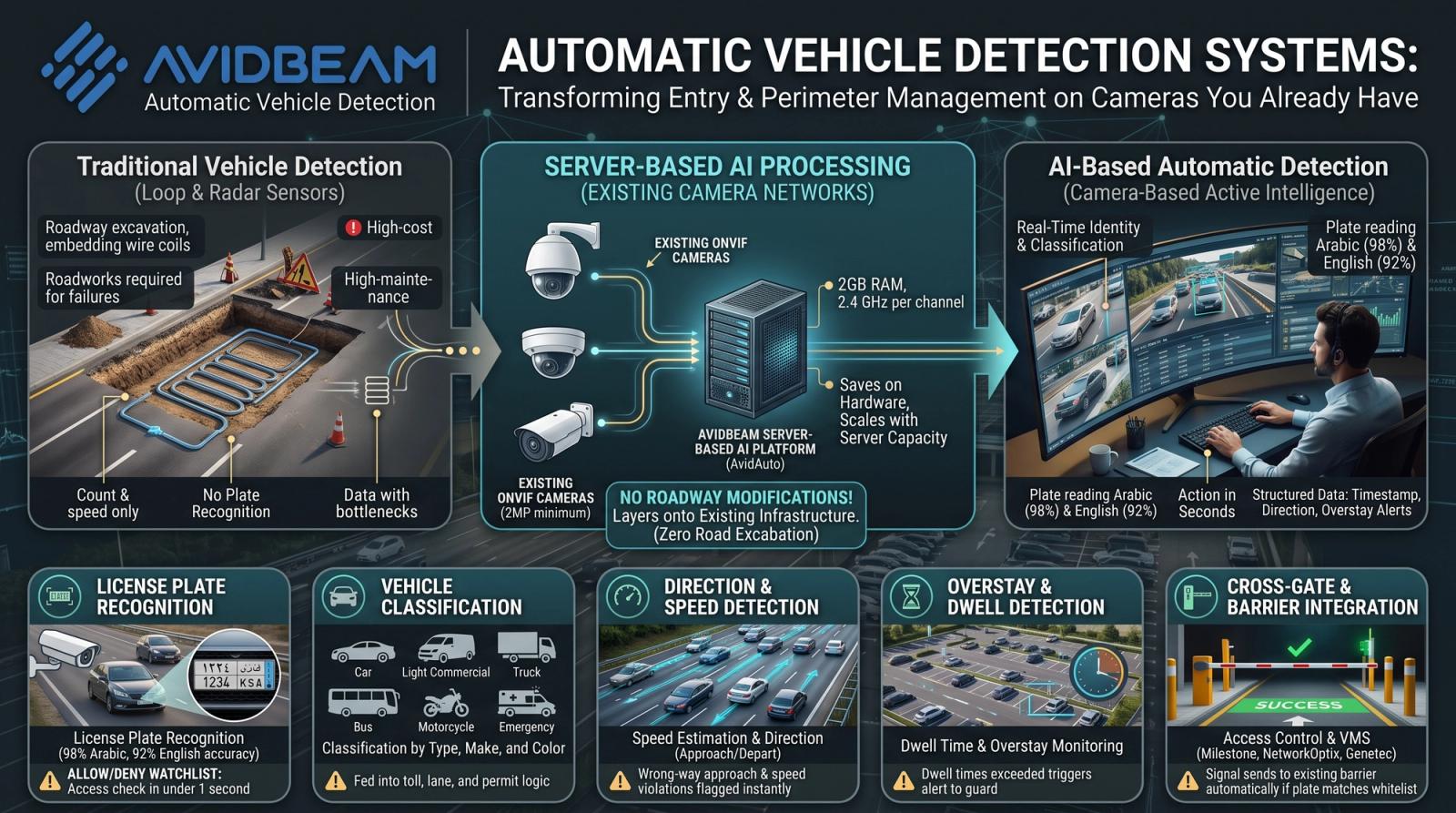
| What is an automatic vehicle detection system?An automatic vehicle detection system is a camera-based platform that uses artificial intelligence (AI) to detect, classify, and identify vehicles as they enter a monitored area, without requiring inductive loops, radar sensors, or any physical roadway infrastructure. The system processes live video feeds from standard IP cameras, reads license plates, classifies vehicles by type, logs entry and exit events, and generates real-time alerts for unauthorized, flagged, or overstaying vehicles. Detection runs continuously at the server level across all connected cameras simultaneously. |
Most vehicle management problems are not hardware problems. The cameras exist at the gate, in the parking structure, along the perimeter, and at the highway entry. What is missing is the layer that reads what those cameras are seeing: which vehicle just entered, whether it is authorized, how long it has been in the zone, and whether it matches a flagged plate.
An automatic vehicle detection system provides that layer. It connects to existing camera infrastructure, processes every frame in real time, and returns structured data on every vehicle that passes through a monitored point. The decision to grant access, trigger an alert, or log an event happens in seconds, without a guard having to read a plate manually.
This article covers how automatic vehicle detection systems work, what they detect, where they are deployed, and what infrastructure they require.
How Does an Automatic Vehicle Detection System Work?
An automatic vehicle detection system applies trained AI models to live video feeds to extract vehicle data from each frame. The process runs in three stages: image capture, model inference, and output generation.
Camera-Based Detection vs Inductive Loop Sensors
Traditional vehicle detection relies on inductive loops, which are wire coils embedded beneath the road surface that sense the magnetic disturbance caused by a passing vehicle. Loops detect presence and count vehicles, but they cannot identify a vehicle, read its plate, or classify it by type. Installation requires road excavation. Maintenance requires road works when a sensor fails.
Camera-based automatic vehicle detection replaces embedded sensors with mounted IP cameras connected to a central server. The AI model running on the server performs all detection tasks: plate reading, vehicle classification, direction tracking, speed estimation, and zone attribution. The roadway surface is not touched. Any Open Network Video Interface Forum (ONVIF)-compliant camera at minimum 2 Megapixel resolution connects to the platform.
The comparison below maps the operational differences between traditional and AI-based automatic vehicle detection across the dimensions that determine cost, accuracy, and capability.
| Dimension | Traditional Vehicle Detection | AI-Based Automatic Detection |
|---|---|---|
| Detection method | Inductive loops or radar sensors embedded in roadway | AI-powered camera-based detection with no roadway modifications required |
| Vehicle classification | Detects presence only; cannot distinguish vehicle type | Classifies vehicle type: car, truck, motorcycle, bus, and emergency vehicle |
| Plate recognition | Not included; requires separate ANPR “Automatic Number Plate Recognition” hardware | License plate recognition integrated at 98% Arabic and 92% English plate accuracy |
| Installation requirement | Road excavation to embed sensors; significant infrastructure work | Camera mounting only; connects to existing IP camera network via ONVIF compliance |
| Maintenance | Sensor replacement requires road works; high cost per failure | Software updates centrally applied; no physical roadway maintenance required |
| Data output | Vehicle count and speed only | Identity, classification, speed, direction, timestamp, entry and exit logs, and overstay alerts |
| False detection rate | High in rain, debris accumulation, and sensor degradation | Low: per-lane baseline learning distinguishes vehicles from environmental interference |
| Scalability | Each lane requires separate embedded sensors | Single server manages detection across all lanes and entry points simultaneously |
Server-Based AI Processing
The accuracy of an automatic vehicle detection system depends on where the AI inference runs. Edge-based systems, where processing happens inside the camera hardware, are constrained by the limited compute available in a camera device. This degrades plate reading accuracy at angle, in low light, at speed, and on non-standard plate formats.
Server-based systems run full-depth AI models centrally. The minimum server specification is 2 GB of Random Access Memory (RAM) and a 2.4 GHz processor per camera channel, allocated at the server level. This architecture supports accurate plate reading at oblique angles, partial occlusion, and vehicle speeds up to highway conditions, because the model has the compute to handle these scenarios.
AvidBeam's AvidAuto platform delivers automatic vehicle detection from this server-based architecture. It reads Arabic license plates at 98% accuracy and English plates at 92% accuracy, classifies vehicles by type, and integrates with access control, parking management, and Video Management System (VMS) platforms.
What Does an Automatic Vehicle Detection System Detect?
A fully capable automatic vehicle detection system covers six detection functions from a single platform connected to the existing camera network.
License plate recognition reads the characters on a vehicle plate as it passes through the camera field of view, matches the plate against pre-configured allow, deny, and watchlist databases, and returns a match result in under one second. Vehicle classification identifies the vehicle type from the video frame: car, light commercial vehicle, truck, bus, motorcycle, or emergency vehicle. This classification feeds lane assignment, toll calculation, and access permission logic.
Direction and speed detection determines whether a vehicle is approaching or departing, and estimates its speed from frame-to-frame displacement. Overstay detection monitors how long an identified vehicle has remained within a defined zone and triggers an alert when the dwell time exceeds the configured threshold. Cross-gate tracking follows a specific vehicle across multiple camera points within the same facility, building a complete movement record.
Together, these functions produce structured, timestamped data on every vehicle that passes through a monitored point. For a breakdown of how this data feeds broader facility security and operations platforms, see AvidBeam's article on video analytics solutions.
Where Are Automatic Vehicle Detection Systems Deployed?
Automatic vehicle detection systems are deployed wherever controlled vehicle access, occupancy monitoring, or enforcement at perimeter and entry points is a requirement. The table below maps deployment environments to their specific detection use cases.
| Deployment Environment | Site Type | Detection Use Cases |
|---|---|---|
| Parking facilities | Multi-storey car parks, surface lots, and valet entry lanes | License plate recognition at entry and exit, occupancy tracking per zone, overstay alerts, and pre-authorized vehicle clearance |
| Gated communities | Residential developments and private estate entry points | Resident vehicle whitelist clearance, visitor plate logging, unauthorized vehicle alerts, and entry/exit audit logs |
| Industrial perimeters | Factory gates, logistics yards, and energy facility access points | Authorized vehicle clearance, flagged plate denial, delivery vehicle scheduling, and access log compliance reporting |
| Highways and toll points | Multi-lane highways, toll plazas, and weigh station entry | Vehicle classification for toll calculation, speed detection, lane assignment, and traffic flow monitoring |
| Government and embassy compounds | Ministry vehicle parks, diplomatic compounds, and critical infrastructure | Pre-enrolled vehicle clearance, visitor plate registration, cross-gate individual vehicle tracking |
| Retail and commercial developments | Shopping centre car parks and hypermarket entry zones | Occupancy display, directional guidance triggers, VIP plate recognition, and customer dwell time analytics |
| Airports and transport hubs | Departure set-down zones, arrivals car parks, and logistics bays | Vehicle classification by type, zone time limits, permit enforcement, and real-time bay availability |
| Smart city corridors | Urban arterials, intersection monitoring, and public transit zones | Traffic density measurement, incident detection, wrong-way vehicle alerts, and data feed to traffic management systems |
| Deploying at a gate, parking facility, or perimeter? AvidBeam's AvidAuto connects to your existing IP cameras without roadway modifications. Contact info@avidbeam.com to discuss your site requirements. |
How Does an Automatic Vehicle Detection System Integrate with Existing Infrastructure?
Integration with existing infrastructure is a primary deployment concern for automatic vehicle detection systems. Organizations have cameras, access control barriers, and parking management software already in place. The question is whether an automatic vehicle detection system adds intelligence to what exists or requires a full replacement.
Camera Integration
AvidBeam's platform connects to any ONVIF-compliant IP camera network. There is no requirement to replace existing cameras, add specialized detection hardware at each lane, or install sensor arrays. The AI processing happens at the server, and the camera serves as the image capture device. For sites with very high vehicle throughput, camera positioning and resolution guidance is provided during deployment scoping to ensure plate readability at the required approach speed.
Access Control and Barrier Integration
The vehicle detection system connects to existing physical access control systems: barriers, bollards, and gate controllers. When a plate match is confirmed against the authorized vehicle list, the system sends a signal to the barrier controller to open. When a plate is flagged or unrecognized, the barrier remains closed and an alert is sent to the operations team. This integration requires no new barrier hardware; the AI layer connects to the existing gate controller through the site network.
VMS and Operations Platform Integration
AvidBeam's platform integrates with existing VMS platforms including Milestone, NetworkOptix, and Genetec, adding vehicle detection intelligence to the operator interface operators already use. As covered in AvidBeam's article on AI security systems, the same server-based architecture that powers vehicle detection also runs behavioral security detection, facial recognition, and compliance monitoring from one unified platform.
FAQ
What is an automatic vehicle detection system?
A camera-based AI platform that reads license plates, classifies vehicle types, logs entry and exit events, and generates real-time alerts for unauthorized or flagged vehicles, without embedded road sensors.
Does an automatic vehicle detection system require new cameras?
No. Any ONVIF-compliant IP camera at minimum 2 Megapixel resolution connects to AvidBeam's server-based platform without hardware replacement.
How accurate is automatic license plate recognition?
AvidBeam's AvidAuto reads Arabic license plates at 98% accuracy and English plates at 92% accuracy through full-depth server-based model inference.
Can the system detect vehicles without reading the plate?
Yes. Vehicle classification by type, direction detection, speed estimation, and overstay monitoring operate independently of plate recognition for vehicles that cannot be read due to occlusion or damage.
What happens when an unregistered vehicle arrives?
The system logs the plate, holds the barrier, and sends an alert to the operations team for manual review. The event is timestamped and stored in the access log.
How does the system handle multiple lanes simultaneously?
Server-based processing manages all lanes from a single platform. Each lane's camera feeds into the central server, and detection runs concurrently across all lanes without per-lane hardware.
What deployment options are available?
On-premise, private cloud, public cloud, and hybrid. Government and high-security sites typically use on-premise to keep vehicle identity data and access logs within the facility network.
| Want to see an automatic vehicle detection system on your existing camera infrastructure?Request a live demo of AvidBeam's AvidAuto platform at your entry points, perimeter, or parking facility. Send an email to info@avidbeam.com to schedule a session with the technical team. |
 Article
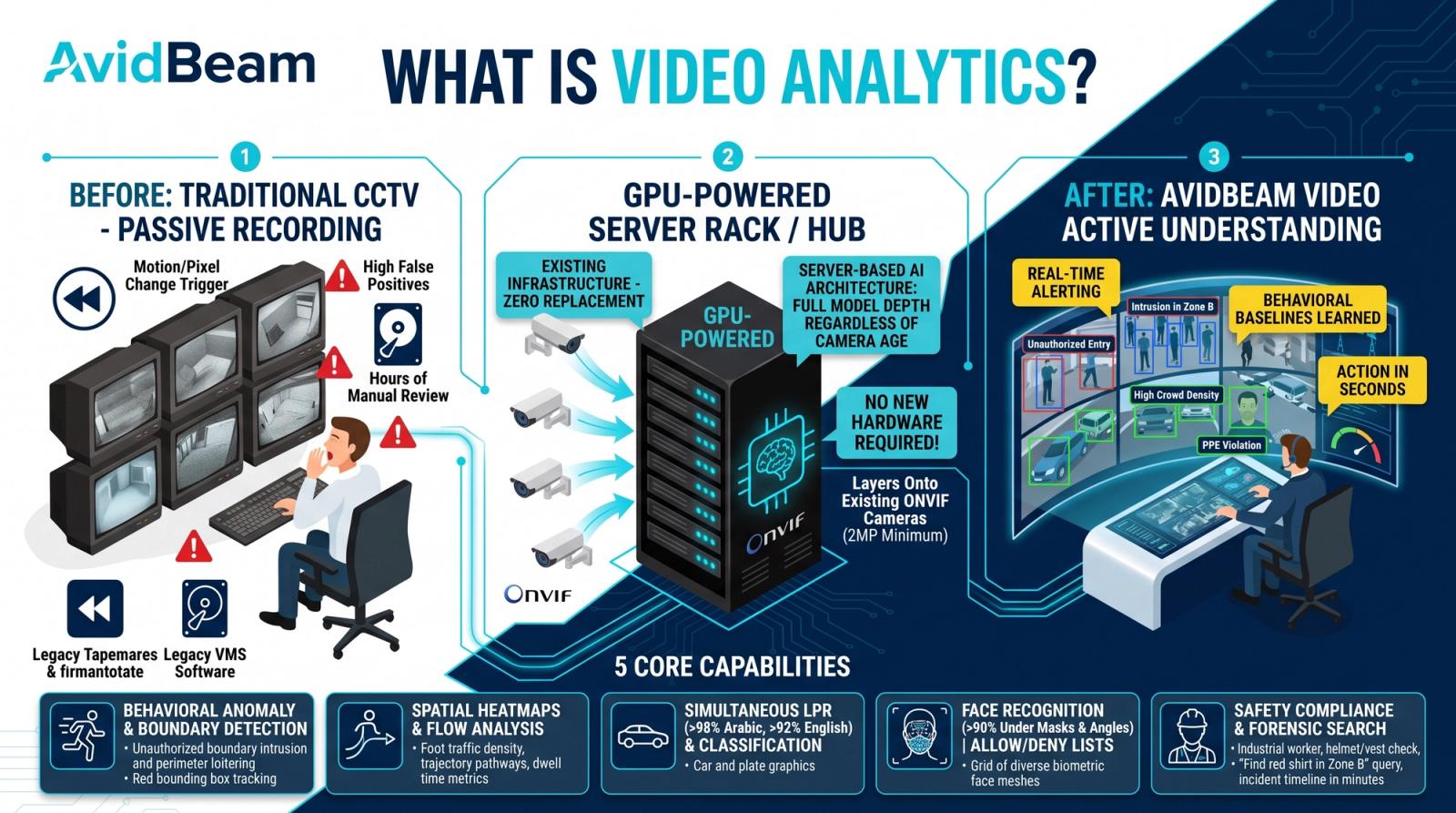
Video Analytics: Turn Camera Feeds Into Operational Intelligence
Your camera infrastructure already captures everything that happens across your facilities. The question is whether anything is actually done with that footage, or whether it sits on a server, reviewed only after something goes wrong.
 Article
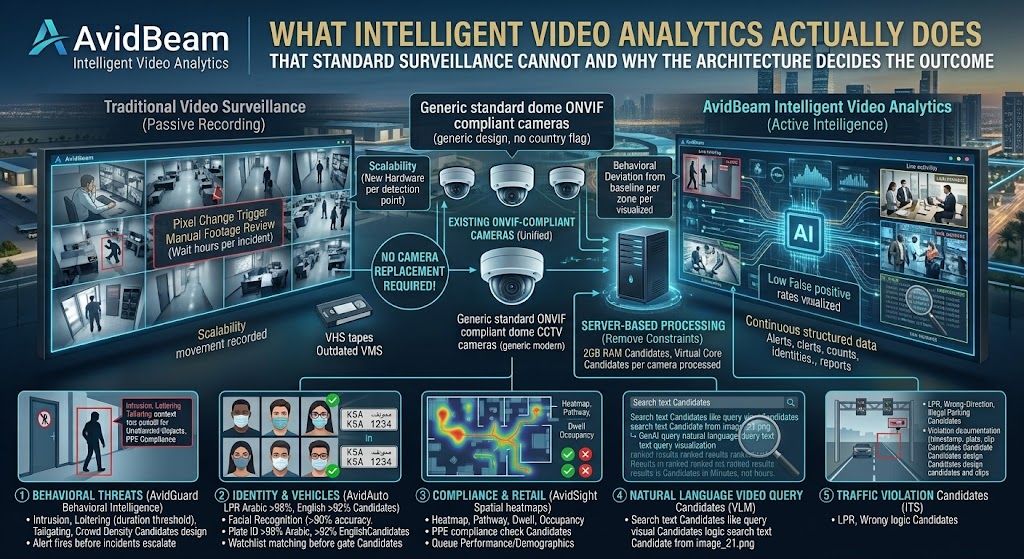
What Intelligent Video Analytics Actually Does That Standard Surveillance Cannot and Why the Architecture Decides the Outcome
Intelligent video analytics is the application of Artificial Intelligence (AI), deep learning, and computer vision to camera feeds to automatically detect security threats, identify individuals, verify compliance, and generate operational intelligence without human review of footage
 Article
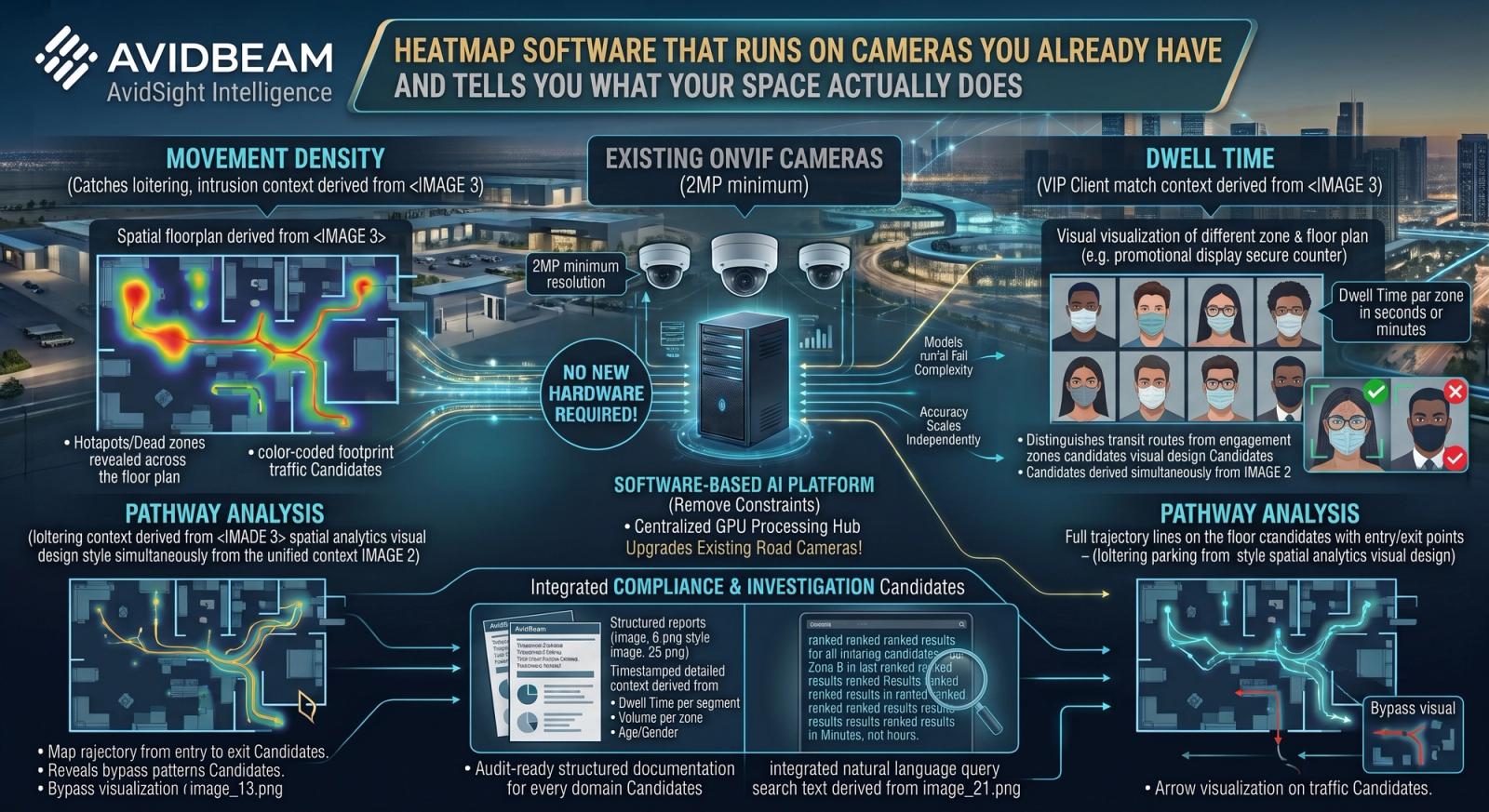
Heatmap Software That Runs on Cameras You Already Have and Tells You What Your Space Actually Does
If you are evaluating heatmap software, you probably already know that something about your space is not working the way you expected. Customers are not finding a product zone. A service counter has inconsistent wait times
Experience AI Video Analytics
on your existing cameras.
Start with a pilot deployment and scale seamlessly as your operational requirements evolve.