Intelligent Video Analytics: What It Is, What It Detects, and Whether Your Cameras Can Run It
Intelligent video analytics is the application of AI and deep learning models to live camera feeds to automatically detect threats, identify people and vehicles, and generate operational intelligence, without a human watching the screen
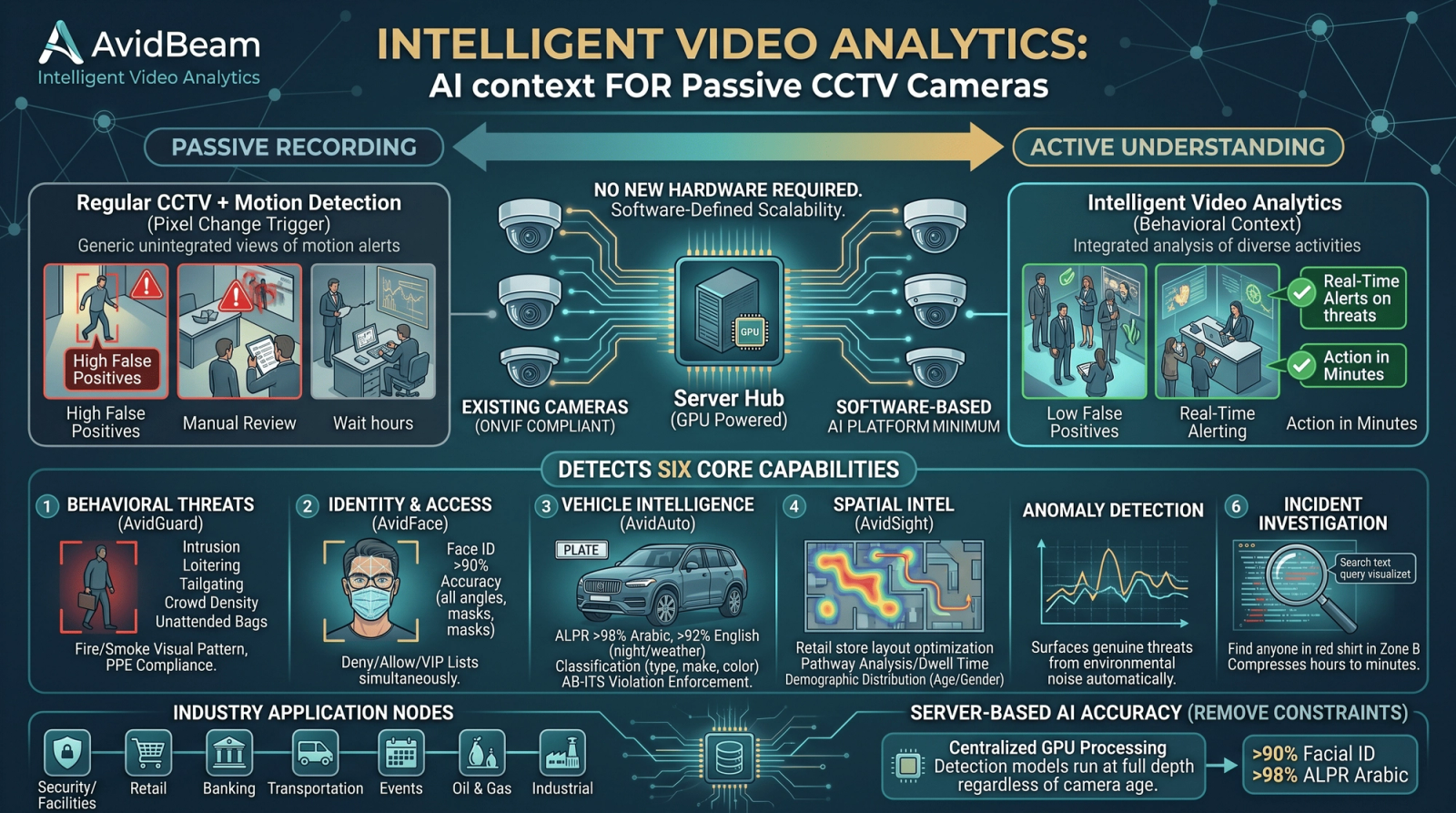
| What is intelligent video analytics?Intelligent video analytics is the application of AI and deep learning models to live camera feeds to automatically detect threats, identify people and vehicles, and generate operational intelligence, without a human watching the screen. Unlike basic motion detection, intelligent video analytics understands context: it knows the difference between a delivery driver and someone loitering near a restricted door, between a normal crowd and one that is growing into a security risk, and between authorized and unauthorized vehicles at a gate. |
Most organizations already have cameras. The cameras record what happens. They do not understand it. A security guard reviewing footage after an incident finds what they need, eventually. But by the time they find it, the incident has already happened, the vehicle has already left, and the person of interest has already gone.
Intelligent video analytics changes what cameras are capable of. The same hardware that passively records video starts actively detecting threats, verifying identities, reading license plates, and alerting teams the moment something happens rather than hours later during a review session.
Furthermore, it does not require replacing any cameras. The intelligence lives in the software platform running on a central server, not in the camera itself. Consequently, any standard camera already installed can become part of an intelligent video analytics network.
What Is the Difference Between Intelligent Video Analytics and Regular CCTV?
The difference is not the camera. It is what happens to the footage after the camera captures it. Regular Closed-Circuit Television (CCTV) records video and stores it. Intelligent video analytics processes that video in real time and extracts structured intelligence from it.
Motion detection is the most common form of basic analytics. It fires an alert when pixels change. Wind, shadows, animals, and staff walking through a zone all trigger the same alert as a genuine intruder. Security teams quickly learn to ignore motion alerts because most of them are false.
Intelligent video analytics replaces pixel-change triggers with behavioral understanding. The system learns what normal activity looks like in each monitored zone at each time of day. It then alerts only when something deviates from that baseline. Consequently, alert quality is higher, response rates are better, and security teams stop treating every notification as noise.
What Can Intelligent Video Analytics Actually Detect?
The range of what intelligent video analytics detects depends on the platform and which modules are active. A well-deployed platform covers six core detection categories, each addressing a different operational problem.
Behavioral Threats
AvidGuard detects behavioral anomalies by comparing live activity against a learned baseline per zone. This covers intrusion across defined boundaries, loitering near access points or ATMs, tailgating at controlled entries, crowd density exceeding safe thresholds, unattended bags near critical infrastructure, fire and smoke from visual patterns, and Personal Protective Equipment (PPE) compliance violations in industrial environments. The alert fires when the behavior crosses the threshold, not after an incident has occurred.
Identity and Access
AvidFace identifies individuals from camera feeds at over 90% accuracy, even under masks, glasses, and non-frontal angles. It matches detected faces against deny lists, allow lists, and Very Important Person (VIP) lists simultaneously at every connected access point. When a flagged individual appears, the alert fires before they reach an interior zone. When an authorized individual arrives, the gate opens without manual verification.
Vehicle Intelligence
AvidAuto detects and classifies vehicles, reads Arabic and English license plates at 98%+ and 92%+ accuracy respectively, and cross-references plates against watchlists in real time. It feeds traffic violation enforcement through AB - ITS, vehicle count and classification analytics through AB - Vehicle Analytics, and parking management through AB - Smart Parking. All of this runs from the cameras already covering the access points, roads, and parking structures.
Spatial and Commercial Intelligence
AvidSight generates spatial intelligence from the same camera feeds used for security. Heatmaps reveal where people go and how long they stay. Pathway analysis shows which zones attract traffic and which are bypassed. Demographic distribution data shows who is visiting which areas. For retail, banking, and facility management, this converts security cameras into operational intelligence tools that improve layout, staffing, and service decisions.
Anomaly Detection
Anomaly detection is the layer that surfaces events that do not fit a known violation category but are nonetheless unusual. As covered in AvidBeam's analysis of what separates modern video surveillance platforms, a well-calibrated anomaly detection layer reduces false positive rates significantly by filtering normal environmental variation from genuine behavioral deviations.
Incident Investigation
After an incident, intelligent video analytics compresses investigation from hours to minutes. AvidBeam's AvidGenAI module accepts natural language queries across the full camera network: find everyone who entered Zone B wearing a red t-shirt, or show all vehicles matching this description near the east gate. Results return ranked, and attached to camera clips without manual footage review.
| Want to know which of these capabilities work on your existing cameras? Send an email to info@avidbeam.com and the technical team will assess your infrastructure. |
Do I Need New Cameras for Intelligent Video Analytics?
No. This is the most common misconception about intelligent video analytics. The intelligence lives in the analytics platform running on a server, not in the camera hardware.
Any camera that meets three basic requirements works with AvidBeam's platform: Open Network Video Interface Forum (ONVIF) compliance, a minimum resolution of 2 Megapixels, and a lens focal length between 3mm and 25mm. Most cameras installed in the last several years meet all three.
The server processes every connected camera's feed centrally. Consequently, adding intelligent video analytics to an existing camera network is a software and server deployment project, not a hardware replacement project. This is both faster and less expensive than organizations typically expect when they first evaluate the technology.
How Accurate Is Intelligent Video Analytics Under Real Conditions?
Accuracy varies significantly between platforms and depends on where the processing happens. Camera-embedded analytics are constrained by the chip inside the camera, which limits model complexity and degrades under low light, rain, and high camera speeds.
Server-based intelligent video analytics removes that constraint. AvidBeam processes all analysis centrally on dedicated server infrastructure with Graphics Processing Unit (GPU) acceleration. The detection models run at full depth regardless of camera age or hardware specification.
In production, AvidBeam's platform sustains facial recognition accuracy above 90% under masks, glasses, hats, and non-frontal angles. License Plate Recognition (LPR) accuracy holds at 98%+ for Arabic and 92%+ for English across nighttime operation and adverse weather conditions.
Standard CCTV vs. Intelligent Video Analytics: What Changes
The table below maps the specific differences between standard Closed-Circuit Television (CCTV) with motion detection and an intelligent video analytics platform. As covered in AvidBeam's guide on evaluating AI video analytics providers, the most consequential differences are accuracy under real conditions and what the platform produces per detection event.
| Dimension | Standard CCTV + Motion Detection | Intelligent Video Analytics |
|---|---|---|
| What triggers an alert | Any motion regardless of context | Behavioral deviation from the learned baseline for that specific zone and time window |
| False positive rate | High; security teams learn to ignore alerts | Low; AI baselines filter weather, shadows, and normal activity from genuine anomalies |
| Identity | Not available | Facial recognition at 90%+ accuracy with real-time watchlist matching |
| Vehicle data | Presence only | Plate, type, make, model, color, and watchlist status per detection event |
| Incident investigation | Manual footage review; hours per case | Natural language query returns ranked results across the full network in minutes |
| Night performance | Same sensitivity regardless of context | Behavioral baselines adjust per time window; after-hours thresholds applied automatically |
| Scalability | New hardware or sensors per zone | Software extension to cameras already covering new areas |
| Capability updates | Firmware change per device | Software update deploys across full network simultaneously |
What Does Intelligent Video Analytics Actually Deliver Per Detection Event?
The table below maps each capability category, how it works, and the specific operational problem it solves for the organization.
| Capability | How It Works | What It Solves |
|---|---|---|
| Behavioral detection | Monitors movement patterns against a learned baseline per zone | Flags intrusion, loitering, tailgating, and crowd density in real time before incidents escalate |
| Identity verification | Matches detected faces against enrolled watchlists in fractions of a millisecond | Confirms who is entering; deny list alerts fire before the individual reaches an access point |
| Vehicle intelligence | Reads plates, classifies vehicles, and cross-references watchlists simultaneously | Automates gate access; generates enforcement records; feeds parking and traffic systems |
| Spatial analytics | Maps movement density and dwell time across the monitored floor plan | Identifies underperforming zones, traffic patterns, and staffing opportunities from camera data |
| Anomaly detection | Compares live behavior against the established operational baseline per zone | Reduces false positives; surfaces genuine threats from environmental noise automatically |
| Incident investigation | Responds to natural language queries across the full camera network | Reconstructs movement timelines in minutes rather than hours of manual footage review |
Which Industries Use Intelligent Video Analytics?
Intelligent video analytics applies wherever camera infrastructure already exists and where the gap between recording and understanding creates an operational cost.
- Security and facilities: behavioral threat detection, identity verification, and incident investigation across commercial buildings, government facilities, and critical infrastructure
- Retail: loss prevention through behavioral anomaly detection, heatmap analysis for layout and staffing decisions, and demographic analytics for merchandising
- Banking: ATM fraud detection, branch occupancy monitoring, vault access compliance, and queue management through AB - Smart Banking
- Transportation and smart cities: traffic flow monitoring, violation enforcement, congestion forecasting, and vehicle tracking across road networks and parking structures
- Events and hospitality: crowd density monitoring, facial recognition check-in, perimeter security, and VIP identification at large-scale gatherings
- Oil, gas, and industrial: PPE compliance monitoring, perimeter intrusion detection, and zone access control across facilities where manual supervision cannot achieve full coverage
FAQ
What is intelligent video analytics?
AI-powered software that processes live camera feeds to detect threats, verify identities, track vehicles, and generate operational intelligence in real time without requiring someone to watch a screen.
How is intelligent video analytics different from motion detection?
Motion detection fires on any pixel change; intelligent video analytics learns behavioral baselines per zone and alerts only on genuine anomalies, dramatically reducing false positives.
Do I need to replace my cameras to use intelligent video analytics?
No. Any ONVIF-compliant camera with a minimum 2MP resolution works; the analytics platform runs on a central server, not inside the camera.
What accuracy does intelligent video analytics achieve?
On AvidBeam's server-based platform: facial recognition above 90% under masks and non-frontal angles; LPR at 98%+ for Arabic and 92%+ for English, sustained under low light and adverse weather.
Can intelligent video analytics run multiple detection types on the same camera?
Yes. Behavioral detection, facial recognition, vehicle intelligence, and spatial analytics can all run simultaneously on the same camera feed through a server-based platform.
How long does it take to deploy intelligent video analytics?
Deployment time depends on camera count and integration complexity; server-based platforms connecting to existing cameras are faster than hardware replacement projects, often going live within weeks.
Which industries benefit most from intelligent video analytics?
Security, retail, banking, transportation, events, oil and gas, and any organization where cameras already cover critical areas but footage is only reviewed after incidents rather than monitored in real time.
| Want to see intelligent video analytics in action?Request a live demo of AvidBeam's platform on your existing cameras. Send an email to info@avidbeam.com to schedule a session with the technical team. |
 Article
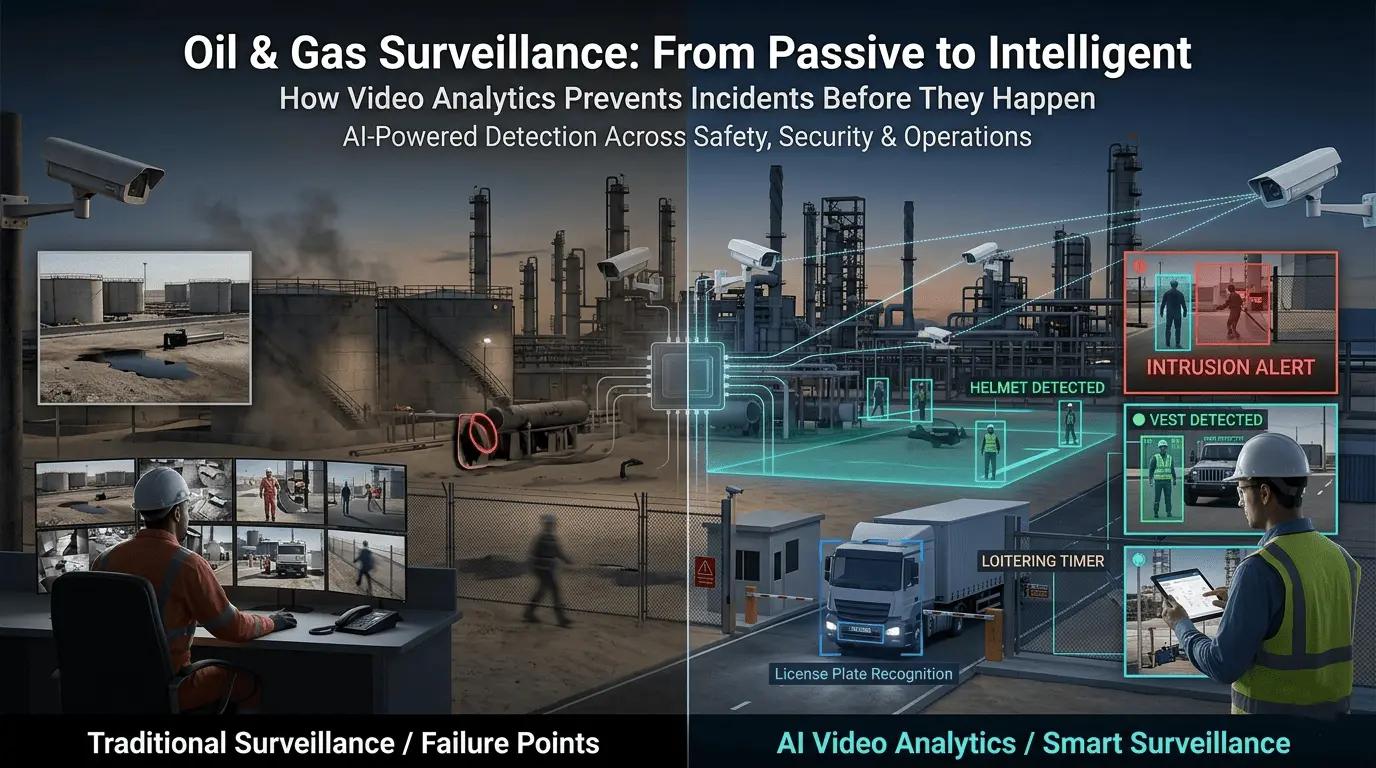
Oil and Gas Video Surveillance: How AI Covers PPE Compliance, Fire Detection and Perimeter Security Simultaneously
Oil and gas video surveillance should go beyond recording. In a petrochemical or refinery environment, cameras should automatically verify Personal Protective Equipment (PPE) compliance per worker per zone
 Article
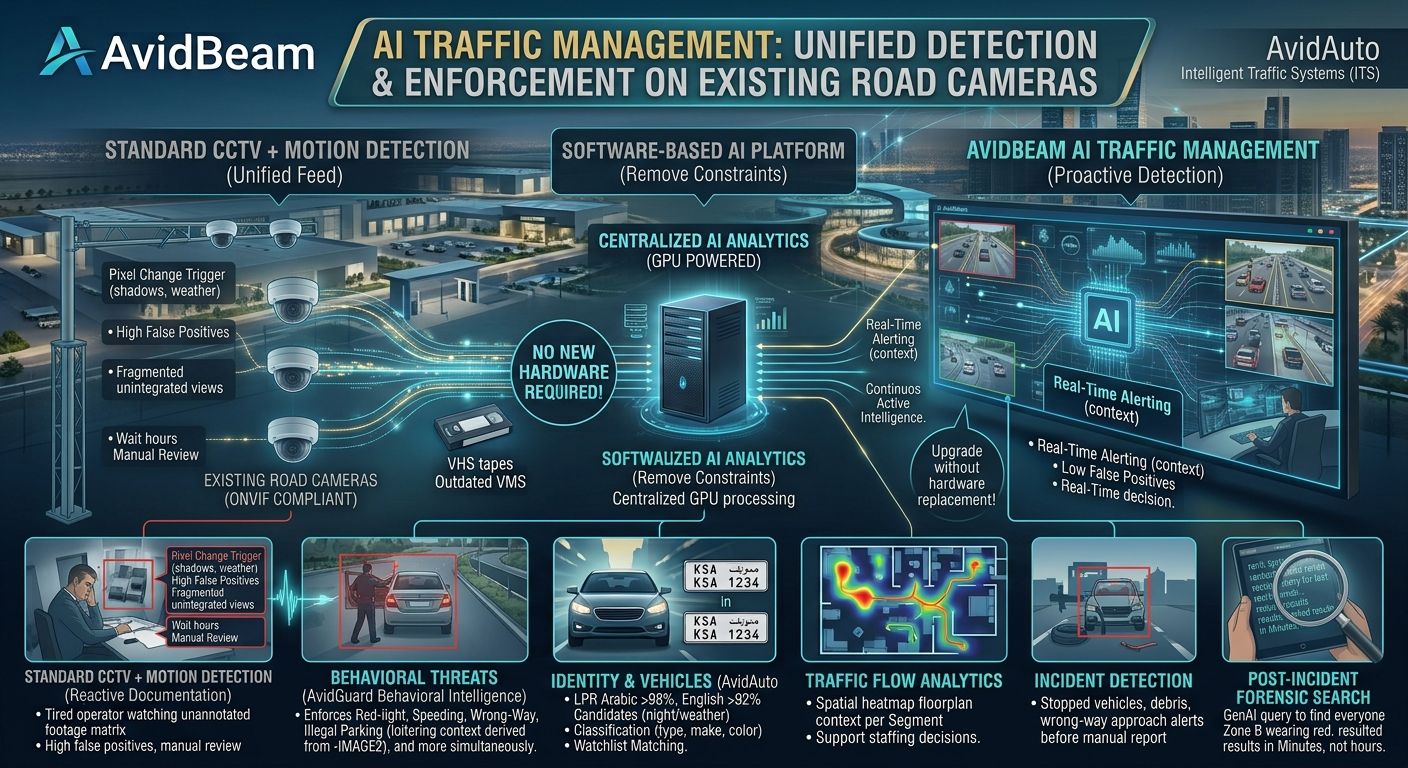
AI Traffic Management: How to Enforce Violations, Monitor Congestion and Forecast Flow Without Adding Officers
AI traffic management is a platform that applies artificial intelligence to road camera feeds to detect violations, monitor traffic density, identify incidents, and produce flow analytics continuously without officers stationed at individual camera points.
 Article
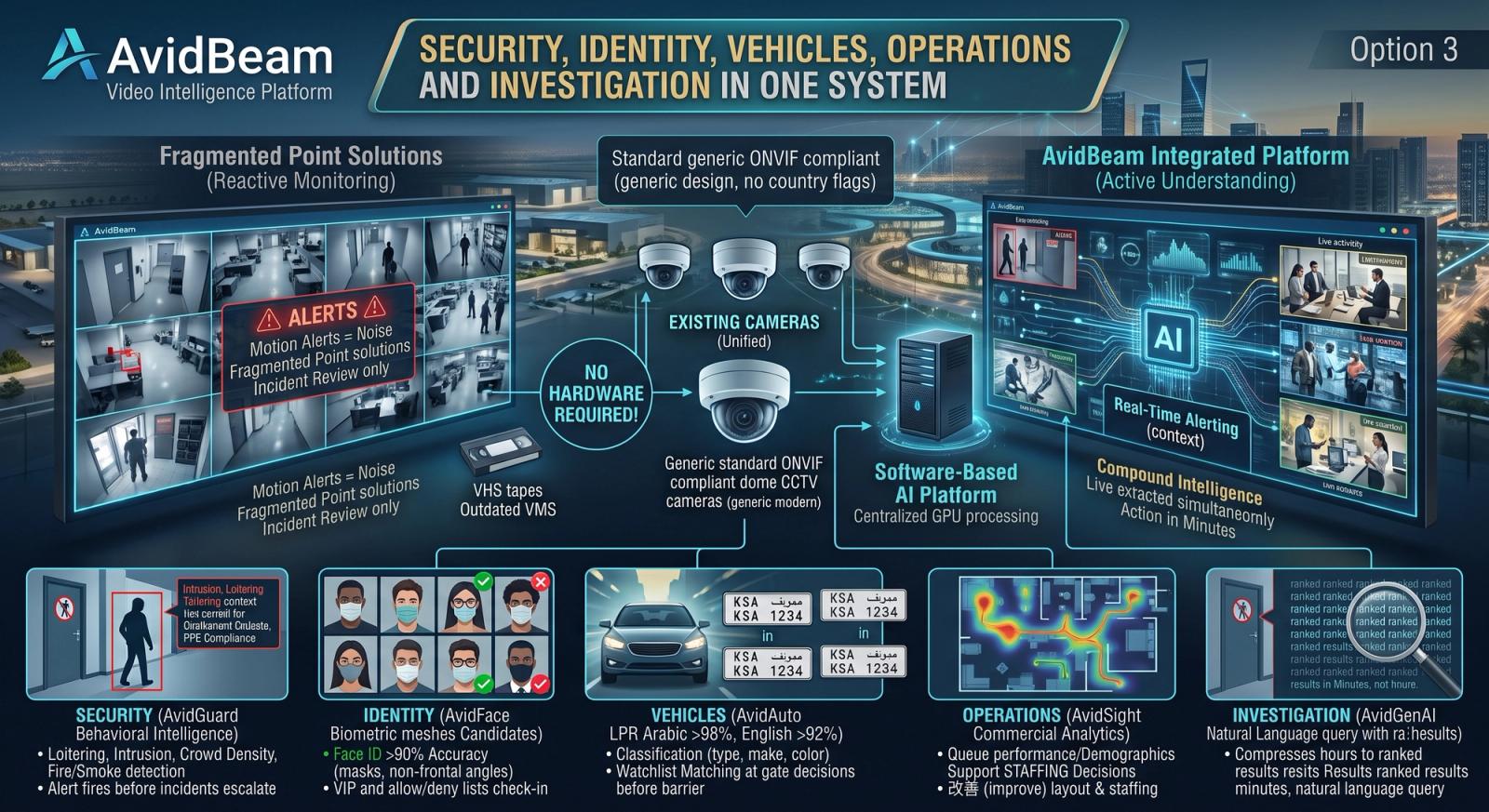
Video Intelligence Platform Explained: Security, Identity, Vehicles, Operations and Investigation in One System
A video intelligence platform is a software system that extracts multiple categories of structured intelligence from camera feeds simultaneously: behavioral security alerts, identity verification
Experience AI Video Analytics
on your existing cameras.
Start with a pilot deployment and scale seamlessly as your operational requirements evolve.