What to Actually Ask AI Video Analytics Companies Before Signing a Deployment Contract
The market for AI video analytics companies has expanded faster than the terminology has caught up. Most vendors in the space describe their offering as AI-powered. The feature lists look similar at a glance. The architecture differences, the accuracy figures under real operating conditions, and the depth of integration across security
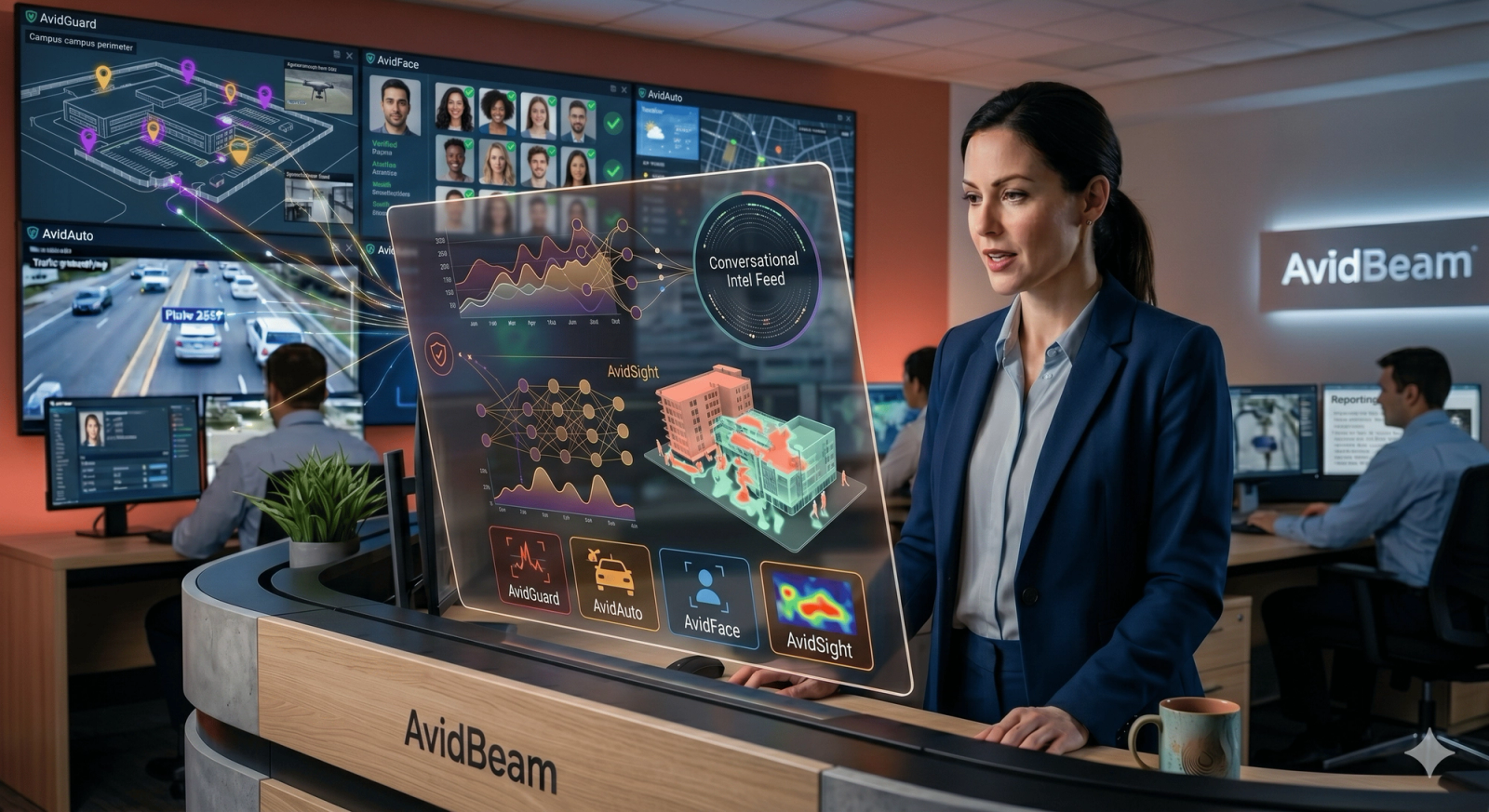
| What is traffic detection?Traffic detection is the automated identification and measurement of vehicle presence, volume, density, flow direction, and behavior across monitored road segments using camera feeds and AI video analytics. Advanced traffic detection platforms go beyond counting vehicles to classifying them, identifying plates, detecting behavioral anomalies, measuring congestion in real time, and forecasting volume patterns, all from existing camera infrastructure without dedicated loop sensors. |
Traffic detection has three distinct operational layers. The first is presence: knowing that vehicles are on the road. The second is understanding: knowing how many, what type, how fast, and in which direction. The third is intelligence: knowing when something is wrong before it becomes a problem, and having enough data to prevent it from happening again.
Most traffic monitoring infrastructure delivers the first layer. Cameras record what is on the road. Counts come from loop sensors or manual observation. However, density alerts, congestion forecasting, incident detection, and vehicle classification all depend on Artificial Intelligence (AI) video analysis running continuously on top of the camera network.
AvidBeam's AvidAuto platform delivers all three layers through its AB - Vehicle Analytics and AB - ITS (Intelligent Traffic Systems) modules. Both run on existing cameras through a server-based AI architecture, without loop sensors, without dedicated traffic detection hardware, and without coverage gaps between monitored segments.
What AI Traffic Detection Produces That Manual Monitoring Cannot
The gap between manual traffic monitoring and AI traffic detection is not a gap of degree. It is a gap in what kinds of questions each approach can answer. Manual monitoring answers: how many vehicles passed this point today? AI traffic detection answers a fundamentally different and more operationally useful set of questions.
Real-Time Density and Congestion
Manual traffic monitoring identifies congestion after it has formed. A driver reports it. A camera operator observes it. By the time a response is coordinated, the bottleneck has already affected adjacent segments. As covered in AvidBeam's analysis of what separates vehicle detection systems operationally, the operational value of AI traffic detection is precisely this: density measurement fires an alert as the concentration builds, before it crosses the threshold that affects flow.
AvidAuto's AB - ITS measures vehicle density per segment continuously. When concentration exceeds a configured threshold, an alert fires to traffic operations. Response can begin before the congestion is visible to drivers approaching the segment. Consequently, the window for intervention is significantly larger than in manual monitoring workflows.
Vehicle Classification and Identity
A vehicle count tells a traffic planner how many vehicles used a segment. Vehicle classification tells them what those vehicles were. AvidBeam's analysis of car recognition technology across vehicle classification scenarios demonstrates how type, make, model, and color data alongside License Plate Recognition (LPR) transforms a count into a traffic intelligence record.
For road authorities, this matters for enforcement, for weight restriction compliance, and for understanding the composition of traffic across different segments and time windows. For facility operators, it feeds access control decisions and forensic investigation capability from the same detection layer.
| To find out how AvidAuto's AI traffic detection applies to your road network and existing cameras, send an email to info@avidbeam.com and the technical team will follow up. |
How AvidAuto's Traffic Detection Works
AvidAuto runs traffic detection through a server-based architecture. All analysis happens centrally on dedicated infrastructure rather than at individual cameras. Consequently, detection model complexity is not constrained by camera hardware, and accuracy stays consistent across nighttime operation, adverse weather, and high vehicle speeds across all connected segments simultaneously.
Continuous Multi-Segment Coverage
Every camera connected to AvidAuto processes traffic detection continuously. There are no monitoring windows, no shift gaps, and no coverage reduction during peak traffic periods when manual observation becomes most strained. The same detection models run at the same accuracy level at 03:00 on a quiet Tuesday as during morning rush on a weekday.
Furthermore, adding new road segments to coverage extends the software layer to cameras already covering those segments. No loop sensor installation. No dedicated detection hardware per lane. Consequently, coverage expansion is a software configuration step rather than a civil works project.
Incident Detection Alongside Volume Monitoring
AI traffic detection identifies incidents on the road surface from the same camera feeds measuring volume and density. Stopped vehicles in active lanes, wrong-way movement at access points, and debris or obstructions in monitored segments all generate alerts automatically.
The incident alert fires at the moment of detection, not when a driver reports the incident or when a camera operator notices it during a manual review. Additionally, the alert includes the camera source, segment identifier, timestamp, and a detection clip. Consequently, traffic authorities receive verified incident data rather than an unconfirmed driver report.
Traffic Detection Outputs and What They Enable
AI traffic detection produces structured data across ten distinct output categories. Each one feeds a different operational or planning workflow. The table below maps every output AvidAuto's traffic detection platform delivers, what it measures, and the operational value each produces.
| Detection Output | What It Measures | Operational Value |
|---|---|---|
| Vehicle presence detection | Identifies vehicles in frame across all conditions | Continuous count per camera; no manual observation required |
| Vehicle classification | Type, make, model, and color identified per detection | Full vehicle profile per event; feeds enforcement and access workflows |
| License Plate Recognition (LPR) | Arabic and English plates read at 98%+ / 92%+ | Plate identity attached to every detection record automatically |
| Traffic volume counting | Vehicles counted per lane and direction by time window | Daily, weekly, and monthly volume data per segment for planning |
| Traffic density measurement | Concentration of vehicles per segment updated continuously | Congestion identified before it develops into a bottleneck |
| Traffic flow analysis | Direction, speed, and distribution across monitored segments | Feeds signal timing and lane allocation decisions with verified data |
| Traffic forecasting | Historical pattern analysis projecting volume by hour and season | Proactive planning before peak periods rather than reactive response |
| Violation detection | Seven violation types via AB - ITS module | Continuous enforcement output alongside detection data |
| Incident detection | Stopped vehicles, wrong-way movement, debris in lane | Early warning before traffic authority receives manual reports |
| Congestion alerting | Density threshold exceeded on monitored segment | Alert fires before congestion affects adjacent network segments |
Traffic Detection Across Environments
AI traffic detection applies wherever vehicle movement across a monitored area determines operational, enforcement, or planning decisions. The detection mechanisms stay consistent across environments. What changes is which output category delivers the most direct operational return.
Urban Road Networks
Urban traffic detection covers intersection throughput, lane utilization, signal timing optimization, and incident detection across the road network. Density alerts and congestion forecasting feed traffic management centers with real-time data across all monitored intersections simultaneously. Furthermore, AB - ITS violation detection runs continuously alongside volume monitoring on the same camera feeds.
Facility and Campus Access Roads
Internal road networks at industrial facilities, corporate campuses, and large-scale developments require the same traffic detection capabilities as public roads. Volume monitoring feeds staffing and logistics scheduling. Congestion alerts identify bottlenecks at access points during shift changes. Incident detection flags stopped vehicles or obstructions on internal access routes before they affect facility operations.
Highway and Expressway Segments
Long-distance highway monitoring requires detection coverage across extended segments without sensor infrastructure at each monitoring point. AvidAuto connects to cameras already mounted along highway corridors and processes traffic detection continuously across the full covered distance. Speed measurement, density monitoring, wrong-way detection at on-ramps, and incident identification all run from the existing camera network.
Smart City Infrastructure
Smart city traffic management integrates detection data from multiple road segments into a unified operations view. AvidAuto feeds volume, density, classification, and incident data from all connected cameras into a centralized interface. Consequently, traffic management centers receive a complete real-time picture across the full monitored network rather than isolated readings from individual sensor points.
Manual Monitoring vs. AvidBeam AI Traffic Detection — Comparison
The table below sets out where AvidAuto's AI traffic detection diverges from manual traffic monitoring at the coverage, data depth, response capability, and planning intelligence level.
| Capability | Manual Traffic Monitoring | AvidBeam AI Traffic Detection |
|---|---|---|
| Detection coverage | Intersections and segments where staff are stationed | Every camera-covered segment continuously, across all hours |
| Vehicle data | Count only; no classification or identity | Full profile: count, type, make, model, color, plate, and plate type |
| Density monitoring | Manual observation; no threshold alerting | Real-time density measurement with configurable congestion alerts |
| Congestion response | Reported after congestion has already formed | Alert fires as density builds; response before bottleneck forms |
| Incident detection | Reported by drivers or observed by staff | Stopped vehicles, wrong-way movement, and lane debris detected automatically |
| Traffic forecasting | Unavailable from manual observation | Historical pattern analysis generates volume projections by hour and segment |
| Violation enforcement | Officer-dependent; inconsistent | Continuous enforcement via AB - ITS across all violation types |
| Hardware requirement | Loop sensors or dedicated detection hardware per lane | Layers onto existing Open Network Video Interface Forum (ONVIF) compliant cameras |
In short, manual traffic monitoring observes. AvidBeam's AI traffic detection measures, classifies, identifies, alerts, enforces, and forecasts, across every connected segment, continuously, on the cameras already installed.
Infrastructure and Deployment
AvidAuto connects to any Open Network Video Interface Forum (ONVIF) compliant camera via standard network protocols. All traffic detection processing runs centrally on dedicated server infrastructure. Therefore, no loop sensors, inductive detectors, or dedicated traffic detection hardware are required at individual road points.
The infrastructure baseline per camera processed:
- 2GB RAM minimum; one virtual core at 2.4 GHz minimum
- Multiple Graphics Processing Unit (GPU) configurations supported for high-density deployments
- Camera resolution: 2MP up to 4K; lens focal length 3mm to 25mm
Video Management System (VMS) integration covers Milestone, NetworkOptix, and Genetec platforms. Deployment options include on-premise, private cloud, public cloud, and hybrid. Notably, AvidAuto has been deployed across an 18,000-camera network in Riyadh's smart parking infrastructure, demonstrating the platform's scalability for city-scale traffic monitoring from a single centralized interface.
FAQ
What is traffic detection?
The automated identification and measurement of vehicle presence, volume, density, flow direction, classification, and behavioral anomalies across monitored road segments using AI video analytics on existing camera feeds.
How does AI traffic detection differ from loop sensor monitoring?
Loop sensors count vehicles at specific points; AI traffic detection classifies vehicles, measures density across segments, detects incidents, forecasts volume patterns, and connects to enforcement, all from existing cameras without civil works.
Does AI traffic detection require dedicated hardware?
No. AvidAuto layers onto any existing ONVIF compliant camera; the minimum is 2GB RAM and one virtual core at 2.4 GHz on the processing server per camera.
What vehicle data does traffic detection produce per event?
Vehicle type, make, model, color, plate number, plate type, timestamp, camera source, segment identifier, and direction of travel, all logged automatically per detection event.
Can AI traffic detection identify incidents automatically?
Yes. AvidAuto detects stopped vehicles in active lanes, wrong-way movement, and lane obstructions automatically, generating alerts with camera source and clip at the moment of detection.
How does traffic forecasting work?
AvidAuto's historical pattern analysis builds volume projections by hour, day, and season per segment, enabling proactive staffing, signal timing, and infrastructure decisions before peak periods.
Can traffic detection and violation enforcement run on the same cameras?
Yes. AB - Vehicle Analytics handles detection and classification while AB - ITS handles violation enforcement on the same camera feeds through the same AvidAuto platform.
| Want to see AI traffic detection in action?Request a live demo of AvidBeam's AvidAuto platform and see how traffic detection applies to your road network and existing cameras. Send an email to info@avidbeam.com to schedule a session with the technical team. |
 Article
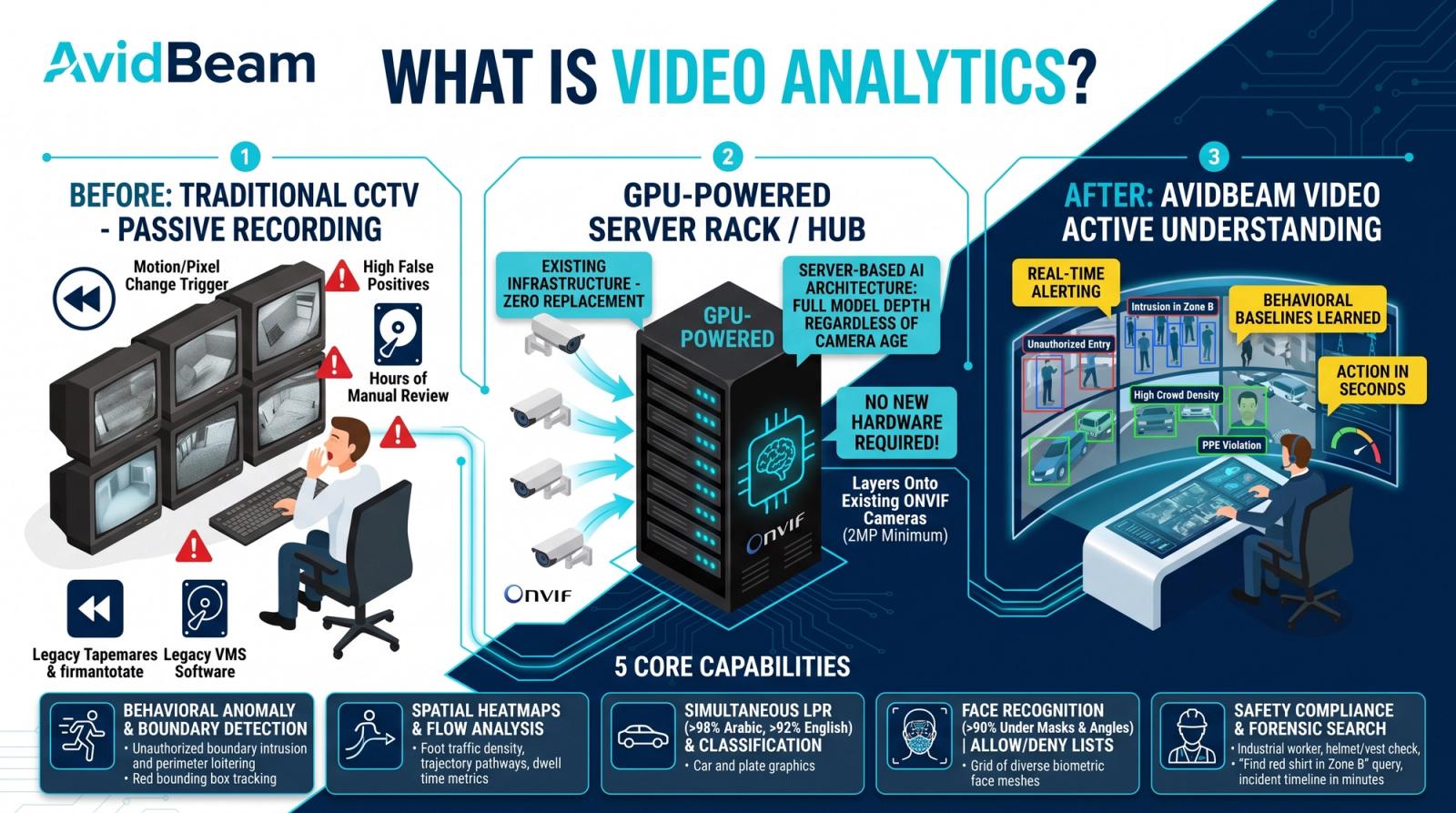
Video Analytics: Turn Camera Feeds Into Operational Intelligence
Your camera infrastructure already captures everything that happens across your facilities. The question is whether anything is actually done with that footage, or whether it sits on a server, reviewed only after something goes wrong.
 Article
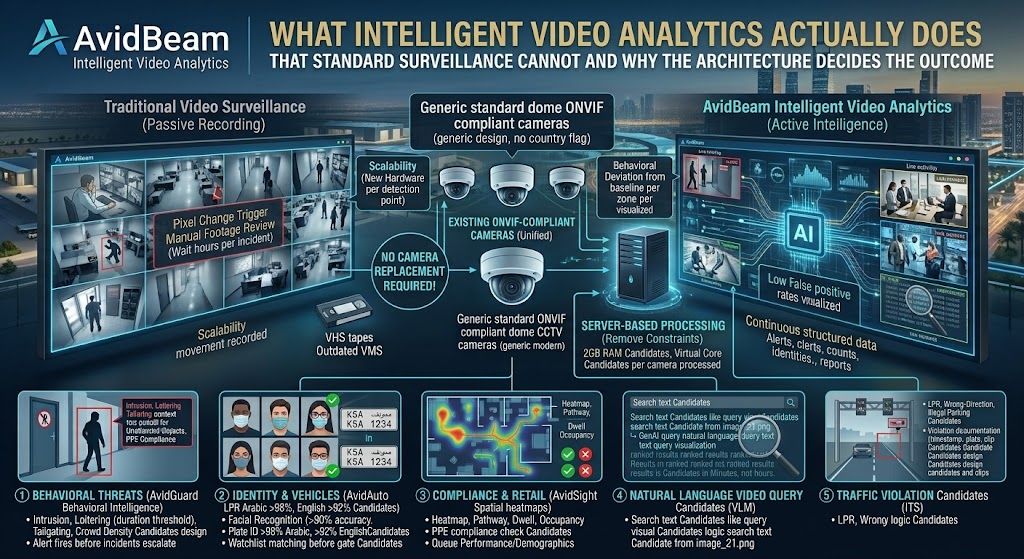
What Intelligent Video Analytics Actually Does That Standard Surveillance Cannot and Why the Architecture Decides the Outcome
Intelligent video analytics is the application of Artificial Intelligence (AI), deep learning, and computer vision to camera feeds to automatically detect security threats, identify individuals, verify compliance, and generate operational intelligence without human review of footage
 Article
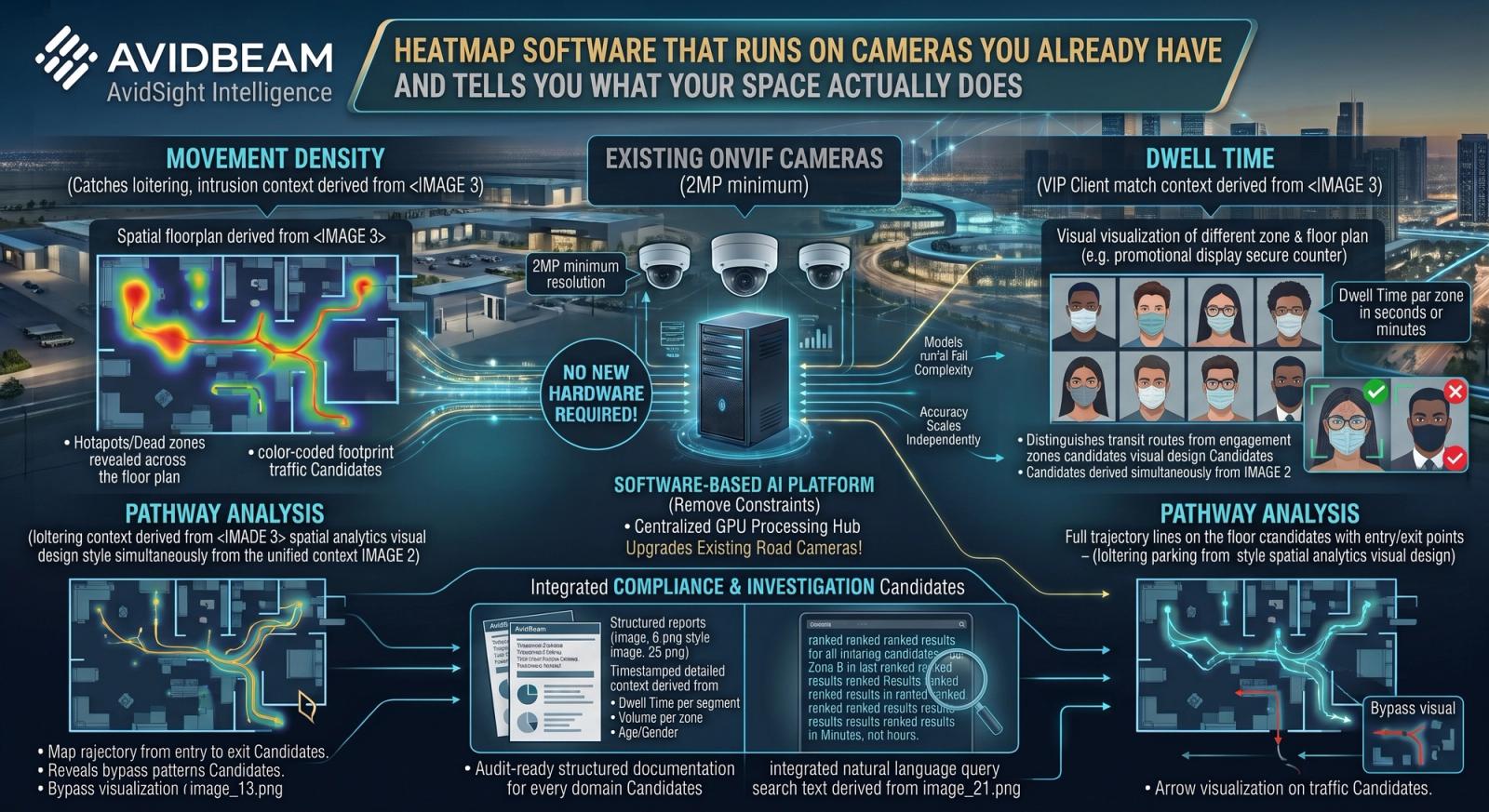
Heatmap Software That Runs on Cameras You Already Have and Tells You What Your Space Actually Does
If you are evaluating heatmap software, you probably already know that something about your space is not working the way you expected. Customers are not finding a product zone. A service counter has inconsistent wait times
Experience AI Video Analytics
on your existing cameras.
Start with a pilot deployment and scale seamlessly as your operational requirements evolve.