Intruder Detection System in 2026: How AvidBeam's AvidGuard Identifies Threats Before They Reach the Facility
A motion sensor tells you that something moved. An Artificial Intelligence (AI) intruder detection system tells you that something happened that should not have, given what normally happens in that zone at that time.
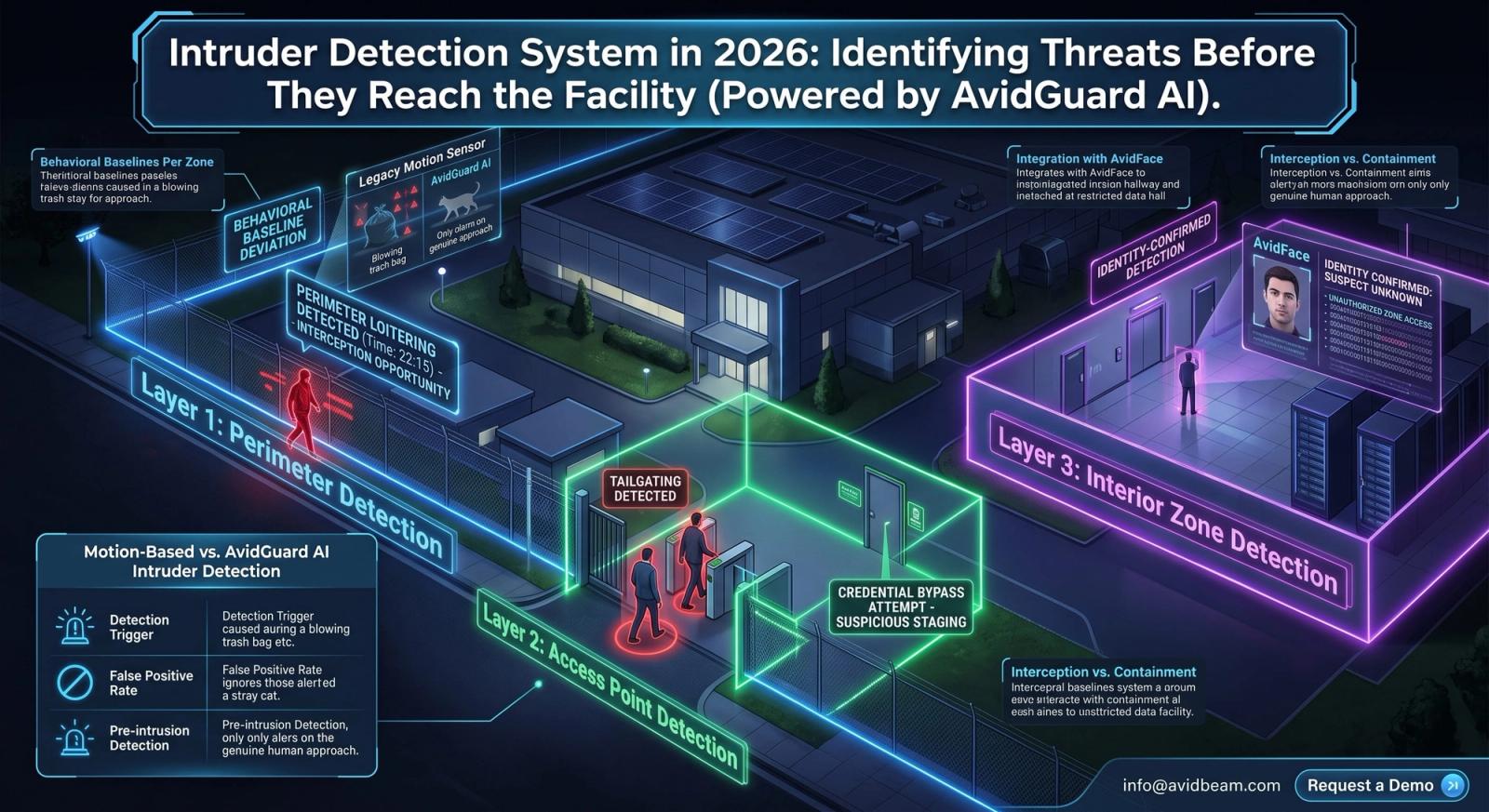
| What is an intruder detection system?An intruder detection system is a security platform that identifies unauthorized presence or access attempts across monitored facility zones. AI-powered intruder detection systems establish behavioral baselines per zone and alert on genuine deviations, covering perimeter approach, loitering near access points, tailgating, and unauthorized zone access. Unlike motion-based systems, AI intruder detection distinguishes actual threats from environmental noise, reducing false positives and increasing the operational value of every alert. |
A motion sensor tells you that something moved. An Artificial Intelligence (AI) intruder detection system tells you that something happened that should not have, given what normally happens in that zone at that time.
The distinction determines the operational value of every alert the system generates. A motion alert fires on wind, passing vehicles, wildlife, and staff doing their jobs correctly. Security teams learn to treat those alerts as noise. An AI intrusion alert fires on behavioral deviation from the established zone baseline. It fires less frequently. Consequently, it gets acted on.
AvidBeam's AvidGuard platform delivers AI-powered intruder detection across perimeter zones, access corridors, and restricted interior areas. It learns what normal activity looks like per zone per time window and alerts on genuine deviations before threats escalate. Furthermore, the detection layer integrates with AvidFace's identity verification to confirm who triggered each intrusion alert — producing identity-confirmed detections rather than anonymous motion events.
Why Most Intruder Detection Systems Alert Too Late
The timing of an intruder detection alert determines what security teams can do with it. An alert that fires after an intruder has cleared the perimeter and reached the interior of a facility leaves response teams with a containment problem. An alert that fires during perimeter approach, before the intruder reaches any access point, leaves response teams with an interception opportunity.
The Perimeter Detection Gap
As covered in AvidBeam's analysis of anomaly detection in video surveillance, the most operationally valuable intrusion detection happens at the perimeter, not at the access point. Perimeter loitering, approach behavior near fence lines or external access points, and clustering near entry barriers are all detectable behavioral signals before any physical security boundary is crossed.
Motion-based perimeter sensors detect presence at the boundary but not approach behavior. By the time a motion alert fires, the individual is already at or past the perimeter line. AvidGuard's behavioral baseline models detect the approach behavior that precedes the perimeter crossing, extending the detection window significantly.
The False Positive Problem
Security teams that receive 40 false alerts before the first genuine intrusion event develop a systematic response to those alerts: they stop treating them as urgent. Consequently, when a genuine intrusion alert fires alongside the false ones, the response time is the same as the response to noise.
AI intruder detection addresses this by distinguishing between motion and anomalous behavior. A delivery vehicle parked briefly at a loading bay does not trigger an alert because parking briefly at a loading bay is normal for that zone. The same vehicle parked in the same location for 90 minutes at 02:00 does trigger an alert because it deviates from the established baseline for that zone at that time.
| To find out how AvidGuard's intruder detection system applies to your facility's existing camera infrastructure, send an email to info@avidbeam.com and the technical team will follow up. |
How AvidGuard's Intruder Detection System Works
AvidGuard applies AI behavioral models to existing camera feeds through a server-based architecture. All detection processing runs centrally on dedicated infrastructure rather than at individual cameras. Therefore, the detection model complexity is not constrained by camera hardware, and detection accuracy holds consistently across nighttime operation, adverse weather, and partial obstructions on every connected camera simultaneously.
Behavioral Baseline Learning
During the initial deployment period, AvidGuard observes activity in each monitored zone across different times of day and operational periods. The behavioral model learns what normal presence patterns look like per zone: how long individuals typically remain, at what hours, in what locations within the zone, and at what density levels.
Intrusion detection thresholds are then calibrated to each zone's established baseline rather than to a default value applied uniformly across the facility. Furthermore, the model continues learning and adapting as operational patterns change over time. Consequently, seasonal schedule changes, new operational workflows, and environmental shifts are absorbed into the baseline without manual reconfiguration.
Alert Content and Response
When AvidGuard detects an intrusion event, the alert includes the camera source, zone identifier, timestamp, event clip, and the specific behavioral deviation that triggered it. The alert fires in real time, not during a retrospective log review. N+1 redundancy maintains continuous intruder detection coverage despite individual hardware failures.
Additionally, when AvidFace is deployed on the same camera network, every intrusion alert can carry confirmed identity data alongside the behavioral detection. Consequently, security teams receive both the behavioral signal and the identity of the individual who triggered it simultaneously, without cross-referencing separate systems.
The Three Detection Layers of an AI Intruder Detection System
An effective intruder detection system operates across three sequential layers. As covered in AvidBeam's analysis of what modern building security systems require, facilities that cover all three layers close the gaps that single-point detection approaches leave open.
Layer 1: Perimeter Detection
The perimeter detection layer covers the outer boundary of the monitored facility. AvidGuard identifies individuals approaching perimeter fence lines, loitering near external access points, and staging near building boundaries. The alert fires during approach behavior, before any physical boundary is crossed.
Perimeter detection is where the intervention window is widest. A security team notified of perimeter loitering has time to verify, respond, and intercept before the individual reaches an access point. By contrast, a security team notified of a door breach has a containment problem rather than an interception opportunity.
Layer 2: Access Point Detection
The access point detection layer covers entries, gates, doors, and transitional zones where authorized and unauthorized individuals intermingle. Three specific detection events are most operationally significant at this layer:
- Tailgating: multiple individuals entering on a single authorization event; detected in real time from camera feeds and invisible to badge systems without a behavioral detection layer running alongside them
- Forced entry approach: behavioral patterns near a door or gate that deviate from normal approach and entry flow; detected before a physical security event occurs
- Credential bypass attempt: loitering near an access point beyond the normal interaction duration; detected as deviation from the zone baseline before an access attempt is completed
Layer 3: Interior Zone Detection
The interior zone detection layer covers restricted areas, server rooms, storage zones, and other spaces where presence without authorization represents a security event rather than a normal operational activity.
Interior zone intrusion detection connects directly to AvidFace's zone movement tracking when both systems are deployed on the same camera network. When an individual appears in a restricted zone without a corresponding access event at the zone boundary, the alert fires against that individual's specific authorization profile. Consequently, the detection is identity-confirmed rather than anonymous, and the alert includes the individual's full zone movement history in the current session.
Intruder Detection Events AvidGuard Covers
The table below maps every intruder detection event AvidGuard identifies, what triggers it, and the security output it produces.
| Detection Event | What Triggers It | Security Output |
|---|---|---|
| Perimeter intrusion | Individual crosses a predefined boundary before reaching the facility | Alert fires before the intruder reaches an access point; maximum intervention window |
| Loitering near entry points | Individual remains near an access point beyond the zone baseline duration | Pre-intrusion staging behavior identified before an access attempt is made |
| Tailgating at access points | Multiple individuals enter on a single authorization event | Detected in real time; invisible to badge systems without a behavioral layer |
| Unauthorized zone access | Individual appears in a restricted zone without a corresponding access event | Alert fires against the individual's specific authorization profile automatically |
| After-hours presence | Individual detected in an area outside its operational hours | Baseline adjusts per time window; lower threshold triggers alert on minimal presence |
| Scene change detection | Physical configuration of a monitored zone changes unexpectedly | Tampering with camera angles or zone boundaries surfaces automatically |
| Left object detection | Unattended item remains near an access point or critical area | Alert fires based on zone-specific duration threshold; no manual observation required |
| Crowd formation near boundaries | Group size near perimeter or access point exceeds configured threshold | Early crowd management response before density reaches a security concern level |
Motion-Based vs. AvidGuard AI Intruder Detection — Comparison
The table below sets out where AvidGuard's AI intruder detection system diverges from motion-based detection at the accuracy, timing, identity, and investigation level.
| Dimension | Motion-Based Intruder Detection | AvidGuard AI Intruder Detection System |
|---|---|---|
| Detection trigger | Any motion in monitored zone; weather, wildlife, and shadows included | Behavioral deviation from learned zone baseline; genuine anomalies only |
| False positive rate | High; security teams learn to ignore alerts | Low; baselines filter environmental noise from genuine intrusion signals |
| Pre-intrusion detection | Not available; detection fires on entry, not approach | Perimeter loitering and approach behavior detected before access attempt |
| Tailgating detection | Not available without dedicated sensor | Detected in real time from camera feeds on the same platform |
| Night detection | Same sensitivity; no context for reduced activity periods | Baseline adjusts per time window; lower threshold for after-hours presence |
| Identity confirmation | Not available from motion detection alone | AvidFace integration confirms identity at every detected intrusion event |
| Post-incident investigation | Manual footage review per camera; hours per case | Image-based search across full camera network; results in minutes |
| Hardware requirement | Dedicated PIR sensors or motion detection units per zone | Layers onto existing Open Network Video Interface Forum (ONVIF) compliant cameras |
In short, motion-based intruder detection reacts to movement. AvidGuard reacts to behavioral anomalies — detecting genuine intrusion signals before they become security events, with identity confirmation and investigation capability on the same platform.
Infrastructure and Deployment
AvidGuard connects to any Open Network Video Interface Forum (ONVIF) compliant camera via standard network protocols. All intruder detection processing runs centrally on dedicated server infrastructure. Therefore, no dedicated motion sensors or PIR (Passive Infrared) units are required at individual detection zones.
The infrastructure baseline per camera processed:
- 2GB RAM minimum; one virtual core at 2.4 GHz minimum
- Multiple Graphics Processing Unit (GPU) configurations supported for higher-density deployments
- Camera resolution: 2MP up to 4K; lens focal length 3mm to 25mm
Video Management System (VMS) integration covers Milestone, NetworkOptix, and Genetec platforms. Deployment options include on-premise, private cloud, public cloud, and hybrid. N+1 redundancy maintains continuous intruder detection coverage across all operational hours without manual monitoring gaps.
FAQ
What is an intruder detection system?
A security platform that identifies unauthorized presence or access attempts across monitored zones using AI behavioral analysis, covering perimeter approach, loitering, tailgating, and interior zone intrusion before incidents escalate.
How does AI intruder detection differ from motion sensors?
Motion sensors fire on any movement regardless of context; AI intruder detection learns behavioral baselines per zone and alerts on genuine deviations, significantly reducing false positive rates.
Can an intruder detection system detect threats before entry?
Yes. AvidGuard detects perimeter loitering, approach behavior, and staging near access points before any physical boundary is crossed, extending the intervention window significantly.
Does AvidGuard require new cameras?
No. AvidGuard layers onto any existing ONVIF compliant camera; the minimum is 2GB RAM and one virtual core at 2.4 GHz per camera on the processing server.
Can the system confirm who triggered an intrusion alert?
Yes. When AvidFace is deployed on the same camera network, every intrusion alert carries confirmed identity data alongside the behavioral detection event.
How does the system perform at night and during off-hours?
AvidGuard's behavioral baselines adjust per time window, applying lower thresholds for after-hours periods so minimal presence in areas that should be empty triggers alerts that daytime presence in the same zones would not.
What other security capabilities run alongside intruder detection?
Tailgating detection, crowd density monitoring, loitering detection, left object detection, scene change detection, fire and smoke detection, and PPE compliance all run on the same AvidGuard platform through the same camera network.
| Want to see an intruder detection system in action?Request a live demo of AvidBeam's AvidGuard platform and see how intruder detection applies to your facility's existing cameras. Send an email to info@avidbeam.com to schedule a session with the technical team. |
 Article
Facial Recognition for Security: What It Catches That Badge Systems Cannot and How It Works on Existing Cameras
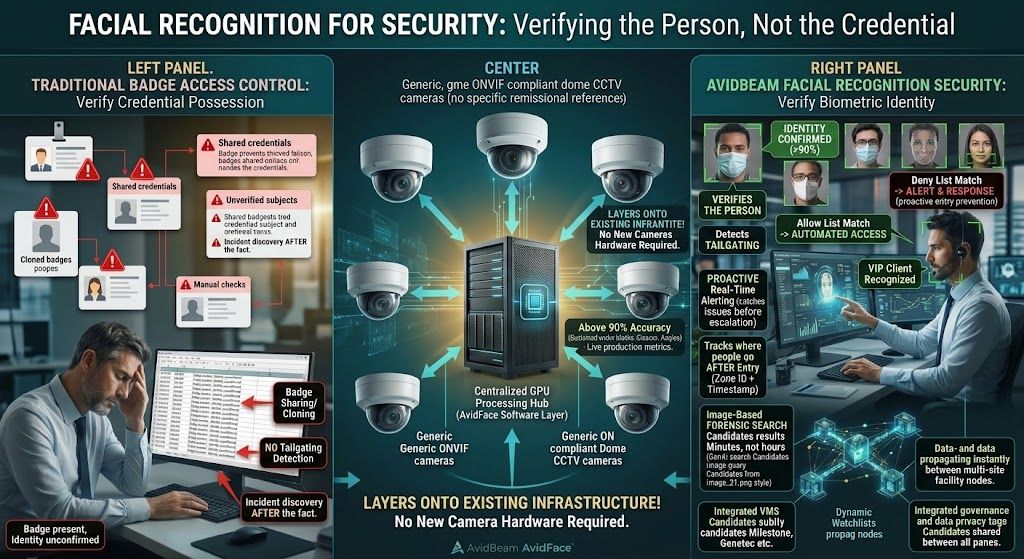
Badge-based access control has one fundamental limitation: it verifies that a credential is present, not that the person presenting it is who it says they are. A badge can be cloned, shared, lost, or used by someone it was not issued to
 Article
What Video Analytics Does for Hotels and Resorts Beyond Recording and Why It Matters for Guest Experience
Video analytics for hospitality is the application of AI to hotel and resort camera feeds to improve guest experience, enhance security, and generate operational intelligence simultaneously
 Article
Video Analytics in Banking: What Your Branch Cameras Can Detect Beyond Recording
Video analytics in banking is the application of AI to branch camera feeds to automatically detect fraud patterns, monitor compliance, manage queues, and generate operational intelligence without requiring staff to watch screens continuously
Experience AI Video Analytics
on your existing cameras.
Start with a pilot deployment and scale seamlessly as your operational requirements evolve.