Facial Recognition for Security: What It Catches That Badge Systems Cannot and How It Works on Existing Cameras
Badge-based access control has one fundamental limitation: it verifies that a credential is present, not that the person presenting it is who it says they are. A badge can be cloned, shared, lost, or used by someone it was not issued to
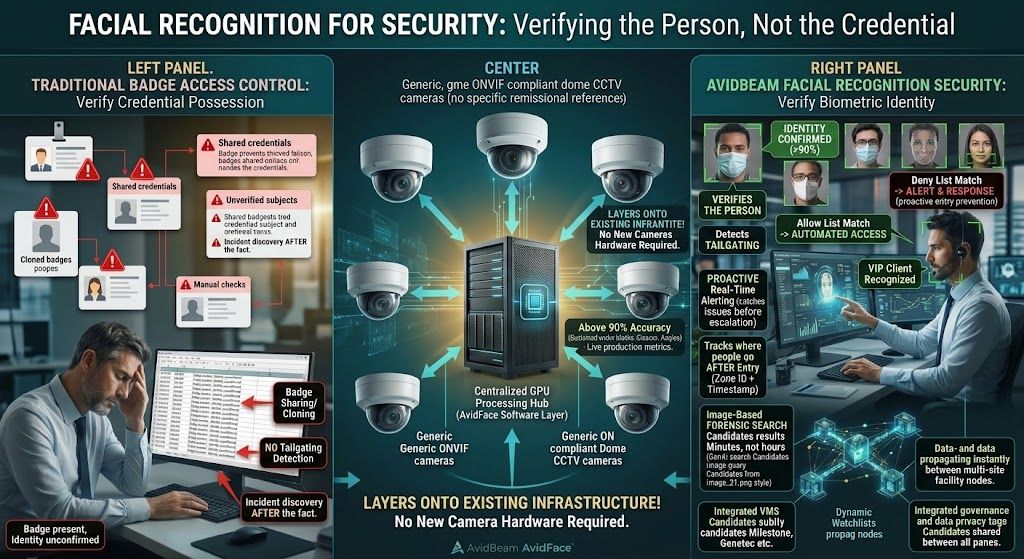
| What is facial recognition for security?Facial recognition for security is the use of AI to identify individuals from camera feeds at access points and throughout a monitored facility, enabling real-time watchlist enforcement, automated access control, tailgating detection, and zone movement tracking. Unlike badge systems, facial recognition verifies the identity of the person, not just the credential they are carrying. It runs on existing cameras through a central server, requires no badge hardware at individual access points, and sustains above 90% accuracy under masks, glasses, and non-frontal angles. |
Badge-based access control has one fundamental limitation: it verifies that a credential is present, not that the person presenting it is who it says they are. A badge can be cloned, shared, lost, or used by someone it was not issued to. The system has no way to detect the difference.
Facial recognition for security closes that gap. Every access event is verified against the actual identity of the person in frame, not the credential in their hand. A flagged individual triggers an alert whether they present a valid badge or not. A tailgating individual triggers an alert whether they have a badge or not. Zone movement anomalies surface based on where a specific person appears, not which credential was last scanned.
All of this runs from the cameras already installed. The intelligence lives in the analytics platform on a central server, not in the camera hardware or in dedicated reader units at individual access points.
What Can Facial Recognition Do for Security That Badge Systems Cannot?
The security gaps that facial recognition closes are specific and consistent across environments. Understanding each one clarifies why the upgrade from credential-based to identity-based security is operationally significant rather than incremental.
It Verifies the Person, Not the Credential
As covered in AvidBeam's analysis of where facial recognition access control begins and conventional systems end, the critical distinction between badge systems and facial recognition is that one verifies possession and the other verifies identity. A badge system confirms that a specific credential was presented. Facial recognition confirms that a specific face was present.
The operational consequence is significant. A badge can be borrowed, cloned, or stolen without the system detecting any anomaly. A face cannot be transferred. Consequently, every access event confirmed by facial recognition carries a level of identity assurance that badge systems fundamentally cannot provide.
It Catches Tailgating
AvidGuard detects tailgating from camera feeds: multiple individuals entering a controlled zone on a single authorization event. This event is invisible to badge systems. The badge reader confirms one valid credential. The second individual entering behind the authorized person leaves no trace in the access log.
With facial recognition and behavioral detection running on the same camera, tailgating generates an alert in real time. The alert fires at the moment of detection, with camera source, timestamp, and the identities of both individuals if enrolled.
It Tracks Where People Go After Entry
A badge system logs access events at reader locations. It does not track where individuals go between reader points. An authorized employee whose credentials permit access to Zone A can move to Zone C undetected unless a reader happens to be positioned at the boundary.
AvidFace tracks individuals across every connected camera by zone ID and timestamp. When an individual appears in Zone C without a corresponding access event at the Zone B boundary, the anomaly surfaces automatically against that individual's specific authorization profile. The alert fires against a named, confirmed identity rather than an anonymous movement detection.
| Want to know which cameras in your existing network qualify for AvidFace? Send an email to info@avidbeam.com for a free infrastructure assessment. |
How Accurate Is Facial Recognition for Security?
Accuracy is the question that determines whether facial recognition is operationally useful or generates too many errors to trust. The answer depends on where the processing happens.
Why Server-Based Processing Sustains Accuracy
Facial recognition systems that embed processing in dedicated reader hardware are constrained by the chip in the housing. Those systems typically degrade under masks, glasses, non-frontal angles, and variable lighting because the embedded models are too small to handle those conditions reliably.
Server-based facial recognition processes all recognition centrally on dedicated server infrastructure with Graphics Processing Unit (GPU) acceleration. The recognition models run at full depth regardless of camera age or hardware specification. AvidFace sustains recognition accuracy above 90% under masks, glasses, hats, non-frontal angles, and variable lighting across all operational hours. These are production figures from live deployments including the Ministry of Foreign Affairs in Saudi Arabia and the Four Seasons Madinah, not controlled test results.
How Fast Does Recognition Happen?
AvidFace completes recognition and watchlist matching in fractions of a millisecond. The alert fires before the individual clears the access point. For deny-listed individuals, this means the security response can begin before the person enters an interior zone rather than after they have already entered and the badge reader has already confirmed their credential.
How Does Facial Recognition Work Alongside Existing Security Systems?
As covered in AvidBeam's analysis of what modern building security systems require, the highest-value security configurations combine facial recognition with behavioral detection rather than treating each as a separate system.
AvidFace and AvidGuard both run on the same camera feeds through the same management interface. A loitering alert near a restricted zone boundary is a behavioral signal. The same alert combined with the identity of the individual from facial recognition is a confirmed security event with a named subject. The compound intelligence is only available when both systems share the same platform.
Furthermore, AvidFace integrates with existing Video Management System (VMS) platforms including Milestone, NetworkOptix, and Genetec. All facial recognition alerts and access events feed directly into the operator's existing interface without requiring a separate management system for identity events.
Facial Recognition Capability Breakdown for Security
The table below maps every security capability AvidFace delivers, how each one works, and what it produces for security operations.
| Security Capability | How It Works | What It Produces |
|---|---|---|
| Deny list enforcement | Every detected face cross-referenced against flagged individuals in real time | Alert fires with confirmed identity before flagged person reaches interior zones |
| Allow list access automation | Authorized personnel identified and cleared without presenting credentials | No badge to clone or share; access decision based on confirmed biometric identity |
| VIP recognition | Designated individuals identified at approach with advance notification | Service or operations team notified before the person reaches the desk or entry point |
| Zone movement tracking | Same individual tracked across every connected camera by zone and timestamp | Unauthorized zone access surfaces automatically against each person's authorization profile |
| Tailgating detection | Multiple individuals entering a controlled zone on one authorization event | Detected in real time from camera feeds; invisible to badge systems without a behavioral layer |
| Unauthorized zone access | Individual appears in restricted zone without corresponding access event | Alert fires against the individual's specific authorization profile automatically |
| Reverse image search | Face image query across full recorded camera network | Top five ranked matches with timestamps and camera sources returned in minutes |
| Attribute detection | Age estimation, gender, eyewear, headwear, and mask presence per detected face | Additional profiling data from the same feed running recognition; no extra processing |
| Multi-site watchlist sync | Single list update propagates to all connected sites instantly | Flagged individual cannot clear a secondary location after being identified at the first |
Badge-Based Access Control vs. Facial Recognition for Security
The table below sets out where facial recognition diverges from badge-based access control across the security dimensions that determine what each system can and cannot detect.
| Security Dimension | Badge-Based Access Control | Facial Recognition for Security |
|---|---|---|
| What is verified at entry | Credential possession: badge or PIN presented | Biometric identity: confirmed match to enrolled face at above 90% accuracy |
| Tailgating | Not detectable without a separate sensor | Detected in real time from camera feeds with behavioral analytics layer |
| Lost or shared credentials | Security gap until credential is reported | No credential to lose or share; face cannot be transferred to another person |
| Flagged individual alert | Not available from badge systems alone | Alert fires with confirmed identity before flagged person clears the access point |
| Zone movement tracking | Badge swipe log: which credential at which reader | Biometric identity linked to every zone appearance across every connected camera |
| Post-incident investigation | Access log review by credential ID; no visual confirmation | Image-based search returns ranked matches with timestamps across full camera network |
| After-hours access | Time-restricted badge rules; no identity confirmation | Behavioral baseline adjusts per time window; unusual presence flagged automatically |
| Scalability | New reader hardware per additional access point | Software configuration extends recognition to cameras already covering new zones |
Badge systems verify that a credential was presented. Facial recognition verifies that a specific person was present, where they went afterward, and whether their presence in any given zone was authorized.
Does Facial Recognition for Security Require New Cameras?
No. AvidFace connects to any Open Network Video Interface Forum (ONVIF) compliant camera with a minimum 2 Megapixel resolution. All recognition processing runs on a central server, not inside the cameras or in dedicated reader units. Consequently, deploying facial recognition for security is a software and server project rather than a hardware replacement project.
The server infrastructure baseline is 2GB RAM and one virtual core at 2.4 GHz per connected camera. Deployment options include on-premise, private cloud, public cloud, and hybrid. On-premise processing keeps all biometric identity data local, the recommended configuration for government and high-security facilities.
FAQ
What is facial recognition for security?
An AI system that identifies individuals from camera feeds at access points and throughout a facility, enabling watchlist enforcement, automated access control, tailgating detection, and zone movement tracking on existing cameras.
What can facial recognition detect that badge systems cannot?
Tailgating, shared or cloned credentials, unauthorized zone access between reader points, and flagged individuals presenting valid badges; all require biometric identity verification rather than credential confirmation.
How accurate is facial recognition for security?
AvidFace sustains above 90% accuracy under masks, glasses, hats, and non-frontal angles through server-based centralized processing regardless of camera age or individual hardware specification.
Does facial recognition for security require new cameras?
No. AvidFace connects to any existing ONVIF compliant camera with 2MP minimum resolution; the recognition processing runs on a central server, not inside individual cameras or reader units.
What happens when a flagged individual is detected?
An alert fires with confirmed identity, camera source, zone identifier, and timestamp before the individual clears the access point; the security team receives the alert with full context while the individual is still at the entry point.
Can facial recognition and behavioral security run on the same cameras?
Yes. AvidFace identity verification and AvidGuard behavioral detection both run on the same camera feeds through the same platform, producing combined identity and behavioral alerts in one unified management interface.
How does post-incident investigation work with facial recognition?
AvidFace's reverse image search accepts a face image and queries every connected camera simultaneously, returning ranked matches with timestamps and camera sources across the full network in minutes.
| Want to see facial recognition for security in action?Request a live demo of AvidBeam's AvidFace platform on your existing cameras. Send an email to info@avidbeam.com to schedule a session with the technical team. |
 Article
What Video Analytics Does for Hotels and Resorts Beyond Recording and Why It Matters for Guest Experience
Video analytics for hospitality is the application of AI to hotel and resort camera feeds to improve guest experience, enhance security, and generate operational intelligence simultaneously
 Article
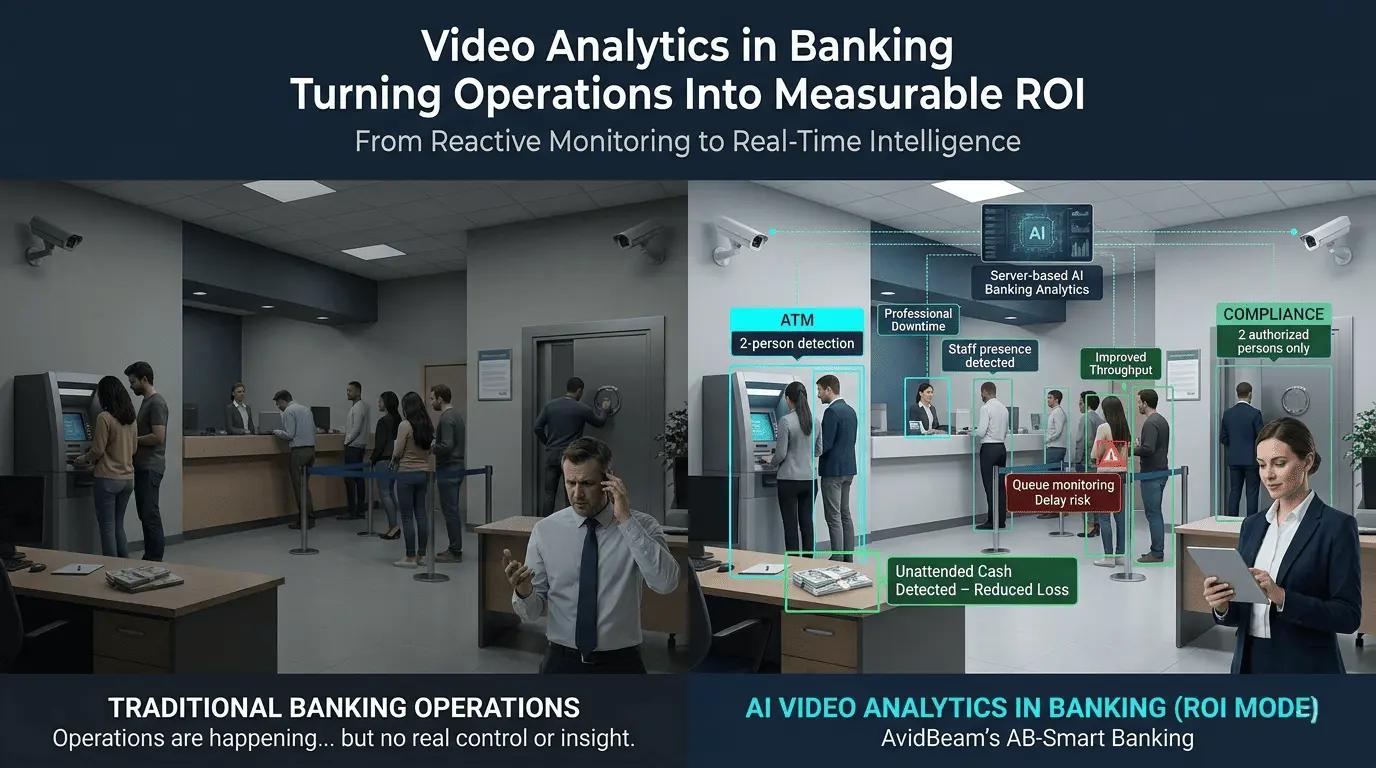
Video Analytics in Banking: What Your Branch Cameras Can Detect Beyond Recording
Video analytics in banking is the application of AI to branch camera feeds to automatically detect fraud patterns, monitor compliance, manage queues, and generate operational intelligence without requiring staff to watch screens continuously
 Article
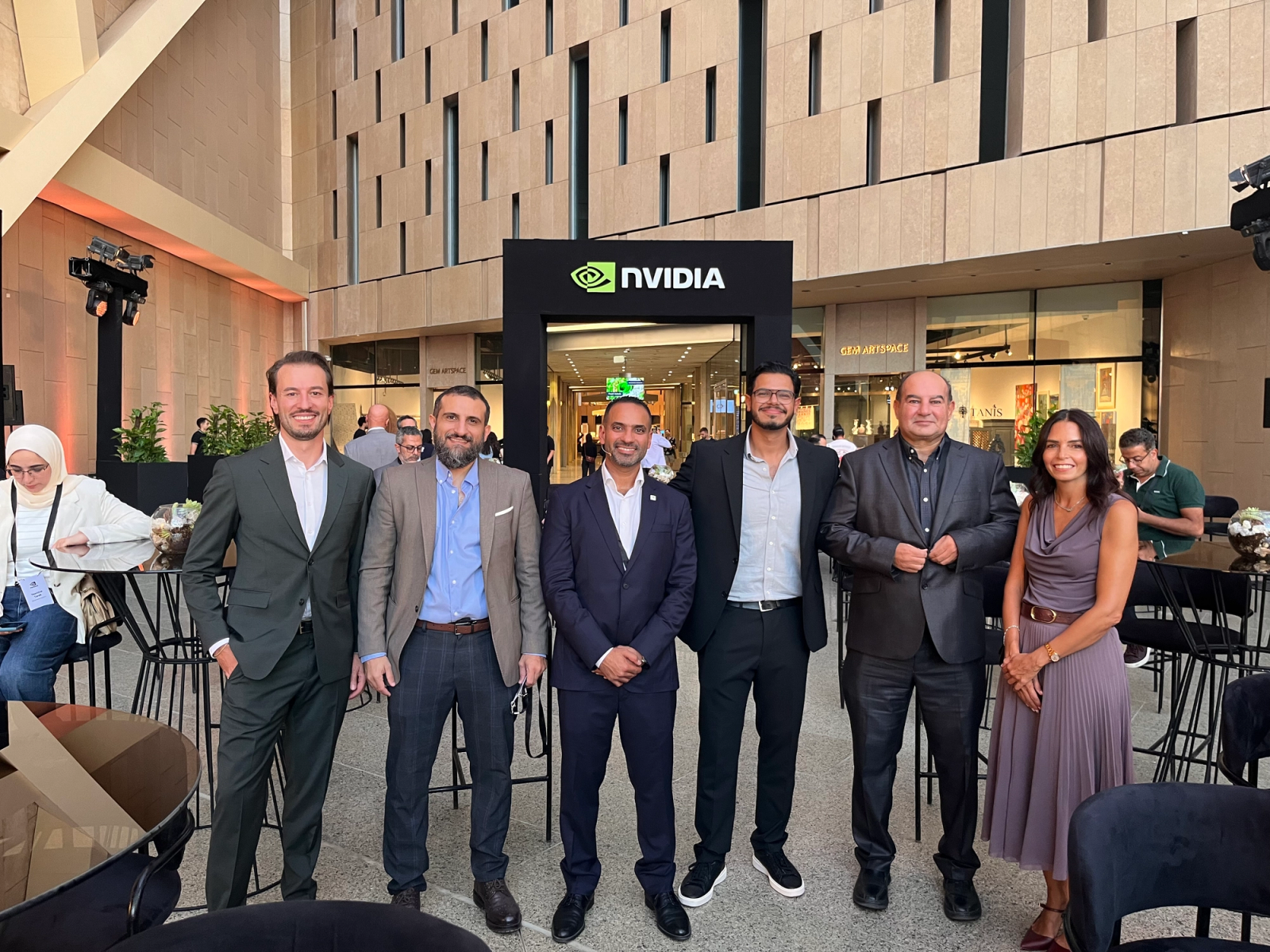
AvidBeam Selected for NVIDIA AI Ecosystem Reception Panel in Egypt: Dr. Hani ElGebaly Joins Egypt's AI Builders at the Grand Egyptian Museum
On September 21, 2026, NVIDIA brought together Egypt's artificial intelligence (AI) ecosystem at the Grand Egyptian Museum in Cairo for a reception that marked a significant step in the country's transition from AI experimentation to production-scale AI deployment.
Experience AI Video Analytics
on your existing cameras.
Start with a pilot deployment and scale seamlessly as your operational requirements evolve.