Car Detection in 2026: How AvidBeam's AvidAuto Turns Every Camera Into a Vehicle Intelligence Point
Car detection is the automated identification of vehicles in a camera feed using AI video analysis.
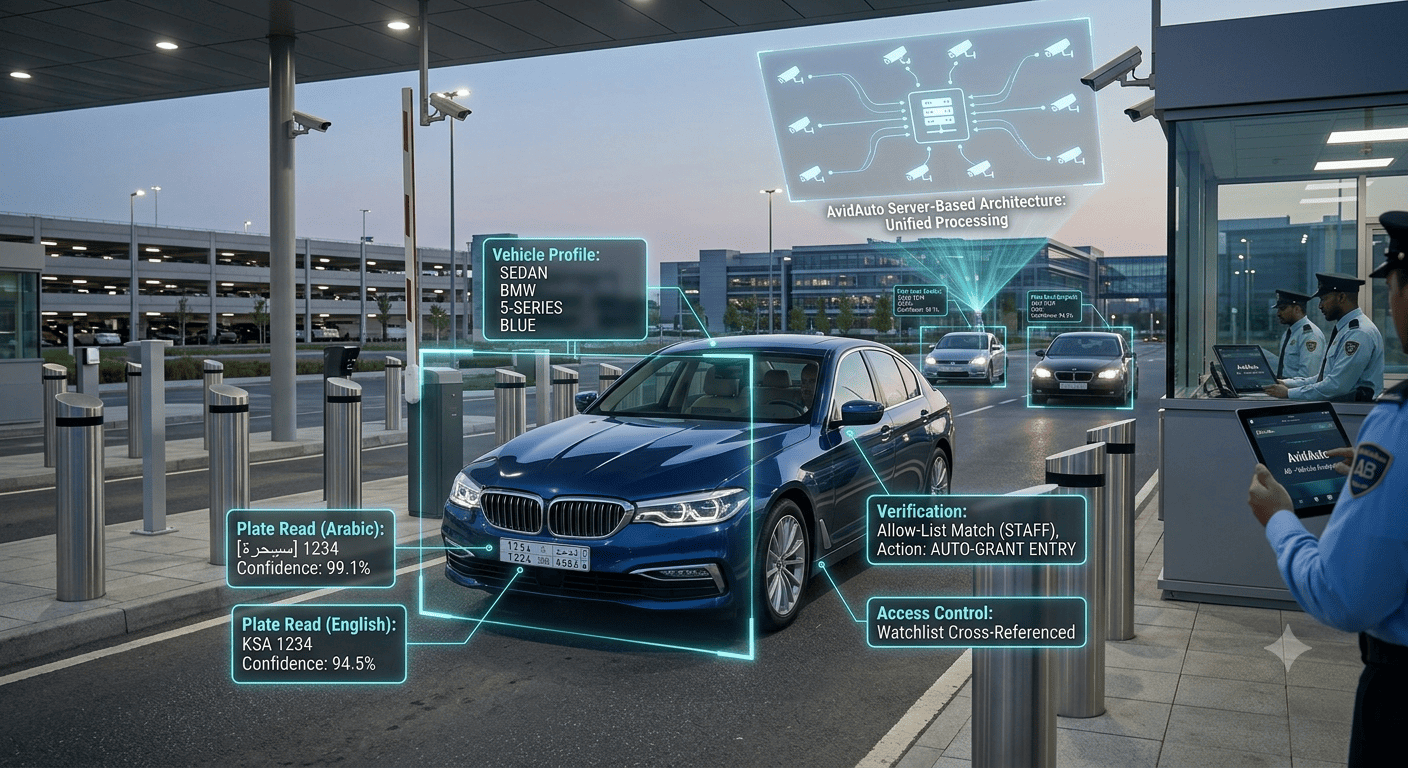
| What is car detection?Car detection is the automated identification of vehicles in a camera feed using AI video analysis. In basic implementations, it confirms vehicle presence in a monitored zone. In advanced platforms like AvidBeam's AvidAuto, car detection triggers a full pipeline: license plate recognition, vehicle classification by type, make, model, and color, real-time watchlist matching, and automated responses through access control, traffic enforcement, and parking management — all from the cameras already installed. |
A camera that detects a car and logs its presence has done the least useful thing it can do with that information. The vehicle was there. That is all the record shows. There is no plate. No vehicle type. No confirmation of whether the vehicle is on a watchlist. No connection to the gate, the enforcement system, or the parking structure beyond the detection point.
Car detection that stops at presence is documentation. Car detection that connects to classification, identity, and automated response is intelligence. The operational return from the two is not comparable.
AvidBeam's AvidAuto platform delivers car detection through its AB - Vehicle Analytics module, running deep learning models on existing camera feeds through a server-based Artificial Intelligence (AI) architecture. Every detected vehicle produces a complete intelligence record: plate, type, make, model, color, watchlist status, and a saved image, all generated before the vehicle clears the camera frame.
What Car Detection Needs to Produce
The criteria that determine whether a car detection system delivers operational value are specific. They cover what the system produces per detection event, what it does with that output in the seconds that follow, and whether it maintains that performance under real deployment conditions.
Detection Under Real Conditions
Real car detection environments are not controlled. As covered in AvidBeam's analysis of car recognition technology and how AvidAuto classifies every vehicle in frame, real deployment conditions include nighttime operation, variable weather, vehicles at speed, partially obscured plates, and mixed Arabic and English character sets on the same network.
AvidAuto processes all detection centrally on server infrastructure rather than at individual cameras. This server-based architecture means detection model complexity is not constrained by camera hardware. Consequently, accuracy holds at 98%+ for Arabic License Plate Recognition (LPR) and 92%+ for English across all the conditions listed above, without per-camera reconfiguration.
Detection Output Beyond Presence
Car detection that produces only a presence confirmation leaves an operator with a timestamp and a camera source. Car detection that produces a full vehicle profile gives an operator a plate number, a vehicle type, a make, a model, a color, a plate category, a watchlist match status, and a saved image of the vehicle.
The difference is operational. A presence log cannot feed an access control decision. A full vehicle profile can. Furthermore, a presence log cannot support a post-incident investigation without manual footage review. A structured vehicle record with plate, classification, and image supports investigation immediately through a structured query.
| To find out how AvidAuto's car detection applies to your existing camera infrastructure, send an email to info@avidbeam.com and the technical team will follow up. |
How AvidAuto's Car Detection Works
AvidAuto's AB - Vehicle Analytics module runs four simultaneous analysis steps on every connected camera feed. All processing happens centrally on server infrastructure, not at individual cameras. Consequently, every camera already on the network becomes a car detection point without hardware replacement.
Detection and Classification
The first analysis step identifies vehicles in the camera frame. The second classifies them by type, make, model, and color. Both steps complete within the same video frame. Furthermore, plate type is identified alongside the vehicle classification: private, commercial, or tourist. The result is a full vehicle profile generated at the moment of detection, not reconstructed afterward.
License Plate Recognition
LPR runs as a third simultaneous step on every detected vehicle. Arabic and English character sets process through the same pipeline without separate configurations. AvidAuto reads both from a single platform setup, which matters operationally for any network that encounters mixed Arabic and English plates, including every road and facility in Saudi Arabia and across the Gulf region.
Watchlist Matching and Response
The fourth step cross-references the detected vehicle's plate against active watchlists in real time. Three list categories run simultaneously at every camera the vehicle passes:
- Deny lists: flagged vehicles trigger a security alert before clearing the gate; the alert includes plate, vehicle profile, camera source, and timestamp
- Allow lists: authorized vehicles clear automatically without manual gate checks; the recognition confirms authorization in fractions of a second
- Very Important Person (VIP) lists: designated vehicles receive priority routing or reserved access; the alert fires at approach, before the vehicle reaches the gate
Watchlist updates propagate to every connected camera simultaneously from the management interface. Consequently, a list change applies across the full network the moment it is made.
What Car Detection Enables Beyond the Gate
Car detection connected to a full vehicle intelligence platform extends well beyond the entry point. As covered in AvidBeam's analysis of what separates vehicle detection systems operationally, the gap between a detection point and a vehicle intelligence platform becomes most visible in what the system does after the initial detection.
Traffic Violation Enforcement
AvidAuto's AB - ITS (Intelligent Traffic Systems) module extends car detection to road-level enforcement on the same camera feeds. Every violation event links the detected vehicle's plate and profile to the violation record automatically. Red-light running, wrong-way driving, lane violations, illegal parking, speeding, mobile phone use while driving, and seatbelt non-compliance are all documented with the vehicle's full profile, camera source, timestamp, and event clip at the moment of detection.
Consequently, car detection that includes AB - ITS produces a complete enforcement record per event without manual documentation or officer presence at individual camera points.
Parking and Zone Management
AB - Smart Parking extends car detection into parking structures after gate clearance. The same plate identity established at the entry camera continues as the vehicle moves through the structure. Real-time occupancy, double-parking detection, unauthorized zone entry, and overnight monitoring all connect to the plate identity from initial detection. Furthermore, entry and exit times feed automated billing or access compliance monitoring without separate sensor infrastructure per parking bay.
Forensic Investigation
Post-incident investigation using car detection without a forensic search layer means manually reviewing footage per camera for a specific plate or vehicle type. AvidAuto replaces that process with a structured multi-attribute query: search by plate, make, model, color, date, time, or camera location across the full recorded network. Results return with saved vehicle images per detection event, compressing investigation from hours to minutes.
Car Detection Across Environments
AvidAuto's car detection applies across every environment where vehicle presence and identity at monitored points determines operational, enforcement, or security decisions.
- Facility and campus access: detection at gates confirms authorization before entry, logs every vehicle movement, and flags deny-listed vehicles before they clear the barrier
- Road networks and intersections: detection across road segments feeds volume analytics, congestion monitoring, and continuous violation enforcement through AB - ITS
- Parking structures: detection at entry feeds AB - Smart Parking occupancy monitoring, unauthorized zone alerts, and automated billing across every level
- Government and high-security sites: detection at all perimeter entry points with real-time watchlist matching and forensic search capability for post-incident investigation
- Smart city infrastructure: city-scale car detection across thousands of cameras managed from one centralized interface, as demonstrated in the Riyadh Smart Parking deployment covering 18,000 cameras
Full Car Detection Capability Breakdown
The table below maps every output AvidAuto's car detection platform produces, what it measures, and the operational result each one delivers.
| Detection Output | What AvidAuto Measures | Operational Result |
|---|---|---|
| Car presence detection | Vehicle identified in frame across all lighting and weather conditions | Continuous monitoring; no manual observation required at access points or road segments |
| Vehicle classification | Type, make, model, and color identified per detection | Full vehicle profile per event alongside every detection record |
| License Plate Recognition (LPR) | Arabic and English plates read at 98%+ and 92%+ accuracy | Plate identity linked to every detection event automatically |
| Plate type identification | Private, commercial, and tourist plates distinguished | Enforcement and access rules applied per plate category without manual review |
| Watchlist matching | Deny, allow, and VIP lists cross-referenced in real time | Alert fires before vehicle clears gate; response before entry, not after |
| Cross-camera tracking | Same vehicle followed across multiple connected cameras | Full movement record from first detection point to final exit |
| Traffic violation detection | Seven violation types via AB - ITS module | Continuous enforcement on monitored road segments alongside detection |
| Parking occupancy monitoring | Vehicle presence and zone compliance via AB - Smart Parking | Real-time occupancy; double-parking and overtime alerts generated automatically |
| Forensic vehicle search | Multi-attribute query across full recorded camera network | Movement pattern reconstructed in minutes; no manual footage review |
| Volume and density analytics | Vehicle count per segment by time window | Peak period data; congestion forecasting from existing camera feeds |
Basic Car Detection vs. AvidBeam AvidAuto — Comparison
The table below sets out where AvidAuto's car detection platform diverges from basic car detection at the output, identity, enforcement, and investigation level.
| Capability | Traditional CCTV Cameras | AvidBeam AvidAuto Car Detection |
|---|---|---|
| Detection output | Presence confirmed; no further data | Plate, type, make, model, color, plate type, and saved image per detection event |
| Identity | Not available without separate LPR hardware | LPR at 98%+ (Arabic) / 92%+ (English) runs alongside every detection event |
| Watchlist matching | Not available from detection alone | Real-time deny, allow, and VIP matching at every camera point the vehicle passes |
| Cross-camera continuity | Each camera operates independently | Same vehicle tracked across every connected camera from entry to exit |
| Violation detection | Not available | Seven violation types enforced continuously via AB - ITS on the same camera feeds |
| Parking coverage | Not available after gate clearance | AB - Smart Parking extends detection into structures with real-time occupancy intelligence |
| Investigation | Manual footage review per camera | Multi-attribute forensic search returns movement timeline in minutes |
| Hardware requirement | Often dedicated detection units per point | Layers onto existing Open Network Video Interface Forum (ONVIF) compliant cameras |
In short, basic car detection logs presence. AvidAuto logs a complete vehicle intelligence record, matches it against watchlists in real time, connects it to access control and enforcement, and makes it searchable across the full camera network in minutes.
Infrastructure and Deployment
AvidAuto connects to any ONVIF compliant camera via standard network protocols. All car detection processing runs centrally on dedicated server infrastructure. The infrastructure baseline per camera processed:
- 2GB RAM minimum; one virtual core at 2.4 GHz minimum
- Multiple Graphics Processing Unit (GPU) configurations supported for higher-density deployments
- Camera resolution: 2MP up to 4K; lens focal length 3mm to 25mm
Video Management System (VMS) integration covers Milestone, NetworkOptix, and Genetec platforms. Deployment options include on-premise, private cloud, public cloud, and hybrid.
FAQ
What is car detection?
The automated identification of vehicles in a camera feed using AI; in advanced platforms like AvidAuto, detection triggers a full pipeline including plate recognition, vehicle classification, and real-time watchlist matching.
What does AvidAuto produce per car detection event?
Plate number, vehicle type, make, model, color, plate type (private, commercial, or tourist), a saved vehicle image, timestamp, camera source, and watchlist match status, all generated before the vehicle clears the frame.
Does car detection require new cameras?
No. AvidAuto layers onto any existing ONVIF compliant camera; the minimum is 2GB RAM and one virtual core at 2.4 GHz per camera on the processing server.
Can the system read Arabic and English plates simultaneously?
Yes. AvidAuto reads both character sets from a single platform configuration at 98%+ accuracy for Arabic and 92%+ for English.
How does watchlist matching work at car detection points?
Deny, allow, and VIP lists are matched in real time at every camera the vehicle passes; alerts fire before the vehicle clears the gate, not after it has entered.
Can car detection and traffic violation enforcement run on the same cameras?
Yes. AB - Vehicle Analytics handles detection and classification while AB - ITS handles violation enforcement on the same camera feeds through the same AvidAuto platform.
How does car detection support post-incident investigation?
AvidAuto's forensic search layer accepts multi-attribute queries by plate, make, model, color, date, time, or location and returns ranked results with saved images across the full camera network in minutes.
| Want to see car detection in action?Request a live demo of AvidBeam's AvidAuto platform and see how car detection applies to your existing camera infrastructure. Send an email to info@avidbeam.com to schedule a session with the technical team. |
 Article
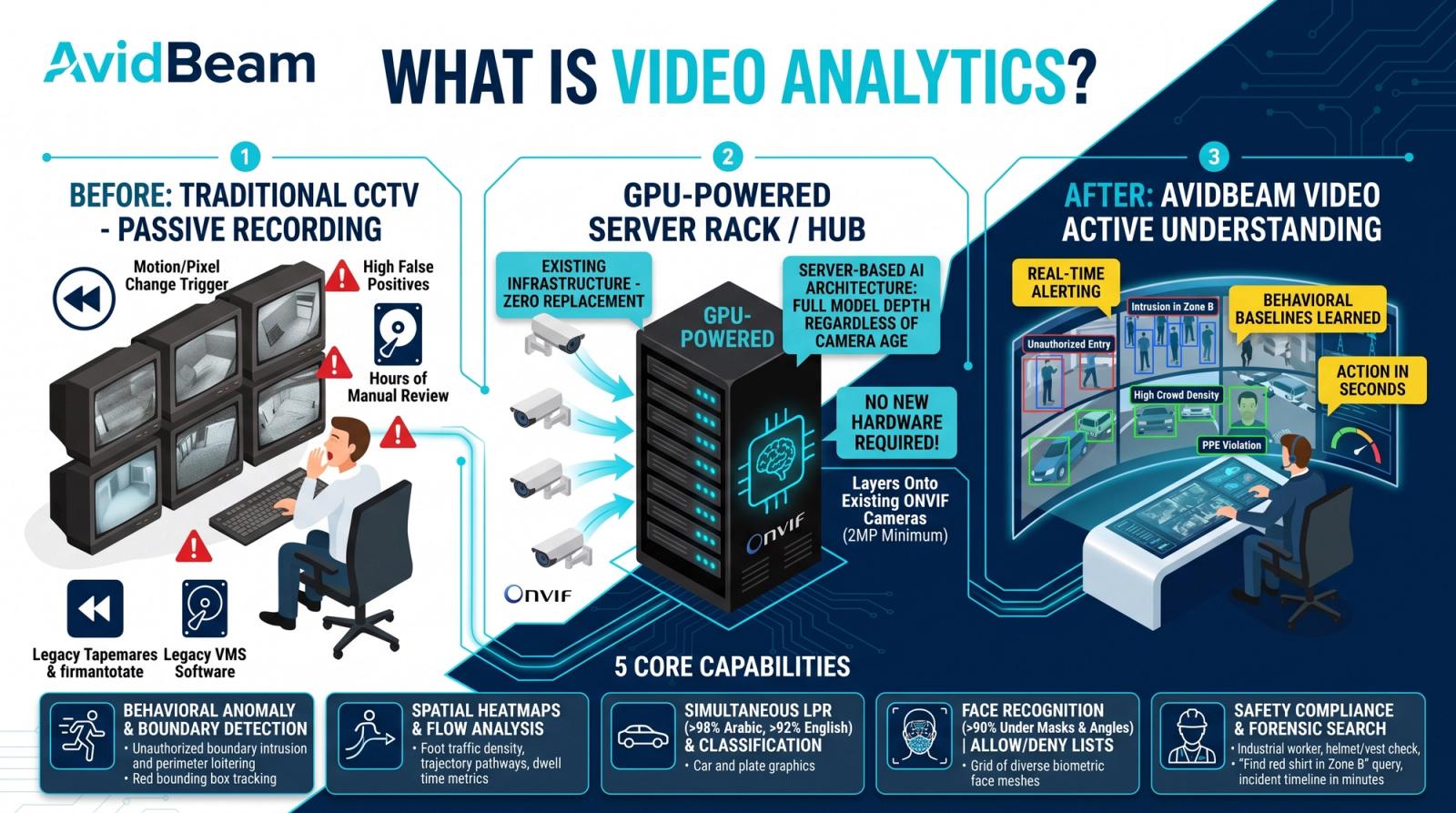
Video Analytics: Turn Camera Feeds Into Operational Intelligence
Your camera infrastructure already captures everything that happens across your facilities. The question is whether anything is actually done with that footage, or whether it sits on a server, reviewed only after something goes wrong.
 Article
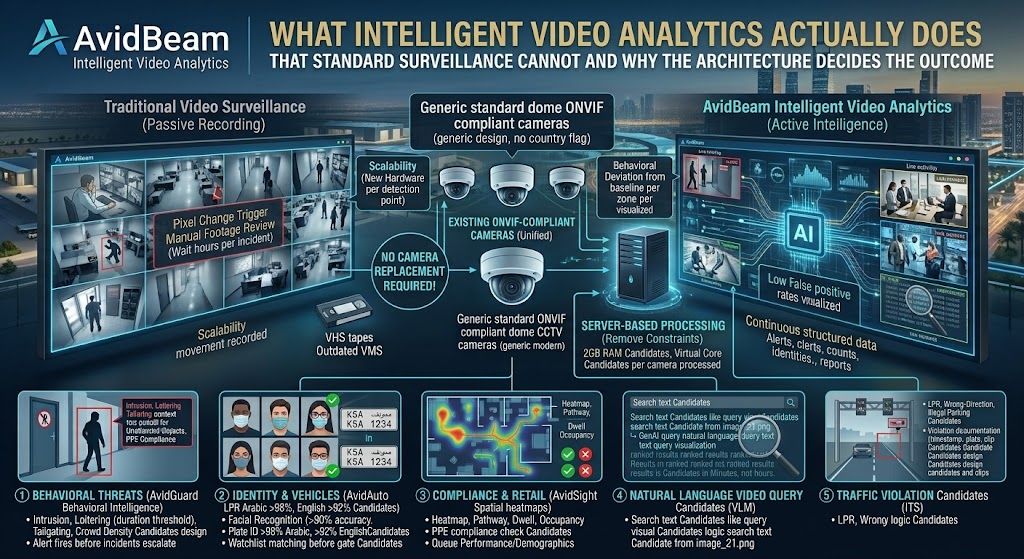
What Intelligent Video Analytics Actually Does That Standard Surveillance Cannot and Why the Architecture Decides the Outcome
Intelligent video analytics is the application of Artificial Intelligence (AI), deep learning, and computer vision to camera feeds to automatically detect security threats, identify individuals, verify compliance, and generate operational intelligence without human review of footage
 Article
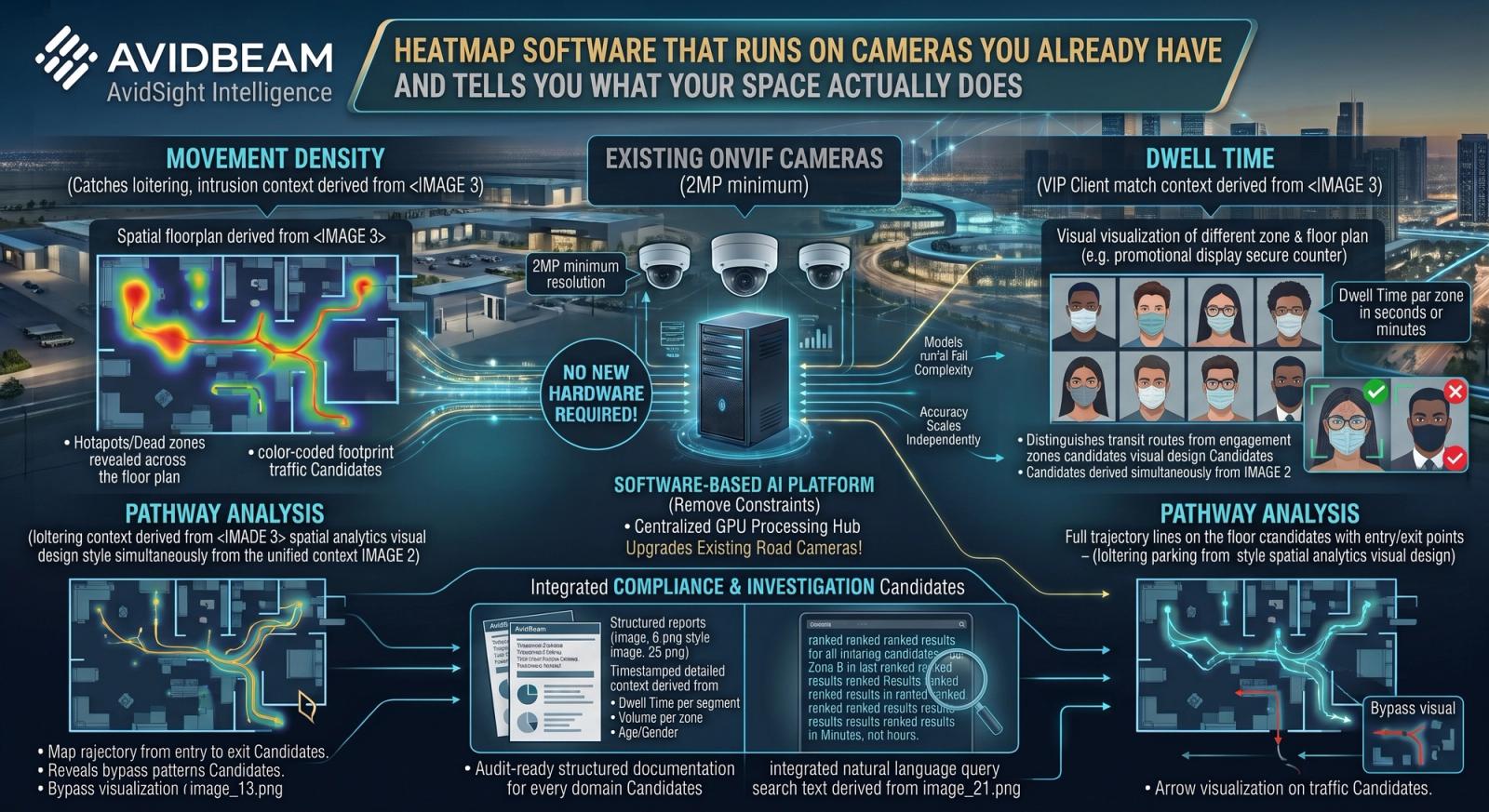
Heatmap Software That Runs on Cameras You Already Have and Tells You What Your Space Actually Does
If you are evaluating heatmap software, you probably already know that something about your space is not working the way you expected. Customers are not finding a product zone. A service counter has inconsistent wait times
Experience AI Video Analytics
on your existing cameras.
Start with a pilot deployment and scale seamlessly as your operational requirements evolve.