License Plate Recognition Explained: From Camera Feed to Gate Decision in Fractions of a Second
License plate recognition (LPR) is an AI-powered system that reads vehicle license plates from camera feeds, extracts the plate text using Optical Character Recognition (OCR) and deep learning models
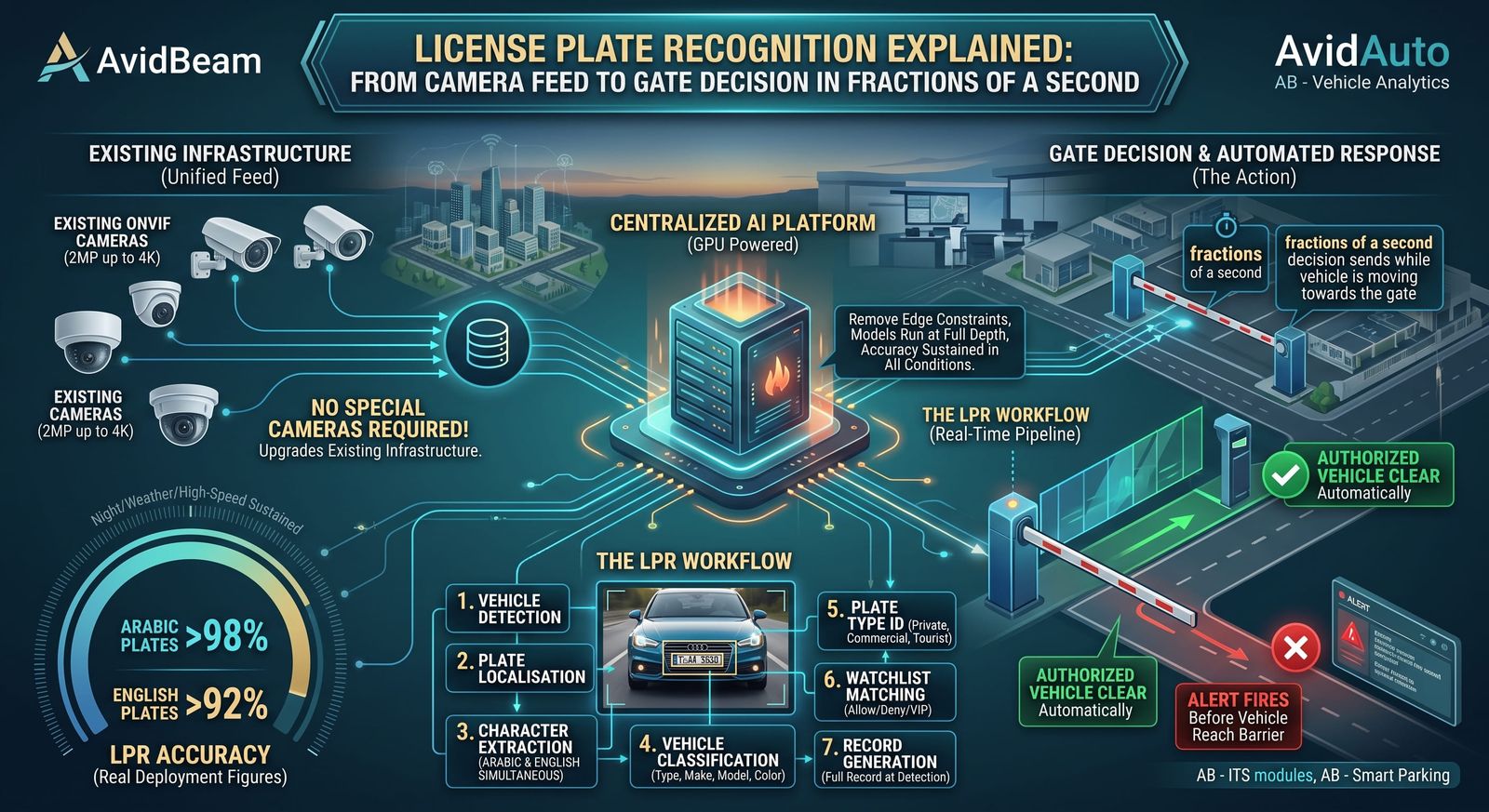
| What is license plate recognition?License plate recognition (LPR) is an AI-powered system that reads vehicle license plates from camera feeds, extracts the plate text using Optical Character Recognition (OCR) and deep learning models, and produces a structured record per detection event. In advanced platforms, the plate read triggers vehicle classification, real-time watchlist matching, and automated responses including gate control, traffic enforcement documentation, and parking management, all within the same processing pipeline. |
If you are evaluating license plate recognition, you probably have one of three problems. Either you are manually verifying vehicles at a gate and want to automate it. Or you have an LPR system that reads plates but does not connect them to anything useful. Or you need enforcement documentation for traffic violations and cannot produce it at the camera without an officer present.
License plate recognition solves all three, but only if the system produces more than a plate string. A plate number alone is a lookup key. The value comes from what the system does with that key in the seconds after reading it: matching it against a watchlist, triggering a gate decision, linking it to a violation record, or making it searchable across a network of cameras after an incident.
AvidBeam's AvidAuto platform delivers license plate recognition through its AB - Vehicle Analytics module. It reads Arabic and English plates simultaneously at 98%+ and 92%+ accuracy respectively, classifies the vehicle by type, make, model, and color in the same processing step, and connects that output directly to gate automation, traffic enforcement, parking management, and forensic investigation.
How Does License Plate Recognition Work?
License plate recognition runs through seven sequential processing steps, all completing within the same camera frame. Understanding each step clarifies why the output quality varies so significantly between systems.
| Processing Step | What Happens | What It Produces |
|---|---|---|
| Vehicle detection | AI identifies a vehicle entering the camera frame | Detection triggers instantly regardless of speed, angle, or lighting conditions |
| Plate localisation | The system isolates the plate region within the detected vehicle | Works on partially obscured, angled, and dirty plates without manual adjustment |
| Character extraction | OCR and deep learning models read each character from the plate region | Arabic and English processed simultaneously from one configuration |
| Vehicle classification | Type, make, model, and color identified alongside the plate read | Full vehicle profile per event, not just a plate string |
| Plate type identification | Private, commercial, and tourist plates distinguished per read | Access and enforcement rules applied per category automatically |
| Watchlist matching | Plate cross-referenced against deny, allow, and VIP lists in real time | Alert fires before the vehicle clears the gate, not after it has entered |
| Record generation | Plate, vehicle profile, image, camera source, and timestamp stored per event | Complete enforcement or access record generated automatically at detection |
The critical architectural point: all seven steps run on a central server, not inside the camera. AvidAuto processes every connected camera's feed centrally through server infrastructure with dedicated Graphics Processing Unit (GPU) acceleration. Consequently, model complexity is not constrained by camera hardware, and accuracy holds consistently under low light, rain, high vehicle speeds, and partially obscured plates.
How Accurate Is License Plate Recognition Under Real Conditions?
This is the question that separates systems that deliver in production from those that perform well in controlled demonstrations. Real deployment conditions are not controlled. Vehicles move at speed. Plates are dirty, angled, or partially blocked. Lighting changes between day and night. Weather degrades image quality.
Why Server-Based Processing Sustains Accuracy
Camera-embedded LPR systems are constrained by the chip inside the housing. As covered in AvidBeam's analysis of car recognition technology in real deployment conditions, edge-based processing uses smaller, simpler models that degrade under the conditions listed above. Server-based processing removes that constraint.
AvidAuto runs recognition models centrally on server infrastructure. The models run at full depth regardless of individual camera age or hardware specification. Consequently, AvidAuto sustains 98%+ accuracy for Arabic plates and 92%+ for English across nighttime operation, rain, high vehicle speeds, and partially obscured plates. These are production figures from live deployments including the Riyadh Smart Parking network covering 18,000 cameras, not controlled test results.
Does It Read Arabic and English Simultaneously?
Yes. AvidAuto processes both character sets through a single platform configuration without separate systems per script. This matters operationally for any network in Saudi Arabia or across the Gulf region, where Arabic and English plates coexist on the same roads and facilities.
Furthermore, AvidAuto identifies plate type alongside the character read: private, commercial, and tourist plates are distinguished per detection event. Consequently, access and enforcement rules can apply per plate category automatically rather than requiring manual categorisation after the fact.
| Want to know if your existing cameras meet AvidAuto's LPR requirements? Send an email to info@avidbeam.com for a free infrastructure assessment. |
Do I Need Special Cameras for License Plate Recognition?
No. AvidAuto connects to any Open Network Video Interface Forum (ONVIF) compliant camera already installed. The recognition processing happens centrally on a server, not inside the camera. Consequently, replacing cameras is not a requirement for deploying LPR.
The camera requirements are straightforward:
- Minimum 2 Megapixel resolution up to 4K
- Lens focal length between 3mm and 25mm
- Mounting angle: pitch between -15 and +15 degrees, yaw between -15 and +15 degrees
- ONVIF compliance for standard network connection
The server infrastructure baseline is 2GB RAM and one virtual core at 2.4 GHz per connected camera. Most camera networks installed in recent years already meet the camera requirements.
What Can You Do With License Plate Recognition?
As covered in AvidBeam's analysis of what separates vehicle detection systems operationally, the plate read is the starting point. The operational value comes from what the system does with that read across the full vehicle lifecycle from gate entry to parking to investigation.
The table below maps the key use cases for license plate recognition and what AvidAuto delivers at each one.
| Use Case | How It Works | Operational Output |
|---|---|---|
| Gate and barrier automation | Plate confirmed against allow list in real time | Authorized vehicles clear without manual checks; unauthorized vehicles trigger alerts before entry |
| Security watchlist enforcement | Plate matched against deny list at every camera point | Flagged vehicles generate alerts with plate, vehicle profile, and timestamp before gate clearance |
| VIP and priority access | Designated plates matched against VIP list at approach | Operations teams notified before the vehicle reaches the gate; reserved access activated automatically |
| Traffic violation enforcement | Plate linked to each violation event via AB - ITS | Red-light, wrong-way, speeding, and illegal parking records include plate and vehicle profile automatically |
| Parking management | Plate identity extended into structures via AB - Smart Parking | Entry and exit timestamps, occupancy monitoring, and permit compliance without separate bay sensors |
| Forensic investigation | Multi-attribute search across full camera network | Movement timeline by plate, make, model, color, or time period reconstructed in minutes |
| Volume and flow analytics | Vehicle counts per camera point by time window | Peak period identification and congestion forecasting from existing camera feeds |
How Does License Plate Recognition Connect to My Gate?
AvidAuto integrates with gate management systems through standard APIs and relay control connections. When a plate is matched against the allow list, the system triggers the gate or barrier open signal automatically. The integration covers boom barriers, sliding gates, and turnstile-style vehicle access points.
The gate decision happens before the vehicle reaches the barrier, not after it stops and waits. AvidAuto reads the plate at approach distance and sends the access decision to the gate controller while the vehicle is still moving toward it. Consequently, authorized vehicles do not need to stop and wait for manual verification.
For deny-listed vehicles, the alert fires to the security operations interface simultaneously with the gate remaining closed. The alert includes the plate number, vehicle profile, camera source, and timestamp so the security team has full context before the vehicle reaches the barrier.
Which Environments Use License Plate Recognition?
- Facility and campus access: gate automation for authorized vehicles, deny list enforcement, and full movement tracking across internal roads from a single platform
- Government and high-security sites: plate-confirmed entry logs, real-time watchlist matching, and forensic search capability across all access points simultaneously
- Parking structures and lots: automated entry, real-time occupancy monitoring, unauthorized zone detection, and exit billing without dedicated bay sensors
- Road enforcement: traffic violation documentation linking plate identity to every violation event via AB - ITS across monitored road segments
- Smart cities: city-scale vehicle tracking and traffic management from centralized infrastructure as demonstrated in the Riyadh Smart Parking deployment covering 18,000 cameras
- Hospitality and commercial: guest vehicle recognition for valet and VIP access management, with notification to operations staff before the vehicle reaches the reception point
FAQ
What is license plate recognition?
An AI system that reads vehicle plates from camera feeds, extracts plate text, and connects that output to gate control, watchlist matching, enforcement documentation, and forensic search.
How accurate is AI license plate recognition?
AvidAuto sustains 98%+ accuracy for Arabic plates and 92%+ for English across nighttime operation, adverse weather, and high vehicle speeds through server-based centralized processing.
Does it read Arabic and English plates on the same network?
Yes. AvidAuto processes both character sets from a single platform configuration without separate systems per script.
Do I need to replace my cameras for LPR?
No. AvidAuto connects to any ONVIF compliant camera with 2MP minimum resolution; the recognition processing runs on a central server, not inside the cameras.
How quickly does the gate open after a plate is read?
The plate is read at approach distance and the access decision sent to the gate controller while the vehicle is still moving toward it; authorized vehicles do not need to stop and wait.
Can LPR and traffic violation enforcement run on the same cameras?
Yes. AB - Vehicle Analytics handles plate reading and classification while AB - ITS handles violation enforcement through the same AvidAuto platform on the same camera feeds.
What happens when a flagged vehicle is detected?
An alert fires immediately with the plate, vehicle profile, camera source, and timestamp; the gate remains closed and the security team is notified before the vehicle reaches the barrier.
| Want to see license plate recognition in action?Request a live demo of AvidBeam's AvidAuto platform on your existing cameras. Send an email to info@avidbeam.com to schedule a session with the technical team. |
 Article
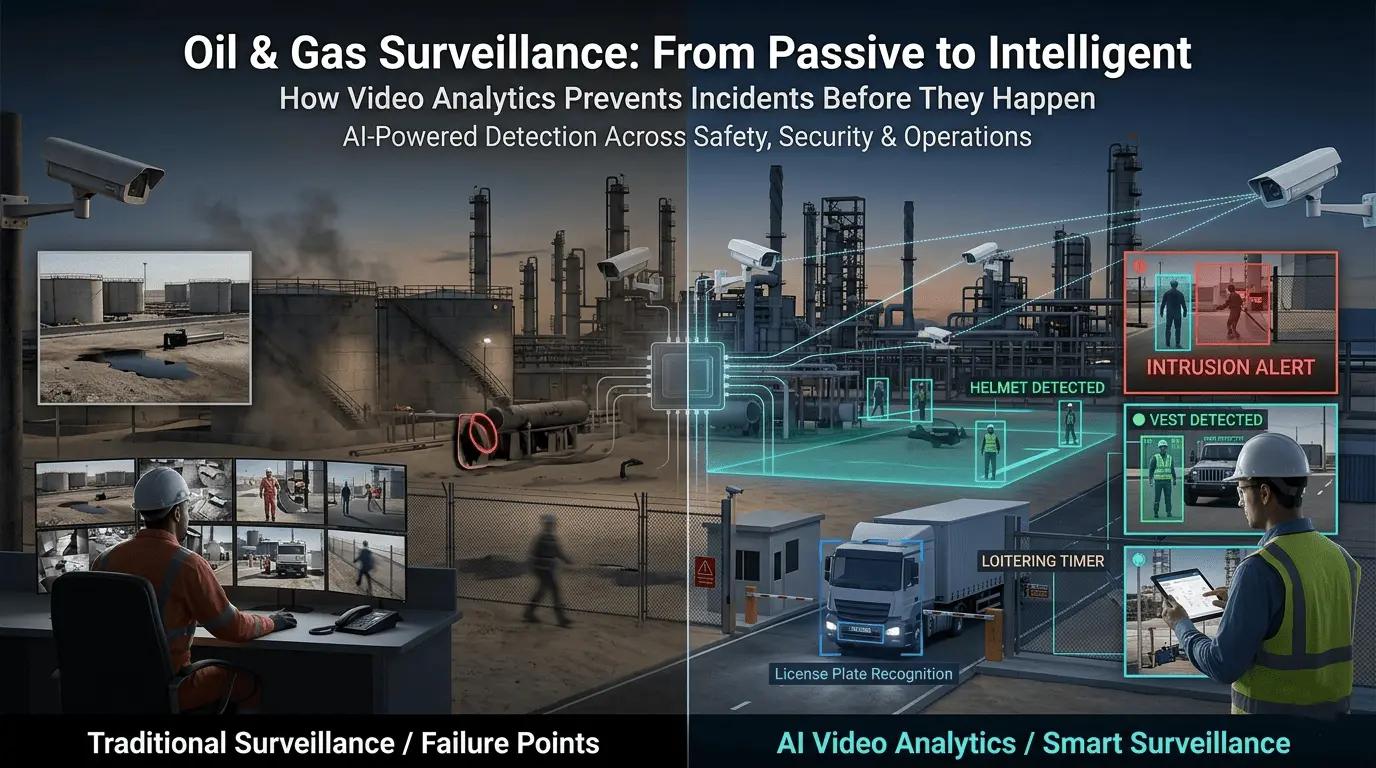
Oil and Gas Video Surveillance: How AI Covers PPE Compliance, Fire Detection and Perimeter Security Simultaneously
Oil and gas video surveillance should go beyond recording. In a petrochemical or refinery environment, cameras should automatically verify Personal Protective Equipment (PPE) compliance per worker per zone
 Article
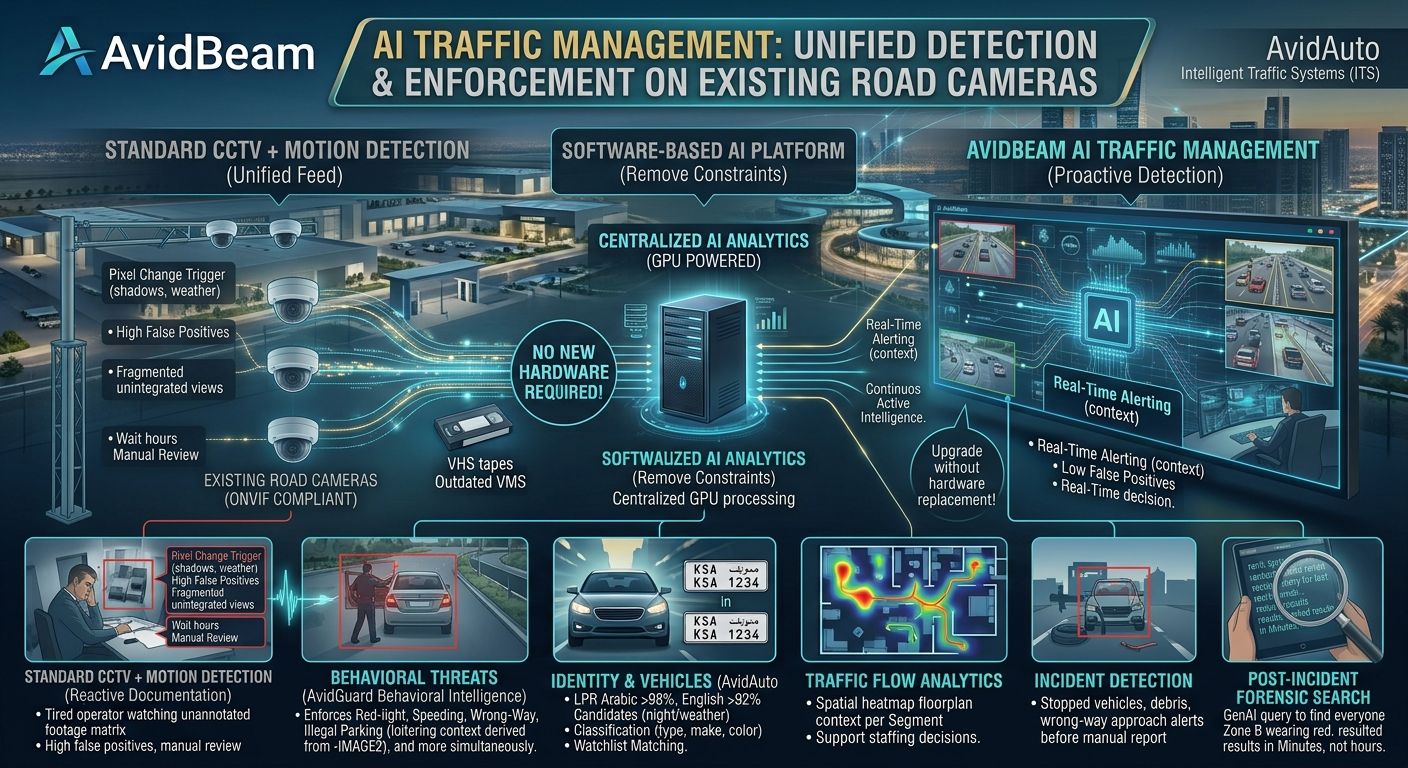
AI Traffic Management: How to Enforce Violations, Monitor Congestion and Forecast Flow Without Adding Officers
AI traffic management is a platform that applies artificial intelligence to road camera feeds to detect violations, monitor traffic density, identify incidents, and produce flow analytics continuously without officers stationed at individual camera points.
 Article
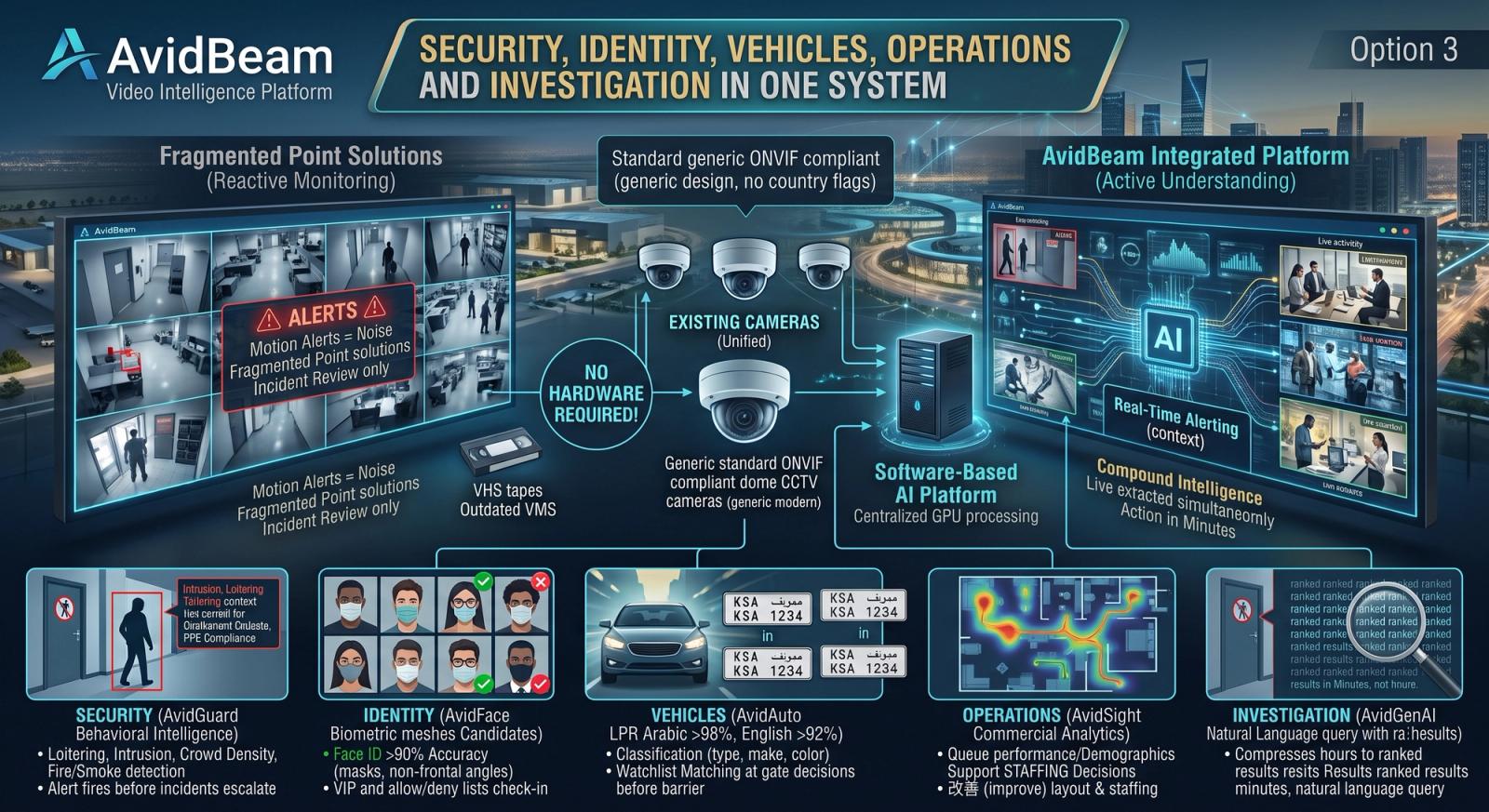
Video Intelligence Platform Explained: Security, Identity, Vehicles, Operations and Investigation in One System
A video intelligence platform is a software system that extracts multiple categories of structured intelligence from camera feeds simultaneously: behavioral security alerts, identity verification
Experience AI Video Analytics
on your existing cameras.
Start with a pilot deployment and scale seamlessly as your operational requirements evolve.