AI Video Analysis in 2026: How AvidBeam Extracts Intelligence From Every Camera Feed
AI video analysis is the application of Artificial Intelligence (AI) models to video feeds to extract structured intelligence from raw footage.
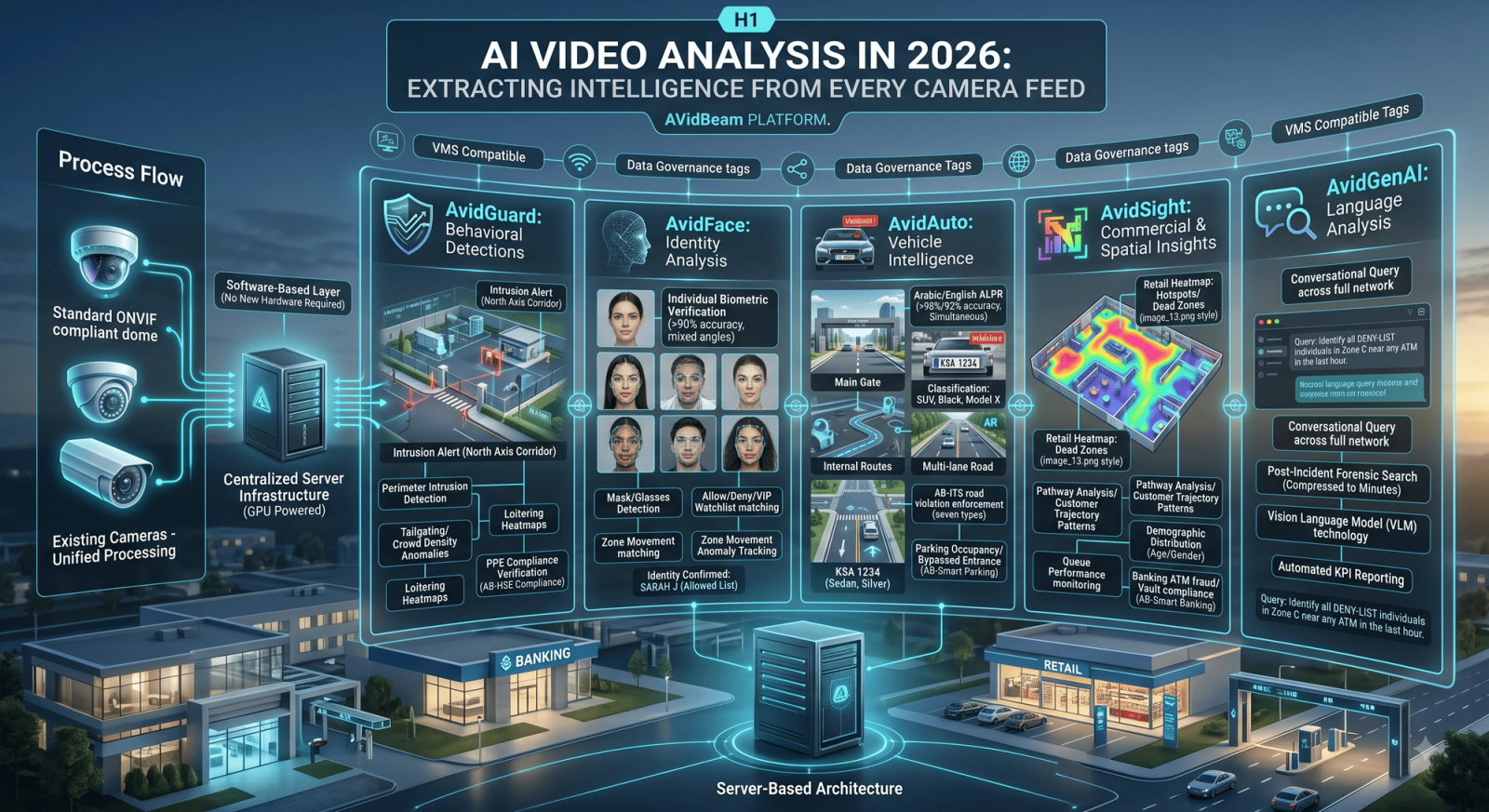
| What is AI video analysis?AI video analysis is the application of Artificial Intelligence (AI) models to video feeds to extract structured intelligence from raw footage. It sits between the camera and the operator: the camera captures what is in front of it; the AI video analysis layer identifies what it means. Outputs include behavioral alerts, identity matches, vehicle profiles, spatial movement data, and natural language investigation results, all derived from the same continuous camera feeds without additional hardware. |
A camera captures light. That is its function. What a camera produces without an analysis layer is footage: a continuous record of what passed in front of it. The footage has no opinion about what it contains. It does not distinguish between a routine delivery and a security threat. It does not flag the individual who has been standing near the ATM for 12 minutes. It does not count vehicles by type or identify the plate of the one that ran the red light.
AI video analysis is the layer that produces those distinctions. It sits between the camera feed and the operator, converting raw footage into structured outputs: alerts, classifications, identity matches, spatial maps, and natural language answers. Consequently, the camera becomes an intelligence instrument rather than a recording device.
AvidBeam's platform applies ten distinct AI video analysis types to existing camera infrastructure across five integrated product suites. Each analysis type extracts a different category of intelligence from the same continuous camera feeds, without requiring additional hardware at individual camera points.
What AI Video Analysis Actually Does to a Camera Feed
The analysis process is invisible to the operator. What they see is the output: an alert, a report, a matched identity, a heatmap. What happens between the camera capturing a frame and the platform producing that output is the AI video analysis layer. As covered in AvidBeam's analysis of AI video analytics solutions and the new standard for enterprise security, understanding what the analysis layer does determines whether the platform's outputs are operationally trustworthy or noise.
From Pixels to Objects
The first step in AI video analysis is object detection. The platform identifies discrete objects in each frame: a person, a vehicle, a bag, a face. Object detection is the foundation on which every subsequent analysis step depends. Without accurate object detection, behavioral analysis, identity matching, and vehicle classification all fail.
Server-based object detection models run on centralized infrastructure rather than at individual cameras. This architectural choice is critical. It means the detection model complexity is not constrained by camera hardware capacity. Furthermore, model updates deploy across the full network simultaneously through software rather than requiring per-camera firmware changes.
From Objects to Intelligence
Once objects are identified, the analysis layer applies domain-specific models to extract intelligence from each detected object and its behavior in context. A detected person is analyzed for behavioral deviation from the zone baseline. A detected face is matched against enrolled identity databases. A detected vehicle generates a plate read, a vehicle classification, and a watchlist match simultaneously.
These analysis types run in parallel on the same camera feeds. Consequently, a single camera positioned at a building entrance simultaneously performs behavioral analysis on individuals approaching the door, facial recognition on faces in the frame, and vehicle classification on any vehicles in the field of view, all from the same continuous video stream.
| To find out how AvidBeam's AI video analysis applies to your facility's existing cameras, send an email to info@avidbeam.com and the technical team will follow up. |
The Ten Analysis Types in AvidBeam's Platform
AvidBeam's AI video analysis platform applies ten distinct analysis types across its five integrated product suites. The table below maps each analysis type, what the AI analyzes in the video frame, and what the analysis produces operationally.
| Analysis Type | What the AI Analyzes | What the Analysis Produces |
|---|---|---|
| Object detection | Identifies objects in frame: people, vehicles, animals, items | Every subsequent analysis step depends on accurate object detection as its foundation |
| Behavioral analysis | Compares detected behavior against the learned zone baseline | Flags deviations: loitering, intrusion, tailgating, crowd density anomalies |
| Identity analysis | Maps facial geometry to a unique faceprint; matches against database | Individual confirmed at 90%+ accuracy in fractions of a millisecond |
| Plate recognition | Extracts plate text using OCR and deep learning models | 98%+ accuracy (Arabic); 92%+ (English); plate type identified alongside plate string |
| Vehicle classification | Identifies vehicle type, make, model, and color from frame | Full vehicle profile per detection event; not just a plate number |
| Spatial analysis | Maps movement density and dwell time across the monitored floor plan | Heatmap output reveals where people go, how long they stay, and what they avoid |
| Demographic analysis | Estimates age and gender distribution from detected faces | Zone-level demographic data from existing cameras without sensor hardware |
| Violation analysis | Compares vehicle and pedestrian behavior against configured road rules | Seven violation types flagged continuously across every monitored segment |
| Anomaly detection | Identifies events that deviate from the established operational baseline | Genuine threats surfaced from noise; false positive rate suppressed |
| Language analysis | Vision Language Model converts video and detections into natural language | Operators query the full network in plain language; investigation in minutes |
How Each AvidBeam Suite Applies AI Video Analysis
Each product suite applies a different combination of the ten analysis types to a specific operational domain. All five share the same server-based processing architecture and the same management interface.
AvidGuard: Behavioral and Anomaly Analysis
AvidGuard applies behavioral analysis and anomaly detection to perimeter zones, access corridors, and operational areas. The platform learns a behavioral baseline per monitored zone and flags deviations from it: loitering, intrusion, tailgating, crowd density anomalies, left object detection, fire and smoke, and Personal Protective Equipment (PPE) compliance violations. N+1 redundancy maintains continuous analysis coverage despite hardware failures.
AvidFace: Identity Analysis
AvidFace applies identity analysis to every face detected in a monitored camera frame. The recognition pipeline maps facial geometry to a unique faceprint and matches it against enrolled identity databases in fractions of a millisecond. Accuracy stays above 90% under masks, glasses, hats, and non-frontal angles. Deny lists, allow lists, and Very Important Person (VIP) lists run in parallel at every connected access point simultaneously.
AvidAuto: Vehicle and Violation Analysis
AvidAuto applies plate recognition, vehicle classification, and violation analysis to every monitored road segment and access point. License Plate Recognition (LPR) reaches 98%+ for Arabic plates and 92%+ for English. Vehicle type, make, model, and color are identified alongside every plate read. AB - ITS applies violation analysis continuously across seven traffic violation types. AB - Smart Parking applies occupancy and compliance analysis to parking structures.
AvidSight: Spatial and Commercial Analysis
AvidSight applies spatial analysis and demographic analysis to retail and banking environments. Heatmap generation, pathway mapping, dwell time measurement, and demographic distribution all derive from the same continuous camera feeds. The AB - Retail module produces commercial intelligence for store layout and merchandising decisions. The AB - Smart Banking module applies occupancy and behavioral analysis to branch-specific compliance monitoring.
AvidGenAI: Language Analysis
AvidGenAI applies Vision Language Model (VLM) analysis to the full platform. It converts video footage and detection outputs into natural language, enabling operators to query the full camera network in plain language. As covered in AvidBeam's analysis of anomaly detection and how AI surfaces genuine threats, the investigation layer is where the full value of continuous AI video analysis compounds: post-incident investigation that previously required hours of manual footage review becomes a single query returning ranked, timestamped results in minutes.
Basic Video Analysis vs. AvidBeam AI Video Analysis — Comparison
The table below sets out where AvidBeam's AI video analysis platform diverges from basic video analysis at the analytical depth, output quality, and operational capability level.
| Capability | Basic Video Analysis | AvidBeam AI Video Analysis |
|---|---|---|
| Analysis depth | Pixel change detection only | Object identification, behavioral analysis, identity, classification, spatial mapping |
| False positive rate | High; motion triggers on anything that moves | Low; behavioral baselines and object context filter genuine events from noise |
| Identity output | Not available | Facial recognition at 90%+ with real-time watchlist matching |
| Vehicle output | Count only | Plate, type, make, model, color, and plate type per detection event |
| Spatial intelligence | Not extracted | Heatmaps, pathway analysis, dwell time, and demographic distribution |
| Investigation capability | Manual footage review | Natural language query returning ranked results across the full network |
| Learning over time | Static; requires manual reconfiguration | Self-learning algorithms adapt to behavioral and operational changes |
| Processing location | At the camera; constrained by hardware | Centralized server; accuracy independent of individual camera capacity |
In short, basic video analysis detects motion. AvidBeam's AI video analysis identifies objects, understands behavior, verifies identities, classifies vehicles, maps spatial patterns, detects violations, and answers operator questions in plain language, from the cameras already installed.
Infrastructure and Deployment
AvidBeam's AI video analysis platform processes all analysis centrally on dedicated server infrastructure. Any Open Network Video Interface Forum (ONVIF) compliant camera already on the network connects without hardware replacement.
The infrastructure baseline per camera processed:
- 2GB RAM minimum; one virtual core at 2.4 GHz minimum
- Multiple Graphics Processing Unit (GPU) configurations supported for higher-density deployments
- Camera resolution: 2MP up to 4K; lens focal length 3mm to 25mm
Video Management System (VMS) integration covers Milestone, NetworkOptix, and Genetec platforms. Deployment options include on-premise, private cloud, public cloud, and hybrid. All ten analysis types are available across all deployment configurations.
FAQ
What is AI video analysis?
The application of AI models to video feeds to extract structured intelligence: behavioral alerts, identity matches, vehicle profiles, spatial data, and natural language investigation results, from existing camera infrastructure without additional hardware.
How does AI video analysis differ from recording?
Recording captures what the camera sees; AI video analysis identifies what it means, producing structured outputs that trigger automated responses rather than requiring manual footage review.
What types of analysis does AvidBeam's platform apply?
Object detection, behavioral analysis, identity analysis, plate recognition, vehicle classification, spatial analysis, demographic analysis, violation analysis, anomaly detection, and language analysis, all running on the same camera feeds simultaneously.
Does AI video analysis require new cameras?
No. AvidBeam's server-based platform connects to any existing ONVIF compliant camera; the minimum is 2GB RAM and one virtual core at 2.4 GHz per camera on the processing server.
Can multiple analysis types run on the same camera simultaneously?
Yes. Behavioral, identity, vehicle, spatial, and violation analysis all run in parallel on the same camera feeds through the same server-based processing platform.
How does AI video analysis improve over time?
Self-learning algorithms adapt behavioral baselines and recognition models continuously without manual reconfiguration, improving accuracy as the operational environment changes.
| Want to see AI video analysis in action?Request a live demo of AvidBeam's platform and see how AI video analysis applies to your facility's existing cameras. Send an email to info@avidbeam.com to schedule a session with the technical team. |
 Article
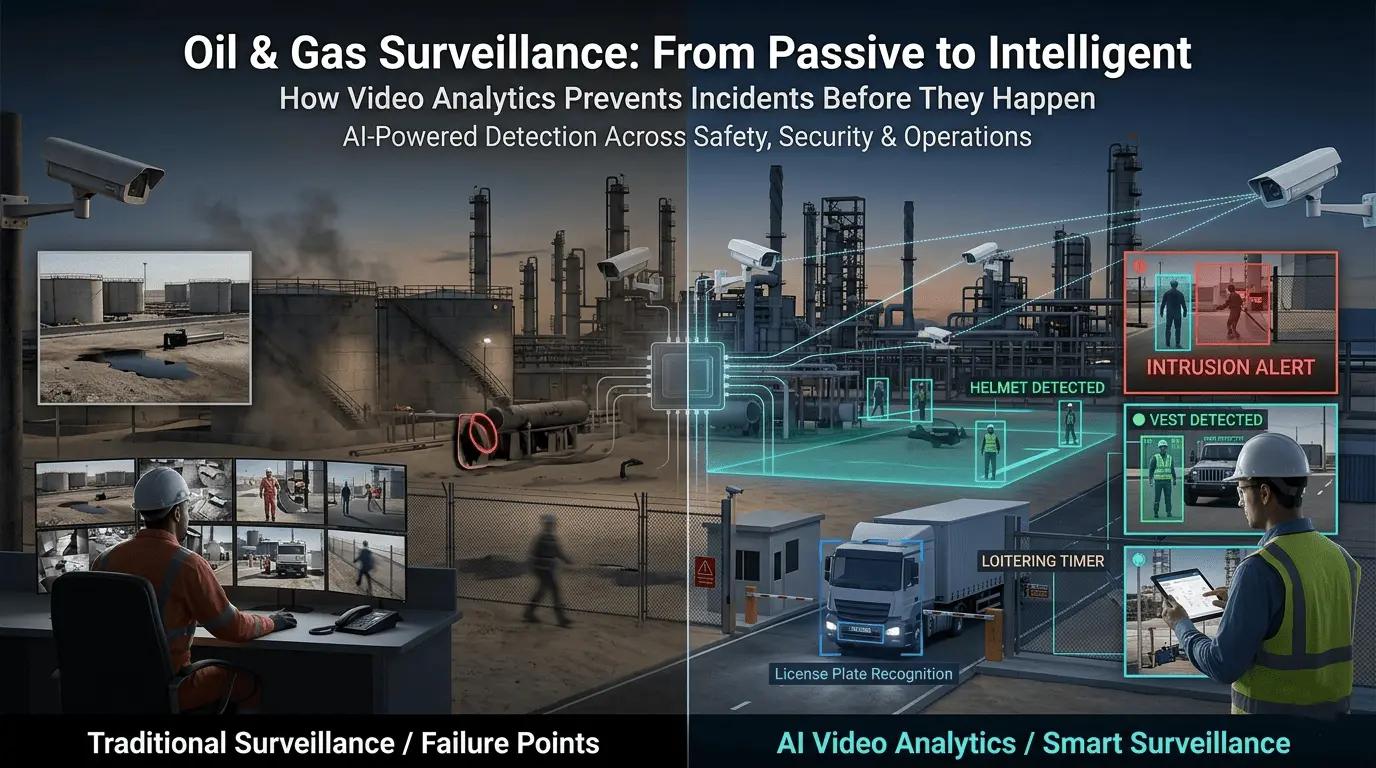
Oil and Gas Video Surveillance: How AI Covers PPE Compliance, Fire Detection and Perimeter Security Simultaneously
Oil and gas video surveillance should go beyond recording. In a petrochemical or refinery environment, cameras should automatically verify Personal Protective Equipment (PPE) compliance per worker per zone
 Article
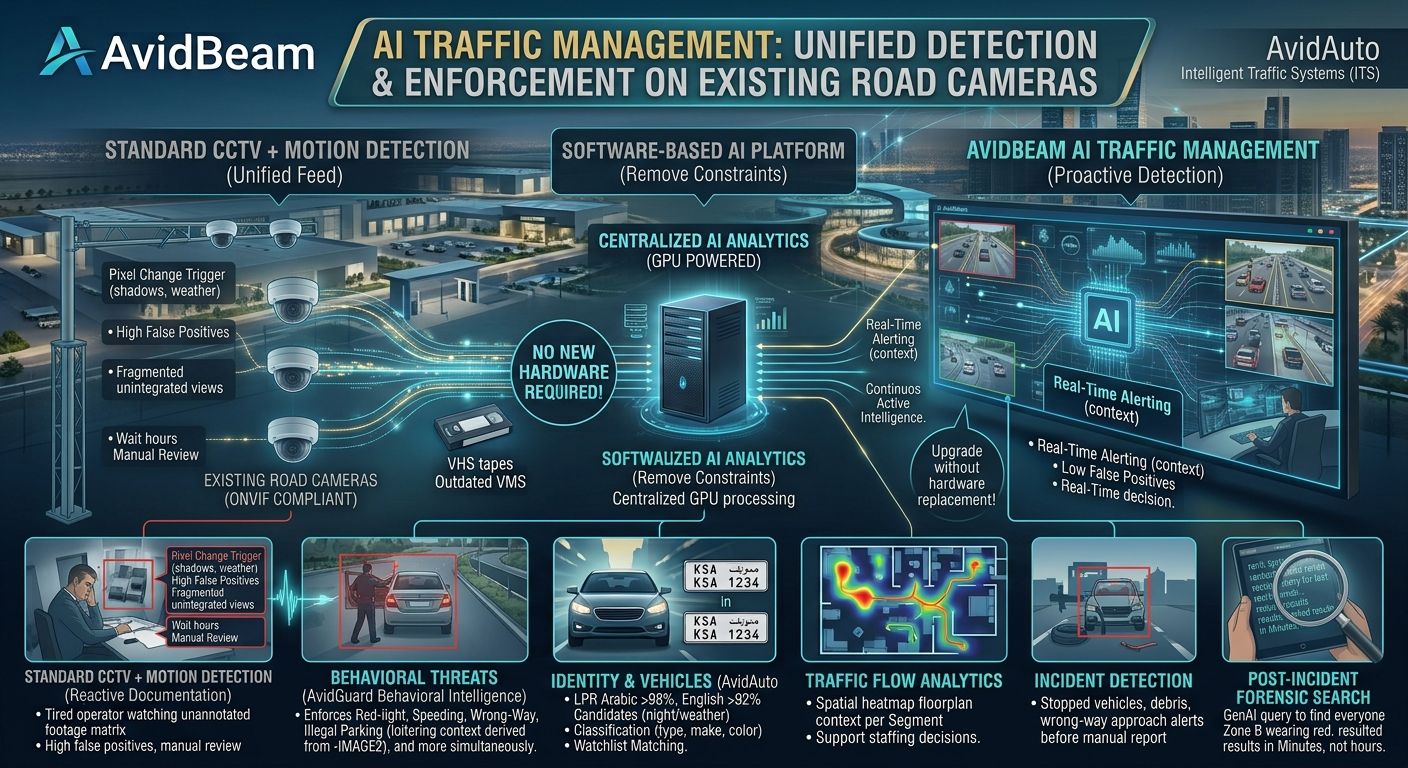
AI Traffic Management: How to Enforce Violations, Monitor Congestion and Forecast Flow Without Adding Officers
AI traffic management is a platform that applies artificial intelligence to road camera feeds to detect violations, monitor traffic density, identify incidents, and produce flow analytics continuously without officers stationed at individual camera points.
 Article
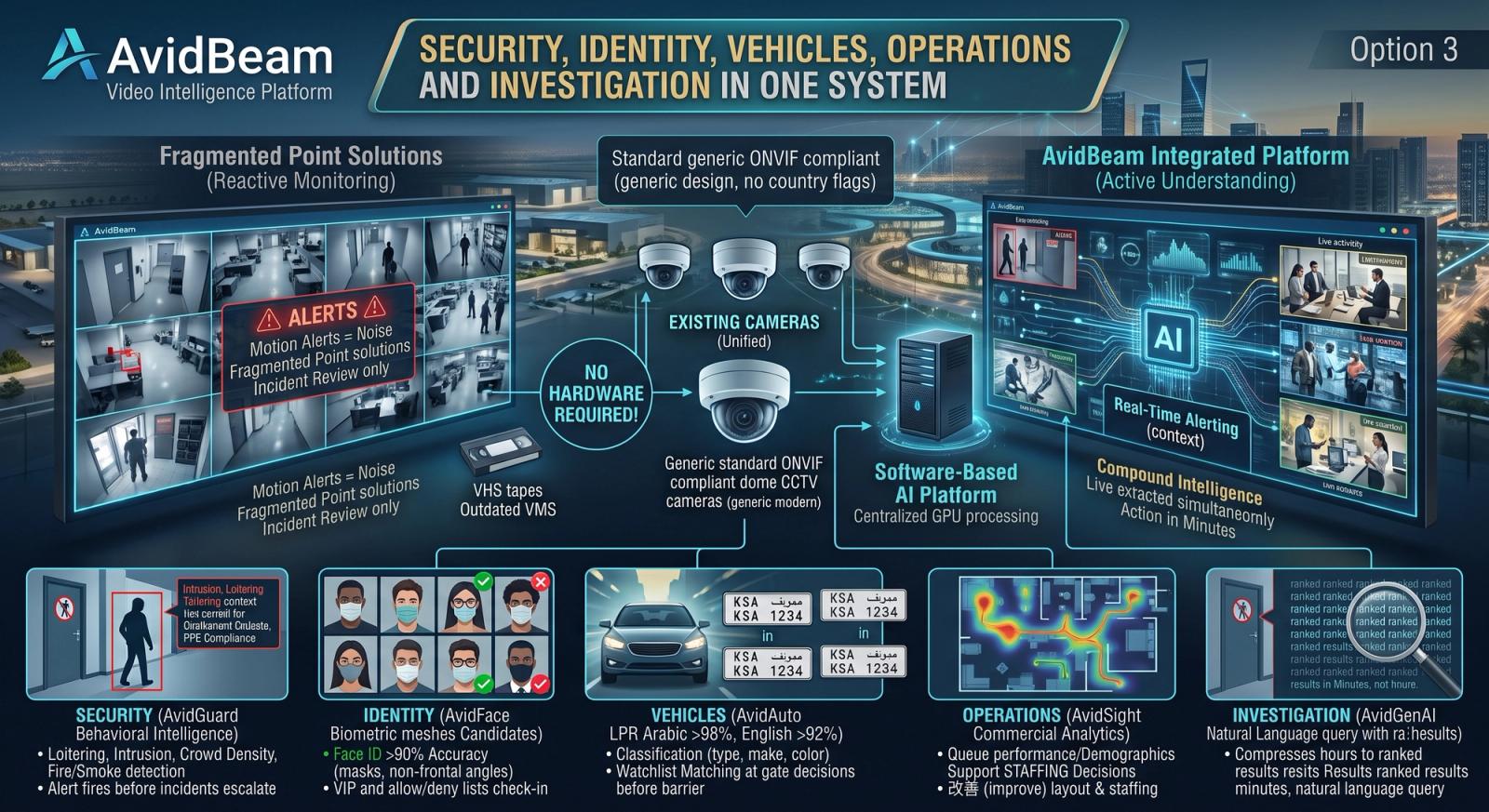
Video Intelligence Platform Explained: Security, Identity, Vehicles, Operations and Investigation in One System
A video intelligence platform is a software system that extracts multiple categories of structured intelligence from camera feeds simultaneously: behavioral security alerts, identity verification
Experience AI Video Analytics
on your existing cameras.
Start with a pilot deployment and scale seamlessly as your operational requirements evolve.